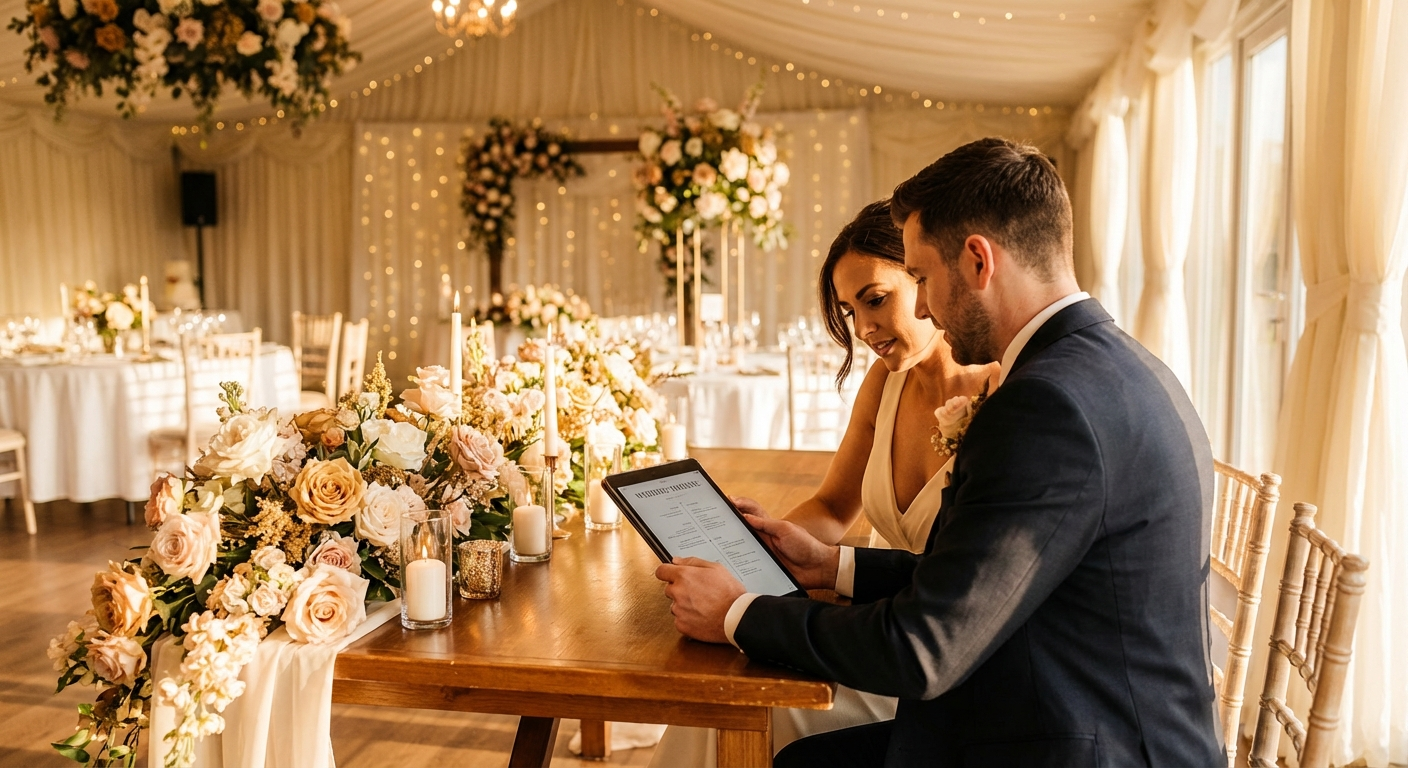
Wedding planning has always been a logistical marathon. Coordinating vendors, managing guest lists, tracking budgets, and making hundreds of interconnected decisions within a fixed timeline pushes even the most organized couples to their limits. In 2026, artificial intelligence has entered the picture not as a futuristic curiosity but as a practical set of tools that real couples are using to reduce stress, save money, and make better decisions.
According to The Knot's 2026 Future of Marriage report, nearly half of engaged couples surveyed have used at least one AI-powered tool during their wedding planning process. The applications range from the mundane, like auto-sorting vendor quotes into comparison spreadsheets, to the surprisingly creative, like generating mood board concepts from a text description of your dream reception. But not every AI tool delivers on its promises, and the gap between marketing claims and actual utility remains wide in some categories.
This guide cuts through the hype to examine how AI is genuinely helping couples plan weddings in 2026, which tools are worth your time, where human judgment remains irreplaceable, and how to integrate technology into your planning process without sacrificing the personal touches that make a wedding yours.
The Current State of AI in Wedding Planning
The wedding industry's adoption of AI has accelerated dramatically over the past eighteen months. What began as basic chatbots on vendor websites has evolved into sophisticated tools that can draft seating arrangements, predict costs based on your location and guest count, generate personalized timelines, and even suggest color palettes based on your venue's architecture and natural lighting.
Three categories of AI tools have gained the most traction among couples planning weddings in 2026. The first is budget and logistics management, where AI excels at crunching numbers, flagging potential overspends, and suggesting alternatives when costs exceed expectations. The second is design and creative inspiration, where generative AI helps couples visualize everything from table settings to invitation layouts before committing to a vendor or style. The third is communication and coordination, where AI assistants manage vendor correspondence, send reminders, and keep the planning timeline on track.
The common thread across these categories is that AI works best as an accelerator for decisions you were already going to make. It narrows options, surfaces information faster, and handles repetitive tasks that would otherwise consume hours of your evening. It does not replace the deeply personal choices that define your wedding, and the couples getting the most value from these tools are the ones who understand that distinction.
AI-Powered Budget Management: Where Technology Shines Brightest
Budget management is arguably where AI delivers the clearest, most measurable value in wedding planning. Traditional budget spreadsheets require manual input, manual categorization, and manual monitoring. AI budget tools automate all three while adding predictive capabilities that spreadsheets simply cannot match.
Modern AI budget platforms pull in real vendor pricing data from your region, compare your allocations against thousands of similar weddings, and flag line items where you might be overpaying or underspending relative to your priorities. If you tell the system that photography is your top priority and catering is second, it can suggest specific reallocation strategies that protect your most important categories while trimming areas you care less about.
The economic pressure on couples in 2026 makes these tools particularly relevant. With 80 percent of engaged couples reporting that inflation and rising costs have influenced their planning, according to The Knot's latest report, having an AI tool that continuously monitors your spending against real market data provides a level of financial awareness that manual tracking cannot achieve. Several platforms now offer real-time alerts when a category is trending over budget, along with specific suggestions for getting back on track.
The most effective AI budget tools also learn from your behavior. As you make decisions and approve vendor quotes, the system refines its understanding of your preferences and adjusts future recommendations accordingly. A couple that consistently chooses premium options in floral design but budget options in transportation will receive different suggestions than a couple with the opposite pattern.
Using AI for Wedding Design and Creative Inspiration
Generative AI tools have opened a new dimension in wedding design that did not exist two years ago. Couples can now describe their vision in plain language and receive visual concepts within seconds. Describe a ceremony space as a garden courtyard with arched trellises wrapped in white wisteria under warm string lighting and an AI image generator will produce a reference image that gives you and your vendors a shared starting point.
This capability is particularly valuable in the early planning stages when couples know what they feel but struggle to articulate what they see. Instead of scrolling through thousands of Pinterest images hoping to find something close, you can generate concepts that match your specific vision and use those as conversation starters with florists, decorators, and venue coordinators.
AI design tools are also proving useful for stationery and invitation design. Several platforms now let you input your color palette, wedding date, and style preferences, then generate complete invitation suite mockups that you can refine and send to a printer. The quality is not yet at the level of a professional graphic designer, but for couples working with tighter budgets, the results are often more than adequate for save-the-dates, programs, and signage.
Where AI design tools still struggle is with cultural specificity and emotional nuance. A tool trained primarily on Western wedding imagery may produce generic results when asked for elements specific to Australian, Indian, or Middle Eastern wedding traditions. This is improving rapidly, but couples planning culturally specific celebrations should treat AI-generated concepts as rough starting points rather than finished designs.
AI Assistants for Vendor Communication and Coordination
Coordinating with multiple vendors is one of the most time-consuming aspects of wedding planning, and it is an area where AI assistants are making a tangible difference. Modern planning platforms now offer AI-powered assistants that can draft initial inquiry emails to vendors, follow up on outstanding quotes, schedule meetings based on both parties' availability, and maintain a running summary of what has been agreed with each vendor.
The practical benefit is significant. A couple working with ten vendors might exchange hundreds of emails and messages over a six-month planning period. An AI assistant that drafts responses for your review, flags messages that need urgent attention, and keeps a summary of commitments and deadlines means you spend less time in your inbox and more time making actual decisions.
Some platforms have gone further, offering AI that can analyze vendor contracts and highlight unusual clauses, compare cancellation policies across vendors, and even suggest negotiation points based on market data. This level of analysis would require hiring a wedding planner in previous years, and while AI does not replace the relationship management and creative expertise a good planner provides, it handles the administrative load that often overwhelms self-planning couples.
The key limitation is that AI communication tools work best with structured, professional interactions. They excel at drafting polite follow-up emails and organizing scheduling logistics. They are less effective at navigating the more nuanced conversations that arise when plans change, budgets shift, or creative disagreements emerge. For those conversations, human judgment and emotional intelligence remain essential.
AI and Guest Management: Smarter RSVPs and Seating
Guest management is another area where AI tools are proving genuinely useful. Traditional RSVP tracking involves manual data entry, constant checking of response rates, and the inevitable task of chasing down guests who have not responded by the deadline. AI-enhanced RSVP platforms automate the follow-up process, sending polite reminders at optimized intervals based on when guests are most likely to respond.
Seating arrangement is perhaps the most unexpectedly powerful application of AI in wedding planning. Anyone who has tried to arrange seating for 150 guests while respecting family dynamics, friend groups, dietary requirements, and personal conflicts knows the task can consume entire weekends. AI seating tools let you input your constraints, including who should sit together, who should be kept apart, dietary groupings, and accessibility needs, and generate optimized arrangements that you can then fine-tune.
The results are not perfect on the first pass, but they eliminate the blank-page problem that makes seating arrangement so daunting. Starting with an AI-generated arrangement and making twenty adjustments is dramatically faster than building one from scratch. Some tools also visualize the social dynamics of your arrangement, showing you potential tension points or isolated guests that you might not have noticed.
Digital RSVP platforms that integrate AI are also getting better at predicting attendance rates. By analyzing patterns across thousands of weddings, these systems can estimate how many of your invited guests will actually attend, helping you plan catering, seating, and favors with greater accuracy. This predictive capability is particularly valuable for couples managing tight budgets who need to minimize waste without risking shortages.
Where AI Falls Short in Wedding Planning
For all its utility, AI has clear limitations in the wedding planning context that couples should understand before relying on it too heavily. The most fundamental limitation is that AI tools optimize for efficiency and patterns, while weddings are fundamentally about personal meaning and emotional resonance.
An AI tool can suggest the most popular first dance songs for 2026, but it cannot know that a particular song reminds you of your first road trip together. It can generate a beautiful color palette, but it cannot understand that you want to incorporate your late grandmother's favorite shade of blue. These personal details are what transform a well-organized event into a wedding that feels uniquely yours, and they require human intention that no algorithm can replicate.
AI tools also struggle with cultural and regional specificity. Wedding traditions vary enormously across cultures, religions, and even regions within a single country. A tool trained predominantly on American or European wedding data may produce recommendations that feel generic or inappropriate for couples from other backgrounds. Australian weddings, for example, have specific traditions around sponsors, cord and veil ceremonies, and money dances that most AI planning tools do not account for in their suggestions.
Privacy is another consideration. AI wedding tools that analyze your budget, guest list, and personal preferences are collecting sensitive data. Before committing to any platform, understand how your data is stored, whether it is used to train models, and what happens to it after your wedding. The convenience of AI-assisted planning should not come at the cost of your personal information being monetized without your knowledge.
Finally, AI-generated content and designs carry a risk of sameness. If thousands of couples are using the same AI tools to generate invitation designs, color palettes, and decor concepts, the risk of your wedding looking like everyone else's increases. Use AI as a starting point, not an endpoint. The final creative decisions should always pass through your own taste and judgment.
A Practical AI-Assisted Wedding Planning Workflow
The most effective approach to AI-assisted wedding planning treats technology as a tool within a human-led process rather than a replacement for personal decision-making. Here is a practical workflow that balances AI efficiency with personal intentionality.
Start by establishing your non-negotiable personal elements: the traditions you want to honor, the aesthetic feelings you want to evoke, the moments that matter most to you as a couple. These are your guardrails, and no AI tool should override them. Write them down and refer back to them throughout the planning process.
Use AI budget tools from the beginning to establish realistic cost expectations for your area and wedding size. Let the data inform your budget allocation, but make the final priority decisions yourself based on what matters to your celebration specifically.
Deploy AI design tools during the inspiration phase to quickly generate and iterate on visual concepts. Share these with your vendors as conversation starters, not as final specifications. Your florist, decorator, and stationer will bring expertise and material knowledge that AI cannot match.
Implement AI communication and scheduling tools once you have selected your vendors. These tools deliver the most value during the middle months of planning when coordination demands peak and decision fatigue sets in.
Use AI guest management and RSVP tools to handle the administrative side of guest communication while personally reaching out to your closest family and friends. The blend of automated efficiency for logistics and personal warmth for relationships produces the best experience for both you and your guests.
Review AI suggestions with the same critical eye you would apply to any other source of advice. AI tools are excellent at identifying options and surfacing data, but the choices that make your wedding meaningful are always yours to make.
Frequently Asked Questions About AI Wedding Planning Tools
Can AI replace a wedding planner?
AI can handle many of the administrative and logistical tasks that wedding planners manage, including budget tracking, vendor coordination, and timeline management. However, it cannot replace the creative direction, crisis management, relationship expertise, and day-of coordination that experienced planners provide. Couples with complex weddings, large guest counts, or high-stakes design visions will still benefit significantly from a human planner. AI works best as a complement to a planner, handling the data-heavy work while the planner focuses on creative and interpersonal elements.
Are AI wedding planning tools free to use?
Many AI wedding planning tools offer free tiers with basic functionality, while premium features require paid subscriptions. Budget tracking tools typically offer free basic versions with paid upgrades for advanced analytics and real-time market data. Design generation tools often charge per image or offer monthly subscriptions. Communication and coordination tools are frequently bundled into comprehensive planning platforms that charge monthly or per-wedding fees. Compare several options and take advantage of free trials before committing to a paid platform.
Is my wedding data safe with AI planning tools?
Data privacy practices vary significantly across platforms. Before sharing personal information including guest names, addresses, budgets, and vendor contracts, review the platform's privacy policy and terms of service. Look specifically for clauses about data sharing with third parties, use of your data for model training, and data retention after your wedding date. Reputable platforms will be transparent about their practices and offer data deletion options. If a platform is vague about how it handles your information, consider that a warning sign.
How does AI improve the RSVP process?
AI-enhanced RSVP platforms automate follow-up reminders, predict attendance rates based on historical data, optimize reminder timing for maximum response rates, and organize guest responses into actionable categories including meal preferences, accessibility needs, and plus-one confirmations. Some platforms also use AI to detect potential duplicate submissions, flag incomplete responses, and generate real-time dashboards that show your response rate and predicted final attendance. The result is less manual tracking and more accurate headcounts for catering, seating, and favor planning.
Do AI wedding tools work for culturally specific celebrations?
Most AI wedding tools are trained primarily on Western wedding data, which means they may not account for traditions specific to Australian, South Asian, Middle Eastern, or other cultural celebrations. This is improving as platforms expand their training data, but couples planning culturally specific weddings should treat AI suggestions as starting points and apply their own cultural knowledge to refine the results. Some newer platforms are beginning to offer culture-specific modes, but these features are still in early development as of 2026.