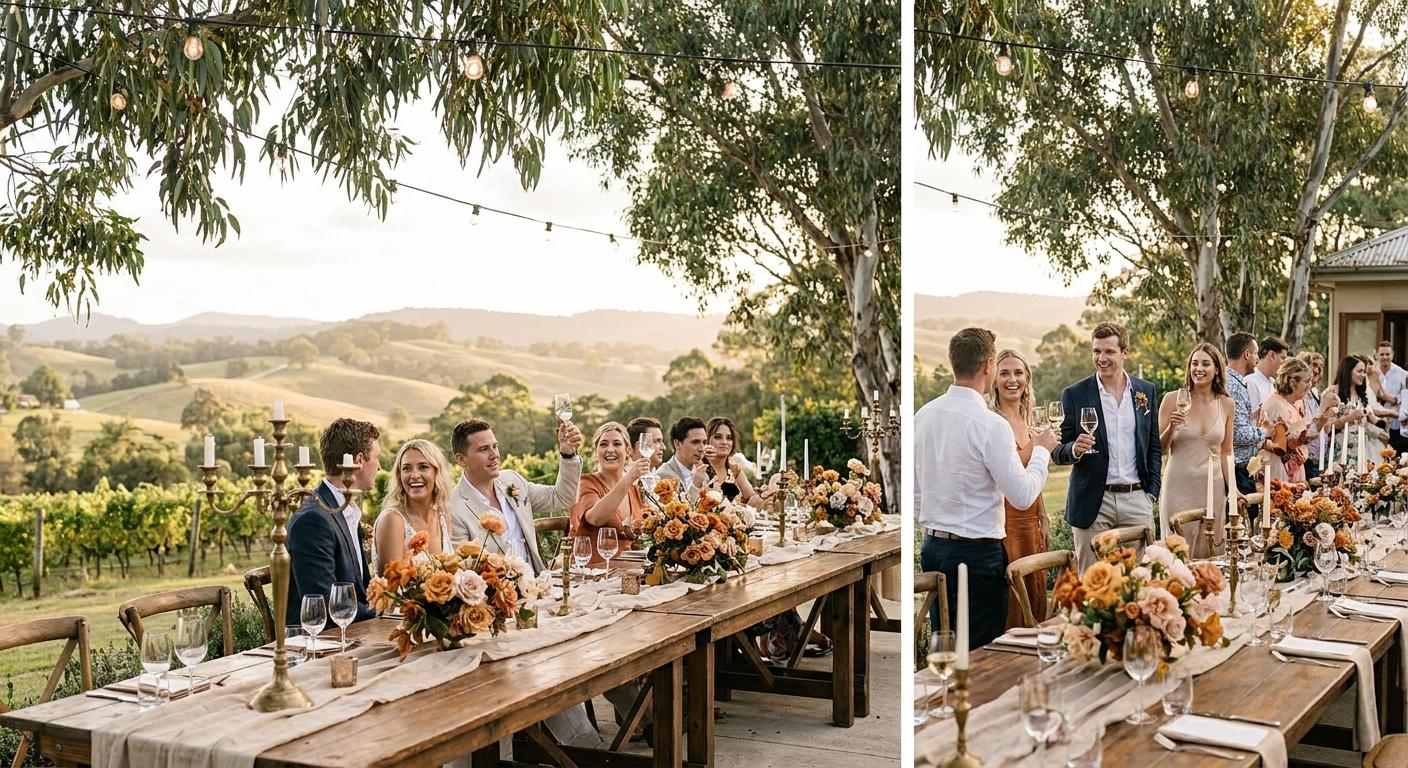
Australian couples are increasingly choosing to say their vows far from the city where they live — in the vine-rows of the Hunter Valley, on the clifftops of Byron Bay, among the karri forests of Margaret River, or in the heritage gardens of the Adelaide Hills. The destination wedding, once considered an extravagance reserved for couples with unlimited budgets and unlimited time, has become one of the most accessible and appealing options in the Australian wedding landscape. The combination of improved regional infrastructure, a national network of specialist wedding suppliers, and the desire for a wedding that feels genuinely different from the everyday has pushed regional and destination weddings into the mainstream of Australian wedding planning in 2026.
This article examines why Australian destination weddings have grown so significantly, what makes them logistically distinct from a city-based celebration, and how digital RSVP management has become the essential tool that makes coordinating a destination wedding as manageable as it is memorable.
Why Australian Couples Are Choosing Destination Weddings
The appeal of a destination wedding in the Australian context is rooted in something more than aesthetics. Yes, the photography from a Hunter Valley vineyard wedding in autumn looks extraordinary — amber vine-rows, golden afternoon light, and a landscape that requires no styling to photograph beautifully. But the reasons Australian couples give for choosing a regional wedding extend well beyond visual appeal.
The first driver is guest experience. A destination wedding transforms a single day into an extended celebration. Guests who travel to a regional location for a wedding are, by definition, investing time and money in the occasion, and that investment changes how they experience it. A welcome dinner the night before, the wedding day itself, and a recovery brunch the morning after — the destination wedding naturally creates the kind of multi-day celebration that couples who marry in their own city often struggle to facilitate. Guests at a Margaret River wedding are present in a way that city wedding guests, who may slip in for the ceremony and leave before the first dance, rarely are. The emotional quality of a destination wedding — the sense of shared experience, the intimacy of being somewhere together — is genuinely different from the city celebration, and couples who have experienced both frequently cite this as the primary reason they would choose a destination wedding again.
The second driver is authenticity. Australian regional landscapes carry a specific character that urban Australia cannot replicate. The light in the Yarra Valley in late afternoon has a quality that Melbourne photographers have been photographing for decades. The coastal drama of the Shoalhaven south of Sydney — the white-sand beaches, the cliffs, the vast Pacific horizon — creates a ceremony setting that needs no decorations. The bushland around the Blue Mountains, with its eucalypt-covered ridgelines and cascading waterfalls, provides an Australian natural aesthetic that couples with overseas guests find particularly compelling. A wedding that is rooted in the specific character of its location is, almost by definition, more personal than a wedding held in a function room that could be anywhere in the country.
The third driver is economics. Counterintuitively, a destination wedding at a regional venue can work out less expensive than a city-based celebration at a comparable quality level. Venue hire fees in regional Australia are generally lower than in Sydney or Melbourne for an equivalent-quality space. Catering costs benefit from proximity to the produce: a Yarra Valley wedding can offer Victorian cool-climate produce at lower supply costs than a city venue that sources from the same regional producers at a markup. Accommodation for guests, while requiring coordination, is frequently less expensive in regional areas. The total cost equation, once calculated properly, often favours the destination wedding — particularly for couples who are willing to be thoughtful about their supplier choices.
The Logistics That Separate Destination Weddings from City Celebrations
A destination wedding introduces logistical complexity that a city-based celebration avoids almost entirely. When your wedding is in the suburb where you live, guests make their own way to the venue, find their own accommodation nearby, and navigate familiar territory. When your wedding is two hours from the nearest major airport in a regional town that most of your guests have never visited, the logistics multiply significantly.
Travel coordination is the first and most fundamental challenge. Your guest list, which might include people flying from Perth to the Gold Coast, from Adelaide to the Hunter Valley, or from regional Victoria to Byron Bay, needs to share travel information with you so that you can identify overlaps, coordinate shared transport, and flag situations where a guest's travel plan makes attending impractical or impossibly expensive. A digital RSVP system that captures flight information, arrival times, and whether a guest is hiring a car enables you to build a transport picture of your guest list before the wedding — and to identify the couples or individuals who would benefit from knowing about shared transport options, regional airport shuttle services, or the train routes that serve many Australian wine regions.
Accommodation coordination is the second layer. Regional wedding destinations frequently have limited accommodation inventory, and when your entire guest list is competing for the same handful of hotels, guesthouses, and Airbnb properties in the weeks before your wedding, the experience for your guests can range from expensive to disappointing. A digital RSVP system that captures accommodation plans — whether guests have booked, where they are staying, whether they need help finding options — gives you the information you need to provide guidance before the accommodation crunch creates problems. Many couples find that a block booking at a preferred hotel, communicated to guests through the RSVP platform, resolves the accommodation challenge cleanly.
The third logistical complexity is the multi-event structure that destination weddings naturally create. When guests have travelled significant distances to attend your wedding, asking them to arrive on the morning of the ceremony and leave that evening is both logistically demanding and a missed opportunity. The couples who deliver the best destination wedding experiences typically plan a wedding weekend rather than a wedding day — a welcome drinks event on the Friday evening, the wedding ceremony and reception on the Saturday, and a recovery brunch or activity on the Sunday. Managing RSVPs for multiple events, with different guest subsets attending each one, is a logistical challenge that spreadsheet-based management handles poorly and a purpose-built digital RSVP platform handles well.
What Your RSVP Process Needs to Collect from Destination Wedding Guests
The standard city wedding RSVP collects name, attendance, meal preference, and dietary requirements. A destination wedding requires more from your guests — and the data you collect at the RSVP stage has direct operational value for the logistics you are managing.
Travel information is the most important addition. Ask guests to confirm their arrival date, departure date, and primary mode of transport to the region. This information sounds simple, but it enables a sequence of practical actions: identifying guests arriving on the same flights who could share a transfer, flagging guests whose arrival timing is incompatible with the ceremony start time and who may need to arrive the day before, and building a guest arrival picture that informs your venue's welcome and check-in logistics. Many regional wedding venues appreciate this information in advance because it affects their staffing and catering timing for pre-wedding events.
Accommodation status is the second critical data field. Ask guests whether they have confirmed their accommodation, whether they need recommendations, and whether they are staying for the full weekend or just the wedding day. This information allows you to identify the guests who have not yet booked and to send targeted guidance before availability becomes a problem — particularly in popular regional destinations like Byron Bay, Margaret River, and the Hunter Valley, where accommodation fills quickly during the peak wedding season from October through April.
Dietary requirements remain important and should be collected with additional context in mind. Guests at a destination wedding may have different dietary needs than at a city event — the regional caterer may have different capabilities than a city-based supplier, and the dining experience is more central to the overall celebration when the reception is the main event of a weekend. Collect dietary requirements with specificity: not just 'vegetarian' but 'vegetarian, no nuts, dairy-free' — and flag any requirements that may need specialist handling to your caterer before the final menu is confirmed.
Song preferences, plus-one details, and gift registry information round out the destination wedding RSVP. The song request field serves double duty at a destination wedding — it gives your DJ or band personalisation material and it gives guests who are less comfortable requesting songs in person a low-friction way to contribute to the evening entertainment. The plus-one field, when your venue has a capacity constraint, needs to be managed with care: destination wedding guests are more likely to ask about plus-ones than city wedding guests, because the travel cost makes attending alone a significant decision.
Australian Destination Wedding Regions and What Makes Each One Distinct
Understanding the character of each destination region helps you communicate with guests about what to expect — and it helps you choose your own location with full awareness of what each area offers.
Byron Bay and the Northern Rivers of New South Wales represent the most culturally distinctive destination wedding region in Australia. The area's appeal is broad: dramatic coastal headlands, boutique hinterland estates, beachfront properties, and a lifestyle culture that is genuinely distinctive rather than manufactured. Byron Bay weddings attract couples who want a relaxed, stylish celebration that reflects their personal aesthetic rather than a wedding formula. The Northern Rivers region — including Bangalow, Mullumbimby, and the Tweed Shire — offers quieter alternatives to Byron Bay itself while retaining the area's essential character. The closest major airport is Ballina Byron Gateway, with Gold Coast Airport approximately 45 minutes from central Byron Bay. Most interstate guests will fly to Gold Coast and drive.
The Hunter Valley is Australia's most established wine wedding destination, located approximately two hours north of Sydney. The region's appeal is its proximity to Australia's largest city, its concentration of quality venues and suppliers, and its classic wine country aesthetic — rolling vine-rows, stone cellar doors, and long lunches that are as much about the wine as the occasion. Hunter Valley weddings work across all seasons but peak in the cooler months from April through August, when the vine rows transition through autumn colour and the temperature is comfortable for outdoor ceremonies. Sydney-based couples can offer guests a day-trip option with coach transport, which reduces the accommodation pressure that affects more remote destinations.
Margaret River in Western Australia is the premier destination wedding region for couples based in Perth or willing to ask their guests to fly interstate. The region's appeal is its combination of world-class wine, spectacular coastline, and old-growth forest — a landscape diversity that no other Australian wine region can match within a compact driving distance. Margaret River weddings typically run over a weekend, with the Friday welcome event, Saturday ceremony and reception, and Sunday farewell activity (often a beach morning or a final cellar door visit) creating a complete experience for guests who have made the journey. The fly-in requirement makes Margaret River a more significant ask for guests than the Hunter Valley, but for those who make the journey, the experience is consistently described as extraordinary.
The Yarra Valley in Victoria offers Melbourne-based couples — and interstate guests willing to fly to Melbourne — one of Australia's most reliable destination wedding settings. The valley's cooler climate means that outdoor celebrations work comfortably through the summer months, unlike the Hunter Valley, and the proximity to Melbourne (approximately one hour's drive) makes regional transport logistics simpler than more distant destinations. The Yarra Valley wedding aesthetic is refined and food-focused: Victorian cool-climate wines, Melbourne-style hospitality, and a landscape that transitions beautifully through the seasons. For couples who want destination aesthetics without the destination complexity, the Yarra Valley is the logical choice.
The Adelaide Hills and Barossa Valley in South Australia represent the underrated option in the Australian destination wedding landscape. South Australia's wine regions — the Adelaide Hills for cool-climate wines and the Barossa for its robust reds — offer exceptional venue diversity within a compact driving distance, a food culture that is as strong as Victoria's, and weather that is more reliably stable in winter than Victoria's higher-altitude wine regions. Adelaide Airport is a manageable international gateway, and the Adelaide Hills is approximately 30 minutes from the city centre. For couples who want a destination wedding that their guests will find genuinely surprising in its quality, South Australia is a region worth considering seriously.
Communicating with Out-of-Town Guests: The Strategy That Reduces Anxiety
Destination wedding guests experience more pre-wedding anxiety than city wedding guests. They are travelling to an unfamiliar location, they are committing to a longer time away from home, they are navigating accommodation logistics, and they are often uncertain about what to expect from a regional venue they have not visited. Your communication strategy — starting from the save-the-date and continuing through to the post-wedding thank-you — directly affects how confident and comfortable your guests feel about the journey.
The save-the-date is the first opportunity to set expectations. For a destination wedding, your save-the-date should include more than the date and location name. It should include a sense of the region — 'we are getting married in the Yarra Valley, a beautiful wine region one hour from Melbourne' — and a preliminary sense of the accommodation situation — 'accommodation in the valley books quickly, we recommend securing your booking early.' This early guidance prevents the situation where guests delay booking accommodation until after they have received the formal invitation and discover that every nearby option is sold out.
The wedding website is your primary communication hub for the period between save-the-date and the wedding itself. A dedicated section on the venue region — with practical information about transport options, recommended accommodation, things to do in the area, and what to pack — answers the questions your guests are too polite to ask you directly. Regional wedding venues often have a visitor information resource or a preferred accommodation partner list that you can reference. Include this information generously: guests who feel informed are guests who arrive relaxed, and relaxed guests participate more fully in the celebration.
The final-week communication — typically sent one week before the wedding — should be specific and practical. Confirm the timeline, provide directions to the venue (with a map link), flag the weather forecast, and confirm any last-minute logistics. For destination weddings, this communication is particularly valuable because your guests are navigating unfamiliar territory: a clear, specific message that confirms where to go, what time to be there, what to wear, and what happens next removes the uncertainty that can cloud the final days before the wedding.
Digital Tools That Make Destination Wedding Management Practical
The administrative complexity of a destination wedding — multiple events, travel coordination, accommodation tracking, guest communication across multiple platforms — is the primary reason many couples choose to limit their celebration to a single day and a single location. Digital tools, and specifically online RSVP platforms, have substantially lowered this barrier. A wedding RSVP system that is configured for destination wedding complexity gives you the organisational infrastructure to manage what was previously manageable only with professional wedding planning support.
The most valuable RSVP features for destination weddings are those that enable segmentation and communication. A guest list segmented by attendance status, by dietary requirements, by accommodation confirmation, and by transport needs gives you the ability to send targeted communications to specific groups of guests without bombarding your entire list with information that is not relevant to them. Guests who have not yet booked accommodation receive a gentle nudge; guests who have confirmed attendance receive the final week's detailed logistics; guests who are struggling with travel arrangements receive a direct offer of assistance. This targeted approach is impossible with a standard spreadsheet or a paper RSVP card, and it is the feature that most directly reduces the administrative load of destination wedding coordination.
The dietary requirements collection, when it feeds directly into your caterer's final numbers, eliminates the error-prone manual transfer process that creates problems at most weddings. Your caterer receives an accurate final count and a complete dietary breakdown — including any specialist requirements that need advance ordering — before the final head count is locked. This is not a minor operational benefit. Incorrect dietary counts are one of the most common sources of stress on the wedding day itself, and a digital RSVP that captures this information correctly eliminates a significant potential problem before it can materialise.
The multi-event RSVP functionality — where different guest segments can confirm attendance at different events — is the feature that makes the wedding weekend logistically possible. Rather than a single yes or no to the wedding, your guests can confirm attendance at the Friday welcome dinner, the Saturday ceremony and reception, and the Sunday recovery brunch independently. This gives you accurate numbers for each event, enables your caterer to plan appropriately for each occasion, and removes the social pressure that can arise when a single RSVP card implies that non-attendance at a pre-wedding event is somehow a slight.
Making the Decision: Is a Destination Wedding Right for You
A destination wedding is not the right choice for every couple, and the decision deserves honest assessment rather than romantic pressure. The couples who have the best destination wedding experiences are those who made the choice deliberately — based on a genuine love for their chosen region, a willingness to invest time in guest communication, and an acceptance that the logistics will require more active management than a city celebration.
If you are drawn to a specific regional landscape, if the idea of creating a multi-day experience for your guests rather than a single evening feels appealing rather than overwhelming, and if you are willing to invest the additional communication effort that destination weddings require, the rewards are significant. The guests who attend your destination wedding will carry memories of a shared experience that a city celebration cannot replicate. The landscape will provide a setting that requires no styling to photograph beautifully. And the celebration will feel, unmistakably, like it belongs to a specific place — which is exactly what a wedding should be.
The tools available to Australian couples in 2026 — digital RSVP platforms, online wedding websites, regional supplier directories, and the growing infrastructure of the Australian destination wedding market — make the logistics manageable for any couple who is willing to plan deliberately. Start early, communicate clearly, and choose a region that you genuinely love. The rest follows from there.