The traditional Australian wedding venue — a hotel function room, a generic events space, a hired community hall — served a purpose for decades. It offered capacity, it offered predictability, and it offered a blank canvas that couples could transform with their own styling choices. It also, increasingly, offered a wedding that looked a great deal like every other wedding held in the same space that year. The neutral linens were the same. The standard layout was the same. The experience of arriving at a venue that had hosted hundreds of other celebrations before yours was, unavoidably, the same.
Australian couples in 2026 are not settling for the same. They are choosing venues that bring something irreplaceable to the day — a landscape that photographs beautifully, a history that adds meaning, a setting that sparks conversation from the moment guests arrive. The shift away from conventional venues has been building for several years, but it has accelerated sharply as social media has raised expectations, as venue discovery tools have made unusual options more accessible, and as the Australian wedding industry has responded with an expanding portfolio of distinctive spaces designed specifically with celebrations in mind.
This guide covers the venue categories leading the unconventional wedding movement in Australia, the specific regions and locations where each category excels, the questions that separate a successful venue choice from a regretful one, and the digital tools — including online RSVP platforms — that make managing a non-traditional venue as practical as it is memorable.
Coastal and Beachfront Venues: Australia's Seaside Wedding Settings
Australia's coastline is one of the most significant competitive advantages an Australian couple has when choosing a wedding venue. With more than 34,000 kilometres of coastline stretching from the tropical waters of North Queensland to the windswept beaches of Tasmania, the range of coastal wedding settings available to Australian couples is unmatched anywhere in the world. Beach weddings and seaside celebrations have been popular for decades, but the quality of venues, the standard of facilities, and the sophistication of coastal wedding venues in 2026 have moved decisively beyond the simple beach ceremony with a marquee reception.
The Gold Coast and its surrounding regions offer some of the most developed coastal wedding infrastructure in the country. Private beachfront properties, oceanfront pavilions, and resort wedding venues along the Gold Coast strip provide the convenience of established facilities while delivering the natural drama that only a coastal setting can provide. For couples seeking something more intimate, the southern Gold Coast suburbs and the Tweed Shire offer quieter beach locations — think Burleigh Heads, Kingscliff, and Salt Village — where boutique venues deliver coastal ceremony and reception experiences without the crowds that characterize the central Gold Coast.
Byron Bay remains one of Australia's most sought-after coastal wedding destinations, and for good reason. The combination of dramatic headland scenery, a relaxed but sophisticated lifestyle culture, and a well-established wedding supplier ecosystem makes it a venue category as much as a location. Wedding venues in Byron Bay range from clifftop ceremonies at the Cape Byron Lighthouse reserve (a public space that requires a special event permit but delivers unmatched views) to private estate gardens, beachfront properties, and boutique hotels in the town centre. The Byron Bay wedding carries a specific cultural cachet — effortlessly stylish, slightly bohemian, definitively Australian — that couples from interstate and overseas find deeply attractive.
Victoria's coastline offers a very different coastal wedding character. The Mornington Peninsula, just over an hour from Melbourne, provides a sequence of coastal venues — beach houses, winery estates with sea views, clifftop gardens — that work exceptionally well for autumn and winter weddings when the peninsula's cool-season light creates some of the most photogenic coastal conditions in the country. The Bass Strait's dramatic grey-blue light is a stark contrast to the bright turquoise of Queensland's coast, and it creates a moody, romantic atmosphere that suits formal and intimate weddings equally well.
Vineyard and Winery Weddings: Regional Australia's Celebration Setting
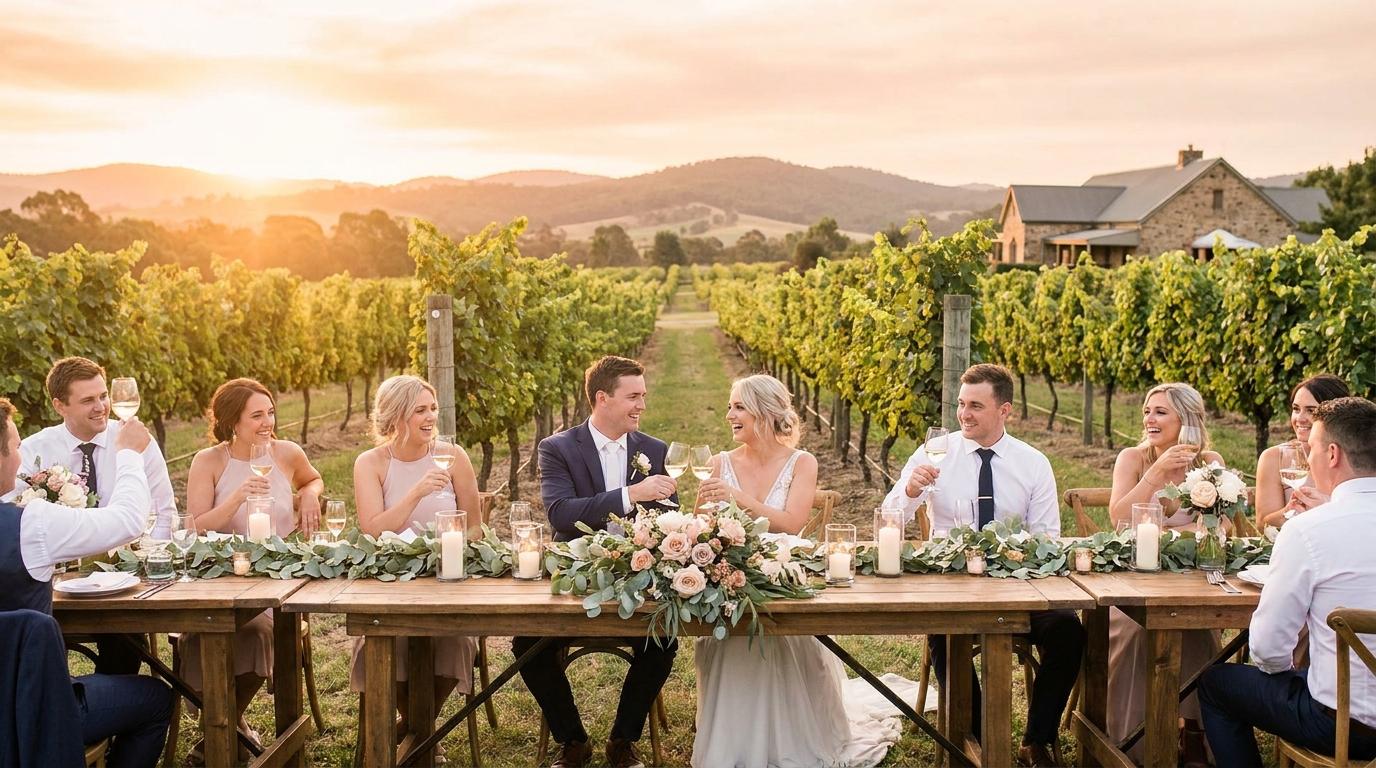
The Australian wine industry has become one of the country's most significant wedding venue providers, with cellar doors, winery restaurants, and vineyard estate properties across the country now explicitly marketing themselves as wedding venues. This is not accidental. The combination of natural beauty, built-in food and wine credentials, manicured landscapes, and a pre-existing aesthetic that photographs beautifully makes wine country venues among the most in-demand wedding locations in Australia regardless of season.
The Hunter Valley, just two hours north of Sydney, is the most established vineyard wedding region in Australia. The combination of proximity to a major city, a critical mass of quality venues, and a landscape defined by rolling vine rows under big open skies has made the Hunter Valley the default recommendation for Sydney couples seeking a destination wedding without the distance. Roche Estates, Bintel, and the historic MV Belmonda are among the venues that have built their reputations specifically on wedding celebrations, and the region's supplier ecosystem — florists, stylists, celebrants — is calibrated to the wine wedding aesthetic. The Hunter Valley wedding season peaks in the Australian autumn (March to May), when the vine rows turn amber and gold and the temperature is comfortable for outdoor ceremonies and long lunches.
The Yarra Valley, Victoria's premier wine region and less than an hour from Melbourne, offers a distinctly different vineyard wedding character. The cooler Victorian climate, the green rolling hills, the heritage homesteads, and Melbourne's deep appreciation for food and wine culture combine to create a wedding aesthetic that is more refined and more food-focused than its Hunter Valley counterpart. Yarra Valley venues such as Domain Chandon, Rochford Wines, and the intimate estate venues scattered through the valley's back roads cater to couples who want a European-style vineyard celebration without leaving Victoria. The Yarra Valley is also notable as a year-round wedding destination — its cooler climate means that even a January wedding is manageable outdoors, unlike the extreme heat of a Hunter Valley summer day.
Margaret River, Western Australia's world-class wine region, has emerged as a premier wedding destination for couples who want both natural beauty and a sense of genuine remoteness. The combination of ocean beaches, old-growth forests, and world-class wineries within a compact region gives Margaret River wedding venues a versatility that few other Australian wine regions can match. A wedding weekend in Margaret River might include a beach ceremony at Prevelly, a forest reception among the karri trees, and a farewell brunch at a cellar door — all within a short drive. For Perth-based couples or couples willing to fly their guests to Western Australia, Margaret River delivers a destination wedding experience that rivals anywhere in the world.
Rustic Barns, Farms, and Rural Estates: The Countryside Wedding Revival
The rustic barn wedding — a category that barely existed as a formal wedding venue in Australia fifteen years ago — has become one of the fastest-growing segments of the Australian wedding venue market. The appeal is straightforward: a working farm or heritage barn offers a built-in aesthetic that requires minimal styling to photograph beautifully, a sense of authenticity and groundedness that feels personal, and a scale and space that a purpose-built events venue cannot replicate. For couples who did not grow up on farms but romanticise the countryside aesthetic, a barn wedding delivers the fantasy without requiring them to actually know how to drive a tractor.
Victoria has led the barn wedding venue development in Australia, with the state's productive agricultural regions — the Dandenong Ranges, the Yarra Valley periphery, the goldfields region around Daylesford and Hepburn Springs — producing a cluster of quality farm and barn venues. The flexibility of these spaces is a significant part of their appeal: a cleared paddock for an outdoor ceremony, a restored barn for the reception, a creek-side location for photographs — all on the same property. The Southern Highlands, just south of Sydney, offers a similar countryside venue character with the added advantage of proximity to New South Wales's largest city. Couples marrying in the Southern Highlands during autumn are treated to one of Australia's most spectacular natural settings, with the region's deciduous trees turning gold and amber through April and May.
South Australia's Adelaide Hills has developed a distinctive rustic venue character that blends vineyard aesthetics with genuine agricultural heritage. The region's old apple orchards, cherry farms, and cattle properties have been progressively converted into wedding venues over the past decade, creating a venue category that is distinct from both the Hunter Valley's wine-focused approach and the purely rustic farm aesthetic. Weddings in the Adelaide Hills benefit from the proximity to Adelaide's strong food culture — regional produce from the Adelaide Hills farmers markets provides an authentic farm-to-table dining experience that aligns naturally with the rural venue setting.
Urban Warehouses, Rooftops, and Industrial Spaces: City-Based Celebration Venues
Not every Australian couple wants a countryside wedding, and the urban wedding venue category has expanded significantly to accommodate those who want a city-based celebration with personality. The warehouse wedding — a concept borrowed from the creative events scene in London and New York — arrived in Australian cities in the early 2010s and has matured into a sophisticated venue category. Repurposed warehouses, converted factories, and purpose-designed creative spaces in Melbourne, Sydney, and Brisbane now offer the scale, the aesthetics, and the flexibility that couples seeking an urban celebration require.
Melbourne's relationship with warehouse and industrial wedding venues is particularly strong, reflecting the city's broader creative culture. The city's extensive legacy of light industrial buildings in inner-suburban postcodes — Collingwood, Fitzroy, Richmond, Northcote — has been progressively converted into event spaces that retain their raw architectural character while offering the infrastructure a wedding reception requires. The Standard, The Precinct, and a growing list of warehouse venues across Melbourne's inner north offer exposed brick, polished concrete floors, high ceilings, and natural light that transforms through the day into the kind of atmosphere that couples and their photographers find irreplaceable.
Sydney's urban wedding venue category has developed around the harbour city rather than against it. Rooftop venues with Sydney Harbour views — The Nielsen, The Glen, and the rooftop spaces scattered through the city fringe — offer the dramatic natural backdrop that the harbour provides as centrepiece. Industrial warehouse venues in Alexandria, Rosebery, and the reborn inner-city precincts of Sydney offer the raw urban aesthetic that contrasts beautifully with the harbour views that are never far away. Brisbane's warmer climate and its river city character have produced a distinctive urban venue category that makes the most of outdoor and semi-outdoor spaces — riverbank venues, warehouse spaces with roll-up walls, and rooftop gardens in Fortitude Valley and New Farm.
Botanic Gardens, Private Estates, and Hidden Garden Venues
Australia's public and private garden venues occupy a unique position in the unconventional venue landscape. They offer a curated natural beauty — established gardens, mature trees, designed landscapes — that a bare paddock or an empty warehouse cannot provide. They also offer a reliability of aesthetics that outdoor venues dependent on weather and season cannot guarantee. For couples who want the beauty of an outdoor setting without the risk of a bare field or a muddy marquee, garden venues offer a compelling middle ground.
The Royal Botanic Gardens in Sydney and Melbourne are the most formally recognised garden wedding venues in the country, offering iconic locations within the gardens themselves — the Calyx at the Sydney gardens, the Fernery at Cranbourne, the various garden settings within the Melbourne gardens — that deliver a natural beauty backed by institutional infrastructure. These venues book quickly and require adherence to strict guidelines, but they deliver an irreplaceable setting that no private garden venue can fully replicate. The Royal Botanic Gardens, Melbourne also offers night-time wedding permits, which opens up the possibility of a garden wedding that transforms into an illuminated evening celebration.
Private estate gardens — often historic homesteads and country houses opened for weddings — represent a growing niche in the Australian venue market. These properties are typically not purpose-built event venues, which gives them an authenticity and a character that a designed events space cannot achieve. They also require more careful management: fewer built-in facilities, greater dependence on weather, and a more complex relationship with neighbours and local councils who may not share the couple's enthusiasm for a 200-person celebration in a quiet rural setting. The couples who choose private estate gardens and navigate these complexities successfully are consistently rewarded with a wedding experience that feels genuinely personal and genuinely private.
Practical Considerations: Questions Every Couple Must Answer Before Booking
Choosing a unique wedding venue is exciting, but the practical considerations that determine whether your chosen venue will deliver on its promise are not always visible on the first inspection or in the curated photographs on the venue's website. Australian couples who have regretted their venue choice — and the data from post-wedding surveys suggests this is a more common regret than couples expect — typically cite the same categories of oversight. Understanding what to ask before you sign a contract is not the romantic part of wedding planning, but it is the part that prevents a beautiful vision from unravelling on the day.
Weather contingency is the first and most critical question for any outdoor or partially outdoor venue. Every Australian venue that hosts outdoor ceremonies needs a documented wet weather plan — not a vague assurance from the venue manager that 'we have you covered,' but a specific, contractually documented alternative that you have seen, understood, and approved before committing. The difference between a marquee that has been pre-ordered and positioned versus a venue that promises to 'figure something out' on the day is the difference between a wedding that proceeds smoothly and a wedding that begins with a stressful scramble. Ask specifically: what happens in rain, in extreme heat (above 38 degrees, which is increasingly common in Australian summer months), and in high wind. Each scenario needs a plan.
Vendor restrictions are the second most commonly overlooked venue consideration. Many unique venues — particularly private estates, barns, and rural properties — operate with preferred supplier lists or outright restrictions on outside vendors. A venue that looks perfect but requires you to use their in-house catering at $180 per head may work out more expensive than a venue with a higher base hire fee that allows you to bring your own caterer. Ask for a complete list of approved suppliers before you commit, and get quotes from those suppliers before you sign. The venue hire fee is only the beginning of the cost calculation.
Noise regulations and curfews are a particular consideration for Australian couples, and they are frequently underestimated. Most local councils in Australia enforce noise curfews on outdoor events, and the specifics vary significantly between councils — some allow amplified music until 11pm outdoors, others require sound levels to be reduced by 9pm. A venue that markets itself as a party space but is operating under a strict council noise approval is a venue that may deliver a very different experience to what the marketing suggests. Get the exact curfew time in writing and confirm it against the council's planning approval for the venue. Then work backwards from the curfew to plan your reception timeline — a midnight finish sounds great on paper but becomes impossible if your venue's noise approval ends at 10pm.
Accessibility and infrastructure are considerations that matter more than couples typically expect on the day itself. A rustic barn wedding with a gravel courtyard sounds charming until a guest in heels is struggling to navigate it, or an elderly relative cannot access the ceremony space because there is no paved path from the car park. Ask the venue to walk you through the guest journey from arrival to departure, and identify any steps, uneven surfaces, or distances that might present challenges. A good venue manager will have solutions for most accessibility concerns, but they can only provide those solutions if they know about the issues in advance.
Managing Your Unconventional Venue: How Digital RSVP Tools Simplify the Complexity
Unique wedding venues typically involve more moving parts than a conventional function space — more suppliers, more logistical complexity, more guests unfamiliar with the setting and needing more guidance. This is where digital wedding management tools, and specifically online RSVP platforms, prove their value beyond the simple function of collecting attendance responses. A wedding RSVP system that is configured for your specific venue and your specific requirements can reduce administrative complexity significantly and give you a single source of truth for guest information that all your suppliers can draw from.
The most useful RSVP platform features for unconventional venue management are those that go beyond yes or no. Dietary requirements collected at the RSVP stage feed directly into your caterer's final numbers. Transport and accommodation information collected from guests helps you understand who needs guidance on getting to a remote location. Song requests and social media handles collected through the RSVP give your DJ or band the information they need to personalise the evening entertainment. An RSVP platform that treats the response as the start of a conversation rather than the end of a data collection process is the one that will continue to prove useful throughout your wedding planning journey.
For couples marrying at a destination venue — a Margaret River winery, a Mornington Peninsula estate, a rural property in the Adelaide Hills — the RSVP platform becomes a guest communication hub as much as a data collection tool. The ability to send updates about the venue, the local area, accommodation options, and the weekend schedule to guests who have confirmed their attendance is a capability that replaces a significant amount of manual email communication. A platform that allows you to segment your guest list by attendance status, by dietary requirements, by accommodation needs, and by transport requirements gives you the organisational infrastructure to manage a complex destination wedding without the spreadsheets that most couples resort to out of necessity.
The venue you choose sets the stage for your wedding day. The tools you use to manage it determine how much of that day you actually get to enjoy. Australian couples in 2026 have access to a broader and better range of both venues and digital management tools than any previous generation. The couples who end their wedding day with the fewest regrets are typically those who spent as much time evaluating the practical infrastructure — the venue's infrastructure and their own management tools — as they did falling in love with the aesthetics.