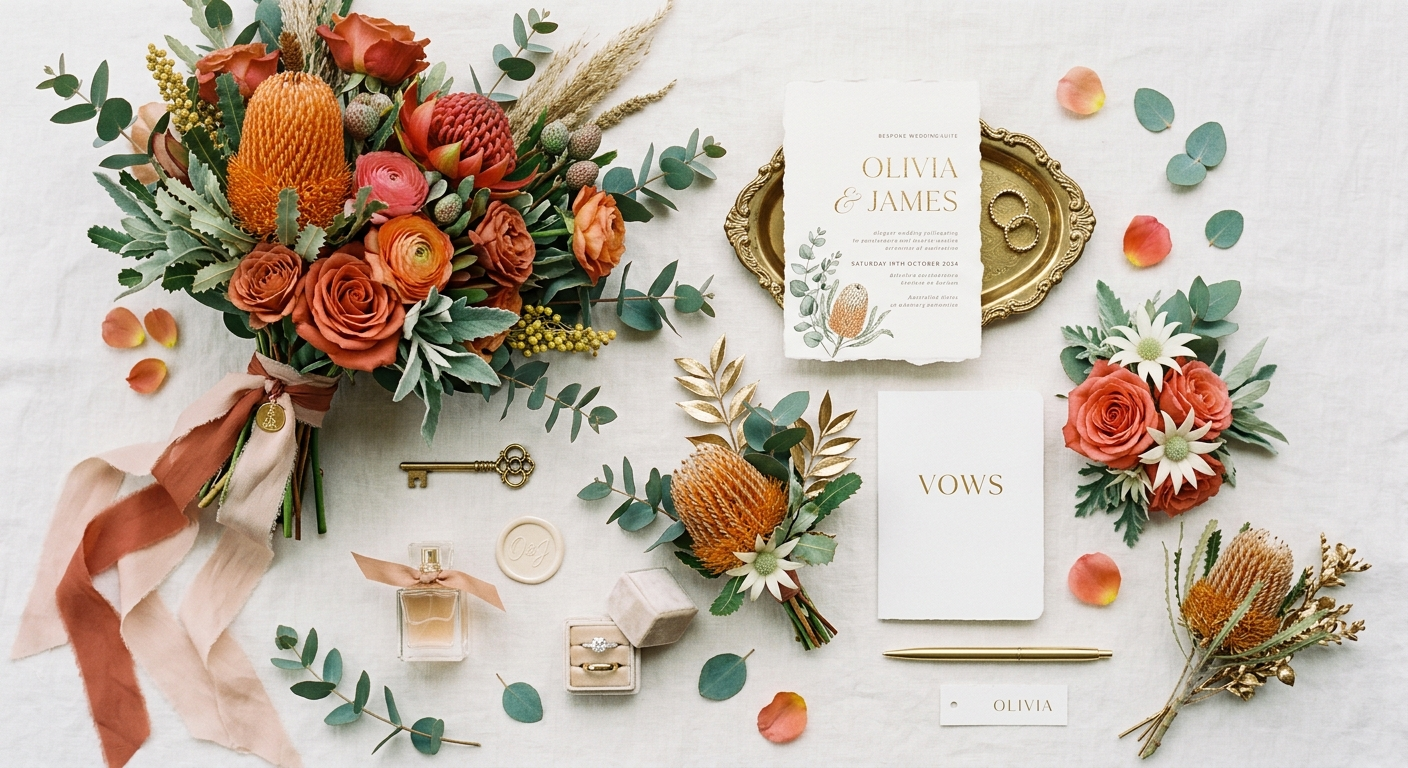
The era of beige weddings is ending, and Australian couples are leading the charge. For much of the 2010s and early 2020s, the wedding colour palette that dominated Australian celebrations was defined by its restraint — ivory and champagne, blush and mauve, taupe and sage. These colours were safe, photographable, and universally flattering. They also became so ubiquitous that they stopped saying anything about the couple choosing them. Walking into an Australian wedding in 2024 and seeing the same dusty rose centrepieces, ivory linens, and gold-rimmed stationery that you had seen at a dozen other celebrations that year was not unusual. It was the norm.
2026 has brought a decisive shift. Australian couples are choosing colour with intention and confidence, drawing on palettes that would have seemed too bold or too unconventional for wedding use five years ago. The drivers of this shift are multiple: the saturation of the neutral aesthetic on Instagram and Pinterest has created a backlash among couples who want their wedding to stand apart; the rise of bold home interiors and personal style expression in everyday life has influenced what couples want their celebrations to look like; and the growing confidence of Australian wedding suppliers — florists, stylists, stationers — in working with saturated colour has made previously challenging palettes accessible at every price point.
This guide covers the bold colour trends defining Australian weddings in 2026, the venues and settings where they work best, the Australian native florals and foliage that complement them, and the practical considerations for couples making colour decisions. It also addresses why your RSVP design — often treated as an afterthought — is one of the most important colour decisions you will make, because it is the first touchpoint where your guests experience your wedding aesthetic in a digital medium.
Why Australian Couples Are Moving Away from Neutral Wedding Palettes
The neutral palette era in Australian weddings coincided with the rise of wedding photography as a cultural institution — the decade when every couple wanted their wedding to look like a magazine spread, and the neutral palette was the aesthetic that read most consistently across different lighting conditions, venue types, and skin tones. Beige and ivory photographed cleanly. Blush and champagne created warmth without competing with the couple. These colours were a safe bet, and for a generation of couples who were navigating wedding planning for the first time, safe was appealing.
The problem with safe is that it stops being distinctive when everyone chooses it. By 2023, the neutral wedding had become so normalised that it was no longer the elevated choice — it was the default, and defaults stopped inspiring. Couples who wanted their wedding to feel personal and specific found that the colour palette that was supposed to reflect their taste was instead reflecting a broader cultural consensus that had nothing to do with them. The backlash was inevitable. The couples getting married in 2026 are not reacting against weddings per se — they are reacting against a homogenised aesthetic that failed to distinguish one celebration from another.
The shift toward bold colour also reflects a generational confidence in personal taste. Millennials, who drove the neutral era, were the first generation to plan weddings with Instagram as a primary reference point, which created a feedback loop where the most photographed palettes became the most requested. Gen Z couples planning weddings in 2026 have a different relationship with social media — they are more likely to use it as a browsing tool than a blueprint, and they are more willing to make choices that feel personal even if they do not have mass-appeal across the algorithm. This generational difference is visible in every colour decision they make.
The Top Bold Colour Trends for Australian Weddings 2026
The colour trends defining Australian weddings in 2026 are defined by saturation, warmth, and a willingness to commit. Where the neutral era favoured soft, desaturated tones, the 2026 palette leans toward colour that announces itself. These are not colours chosen for their safety — they are colours chosen because the couple loves them and wants their wedding to feel unmistakably theirs.
Deep terracotta and burnt orange are the defining warm tones of 2026. These colours draw on the Australian landscape — the red earth of the outback, the clay soils of regional Victoria, the warm light of a Sydney summer evening — and they read beautifully in outdoor and vineyard settings. Terracotta pairs exceptionally well with native Australian foliage, particularly eucalyptus and banksia, which creates a palette that is distinctly Australian without feeling forced or literal. Couples using terracotta palettes at venues like those in the Hunter Valley, the Adelaide Hills, or the Margaret River wine region are finding that the colour harmonises with the natural environment rather than competing with it.
Rich emerald and deep forest green are the complementary counterpoint to terracotta, and they dominate the bridal party and floral design space. The green-into-gold autumn palette that works so well in the Yarra Valley and the Southern Highlands translates beautifully to wedding colour schemes, with emerald bridesmaid dresses, deep green foliage installations, and gold metallic accents creating a richness that the blush-and-ivory palette could not achieve. The Australian native floral palette — eucalyptus, waratah, flannel flower, banksia — pairs naturally with emerald tones, which means couples are not forced to choose between bold colour and botanical authenticity.
Dusty mauve and deep plum have replaced blush as the pink-adjacent tone of choice for couples who want warmth without brightness. The dusty mauve trend reflects a sophisticated colour sensibility — these are not the hot pinks or bright corals of a previous era, but rather muted, complex tones that photograph beautifully in golden-hour light and complement a wide range of skin tones. Plum works particularly well in evening ceremonies and receptions, where the depth of colour creates drama under lighting that would wash out lighter shades.
Bold jewel tones — sapphire blue, deep burgundy, amethyst purple — are appearing in smaller but significant doses, particularly in invitation suites, table linens, and bridesmaid dress collections. The jewel tone trend is strongest among couples who are drawn to a more editorial or fashion-forward wedding aesthetic, and it is most commonly seen in city-based celebrations in Melbourne and Sydney where the supplier ecosystem supports more experimental styling choices.
The Most Effective 2026 Australian Wedding Colour Combinations
The colour combinations working best in Australian weddings 2026 are those that combine warmth with depth. Terracotta and sage green — sometimes called the Australian native palette — is the combination that appears most frequently in Pinterest saves and supplier portfolios this year, and it works because it is both specific to the Australian landscape and universally appealing. The pairing of burnt orange and deep cream or ivory creates a warmer, more romantic feeling that suits garden and estate weddings without feeling generic.
Dusty mauve combined with champagne and gold accents gives a romantic warmth that has replaced the all-blush palette as the go-to romantic wedding aesthetic. The addition of gold prevents the mauve from reading as too pastel or too sweet, and it grounds the palette in a sophistication that suits formal and semi-formal ceremonies equally. This combination has been particularly popular for Melbourne weddings, where the cooler climate and the city's strong design culture supports more nuanced colour work.
Emerald green with touches of gold and ivory creates a luxurious, editorial palette that works well in urban settings — think rooftop venues in Brisbane, industrial spaces in Melbourne, or harbour-side locations in Sydney. The key to making emerald work is contrast — the green needs to be set against lighter or neutral tones to prevent the palette from reading as one-dimensional. Gold cutlery, ivory linens with emerald runners, and white florals against deep green foliage installations create the depth that makes this palette compelling.
Venue Types and Settings: Where Bold Colours Work Best in Australia
Bold colour performs differently depending on the venue setting, and Australian couples are making venue-colour pairings that take this into account. Outdoor venues — vineyard estates, coastal gardens, rural properties — are the natural home for warm, earthy bold palettes because the natural environment provides a backdrop that complements rather than competes with saturated colour. A terracotta and sage palette at a Hunter Valley winery looks like it belongs there because the landscape shares those colour notes. A deep emerald palette at a coastal garden wedding in the Gold Coast hinterland creates a lushness that enhances rather than overwhelms the outdoor setting.
Indoor venues require more careful colour consideration. A bold palette in a space with neutral walls, exposed brick, or natural timber reads differently than in a white-walled modern venue. The key principle for indoor bold colour application is to let the colour breathe — concentrated doses in the florals, table linens, and stationery with a more neutral base prevents the space from becoming overwhelming. A Melbourne reception in a heritage building with high ceilings and neutral walls can carry a dusty mauve and gold palette across the full space, while the same palette in a smaller, more intimate venue would need to be applied more selectively.
The Australian coastal wedding — whether in Byron Bay, the Mornington Peninsula, or the Whitsundays — has its own colour logic. Sandy beaches, turquoise water, and whitewashed venues create a natural neutral base that actually supports bolder palette choices than you might expect. A coral and navy combination, a sage and driftwood palette, or a deep teal with white florals reads beautifully against the coastal landscape and photographs exceptionally well in the strong natural light that characterises Australian beach locations.
Bold Colour Meets Australian Native Flora: A 2026 Wedding Styling Perfect Pairing
One of the most distinctive aspects of the 2026 Australian wedding colour trend is the way bold palettes are being paired with Australian native flora. The traditional view of natives as informal or rustic — suited to boho outdoor ceremonies but not to formal celebrations — has been comprehensively overturned by a new generation of Australian florists who are using natives with the same sophistication they would bring to imported roses or peonies.
The native palette available to Australian couples in 2026 is broader and morecolourful than most people realise. Waratahs — the floral emblem of New South Wales — deliver a bold red-pink that is more saturated than most imported flowers can achieve. Banksia offer warm rust, orange, and yellow tones that integrate perfectly with terracotta palettes. Flannel flowers provide a clean white that works in formal arrangements without the fragility of imported daisies. Geraldton wax and Leucadendron bring structured forms and colours ranging from lime green to deep burgundy that add architectural interest to arrangements. When these natives are combined with bold, saturated colour palettes — terracotta runners, emerald foliage, dusty mauve accents — the result is a wedding aesthetic that is unmistakably Australian.
The practical advantage of native flora for bold colour palettes is their resilience in Australian conditions. Flowers grown for the export market — the roses, peonies, and garden roses that dominate traditional wedding palettes — are bred for European conditions and deteriorate quickly in Australian heat. Australian native flowers are adapted to local climate conditions and hold their colour and form better in the warmth that characterises most Australian wedding seasons. For couples marrying during the Australian spring and summer — October through March — natives offer a beauty and a practicality that imported flowers cannot match.
Why Your Digital RSVP Design Is a Critical Part of Your Colour Story
Couples investing significant thought in their ceremony and reception colour palette often overlook the digital touchpoints — the wedding website, the RSVP form, the save-the-date — as colour decisions. This is a missed opportunity that is becoming harder to justify in 2026, when guests experience the couple's wedding aesthetic digitally before they experience it in person. The colour of your wedding website and RSVP interface is the first colour touchpoint your guests encounter, and it sets the expectation for what the celebration itself will look like.
A wedding RSVP platform that allows colour customisation — custom backgrounds, accent colours, font choices — gives couples the ability to extend their visual identity from the physical celebration into the digital experience. A couple using a terracotta and sage palette for their Hunter Valley wedding should have a wedding website and RSVP form that reflects those colours, not the default cream background and black text of a generic platform. The consistency matters because it signals to guests that every detail of the wedding has been considered, and it builds anticipation for the visual experience they will encounter on the day.
The practical case for colour-coordinated digital RSVP design is also significant. Guests who receive a save-the-date with a distinct visual identity — bold colours, a specific typeface, a cohesive design language — are more likely to remember the wedding details, more likely to visit the wedding website, and more likely to complete their RSVP promptly. The colour and design of the RSVP is not cosmetic — it is functional. It communicates the tone of your wedding (formal, relaxed, glamorous, intimate) and it shapes the guest's emotional response to the invitation to celebrate with you. A digital RSVP platform that treats colour as an afterthought is a platform that is working against the experience you are trying to create.
How to Implement a Bold Colour Palette Without Overwhelming Your Wedding
The most common mistake couples make when committing to a bold colour palette is overapplication. Bold colour used in every element — the invitations, the florals, the linens, the bridesmaid dresses, the groomsmen attire, the cake, the lighting — creates sensory overload that undermines the impact of the individual colour choices. The couples who use bold colour most effectively in 2026 understand the principle of distribution: bold colour concentrated in a few strategic elements creates maximum impact, while the same colour spread across every detail becomes noise.
The practical application principle is straightforward: choose one or two bold elements and build the rest of the palette around them. A terracotta colour palette might concentrate the boldest application in the floral installations — a dramatic terracotta and green arrangement at the ceremony entrance and a matching statement arrangement at the reception entrance — while keeping table linens neutral (cream or ivory), bridesmaid dresses in a complementary sage or olive green, and stationery in a clean ivory with terracotta accents. The bold elements lead; the rest of the palette supports.
Lighting is the element that couples most commonly forget when planning their colour palette, and in 2026 it deserves more attention than it typically receives. Uplighting in a complementary bold colour — amber uplights for a terracotta palette, deep green for an emerald theme — transforms an indoor venue in a way that neutral linens and ivory florals cannot achieve. For evening receptions in particular, investing in a lighting design that extends your colour palette into the evening hours is one of the highest-impact decisions you can make, and it is often available as an add-on from your DJ or entertainment supplier at a fraction of the cost of additional florals or linens.
The bold colour trend in Australian weddings 2026 is not a passing aesthetic moment — it reflects a fundamental shift in what couples want their wedding to communicate. The neutral palette era was defined by its universality and its safety. The bold colour era is defined by its specificity and its confidence. Couples who are choosing terracotta and sage, dusty mauve and gold, emerald and ivory, are making a statement about who they are and what they value, and they are choosing colours that will remain meaningful to them in a way that a beige and blush palette never could.
The practical advice for couples navigating colour decisions in 2026 is simple: choose colours you genuinely love, commit to them fully, and resist the temptation to dilute them for universal appeal. The weddings that look most intentional and most distinctive are the ones where the couple made a clear colour decision and executed it consistently across every touchpoint — from the save-the-date to the ceremony florals to the RSVP interface to the table settings to the evening lighting. Bold colour done well is not risky. It is memorable. And in a decade of wedding photography that you will look at for the rest of your life, memorable is worth more than safe.