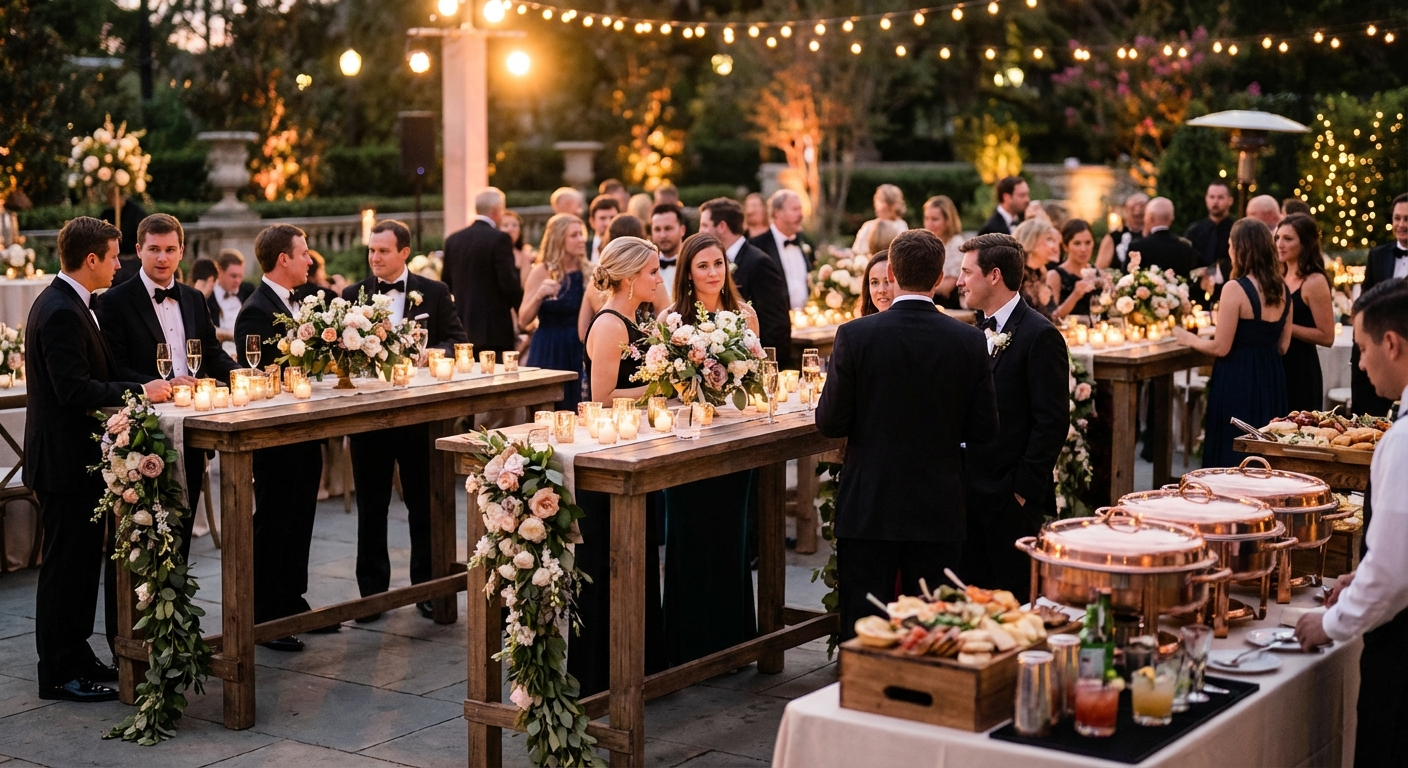
The traditional seated wedding reception follows a rigid formula. Guests find their assigned tables, sit down, eat a plated meal in courses, listen to speeches between bites, and wait for the band to signal that movement is finally allowed. For decades, this format has been the default, and deviating from it felt like breaking an unwritten rule. In 2026, that rule is being rewritten by couples who want their reception to feel less like a formal dinner and more like the best party they have ever attended.
The cocktail-style reception replaces assigned seating and plated courses with a flowing, standing-format celebration built around passed appetizers, curated drink stations, small plates, and open movement throughout the venue. Guests mingle freely, graze at their own pace, and spend the evening in conversation and on the dance floor rather than anchored to a single chair for hours. It is a format that prioritizes connection, energy, and experience over tradition and protocol.
This shift is not a fringe experiment. Vogue, The New York Times, and The Knot have all identified cocktail-style receptions as one of the defining wedding trends of 2026, driven by couples who see their reception as an experience to be felt rather than a meal to be served. Whether you are planning a celebration for sixty guests or six hundred, this guide covers every practical detail you need to execute a cocktail reception that impresses, feeds, and energizes your guests from the first toast to the last dance.
Why Cocktail-Style Receptions Are Taking Over in 2026
The forces driving the cocktail reception trend mirror broader cultural shifts in how people socialize and eat. The rise of wine bars, tapas restaurants, rooftop lounges, and standing-room cocktail experiences has trained a generation to associate good times with movement, variety, and casual elegance rather than with formal seating and multi-course meals. Couples planning weddings in 2026 want their reception to capture that same energy.
The Knot's 2026 Wedding Trends Report highlights a decisive move away from overly traditional reception formats toward experiential, community-centric celebrations. Couples are rejecting the idea that a proper reception requires a seated dinner and instead asking a more fundamental question: what format will make our guests have the best time? For many, the answer is a cocktail reception that keeps the room alive with conversation, laughter, and constant motion.
There is also a financial dimension that couples appreciate. A cocktail reception can deliver a more impressive culinary experience at a lower per-head cost than a plated dinner, because the food format favors variety and volume over individually plated, course-by-course service. The savings on formal table settings, printed menus, and extensive wait staff can be redirected toward better drinks, a stronger band, or a more dramatic venue.
Finally, cocktail receptions solve the age-old problem of dead time. In a seated reception, there are inevitable lulls: the gap between courses, the awkward silence during a too-long speech, the restless energy of guests trapped at tables while the couple takes photos. A standing reception eliminates these dead zones. The party starts when the couple arrives and never stops because there is no format requiring guests to sit still and wait.
Planning the Food for a Cocktail-Style Reception
The biggest concern couples raise about cocktail receptions is whether guests will feel adequately fed. This is a legitimate question, and the answer depends entirely on execution. A well-planned cocktail reception feeds guests more generously than a plated dinner. A poorly planned one leaves people hungry and frustrated. The difference comes down to volume, pacing, and variety.
How Much Food to Serve at a Standing Reception
The standard formula for a cocktail reception that replaces a sit-down dinner is ten to twelve pieces of passed food per guest for the first hour, followed by six to eight pieces per hour for each subsequent hour. For a four-hour reception, that translates to roughly twenty-eight to thirty-six individual bites per person. This sounds like a large number, and it is. The goal is abundance. Guests should never feel like they are chasing trays or rationing their intake.
In addition to passed items, most successful cocktail receptions include at least two or three stationary food displays that guests can visit at will. A raw bar, a cheese and charcuterie spread, a bread and olive oil station, or a composed salad display provides a constant baseline of food that is always available, regardless of how frequently trays circulate. These stations prevent the most common complaint about cocktail receptions: that guests who were talking when a tray passed missed their chance to eat.
Structuring a Cocktail Reception Menu
A strong cocktail reception menu moves through phases the same way a seated dinner moves through courses, but without the formality of distinct breaks. The first hour features lighter bites: ceviche spoons, bruschetta, dumplings, and crudites. The middle portion introduces more substantial fare: sliders, skewers, risotto cups, carved meat on toasted bread, and warm composed bites. The final phase returns to lighter, sweeter notes: miniature desserts, fruit, cheese, and late-night comfort bites like grilled cheese triangles or mini tacos.
This pacing gives the evening a natural arc without requiring anyone to sit down or stop socializing. Guests experience the progression of flavors as a backdrop to the party rather than as the main event. The food enhances the experience without dictating the schedule, which is the fundamental advantage of the cocktail format.
Handling Dietary Restrictions in a Cocktail Format
Cocktail receptions are inherently better at accommodating dietary restrictions than plated dinners. With a dozen or more items circulating throughout the evening, guests with specific needs can choose what works for them without requiring a special plate or feeling singled out. The key is ensuring that at least a third of your passed items are vegetarian, that at least two stationary displays are naturally gluten-free, and that your catering team can clearly identify allergens when guests ask about specific bites.
For guests with severe allergies, consider a small dedicated station with clearly labeled items. This approach is less conspicuous than a specially plated meal delivered to a single seat and gives the guest autonomy over their choices rather than dependence on a server remembering their restrictions.
Venue Layout and Flow for a Standing Reception
The physical layout of a cocktail reception is fundamentally different from a seated one, and getting it right is essential to the experience. A standing reception requires intentional design that guides movement, creates gathering zones, and prevents bottlenecks.
Creating Zones That Encourage Movement
The best cocktail reception layouts divide the space into distinct zones that give guests reasons to explore. A bar in one corner, a food display in another, a lounge area with sofas and low tables in a third, and the dance floor occupying the center or a connected room. This distribution ensures that guests naturally circulate rather than clustering in a single area. Each zone should have its own visual identity and atmosphere so that moving between them feels like discovering different rooms of a party rather than wandering aimlessly.
Outdoor-indoor combinations work exceptionally well for cocktail receptions. A terrace or garden for drinks and conversation with an interior space for food stations and dancing creates a natural flow pattern that keeps the energy distributed. String lights, lanterns, or fire features in the outdoor zone create ambiance that draws guests outside, while music and food stations pull them back in.
Providing Enough Seating Without Assigned Tables
A cocktail reception is not a standing-only event, and failing to provide adequate seating is the most common mistake couples make. The rule of thumb is seating for fifty to sixty percent of your guest count at any given time. This does not mean formal dining tables with place settings. It means a mix of cocktail tables with stools, lounge furniture groupings, bench seating along walls, and scattered chairs throughout the space.
Elderly guests, pregnant attendees, and anyone with mobility limitations need guaranteed seating. Reserve a quiet area with comfortable chairs and a nearby food station so that these guests can enjoy the reception without standing for hours. Communicate this arrangement in advance through your RSVP system so guests who need it know where to find it.
Designing the Drinks Program
The drinks are the namesake of the format, and they deserve careful attention. A cocktail reception without a strong drinks program is just a standing dinner, and that misses the point entirely.
Signature Cocktails That Tell Your Story
Two to three signature cocktails are the standard for a cocktail reception, and they should reflect the couple's taste and the event's aesthetic. A gin-based floral cocktail for a garden venue, a smoky mezcal creation for an industrial loft, or a tropical rum punch for a beachside celebration ties the drink program to the setting and creates a cohesive sensory experience. Include at least one non-alcoholic signature option that receives the same level of creativity and presentation as the alcoholic drinks. Guests who do not drink alcohol should feel equally catered to, not relegated to a basic soda or juice.
Bar Placement and Service Logistics
Multiple bar stations are essential for a cocktail reception. A single bar creates a queue that kills the flow of the party. The general rule is one bar or service point per fifty to seventy-five guests, distributed throughout the space so that no guest ever has to walk far or wait long for a drink. Consider mixing full-service bars with self-serve stations for wine, beer, and water to distribute demand and keep lines short.
Timing matters for bar service. A champagne pass during the couple's entrance, a cocktail hour that transitions seamlessly into the reception, and a late-night shift toward coffee, digestifs, and nightcaps creates a drinks arc that matches the energy of the evening. Heavy cocktails early in the night lead to guests burning out before the dance floor opens. Lighter, more refreshing options at the start with spirit-forward drinks appearing later keeps the energy sustainable.
How Your RSVP System Supports a Cocktail Reception
A cocktail-style reception creates unique RSVP considerations that your digital invitation system should address proactively.
Setting Guest Expectations Through the RSVP
Many guests will assume a wedding reception means a seated dinner unless told otherwise. Your RSVP page and invitation should communicate the cocktail format clearly and positively. Phrases like join us for an evening of cocktails, small plates, and dancing or a cocktail reception with curated bites and craft drinks set the right expectation without sounding like an apology for not serving a plated meal. Frame the format as a deliberate, exciting choice rather than a cost-cutting measure.
Your RSVP form should collect dietary restriction information even though the format is more forgiving than a seated dinner. Knowing that twelve guests are vegetarian, three are gluten-free, and one has a nut allergy allows your caterer to adjust the mix of passed items and station offerings accordingly. Digital RSVP platforms that allow custom questions make this data collection seamless.
Why Accurate Headcounts Matter Even More
Paradoxically, accurate headcounts are more critical for cocktail receptions than for seated dinners. With a plated meal, a few extra or missing guests can be absorbed by the kitchen. With a cocktail reception, the total food volume is calculated per person, and a significant discrepancy between expected and actual attendance directly impacts whether guests feel well fed or go hungry. Your RSVP system should include automated reminders, easy response modification, and real-time tracking so your final numbers are as accurate as possible in the days leading up to the event.
Entertainment and Programming Without a Seated Format
Without the built-in structure of courses and speeches between them, a cocktail reception needs its own programming rhythm to maintain energy throughout the evening.
Rethinking Speeches and Toasts
Long speeches are the enemy of a cocktail reception. A guest standing with a plate of appetizers in one hand and a drink in the other does not want to listen to a fifteen-minute toast. Keep speeches short, ideally two to three minutes each, and limit the total number to three or four. Schedule them during a natural pause, such as when a new food phase is being set up, rather than interrupting the flow of the party. Some couples opt for a single group toast at the beginning, then share longer personal messages privately or in written form at each table.
Music and Dance Floor Timing
Music should run continuously at a cocktail reception, transitioning from background-level during the first hour to dance-floor energy as the evening progresses. The first dance can happen anytime, but it often works best about ninety minutes into the reception, when guests have eaten enough to feel comfortable and drunk enough to join the floor afterward. Live bands and DJs both work for cocktail receptions, though a DJ has the advantage of precise volume control and seamless transitions that match the fluid nature of the format.
Frequently Asked Questions About Cocktail-Style Wedding Receptions
Will Guests Actually Get Enough to Eat?
Yes, if you plan for it. A properly catered cocktail reception provides more total food per guest than a plated dinner. The key is volume and pacing. Ten to twelve passed pieces per hour for the first hour, six to eight per hour after that, plus stationary displays that are always accessible. When guests report feeling underfed at cocktail receptions, it is almost always because the couple underestimated the quantity needed, not because the format itself is inadequate.
How Do You Accommodate Elderly or Less Mobile Guests?
Designate a comfortable seating area with nearby food and drink access. Inform these guests through your RSVP follow-up that reserved seating is available and direct them to it upon arrival. Assign a server to check on this area regularly to ensure plates and drinks are replenished without requiring these guests to stand in lines or chase passing trays. This arrangement lets them enjoy the energy of the cocktail format without the physical demands.
Is a Cocktail Reception Cheaper Than a Seated Dinner?
It can be, but not automatically. The savings come from reduced staffing for table service, no formal place settings or printed menus, and the ability to use a wider range of venues that do not require extensive dining infrastructure. However, the food itself may cost a similar amount per head because you need significant volume and variety to make the format work. The net result is typically a ten to twenty percent savings compared to a plated dinner of equivalent quality, with the difference being reallocated to other experience elements like better drinks, lighting, or entertainment.
How Long Should a Cocktail Reception Last?
Three to four hours is the standard for a cocktail reception. Shorter than three hours and the event feels rushed, with guests barely settling in before the evening winds down. Longer than four hours and fatigue sets in, especially for a standing-format event. If your celebration will run longer, consider transitioning to a late-night lounge phase with lower lighting, seated areas, and a final round of comfort food and nightcaps to give the evening a natural wind-down rather than an abrupt ending.
Can a Cocktail Reception Be Formal Enough for a Traditional Wedding?
Absolutely. Formality is determined by the venue, the attire, the service style, and the presentation, not by whether guests are seated. A cocktail reception in a grand ballroom with white-gloved servers passing canapes on silver trays, a live string quartet, and champagne towers is as formal as any plated dinner. The format is a choice about flow and energy, not about elegance. Some of the most sophisticated wedding celebrations in the world use a cocktail format precisely because it allows the venue and the atmosphere to take center stage.
The cocktail-style reception is not a compromise or a shortcut. It is a deliberate choice to prioritize connection, movement, and energy over the rigid structure of a seated dinner. When executed well, it creates an atmosphere where every guest feels free to enjoy the evening on their own terms: eating what they love, talking to whoever they want, and dancing whenever the music moves them.
The practical requirements are straightforward but non-negotiable. Generous food quantities, intentional venue layout, multiple bar stations, adequate seating for those who need it, and clear communication through your RSVP system about what guests can expect. Miss any of these fundamentals and the format falters. Get them right and you create a celebration that guests will remember as the best wedding they have ever attended.
In 2026, the question is no longer whether a cocktail reception is appropriate for a wedding. The question is whether a seated dinner is still the best way to celebrate the most important day of your life. For a growing number of couples, the answer is no. The cocktail reception offers something a plated dinner never can: a party where everyone, including the couple, is on their feet, in the moment, and fully present for every minute of the celebration.