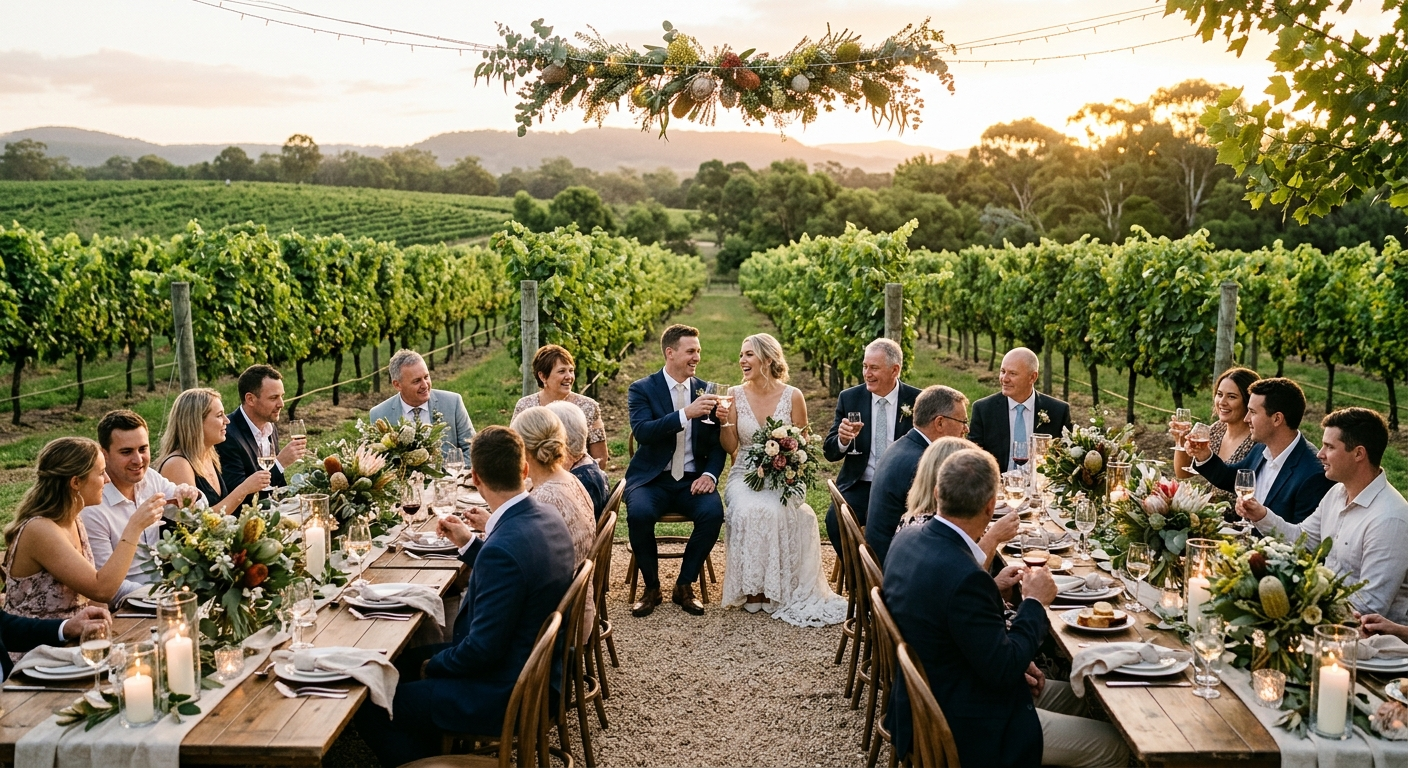
The numbers are stark and they tell a clear story. The average Australian wedding guest list in 2019 sat at approximately 87 guests. By 2026, that number has fallen to 63, and the trend shows no sign of reversing. The driving force behind this contraction is the rise of the micro wedding — an intimate celebration with 30 to 50 guests that has transformed from a pandemic-era compromise into a deliberate, highly desirable choice for Australian couples who are redefining what a wedding can look like. The question is no longer whether micro weddings are acceptable. They are now the aspirational default for a growing segment of Australian couples.
The appeal is multifaceted and rooted in genuine advantages rather than novelty. A smaller guest list means a dramatically lower budget — not just proportionally lower, but meaningfully lower in absolute terms, because the economics of weddings do not scale linearly. The cost of feeding 150 guests is not twice the cost of feeding 75; it is closer to three times, when venue size, table settings, centrepieces, catering portions, and the general amplification of every element are taken into account. Couples who choose micro weddings frequently redirect the savings into quality — better food, a more dramatic venue, a longer celebration, or simply a more comfortable financial position after the event.
Beyond finances, the appeal of the micro wedding is experiential. Australian couples who have chosen intimate celebrations consistently describe the same benefit: they spent their wedding day surrounded by the people who matter most, and they were present for every moment. The complaint that couples who invite 150 guests most often raise — that they spent their reception meeting and greeting rather than dancing, talking, and celebrating — simply does not arise in a micro wedding. With 30 or 40 guests, every person at the reception is someone the couple has actively chosen to be there, and the celebration reflects that intention in every dimension.
This guide covers the full terrain of Australian micro wedding planning: the financial case, the guest list management, the venue selection strategy, the styling approach, the supplier considerations, and the specific Australian venues and regions that have positioned themselves as micro-wedding destinations. Whether you are planning a small celebration from scratch or considering trimming a larger guest list, this guide provides the framework and specific information to make the decision and execute it well.
Why Australian Couples Are Choosing Micro Weddings in 2026
The financial driver is the most frequently cited reason for choosing a micro wedding, and it is a compelling one. The average cost of a wedding in Australia in 2025 was approximately $36,000, according to the Easy Weddings Annual Survey. That figure includes weddings across all sizes and budgets, but it is heavily skewed by the large, expensive events that still dominate the industry averages. A micro wedding with 30 to 50 guests, executed at a high quality level, typically costs between $15,000 and $28,000 depending on the venue, the catering standard, and the styling ambition. The saving of $8,000 to $20,000 compared to an equivalent-quality larger wedding is substantial, and for many couples it is the difference between having a wedding at all and deferring it indefinitely.
The experiential advantage is equally significant but less quantifiable. Australian couples who chose micro weddings in the 2024 and 2025 period consistently report that their wedding day felt more like them — more personal, more present, and more connected — than they believe a larger event would have felt. The comment appears in different language across dozens of interviews and reviews: I felt like I was actually at my wedding. I was not running between tables all night. I knew every face in the room. I danced more in two hours than I have ever danced. These responses reflect a genuine shift in what couples value about their wedding day, and that shift has accelerated the adoption of micro weddings well beyond the pandemic period that initially normalised them.
The social dynamics of modern Australian life have also contributed to the micro wedding trend. The geographic dispersal of Australian families — where siblings may live in different cities, where extended families are spread across states — means that a 150-guest wedding often includes a large proportion of guests who are friends of parents rather than genuine connections of the couple. Many couples find that the calculus of who to invite has become more complex as adult friendship circles have become more fluid and as second-marriage family dynamics have added layers of sensitivity. A micro wedding simplifies these dynamics by making it easier to draw a clear and comfortable line around the guest list.
Micro Wedding Cost Breakdown: What Australian Couples Actually Spend
Industry data from Australian wedding planning platforms indicates the following average micro wedding costs for 2026. Venue hire for an intimate wedding venue — a winery, a private estate, a restaurant with event capability, or a dedicated intimate-events space — typically ranges from $3,000 to $8,500 depending on the venue and the season. The advantage of the smaller guest list is that it opens up venue options that would be unaffordable or impractical for a larger group: a private dining room at a leading Melbourne restaurant, a cliff-top estate on the Gold Coast, or a boutique winery in the Yarra Valley become viable options when the guest list is 40 rather than 140.
Catering for a 40-guest micro wedding at a mid-to-premium level typically costs between $4,000 and $9,000, depending on the format. A seated dinner with a three-course menu and premium beverages will sit at the higher end; a standing cocktail function with substantial canapes may offer similar per-head value at a lower total cost. Photography and videography for a micro wedding — one photographer and one videographer is typically sufficient for this size — typically costs between $3,000 and $6,500 depending on the experience level of the supplier. Floristry, styling, and stationery collectively represent between $2,000 and $5,000 for a well-executed micro wedding. Celebrant fees, marriage licences, and miscellaneous costs add approximately $1,000 to $2,000.
Managing the Micro Wedding Guest List Without Starting Family Drama
The guest list is where micro wedding planning gets personal, and it is where the most significant emotional labour of the process lies. The challenge is not conceptual — most couples understand intuitively that an intimate wedding means fewer guests. The challenge is practical: how do you draw the line in a way that does not permanently damage relationships with family members who expected to be invited? This is the question that derails more micro wedding plans than any other, and it requires both strategy and empathy to navigate.
The foundational principle is that the decision to have a micro wedding must be made and communicated before the guest list is finalised. Couples who announce a micro wedding and then produce a guest list of 90 people have not actually had a micro wedding — they have had a smaller wedding with the same tensions. The definition of a micro wedding is a guest list of 30 to 50 people. The decision to have one must be genuine and must be communicated clearly as a preference, not a constraint. When it is framed as a preference — We have always dreamed of an intimate wedding with just our closest people — the response from family and friends is meaningfully different from when it is framed as a budget constraint — We can only afford 40 guests.
For couples with large extended families who expect invitations, the strategy of ceremony-plus-reception separation is a well-established and widely accepted approach. The couple hosts a small ceremony — the 30 to 50 guests — with a full reception including dinner and dancing. A larger group is then invited to an evening celebration — a dessert-and-dancing event from 8:00 pm onwards — that does not require the same catering investment and that feels celebratory without replicating the full wedding experience. This approach requires careful communication and some sensitivity around the distinction between the two events, but it is well understood within the Australian wedding context and it has become an accepted convention for managing the tension between intimacy and inclusion.
Negotiating Guest List Expectations with Parents and In-Laws
The parent negotiation is the guest list challenge that couples most consistently underestimate. Parents — particularly those who are contributing financially to the wedding — often have their own expectations about who should be invited, rooted in social obligations, family relationships, and cultural expectations that may differ substantially from the couple's preferences. The key to managing this negotiation is to have the conversation early, before any decisions are communicated publicly, and to frame it as a positive choice rather than a limitation.
A practical approach is to offer parents a defined allocation: you may invite 10 people from your side of the family. This gives parents agency within a clear boundary, which is more productive than an open-ended negotiation that eventually produces conflict. The same approach applies to both sets of parents. When each set of parents is given a specific allocation — and when the couple makes clear that this allocation is firm — the guest list management becomes a process of allocation rather than exclusion, which is a psychologically different experience for everyone involved.
Australia's Best Micro Wedding Venues for 30 to 50 Guests
Australia has an exceptional range of venues that are ideally suited to micro weddings — spaces that simply do not work at scale but that become magical with 30 to 50 guests. The key is knowing where to look, because many of the best micro wedding venues in Australia do not market themselves as wedding venues at all — they are restaurants, private estates, cellar doors, and function spaces that have discovered that the intimate events market is both lucrative and complementary to their primary business.
In New South Wales, the Hunter Valley wine region offers an exceptional concentration of micro-wedding-appropriate venues. The cellar doors and boutique wineries of Pokolbin, Rothbury, and the surrounding area include properties that can host 30 to 60 guests in genuinely stunning settings. The advantage of the Hunter Valley for a micro wedding is the combination of landscape beauty, accommodation availability for guests who are travelling from Sydney (approximately two hours by car), and the critical mass of quality venues that allows couples to compare options without a long search. The region is particularly well-suited to couples who want a wine-country aesthetic without the premium pricing of the Yarra Valley or Mornington Peninsula.
Victoria's Yarra Valley remains the premier micro wedding destination in Australia for couples who are willing to invest in a premium experience. The region's combination of world-class wineries, dramatic landscape, proximity to Melbourne, and well-developed wedding infrastructure makes it the default choice for couples who are planning a destination micro wedding within Australia. The Yarra Valley's micro wedding venues range from intimate cellar door spaces that host 20 to 40 guests to larger estate properties that can accommodate up to 80 guests with the kind of exclusivity that defines a micro wedding experience.
In Queensland, the Gold Coast Hinterland offers a distinct micro wedding proposition: rainforest and mountain settings that are unlike anything available in the southern states. The properties in the Tamborine Mountain and O'Reilly's area offer tropical and subtropical landscape drama — waterfalls, ancient trees, misty mountain ridges — within a two-hour drive of Brisbane. The Byron Bay region in Northern NSW offers coastal beauty and a lifestyle aesthetic that attracts couples who want their wedding to reflect a specific kind of Australian relaxed luxury.
South Australia's Barossa Valley and Adelaide Hills offer exceptional micro wedding venues with a food-and-wine focus that suits couples who want the catering to be a centrepiece of the celebration. The Barossa's strength is its culinary culture — the region produces outstanding produce, and its wedding venues have developed menus that reflect this quality. A micro wedding in the Barossa is often a food-led experience as much as a photography-led or landscape-led one, and couples who care deeply about the quality of what they serve find the region particularly compelling.
City-Based Micro Wedding Venues: Sydney, Melbourne, and Brisbane
City venues for micro weddings offer a different set of advantages: accessibility for guests, no requirement for travel or accommodation, and access to the city's best restaurants and hospitality operators as actual venue options. Melbourne's restaurant scene in particular includes a significant number of spaces that are designed for exactly the kind of intimate, high-quality event that a micro wedding represents. Private dining rooms in restaurants like Attica, Cutler & Co, and Sepia can host 30 to 50 guests in spaces that are designed for hospitality excellence rather than event-generic functionality, and the result is a wedding experience that feels like a dinner rather than a staged event.
Sydney's harbor-side venues offer micro wedding options that leverage the city's most iconic scenery. The Harbor has dozens of restaurants and function spaces with water views that can host 30 to 60 guests comfortably. The advantage of a Sydney harbor micro wedding is the photography — the harbor in any light is extraordinary, and in the golden hour light of an Australian winter afternoon (which occurs around 4:30 to 5:00 pm from May through August), the harbor produces images that compete with any landscape-based wedding destination.
Styling a Micro Wedding: How Intimacy Amplifies Design Impact
The styling challenge for a micro wedding is qualitatively different from styling a larger event. With 150 guests, the venue's architecture and the overall spatial impact carry most of the visual weight. With 40 guests in a smaller space, every detail is visible — the napkin fold, the stemware, the individual place card, the lighting temperature, the floral arrangement that sits three metres from the guest rather than fifteen. The intimacy of a micro wedding amplifies the importance of every styling decision, and it rewards couples who invest in considered, detailed design.
The advantage of this amplification is that it makes high-impact styling more accessible. A floral installation that would cost $4,000 to fill a large ballroom might cost $1,200 to create the same visual impact in a smaller space. Table linens, stemware, and flatware that might look standard in a large room look exceptional in an intimate one. The per-guest styling investment in a micro wedding produces a higher visual return than the same investment at a larger event, which means that couples with a moderate styling budget can achieve a result that looks significantly more premium than the budget would suggest.
The leading micro wedding styling trends for 2026 in Australia draw on natural materials, textured surfaces, and warm, layered design. Think: linen tablecloths in oatmeal or sage, mismatched vintage china in complementary tones, taper candles in brass holders, dried grasses and native flowers in loose, natural arrangements, and timber furniture that grounds the design in warmth. The aesthetic is deliberately less formal than the staged, symmetrical design language of traditional wedding styling — it reads as more personal, more curated, and more aligned with the lifestyle values of the couples who are choosing micro weddings.
Floral Design for Australian Micro Weddings: Less But Better
The floral approach for a micro wedding should be quality over quantity — one stunning arrangement on the wedding table is worth more than three ordinary ones throughout the venue. The micro wedding format allows couples to invest in premium blooms that would be cost-prohibitive at scale: garden roses, peonies (available in Australia from September through May), French lavender, and deep-hued dahlias in season. The investment in these premium flowers is visible and memorable in a way that mass plantings cannot replicate.
Australian native flowers are particularly well-suited to micro wedding floristry. The textures and forms of banksia, waratah, gumnut, and eucalypt varieties offer visual drama that translates exceptionally well in close-view arrangements. A single statement piece — a large protea stem in a ceramic vessel, or a collection of banksia stems in a timber trough — can serve as the floral centrepiece for an entire micro wedding, reducing the floral budget while increasing the visual impact. This approach also aligns with the sustainability values that many couples choosing micro weddings hold, as Australian native flowers have a lower carbon footprint than imported varieties.
The Supplier Considerations for Australian Micro Weddings
Micro weddings have changed the supplier equation in ways that are still working themselves out in the Australian market. The traditional wedding supplier ecosystem — venues, caterers, photographers, florists, musicians — was built around events of 80 to 150 guests. Many suppliers have minimum pricing or minimum guest requirements that make them expensive on a per-event basis for smaller weddings, even when the absolute cost is lower. Understanding this dynamic and finding suppliers who are genuinely set up for micro weddings is one of the key planning challenges for Australian couples in 2026.
The photographers who are best suited to micro weddings are often those who are not exclusively wedding photographers — editorial and portrait photographers who bring a different visual sensibility to the event and who are comfortable working in the intimate, low-key environment that a micro wedding creates. The best micro wedding photographers in Australia are producing images that look fundamentally different from mainstream wedding photography: more editorial, more intimate, more focused on the moments between posed shots. Couples should look beyond the traditional wedding photography directory and explore editorial and lifestyle photographers who shoot intimate events.
The catering consideration for micro weddings is different from larger events in a specific way: because the guest count is low, the quality of the individual dishes matters more, and the service format can be more considered. A 40-guest seated dinner with a six-course tasting menu and matched wines is within the capability of most premium caterers and represents a dining experience that would be impossible to execute at a 150-guest scale. Couples who care deeply about food and wine should view the micro wedding format as an opportunity to offer their guests an exceptional culinary experience rather than a scaled-down version of a standard wedding menu.
The Micro Wedding Is Not a Compromise — It Is a Choice
The framing of micro weddings as a pandemic-era compromise has not fully receded, and it creates an unnecessary confusion for couples who are considering this format in 2026. A micro wedding is not what you have when you cannot afford a larger one. It is a deliberate choice to create an intimate celebration with the people who matter most, made for reasons of quality, experience, financial prudence, and personal preference. The couples who have chosen micro weddings and reported positively on the experience have overwhelmingly made this choice as a preference, not a constraint, and that framing — held clearly from the beginning — shapes every subsequent decision in the planning process.
The practical dimension of the micro wedding advantage is real and significant: better venues become accessible, better food becomes affordable, better photography becomes achievable, and the day itself becomes more present and more connected. These are not secondary benefits. They are the point. A wedding with 40 guests that is exceptional in every dimension is worth more — to the couple, to the guests, and to the memory of the day — than a wedding with 140 guests that is merely adequate in each. The micro wedding is not a smaller version of a large wedding. It is a different kind of wedding, and it rewards the couples who choose it with an experience that larger weddings structurally cannot provide.
For more Australian wedding planning guidance, explore the WeddingRSVP blog. From venue selection to RSVP management, our articles provide the information Australian couples need to plan a wedding that reflects their values and delivers an exceptional experience for everyone who attends.
The rise of micro weddings in Australia is not a trend that will recede when economic conditions change. It reflects a deeper shift in what couples value about their wedding day — presence over scale, quality over quantity, and the genuine experience of celebrating with the people who matter most. For Australian couples planning their wedding in 2026 and beyond, the micro wedding format offers a path to an exceptional celebration that is within reach financially, logistically, and emotionally.
To explore more Australian wedding planning resources, visit the WeddingRSVP blog. Our guides cover every aspect of the planning process, from selecting the perfect intimate venue to managing your RSVP timeline, all written with the Australian couple in mind.