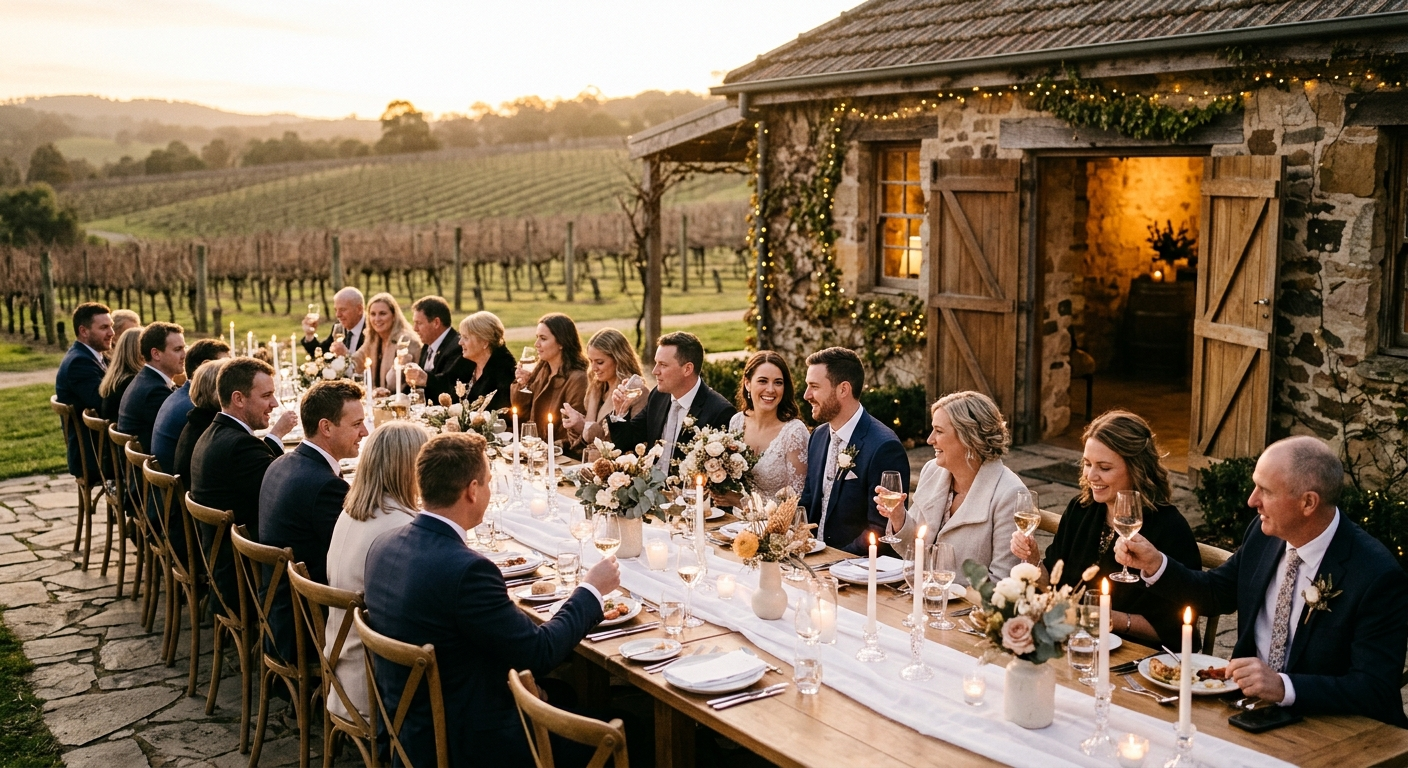
The Australian wedding landscape in 2026 is undergoing a quiet but significant shift. Across the country, from the coastal clifftops of Byron Bay to the heritage gardens of the Adelaide Hills, couples are choosing to say their vows before a smaller gathering rather than a large crowd. The micro-wedding — typically defined as a celebration with 30 guests or fewer — has moved from an emergency contingency plan into a deliberate, first-choice format for Australian couples who want their wedding day to feel personal, present, and deeply connected. According to the Easy Weddings 2026 Wedding Trends Report, intimate micro-weddings are among the top three planning priorities for Australian couples this year, driven by a desire for quality over quantity, meaningful experiences over spectacle, and a celebration that reflects the couple rather than a formula.
This guide covers everything you need to know about planning a micro-wedding in Australia in 2026. From the financial realities to the guest list strategy, from venue selection to RSVP management, this is the complete reference for Australian couples considering a smaller, more intentional celebration.
What Is a Micro-Wedding, Exactly?
The term micro-wedding has been in use for several years, but its definition has evolved as more couples have adopted the format. In the Australian context for 2026, a micro-wedding is most commonly understood as a wedding celebration with 30 guests or fewer. Some definitions extend to 50 guests, but the practical threshold that defines the micro-wedding experience — the intimacy, the economics, and the planning approach — is generally agreed to sit at 30 and below. Above 50 guests, you are entering the territory of a small traditional wedding, where the planning dynamics change substantially.
The micro-wedding sits alongside a related but distinct format: the elopement. An elopement typically involves only the couple and perhaps two witnesses, with little or no guest attendance. A micro-wedding is smaller than a traditional wedding but retains the structure — ceremony, reception, guest participation — in an intimate form. The Pinterest 2026 Wedding Trends Report identified low-key pre-wedding soirees and intimate gatherings as a defining aesthetic direction for the year, and the micro-wedding sits at the centre of this trend.
What distinguishes the micro-wedding from a simply small wedding is not just the head count — it is the philosophy. A micro-wedding is planned around the assumption that every guest matters. Every person in the room has been chosen deliberately. Every element of the celebration can be personalised because the scale allows it. This is not a compromise format for couples who could not afford a larger event. For many of the couples choosing it in 2026, it is the preferred format — a celebration that a large wedding simply could not deliver.
Why Australian Couples Are Choosing Micro-Weddings in 2026
The drivers behind the micro-wedding trend in Australia are multiple and interconnected, and understanding them helps you assess whether a micro-wedding is the right choice for your circumstances.
The financial argument is the most frequently cited and the most genuinely compelling. Australian wedding costs have risen substantially over the past five years, with the average cost of a traditional wedding in Sydney or Melbourne now regularly exceeding $60,000 to $80,000 AUD when venue hire, catering, photography, styling, andcelebrant fees are all included. The venue hire fee alone at a popular metropolitan or regional venue can run to $8,000 to $15,000 AUD on a peak-season date. A micro-wedding fundamentally changes this equation. Venue hire fees for spaces suited to 30 guests are typically 40 to 60 percent lower than for larger spaces. Catering costs, calculated on a per-head basis, are lower — but the saving is partially offset by the fact that many couples choose to spend more per head on a micro-wedding to deliver a higher-quality experience. Photography, celebrant, and styling costs do not scale linearly with guest count, which means these line items deliver better value on a micro-wedding budget.
The experience argument is equally important and frequently underrated. A wedding with 30 guests is a fundamentally different social event from a wedding with 130 guests. Every person in the room knows each other. The conversation at every table is genuine and personal. The speeches are not performances directed at a passive audience — they are words exchanged between people who have a real relationship. The couple has time to speak with every guest individually. No one is left out, overlooked, or seated among strangers they have nothing in common with. The emotional texture of a micro-wedding is qualitatively different, and the couples who have made the choice consistently report that the day felt more meaningful, more present, and more genuinely celebratory than they expected a wedding could feel.
The stress argument deserves acknowledgment too. Planning a wedding for 30 people is administratively simpler than managing a list of 130. The logistics of seating charts, dietary requirements, plus-one politics, and vendor coordination all scale differently at the micro-wedding level. A couple managing their own planning without a professional wedding planner can realistically handle a micro-wedding in a way that a large wedding typically does not allow.
The Realistic Micro-Wedding Budget for Australian Couples
One of the most common questions about micro-weddings is whether they actually save money — and the honest answer is yes, but not in the way most people assume. A micro-wedding is not simply a large wedding with fewer chairs. It is a different cost structure, and understanding that structure enables you to make informed decisions about where to spend and where to save.
The venue cost reduction is the most predictable saving. A ceremony and reception space that accommodates 30 guests will cost substantially less than a space designed for 120. Boutique venues in capital cities — the converted warehouses, rooftop spaces, private dining rooms, and heritage buildings that have driven the Australian wedding venue market — frequently offer micro-wedding packages that include venue hire, basic styling, and sometimes catering at a combined price point that represents significant value compared to hiring a larger venue separately. In the Hunter Valley, micro-wedding packages at boutique cellar door venues start from approximately $3,500 to $6,000 AUD for a full-day hire, compared to $12,000 to $20,000 AUD for larger vineyard venues at peak season.
The per-head catering cost on a micro-wedding tends to be higher than on a large wedding, because caterers have minimum fees that do not disappear when your guest count is small. A caterer charging $120 per head for a 100-person wedding may charge $160 to $180 per head for a 25-person event, because their setup, staffing, and minimum food costs are amortised across a smaller number of covers. However, the total catering bill is still substantially lower — $4,500 AUD for 25 guests at $180 per head versus $12,000 AUD for 100 guests at $120 per head — and the quality of the dining experience is typically higher because the caterer can deliver restaurant-level food in a way that is impractical for a 100-person event.
Photography and videography costs on a micro-wedding can be comparable to large-wedding rates because the time investment for the photographer is similar. A full-day micro-wedding still requires the same coverage hours, the same post-production work, and the same equipment. However, photographers who are in high demand during peak season may offer more competitive rates for micro-wedding dates during off-peak periods, which can bring the total cost down without compromising on quality.
The realistic total budget for a micro-wedding in Australia in 2026, planned thoughtfully and without excessive compromise on quality, ranges from $15,000 to $35,000 AUD depending on location, season, and supplier choices. A celebration at a boutique Melbourne restaurant venue in winter might come in at $15,000 to $20,000 AUD with careful planning. A Margaret River micro-wedding at a premium winery estate, with interstate guests and a three-day celebration structure, might reach $30,000 to $40,000 AUD. Neither figure is a rule — they are reference points for couples building their own budget.
Australian Venues That Excel for Micro-Weddings
Australia has an exceptional range of venues that are genuinely better suited to a micro-wedding than to a large celebration. Identifying these venues — and understanding why they work better at 30 guests than at 100 — is one of the most important steps in micro-wedding planning.
Cellar doors and winery estates represent the most obvious micro-wedding venue category in Australia, and for good reason. A Hunter Valley cellar door with a private tasting room and courtyard, a Yarra Valley stone winery building, a Margaret River estate with ocean views — these spaces are intimate by design, and they deliver an atmosphere that larger venues struggle to replicate. The combination of architectural character, regional landscape, and in-house catering capability makes winery micro-weddings a consistently popular choice. Booking windows vary by region: Margaret River venues require 6 to 12 months notice during peak season (October through April), while Hunter Valley cellar doors may have availability with 3 to 6 months notice outside the peak period.
Private gardens and heritage estates are another category that suits micro-weddings exceptionally well. Australia has a strong tradition of private garden weddings — from the heritage gardens of the Adelaide Hills to the coastal gardens of the Sunshine Coast hinterland — and many of these spaces are simply too small or too fragile to accommodate large guest lists. The Dandenong Ranges gardens, the private estates of the Southern Highlands, the hinterland gardens of the Gold Coast and Northern Rivers — these spaces deliver a natural beauty that requires minimal styling to photograph beautifully, which reduces the decoration budget significantly.
Restaurant and private dining venues have emerged as one of the fastest-growing micro-wedding venue categories in Australian capital cities. The appeal is practical: the venue hire fee is either minimal or absent, the catering infrastructure is built in, and the atmosphere of a celebrated restaurant adds an immediate quality signal to the celebration. Melbourne leads this category in Australia, with a restaurant culture that has enthusiastically embraced the micro-wedding format. Sydney, Brisbane, and Adelaide all have strong restaurant micro-wedding options, and Perth's dining scene has developed substantially over the past three years, offering couples a growing range of quality options. Restaurant micro-wedding packages in Melbourne typically range from $150 to $280 per head for a three-course dinner with wine, with minimum guest requirements of 20 to 35 depending on the venue.
Coastal and beach venues suit micro-weddings particularly well because the beach ceremony — which requires no infrastructure beyond a permit and a view — is genuinely scalable to small guest lists. The dramatic coastal settings of Australia — from the Noosa headland to the Mornington Peninsula beaches, from the Shoalhaven coast south of Sydney to the Wine Coast beaches of South Australia — deliver ceremony and photography settings that are simply not available to larger weddings. A beach micro-wedding permit in Queensland typically costs $100 to $300 AUD depending on the council area, and the combined cost of a beach ceremony plus a nearby restaurant or venue reception is one of the most cost-effective micro-wedding formats available in Australia.
The Guest List Strategy That Makes or Breaks a Micro-Wedding
The guest list is the most emotionally complex dimension of micro-wedding planning, and it is where couples most frequently encounter unexpected difficulty. When your limit is 30 guests, every exclusion is personal, and the social dynamics of deciding who is in and who is out require more care than a large wedding demands.
The practical starting point is to define your non-negotiable guest categories and calculate from there. Most couples start with immediate family, parents, siblings, and grandparents — this core group typically numbers between 10 and 18 people depending on family structure. From there, the remaining slots — to reach your total of 20 to 30 — are allocated to close friends, valued relatives, and any other individuals who genuinely matter to the couple. The discipline of working backwards from a number rather than forwards from a relationship list tends to produce clearer, less emotionally fraught decisions than the alternative.
The communication challenge around the micro-wedding guest list is real and should be planned for. Australian wedding culture carries an assumption that a save-the-date or engagement announcement implies a full wedding invitation, and couples who are having a micro-wedding need to manage this expectation proactively. The most effective approach is transparency — communicating early, warmly, and honestly about the intimate nature of the celebration. A message that explains, genuinely and without apology, that the couple has chosen an intimate celebration with a limited guest list because the venue accommodates only 30 guests, and that they would love to celebrate with everyone but this is simply not possible, tends to be received with understanding. The couples who struggle are those who send save-the-dates to 80 people and then have to explain to 50 of them that there is no room — that situation is emotionally costly and avoidable.
The plus-one policy for a micro-wedding needs to be explicit and consistent. Most couples in a 30-guest micro-wedding do not have the capacity to offer plus-ones to single guests, and the expectation management here is important. A clear statement on the invitation or wedding website — 'We have planned an intimate celebration and are unable to accommodate plus-ones' — resolves this question cleanly. Guests who are given this information in advance, rather than discovering it when they receive their invitation, consistently report feeling less disappointed.
Creating a Multi-Day Micro-Wedding Experience
One of the genuine advantages of the micro-wedding format is that it naturally accommodates — and benefits from — a multi-day celebration structure. When your guest list is 30 people who have all travelled to attend, asking them to arrive the day before, stay the night, and depart the day after is a reasonable request. The multi-day micro-wedding is trending strongly in Australia in 2026, and it is one of the formats that the Pinterest Wedding Trends Report specifically identified as gaining momentum.
The structure that works best for most couples is a three-part format: a welcome event on the evening before the wedding (informal, low-key, often a restaurant dinner or a relaxed gathering at the accommodation), the wedding day itself, and a farewell event the following morning (a brunch, a beach morning, a winery visit). This structure gives guests the experience of a full celebration weekend rather than a single evening, and it gives the couple extended time with the people who matter most to them.
The welcome event does not need to be elaborate. A restaurant booking for 30 people, a casual drinks gathering at a local pub, or a private function room at a hotel are all appropriate formats. The purpose is social — giving guests who may not all know each other a chance to meet and relax before the formal occasion. A micro-wedding welcome dinner is an opportunity to introduce people, set a warm and informal tone, and reduce the social awkwardness that can arise when 30 strangers spend an entire wedding day together.
The farewell event serves a different purpose — it provides a natural ending point that does not require the wedding day to carry all the emotional weight. A morning-after brunch at the venue or a nearby cafe, a beach morning with coffee and pastries, a final cellar door visit at the winery where you married — these occasions give guests who need to leave earlier on the Sunday morning a proper farewell, and they give the couple a moment to decompress and connect with their guests in a completely different register from the formal wedding day itself.
Micro-Wedding RSVP Management: Why Every Response Matters
The RSVP process for a micro-wedding carries more weight than for a traditional wedding, and it deserves correspondingly more attention in your planning process. When your guest list is 30 people, every non-response, every dietary requirement, every last-minute cancellation has a material impact on the event. A digital RSVP platform that captures the information you need and enables prompt communication is not a luxury for a micro-wedding — it is a practical necessity.
The data you collect at the RSVP stage for a micro-wedding should be richer than the standard city-wedding RSVP. Beyond the basic attendance and dietary fields, a micro-wedding RSVP should capture arrival information (which guests are staying overnight, and where), transport needs (whether anyone requires a lift from the airport or train station), and any dietary requirements beyond the standard categories. Because every guest is known personally to the couple, the follow-up on non-responses is both possible and expected — and a digital RSVP platform that sends automatic reminders and enables direct communication with individual guests makes this process manageable.
The last-minute cancellation risk is the most significant RSVP-related concern for micro-wedding planning. When a guest cancels from a 30-person wedding two weeks before the event, you are missing 3 to 4 percent of your guest list. When that cancellation occurs one week before, the catering and seating logistics require rapid revision. A digital RSVP platform that tracks response history, captures waitlist information (from guests who were not initially invited but who might be able to attend if space opens up), and enables same-day communication with your guest list is the operational tool that most directly reduces micro-wedding planning stress.
The plus-one and dietary requirement fields in your RSVP need to be explicit and unambiguous. A guest at a micro-wedding who arrives to discover that there is no seat for their partner, or that the menu does not accommodate their dietary needs, is a situation that is both emotionally uncomfortable and entirely avoidable with clear RSVP field design. Ask about plus-ones explicitly. Ask about dietary requirements with enough specificity to capture the detail that matters — not just 'vegetarian' but 'vegetarian, gluten-free' or 'vegan, nut allergy'.
The communication cadence for a micro-wedding should be warm, personal, and more frequent than for a traditional wedding. Because your guests are known to you individually, they respond to communication that reflects that knowledge. A welcome message from the couple rather than from 'The Wedding Team' sets the tone. A personal note to guests who have travelled from interstate acknowledges the effort they have made. A final logistics message one week before the event, with venue directions, accommodation information, and a reminder of the timeline, ensures that every guest arrives informed and ready to enjoy the day.
Micro-Wedding Timing: Seasonal Considerations for Australian Couples
The winter months from June through August in Australia represent a genuinely favourable season for micro-wedding planning, and one that more Australian couples are actively considering in 2026. The Easy Weddings 2026 Trends Report identified winter weddings as a growing category, driven by cost advantages, supplier availability, and the atmospheric quality that the Australian winter delivers in many regions.
The cost advantage of a winter micro-wedding is most significant at the venue and supplier level. Many Australian wedding venues offer 15 to 25 percent discounts on venue hire fees for winter bookings from May through August, and photographers who are fully booked during spring and summer may have genuine availability on a winter weekend. For a micro-wedding budget, these savings are proportionally meaningful — a $2,000 venue discount on a $20,000 total budget represents a 10 percent reduction that can be redirected toward a better photographer or a higher-quality catering experience.
The atmospheric advantage of a winter micro-wedding is region-dependent but frequently cited by couples who have experienced it. The Yarra Valley in winter — with its frost-covered mornings, bare vine-rows, and the warm light of a winter afternoon — creates photography conditions that spring and summer cannot replicate. A cellar door wedding in the Adelaide Hills in July, with a fireplace lit inside and a misty garden outside, delivers an intimacy and atmosphere that a summer outdoor wedding struggles to match. The Blue Mountains in winter, despite the cold, offer some of the most dramatic and distinctive wedding photography settings in Australia for couples who plan for the conditions.
For any season, the micro-wedding outdoor contingency plan requires explicit attention. If your ceremony is outdoors or your photography involves outdoor locations, a documented wet-weather plan — a confirmed alternative space or structure, agreed with your venue in advance — is essential. The intimacy of a 30-person ceremony means that a last-minute scramble to relocate is both more noticeable and more manageable than at a large event, but it still needs to be planned rather than improvised.
The micro-wedding is not a compromise format for Australian couples in 2026. It is a deliberate choice that delivers what many couples want from their wedding day: intimacy, presence, personalisation, and a celebration that reflects who they are rather than a formula they are following. The financial case is real — a well-planned micro-wedding in Australia in 2026 can deliver a genuinely superior experience to a traditional wedding at a comparable or lower total cost. The emotional case is even stronger: the couples who choose micro-weddings and invest thoughtfully in the planning consistently describe their day as more meaningful, more connected, and more genuinely joyful than they believe a larger celebration could have delivered.
The practical advice for Australian couples considering a micro-wedding is straightforward: define your guest list before you look at venues, choose a venue that matches your list size rather than the list you wish you had, invest in the guest experience elements that matter most at 30 people (food, photography, comfort), and use a digital RSVP platform that captures the information you need to manage a smaller, more personal celebration with confidence. The result will be a wedding day that feels, in every dimension, like it was made for the people who were there — because it was.