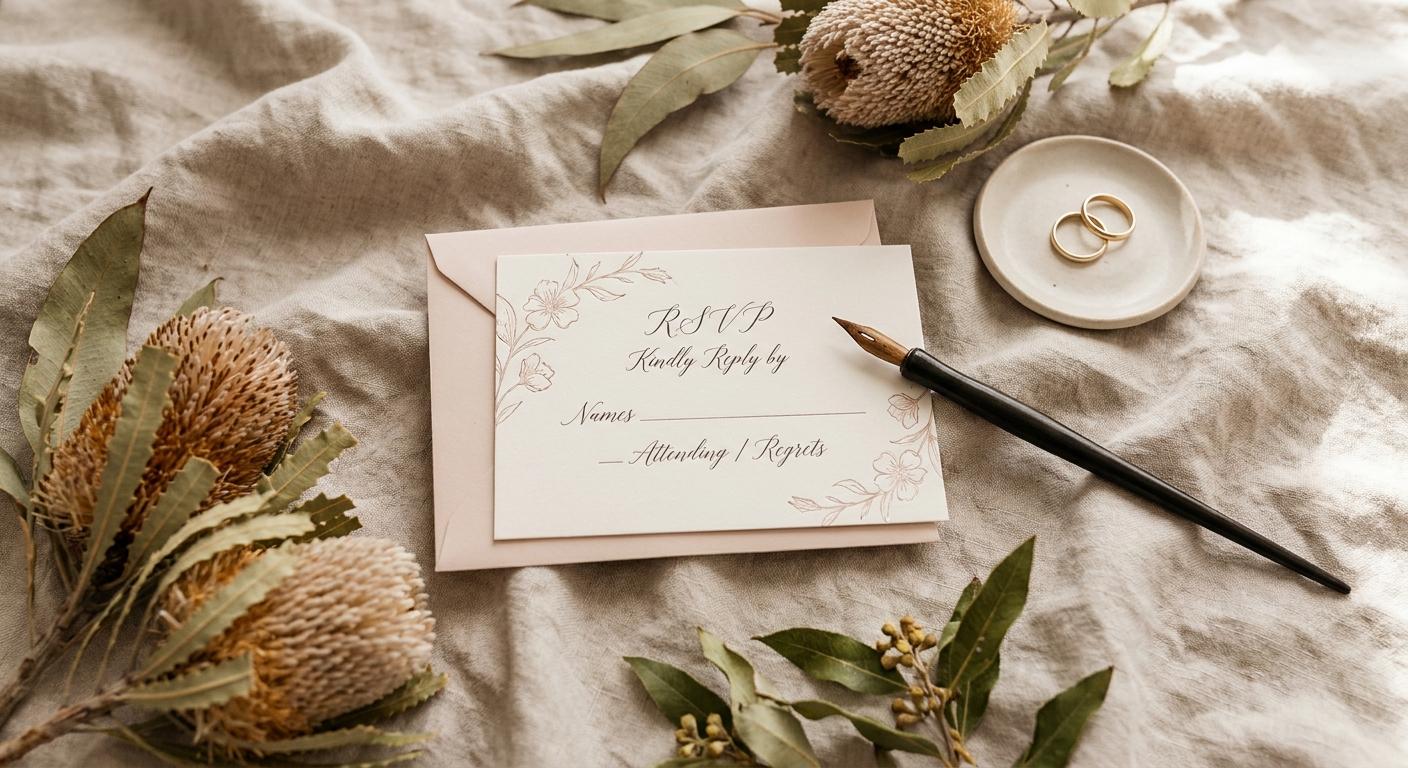
Somewhere between the save-the-date and the seating chart lies the RSVP — the moment where guest communication either flows effortlessly or falls apart. In 2026, Australian couples are discovering that the wording on their RSVP cards and digital response forms matters far more than they realised. A single ambiguous sentence about dietary requirements can generate thirty panicked guest messages. A vague plus-one policy can result in fifty unconfirmed attendees two weeks out from the ceremony. A missing dietary field on a digital form can leave a caterer guessing about gluten-free serves the morning of the event.
The good news is that RSVP wording is a solved problem. The same challenges appear in every Australian wedding, and the couples who handle them gracefully share a common approach: they write clearly, they ask for information specifically, and they give guests the context needed to respond accurately. This guide covers every scenario Australian couples encounter in 2026, with wording templates, digital form field recommendations, and the reasoning behind each choice.
Whether you are sending physical RSVP cards through Australia Post or using a digital RSVP platform like WeddingRSVP, the principles are the same. Clarity is not coldness. Directness is not rudeness. Guests appreciate knowing exactly what is expected of them, and the couples who communicate that clearly consistently report higher response rates, fewer day-of surprises, and a significantly calmer lead-up to their wedding day.
Why RSVP Wording Matters More Than Ever in 2026
The shift toward smaller, more intimate weddings has raised the stakes on every RSVP response. Where a 200-guest wedding could absorb one or two last-minute cancellations or dietary surprises without major disruption, a 60-person celebration has almost no buffer. A single guest who assumed their partner was included when the RSVP did not specify, or who failed to mention their coeliac condition because there was nowhere to do so, can create a genuine problem on the day. The wording on your RSVP is not a formality. It is the last line of defence between your carefully planned guest experience and a series of avoidable surprises.
Digital RSVP platforms have also changed the information couples can realistically collect. Where a paper RSVP card is limited by space and design, a digital form can include conditional logic — showing dietary requirement fields only to guests who indicate they have restrictions, or expanding plus-one fields based on relationship type. Australian couples who have embraced digital RSVP platforms consistently report that the ability to collect structured data has transformed their planning experience, but only when the wording and field design are set up thoughtfully from the start.
The third factor is generational. Australian guests in 2026 are juggling more complex lives than previous generations. Many have dietary requirements — whether medical, religious, or lifestyle-based. Blended families mean that plus-one policies require genuine consideration rather than a blanket rule. Work commitments, interstate travel, and the rising cost of living mean that guests are weighing attendance decisions more carefully. Your RSVP wording needs to meet your guests where they are, not where you assume they are.
The Non-Negotiable Information Every Australian Wedding RSVP Must Collect
Before considering the tricky scenarios, it is worth establishing what every RSVP — digital or physical — must collect as a baseline. The core information requirements are consistent across Australian weddings regardless of size, style, or location. Missing any of these pieces of information creates downstream planning problems that are difficult to solve close to the wedding date.
The first requirement is a clear confirmation of attendance intent. The guest must be able to say yes, no, or yes-with-conditions (such as a plus-one). This sounds obvious, but many RSVP designs create ambiguity here. A card that simply says 'We will be there' without a checkbox for 'Regretfully unable to attend' leaves non-attending guests uncertain about how to communicate their absence. A digital form that asks 'Will you be attending?' but does not offer a clear 'No' option alongside the affirmative creates the same problem. Always provide a clear, explicit pathway for both attendance and non-attendance.
The second requirement is the guest's name and the names of any additional attendees they are bringing. For a digital RSVP, this means individual name fields for each invitee, not a single 'Name' field that captures only the primary guest. The goal is to have every attending guest identifiable by name so that place cards, dietary records, and seating arrangements can be built accurately. For physical cards, this means a line for each guest's name, not just the household name on the envelope.
The third requirement is a meal or dietary preference indicator. Even if your wedding has a simple shared-plates menu, you need to know which guests have dietary restrictions so the caterer can plan accordingly. The minimum viable approach is a single dietary requirements field with a free-text entry. The better approach — which digital platforms make practical — is a structured selection of common dietary categories with a free-text field for specifics.
The fourth requirement is a response deadline. Your RSVP must include a specific date by which guests must respond, and that date must be early enough to allow for final headcounts, seating plans, and vendor confirmations. The standard recommendation for Australian weddings is four weeks before the event, which typically means sending RSVP requests eight weeks before the wedding and setting the response deadline six weeks out. This gives you a two-week buffer for following up non-responses before your venue and caterer require final numbers.
How to Ask About Dietary Requirements Without Making Guests Feel Like They Are Ordering a Taxi
Dietary requirements are the RSVP element that causes the most anxiety for both couples and guests. Couples worry about offending guests by asking, or about missing a requirement that manifests as a problem on the day. Guests who have dietary restrictions often feel awkward raising them, particularly in a formal wedding context where they do not want to be a burden or create extra work. The wording you use to ask about dietary requirements matters enormously in shaping how guests respond.
The first principle is to normalise dietary requirements in your wording. Do not ask 'Do you have any special dietary requirements?' in a way that implies special pleading. Instead, frame it as a standard part of the planning process that applies to everyone. A wording like 'Please let us know of any dietary requirements so we can ensure your meal is prepared to your preference' treats dietary information as routine rather than exceptional. This phrasing works because it applies to every guest equally — a guest without dietary restrictions can simply skip the field or write 'None', while a guest with specific needs has been explicitly invited to share them.
For digital RSVP platforms, the field design matters as much as the wording. A free-text field labelled 'Dietary requirements' will capture some responses but miss others — guests who are unsure whether their preference counts as a 'requirement' may leave it blank. A better approach is to offer structured options that cover the most common categories: 'No restrictions', 'Vegetarian', 'Vegan', 'Gluten-free', 'Dairy-free', 'Halal', 'Kosher', 'Nut allergy', 'Other (please specify)'. This gives guests a clear framework and generates structured data that your caterer can work with directly.
For physical RSVP cards, the options are more limited by space, but a simple wording like 'Dietary requirements: ________________________________' followed by a note saying 'Please let us know of any dietary requirements for catering purposes' is sufficient. The key is the explanatory note — without it, many guests will assume the field is not for them. The note frames the question as a planning tool rather than an interrogation.
The Australian Dietary Landscape: What Couples Need to Know
Australia has one of the highest rates of dietary restriction in the world. According to recent Food Standards Australia and New Zealand data, approximately 2 percent of Australians have coeliac disease, a similar portion follows a vegan diet, and a growing segment follows gluten-free or low-FODMAP diets for health reasons rather than preference. When combined with religious dietary requirements — particularly halal and kosher for Muslim and Jewish guests — and common allergies such as peanut and shellfish allergies, the proportion of guests who have some form of dietary consideration is significant enough that assuming it does not apply to your guest list is a planning risk.
The cultural dimension of Australian weddings adds another layer. Many Australian weddings include guests from culturally diverse backgrounds where food carries specific significance. An Indian-heritage couple may have a significant portion of guests who eat vegetarian by tradition. A Greek Orthodox ceremony followed by a reception may include guests who keep fasting traditions. Rather than treating dietary requirements as edge cases to be managed, the most thoughtful couples treat them as an opportunity to demonstrate care for their guests. Asking clearly and acting on the information communicates that every guest's experience matters.
The practical implication is that your caterer needs advance notice of dietary requirements — not just the raw numbers, but the specific breakdown. A caterer who knows on the RSVP deadline that twelve guests require gluten-free meals and three require halal certification can plan accordingly. A caterer who finds out on the morning of the wedding that several guests cannot eat the standard menu has limited options. The information flow from your RSVP to your caterer is as important as the wording that collects it.
The Plus-One Policy: Writing a Policy That Guests Actually Understand
The plus-one question is the RSVP element that generates the most confusion, the most awkward conversations, and — in the age of social media and relationship complexity — the most genuine uncertainty about what is appropriate. Australian couples in 2026 are navigating a genuinely complex landscape: some guests are in long-term relationships but not formally partnered, some are recently separated and unsure whether their new partner should be included, some have children they assumed would be welcome, and some simply do not know where the line is.
The most effective plus-one wording is explicit rather than implied. The phrase 'You are welcome to bring a guest' creates fewer problems than 'We have reserved two seats in your honour', which can be read as implying that a plus-one is available even when it is not. But the most common RSVP mistake is the one that offers no guidance at all — a blank line for 'Number of guests' with no context about whether that field means one, two, or more. This leaves guests to guess, and guests who guess incorrectly create headcount problems that are difficult to reverse.
A clear plus-one policy wording for a digital RSVP might read: 'We have allocated one seat for you. If you are in a committed relationship and your partner is included in your invitation, please ensure their name appears in the guest details below. Additional guests beyond those named on your invitation require prior approval — please contact us directly.' This wording is direct without being cold, and it gives guests a clear framework for understanding who is included and how to request an exception.
For physical cards, the challenge is communicating the same information within space constraints. A wording like 'We have reserved [one seat / two seats] in your honour' is the clearest approach, where the couple fills in the number based on their actual invitation. This requires careful management — each invitation needs to accurately reflect the number of seats allocated — but it eliminates the ambiguity that causes most plus-one confusion.
Communicating an Adults-Only Wedding Policy Without Starting a Family Dispute
The adults-only wedding policy is one of the most sensitive RSVP conversations, particularly for Australian couples whose guest lists include family members with young children. Many couples feel conflicted about excluding children — they love their nieces and nephews, they want to be inclusive, and they feel guilty about the cost and logistics of a child-free wedding. But the decision to have an adults-only wedding is a legitimate one, and the couples who communicate it clearly rarely encounter the family conflict they feared.
The key to communicating an adults-only policy is to state it as a fact rather than asking for an exception. The phrasing 'We love your children, however our wedding is an adults-only occasion' is firm but warm. The phrasing 'Please indicate the number of children attending' implies that children are welcome. The phrasing 'We have not allocated seats for children' is factual and clear but can feel cold if not framed with context. The best approach for most couples is to acknowledge the children, state the policy, and offer a reason that personalises it — 'Our wedding venue has limited space and we want the evening to be a celebration our adult guests can fully enjoy.'
For digital RSVP platforms, the adults-only policy is best handled by not including a child ticket option in the form at all. If the form only allows adult guest entries, the policy is communicated by omission rather than by declaration, which some couples find less awkward. However, this approach only works if the couple has been clear elsewhere — on the wedding website, in the invitation text, or in a note accompanying the invitation — that the event is adults-only. Guests should never discover the policy only when the RSVP form does not offer a child option.
The one exception to the adults-only rule that most couples choose to make is for couples whose ceremonies are during the day in a family-friendly venue with a relaxed atmosphere. A Sunday afternoon winery wedding in the Yarra Valley or a midday garden ceremony in Adelaide may genuinely welcome children, and in those cases the RSVP wording should explicitly invite them rather than leaving it ambiguous. 'The whole family is welcome to join us' is clear and warm. 'Children are welcome at the ceremony' clarifies the scope if the reception has different arrangements.
The Gift and Wishing Well Question: Australian Wording That Maintains Warmth
Australia has moved firmly into the wishing well era, with cash gifts via wishing well or bank transfer now the overwhelming norm at Australian weddings. However, the question of how to communicate this preference on an RSVP — or whether to communicate it at all — remains genuinely awkward for many couples. The concern is that mentioning gifts on the RSVP feels transactional or greedy, particularly for couples who genuinely do not need gifts and would prefer contributions to a honeymoon or home fund.
The most effective approach in 2026 is to include wishing well information on the wedding website rather than the RSVP card or form. This separates the two functions — the RSVP handles attendance confirmation, and the website handles logistics and preferences. On the website, a wishing well section can be framed positively: 'Your presence is the greatest gift. For those who have asked, we have a wishing well set up for those who wish to contribute.' This wording acknowledges that gifts are not expected while providing the information for guests who want to give.
For couples who want to include wishing well information on the RSVP itself — which remains common, particularly for older guests who may not check the website — a brief, warm note works well. 'Your presence is a gift enough. For those who wish to celebrate with a gift, a wishing well will be available at the reception' is gracious and clear without being demanding. The key is the opening phrase — 'Your presence is a gift enough' — which establishes that attendance is the priority and gifts are entirely optional.
Why Australian Couples Are Choosing Digital RSVP Platforms in 2026
The case for digital RSVP platforms has never been stronger. Australia Post processing times have increased in recent years, physical cards are frequently lost or delayed in transit, and the administrative burden of tracking paper responses across a spreadsheet is a significant source of stress for couples who would rather be enjoying their engagement. Digital platforms solve all of these problems while offering information collection capabilities that paper cards simply cannot match.
The core advantage is real-time response tracking. With a digital RSVP platform, couples can see exactly who has responded, who has not, and what dietary requirements or plus-one requests have been submitted, at any moment. This eliminates the anxious countdown to the RSVP deadline and makes follow-up targeted rather than scattergun. A simple message to guests who have not responded — 'We are closing our RSVP list in one week and would love to hear from you' — can be sent to exactly the guests who have not replied, rather than being broadcast to the entire guest list.
The data export capability is equally valuable. A digital RSVP platform that exports guest information in a structured format can feed directly into seating chart tools, vendor spreadsheets, and day-of coordination documents. The couples who use digital platforms consistently report that the time saved on manual data entry — and the reduction in transcription errors — is one of the most appreciated benefits of the platform. Your caterer needs a guest count and dietary breakdown. Your florist needs a table count. Your photographer needs a run sheet. Digital platforms make all of this information available in structured, exportable form.
For Australian couples specifically, the multi-device accessibility of digital platforms is important. Australian guests are distributed — some are in the same city as the wedding, others are interstate, and some are overseas. A digital RSVP platform that works on mobile devices and sends email or SMS reminders makes it easy for guests to respond regardless of their location or schedule. Guests who are commuting on a train can complete their RSVP on a phone. Guests who received the invitation at an awkward moment can respond that evening from their laptop. The friction in the response process directly affects response rates, and digital platforms reduce that friction to near zero.
Setting and Enforcing Your RSVP Deadline: The Australian Timeline
The RSVP deadline is the date by which guests must confirm their attendance. Getting this right is one of the most consequential planning decisions for an Australian wedding, because it directly determines the headcount that your venue, caterer, and other vendors will charge. A deadline that is too close to the wedding date leaves no buffer for non-responding guests, last-minute cancellations, or vendor adjustments. A deadline that is too far in advance risks losing responses — guests who respond immediately to a card sent eight weeks before the wedding may be lost by the time the date actually arrives.
The recommended timeline for Australian weddings is as follows. Save-the-dates go out twelve months before the wedding for destination or large weddings, or six months before for smaller, local events. Invitations go out eight weeks before the wedding. The RSVP deadline is set at four weeks before the wedding, which means guests have four weeks to respond from the time they receive their invitation. This gives the couple two weeks before the venue and caterer final headcount dates to chase non-responses, manage cancellations, and finalise numbers.
The enforcement of the RSVP deadline is an area where many couples feel uncomfortable but should not. The phrase 'RSVP by [date]' is not a suggestion — it is a statement of fact that reflects a genuine operational deadline. Venues and caterers charge based on confirmed headcounts, and last-minute additions are frequently impossible or expensive. A guest who ignores the RSVP deadline is not making a casual administrative oversight; they are creating a real planning problem. A polite but firm follow-up message — 'We need to confirm final numbers with our venue by [date] and would love to have you there. Could you please respond by [new date]?' — is entirely reasonable and should not be avoided out of politeness.
The RSVP is the most underrated element of Australian wedding planning. It is the interface between your carefully considered guest list and the actual people who will be there on the day. The wording you use — on a card, in an email, or on a digital form — shapes how guests experience that interface and determines whether you get the information you need to execute a flawless event.
The principles are consistent regardless of format: be specific, be clear, be warm, and give guests the context they need to respond accurately. Ask about dietary requirements in a way that normalises them. State your plus-one policy without ambiguity. Communicate your adults-only rule without apology. Set a deadline and enforce it. And seriously consider a digital RSVP platform — the time saved on manual tracking and the quality of the data collected will pay dividends in the weeks before your wedding.
Your guests want to celebrate with you. They want to respond clearly and correctly. Give them the wording that makes that easy, and you will have a guest list that is confirmed, accurate, and ready to enjoy your wedding with you.