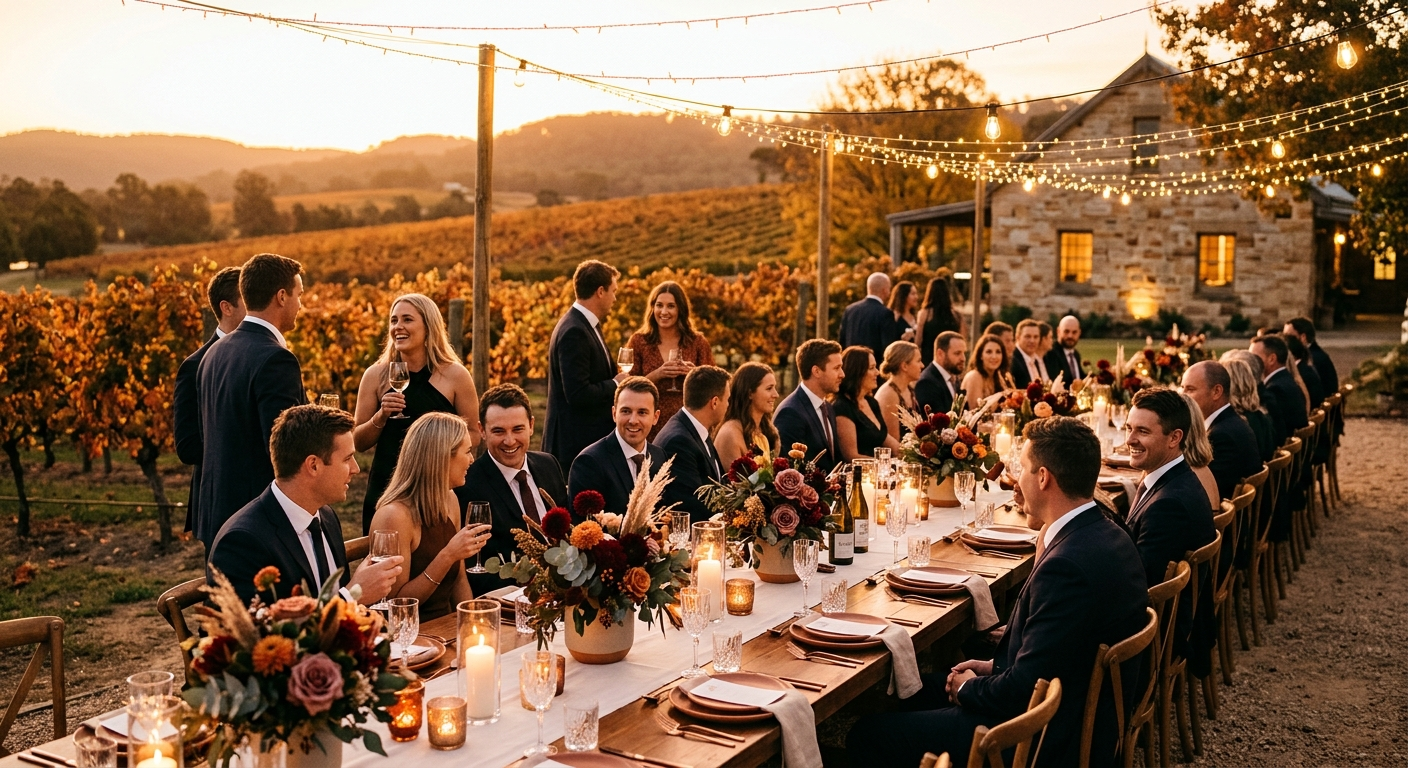
The Australian wedding is undergoing a fundamental reconfiguration. For decades, the formula was consistent: a ceremony, a reception, a first dance, and a cake cutting. One day, one venue, one focused celebration. That formula is not gone, but it is no longer the default. Australian couples in 2026 are making a deliberate and increasingly widespread choice to extend their wedding across multiple days, transforming what was a single event into an extended experience that unfolds over a weekend or longer.
The data supporting this shift is compelling. Wedding platforms and celebrants report that enquiries about multi-day celebrations have increased significantly over the past two years, with couples specifically citing a desire to spend more meaningful time with their guests, create more memorable experiences, and reduce the pressure and brevity of a single-day celebration. The multi-day wedding weekend has moved from the realm of celebrity fantasy into the mainstream of Australian wedding planning.
The appeal is intuitive once you understand it. A single wedding day, however beautifully executed, is inherently compressed. The ceremony runs for 20 minutes. The cocktail hour is an hour. The reception dinner is four hours. Guests experience the celebration in discrete, timed segments that leave little room for the organic, unscripted moments that most couples say they value most. A multi-day format stretches these moments across a longer canvas, giving guests time to settle, connect, and be present rather than rushing from one segment to the next.
This guide covers everything Australian couples need to know about planning a multi-day wedding weekend in 2026. It explains why the trend has emerged, how to choose the right format for your celebration, what an effective itinerary looks like, which Australian venues are best equipped for extended events, how to communicate expectations to guests, and how to manage the logistical complexity of coordinating multiple days of celebration. Whether you are considering a relaxed two-day format or an ambitious four-day program, this guide will help you plan an extended celebration that delivers on the promise.
Why Australian Couples Are Choosing Multi-Day Wedding Celebrations
The shift toward multi-day wedding celebrations in Australia reflects a combination of changing social dynamics, evolving values, and a growing awareness that the single-day format has structural limitations that no amount of styling or planning can fully resolve.
The most immediate driver is the desire for quality time with guests. Australian couples frequently describe a specific frustration with conventional weddings: they spend their day moving between obligations - greeting guests, cutting the cake, doing photographs - and have almost no unstructured time to actually spend with the people who traveled to celebrate with them. A wedding day can feel like a performance rather than a celebration, and the guests who traveled the farthest often have the least access to the couple at the event they attended.
Multi-day formats resolve this dynamic by distributing the celebration across a longer time horizon. When the wedding itself is the centrepiece of a three-day program, the pressure on that single day is reduced. There is time for a welcome event where guests and the couple mingle informally. There is time on the wedding day itself for the ceremony and reception to breathe without the feeling of a schedule to keep. There is time the day after to gather again in a relaxed, debrief-style setting without the formality of a structured event.
A second driver is the changing nature of Australian guest lists. Australian couples increasingly have guests who are scattered geographically - friends from different cities, family members who have relocated interstate or overseas. For many guests, attending a wedding is already a significant logistical commitment requiring leave from work, travel arrangements, and accommodation. A multi-day format that acknowledges this commitment and provides a richer experience in return is experienced by guests as generous rather than demanding.
The festivalisation of weddings is a third factor. Australian festival culture - from music festivals to food and wine events - has normalised the idea that a premium experience can and should unfold across multiple days. Couples who attend or participate in festival culture bring those expectations to their own celebrations. The idea that a wedding should be a single contained event, rather than an extended experience, feels increasingly arbitrary to couples who have experienced the pleasure of multi-day events in other contexts.
How Australian Wedding Guest Dynamics Are Changing
The Australian wedding guest list has changed substantially over the past decade. The traditional model - a large gathering of extended family, family friends, work colleagues, and social acquaintances - has contracted. Australian couples in 2026 are more likely to have a smaller, more deliberately curated guest list built around genuine relationships rather than obligation. This smaller, more intimate guest list is inherently better suited to a multi-day format.
When a guest list is built around people who genuinely matter, the desire to spend meaningful time with each guest becomes more acute. A couple who has invited only their closest 50 people is not satisfied with exchanging greetings across a crowded dance floor. They want dedicated time with those people, and a multi-day format provides that time in ways that a single day cannot.
Interstate and international guests represent another dynamic that favours multi-day celebrations. An increasing proportion of Australian wedding guest lists include people who have traveled from interstate cities - particularly Melbourne, Sydney, and Brisbane guests attending regional weddings in Victoria, New South Wales, or Queensland - or from overseas. These guests have made a substantial logistical and financial commitment to attend. A single day of celebration can feel like a missed opportunity to a guest who has traveled for 14 hours to be there. A multi-day format gives them more value for their investment.
The Post-Pandemic Re-evaluation of Celebration
The COVID-19 pandemic created an unexpected laboratory for rethinking celebration. When large gatherings were prohibited, many couples discovered what was possible - and what was meaningful - in small, intimate events. The forced experimentation of 2020 and 2021 accelerated a shift in thinking about wedding format that has continued to gain momentum since restrictions lifted.
What couples discovered during the pandemic was that the quality of presence at a celebration mattered more than the quantity of guests. A wedding with 20 people where every guest was fully present and engaged felt more significant than a wedding with 150 people where the couple barely had time to speak with anyone. Multi-day formats amplify this quality of presence by giving guests time to settle, relax, and engage across multiple interactions rather than a single compressed experience.
The pandemic also normalised hybrid and extended formats for other types of celebration. Birthday weekends, anniversary gatherings, and milestone events that previously would have been single-day affairs have increasingly adopted multi-day formats. Wedding planning has absorbed these expectations, with couples applying the same thinking to their celebrations that they apply to other significant events in their lives.
Choosing Your Multi-Day Format: From Two Days to a Full Week
Multi-day weddings do not have a single format. They range from a simple two-day structure to ambitious week-long programs that span a destination. Understanding the spectrum of options, and the requirements and trade-offs of each, helps you identify the format that best matches your ambition, guest profile, and budget.
The two-day format is the most accessible entry point into multi-day celebrations and the one most likely to appeal to couples who are犹豫 about committing to a longer program. The structure is straightforward: a welcome event on the evening of day one, with the wedding ceremony and reception on day two. This format delivers the core benefit of the multi-day approach - reducing pressure on the wedding day itself and creating time for informal connection - while requiring relatively modest logistical coordination.
The three-day format is the most popular among Australian couples who have chosen the multi-day path. It typically runs from Friday evening through Sunday afternoon, with the wedding ceremony and reception on the Saturday. The Friday welcome event, Saturday wedding day, and Sunday farewell brunch or casual lunch create a complete three-act structure that gives the celebration a natural rhythm and allows both the couple and guests to be fully present at each stage.
The four-day format or longer is typically reserved for destination weddings where guests are traveling internationally or significant distances, or for couples with very specific creative visions for their celebration. A four-day format might include a welcome dinner on Thursday, a rehearsal or relaxed day event on Friday, the wedding on Saturday, and a farewell brunch or activity on Sunday. This format requires substantial coordination and a higher budget, but delivers an experience that is qualitatively different from shorter formats.
The Two-Day Format: Structure and Benefits
A two-day format works well for couples who want the multi-day experience but have logistical constraints - a tight budget, a venue that is only available for two days, or a guest list that includes many interstate guests who may not be able to commit to a longer stay. The structure is the simplest to execute: an informal welcome dinner on the evening of day one, followed by the wedding ceremony and reception on day two.
The welcome dinner for a two-day format should be low-key and welcoming rather than elaborate. A shared meal at a local restaurant, a catered BBQ at the venue, or a wine-tasting session at a regional winery sets a warm tone for the following day without creating additional stress for the couple. The key is to create an opportunity for guests to arrive, settle, and meet each other before the formality of the wedding day.
The two-day format also works well for backyard weddings or smaller properties where hosting a full crowd for multiple days may be impractical. A couple getting married at a family property in regional NSW or Victoria can host a welcome dinner on the Friday evening, the ceremony and reception on the Saturday, and a relaxed morning-after gathering on the Sunday without needing to coordinate accommodation or transport for a large group across multiple days.
The Three-Day Format: The Australian Sweet Spot
The three-day format has emerged as the most popular and most achievable multi-day structure for Australian couples. Running from Friday evening to Sunday afternoon, it provides three distinct phases of celebration that each serve a different purpose.
The Friday evening welcome event sets the tone for the entire weekend. This is typically a relaxed, informal gathering - a cocktail party, a winery dinner, a poolside gathering at a resort, or a shared meal at a local restaurant. The welcome event should be designed to be low-pressure: guests are arriving throughout the day, some may be tired from travel, and the atmosphere should be warm and introductory rather than grand or formal. A welcome drinks event with canapes and a string quartet or DJ works well for larger groups; a family-style shared dinner suits smaller, more intimate celebrations.
The Saturday wedding day is the centrepiece of the three-day format, but it benefits enormously from the buffer days on either side. The couple and their guests are already settled, already comfortable with each other, and already relaxed. The ceremony and reception unfold with a sense of ease and presence that is difficult to achieve when everyone has just met for the first time at the event. The couple has had time to do their hair and makeup, do a rehearsal, and settle into the experience rather than rushing through preparations.
The Sunday farewell event is the emotional completion of the three-day arc. A relaxed Sunday morning brunch or long lunch - typically running from 10am to 2pm - allows guests and the couple to debrief the wedding, share favourite moments, and say their proper goodbyes in a setting that is warm but unhurried. This farewell event is often the most emotionally memorable of the three days, precisely because it is low-pressure and driven by genuine connection rather than any formal agenda.
The Extended Destination Format: Four Days and Beyond
An extended destination format - four days or more - is the most ambitious and most impactful multi-day structure. It is typically chosen by couples having a destination wedding at a location that is itself a significant draw for guests: a Margaret River winery, a Hunter Valley estate, a Yarra Valley vineyard, a Flinders Island retreat, or an international destination. The format turns the wedding into a genuine holiday experience for guests.
A four-day program might look like this: Thursday evening welcome dinner at a regional restaurant; Friday daytime activities (a wine tour, a cooking class, a relaxed exploration of the local area) with an informal evening gathering; Saturday wedding ceremony and reception; Sunday farewell brunch and departure. Each day has a distinct character and purpose, and the wedding day itself is the climax of a longer narrative arc.
The extended format works best when the destination itself offers enough to do to fill the days without requiring extensive coordination from the couple. A winery region with good restaurants, wine tasting experiences, and scenic walks is naturally suited to this format because guests can fill their daytime hours independently while the couple focuses on final preparations. A remote destination with limited local infrastructure requires more active coordination - which can add cost and complexity that offsets the experiential benefits.
Building Your Multi-Day Itinerary: Structure, Activities, and Free Time
The itinerary is the connective tissue of a multi-day wedding. Done well, it provides structure and guidance while leaving generous space for organic, unscripted moments. Done poorly, it creates a schedule that feels more demanding than a single-day wedding and leaves guests exhausted rather than fulfilled. The key principle is simple: build an itinerary with rhythm, not a timetable with obligations.
A well-designed multi-day itinerary alternates between structured events and unstructured time. Every day should not be filled with scheduled activities. The time between planned events - the morning swim, the afternoon nap, the evening walk - is often where the most memorable moments of a multi-day celebration occur. Couples who try to fill every hour with something organised create a fatigue that is the opposite of the relaxed atmosphere they are trying to cultivate.
The structure of each day should follow a natural rhythm. Morning events should be optional and low-key - yoga, a beach walk, a slow breakfast. Afternoon activities can be more structured if desired but should still be presented as suggestions rather than requirements. Evening events are the natural gathering points and can be more formal in their structure. This rhythm - loose in the morning, flexible in the afternoon, social in the evening - mirrors how people naturally relax and interact over an extended stay.
Friday Evening: The Welcome Event
The Friday welcome event is the opening act of your multi-day wedding weekend and sets the tone for everything that follows. It should feel warm, inviting, and introductory - a first impression that makes guests feel welcome and excited about the days ahead.
The format of the welcome event depends on your venue, your guest count, and your aesthetic. A cocktail party with standing tables, canapes, and a bartender is a versatile format that works well for groups of 30 to 100. It allows guests to mingle freely, keeps energy high, and does not require the seating logistics of a formal dinner. For smaller groups of 20 to 30, a long shared dinner - family-style tables, communal food, a toast from the couple - creates a more intimate introduction.
The welcome event should be clearly communicated to guests well in advance, ideally as part of your save-the-date or initial wedding website information. Guests need to know whether the Friday event is included in their attendance, whether they should dress formally or casually, and whether they should arrive by a specific time. Ambiguity about the welcome event is one of the most common sources of guest anxiety in multi-day wedding planning.
Saturday: Your Wedding Day
The wedding day in a multi-day format is experienced differently from a single-day wedding. Because the couple and guests have had a day to settle in, the Saturday ceremony and reception unfolds with a warmth and ease that is palpable. There is less nervousness, fewer logistical hiccups driven by last-minute arrivals, and a general sense that everyone is present and ready to celebrate.
The schedule for the Saturday wedding day can be more relaxed than in a single-day format, because there is no pressure to pack every moment with activity. The ceremony can start at a time that feels unhurried - mid-afternoon at 3pm or 4pm works well for outdoor ceremonies in autumn and spring, giving the ceremony the benefit of soft natural light and allowing the reception to flow naturally into the evening. A ceremony that begins at 4pm, followed by a cocktail hour and a reception dinner that runs from 6pm to midnight, gives the evening a natural arc that works beautifully with the multi-day format.
One of the practical benefits of the multi-day format for the wedding day itself is that the couple has already done their rehearsal on Friday and does not need to allocate Saturday morning to rehearsal or setup coordination. This time can be used for final preparations, for a relaxing morning with close friends or family, and for arriving at the venue unhurried rather than rushed.
Sunday: The Farewell Brunch
The Sunday farewell brunch or lunch is the emotional and social completion of the multi-day wedding weekend. It is typically a relaxed, buffet or family-style meal that runs from around 10am to 2pm, giving guests time to eat, share memories from the wedding, say their goodbyes, and begin their journeys home.
The farewell event should require minimal decoration or styling - by this point, the setting and the company are what matter. A beautiful regional venue, a relaxed outdoor setting, and good food are the essential ingredients. A long table set simply with flowers and candles, or a buffet spread on a terrace overlooking a vineyard or coastline, creates the right atmosphere without requiring the couple to coordinate another elaborate setup.
Many couples choose to use the farewell event to do a proper thank-you toast, to share favourite moments or photographs from the wedding, or to present a small gesture to close family and the wedding party. This is also a natural moment to farewell guests who are departing early, rather than doing so in a rushed, awkward moment at the end of the Saturday reception.
Activity Suggestions for Each Day
The activities you include in your multi-day itinerary depend on your location, your guest profile, and your budget. Below are options that work well in the Australian context, particularly in regional destinations that are popular for multi-day celebrations.
In the Yarra Valley and Mornington Peninsula, wine tasting experiences at local wineries are a natural activity for Friday afternoon or Saturday morning. Many wineries offer private tasting experiences for wedding groups that can be pre-arranged. A cooking class or a visit to a local produce market in the Yarra Valley adds variety to the program and gives guests something to talk about beyond the wedding itself.
In the Hunter Valley, the proximity of multiple wineries, breweries, and restaurants makes the region ideal for a structured tasting itinerary on Friday afternoon. A sunset session at a brewery with a live musician, followed by a casual dinner at one of the region's celebrated restaurants, creates a full evening without requiring the couple to coordinate every detail.
In Margaret River, surf lessons, wine tours, coastal walks, and visits to the region's caves and forests offer activity variety that is difficult to match elsewhere in Australia. A Friday afternoon walk along Cape Track or a morning surf session before the wedding creates memorable shared experiences that guests will reference for years.
In Byron Bay and the Gold Coast hinterland, beach activities, sunrise walks to the lighthouse, and visits to local markets provide a distinctive activity program. The region's wellness culture - yoga studios, spas, and health-focused restaurants - resonates strongly with guests who appreciate a more mindful approach to celebration.
In the Blue Mountains, guided bushwalks, visits to the当地 galleries and nurseries, and relaxed pub lunches in Leura or Katoomba create a program that feels distinctly Australian and culturally rich. A multi-day wedding in the Blue Mountains is particularly well-suited to guests who appreciate natural beauty and cultural depth over wine-centric programming.
Australia's Best Venues for Multi-Day Wedding Celebrations
Not every wedding venue is suited to multi-day events. The venues that deliver best in a multi-day format share several qualities: accommodation on-site or within walking distance, flexible spaces that can host different types of events across different days, experienced staff who understand multi-day coordination, and outdoor spaces that remain beautiful and usable across multiple days.
When evaluating a venue for a multi-day wedding, ask specifically about their multi-day packages, their recommended accommodation partners, their preferred supplier lists for multi-day events, and their policies on multiple supplier access across different days. A venue that is comfortable with multiple-day hire and has experience managing the logistics of an extended event will have clear, established answers to these questions.
Victoria: Yarra Valley, Mornington Peninsula, and Daylesford
Victoria offers Australia's most concentrated collection of venues suited to multi-day wedding celebrations. The Yarra Valley in particular has venues that have developed specific multi-day packages and event infrastructure that make the extended format achievable without excessive coordination complexity.
Premium Yarra Valley venues like Rochford Wines, Oakridge Wines, and Steenzetti Country House offer exclusive multi-day hire options that include ceremony setup, catering for multiple events, and on-site accommodation for a core group of guests. The region's proximity to Melbourne - 90 minutes by car - means guests can drive themselves or take shuttle services without requiring flights or complex transport arrangements.
The Mornington Peninsula's multi-day appeal centres on its coastline and its concentration of boutique accommodation properties. Venues like Montalto Vineyard and Olive Farm, and private estate properties in the Red Hill area, offer the combination of winery settings and premium accommodation that makes multi-day celebrations achievable and enjoyable for guests.
Daylesford and the Macedon Ranges offer a very different multi-day setting: spa towns, historic hotels, and cottage accommodation that create an intimate, restorative atmosphere ideal for smaller weddings of 20 to 50 guests. This region is particularly well-suited to couples seeking a relaxed, intimate format rather than a high-energy program.
New South Wales: Hunter Valley and Blue Mountains
The Hunter Valley has Australia's most developed multi-day wedding infrastructure, with multiple venues now offering purpose-built multi-day packages that include exclusive property hire, catering across multiple events, and coordination support. The concentration of accommodation options in Pokolbin - from the premium Tuscany Winery Resort to numerous boutique guesthouses and holiday rentals - means guests can be accommodated on the doorsteps of the celebration.
Blue Mountains venues for multi-day celebrations centre on the historic guesthouses, boutique lodges, and private estates in Leura, Katoomba, and the Megalong Valley. Properties like The Old Dairy Farm and privately owned estates with wedding infrastructure offer exclusive multi-day use that creates genuine separation from the outside world - which is the essential ingredient for a successful multi-day experience.
For coastal multi-day options, the Hawkesbury River region and the Central Coast offer accessible waterfront and riverside venues within 90 minutes of Sydney that work well for smaller, more relaxed celebrations.
Queensland: Gold Coast Hinterland and Byron Bay
Queensland's climate advantage is significant for multi-day weddings. April, May, June, September, and October offer warm, dry weather that allows outdoor events across all three days without the weather risk that characterises the same period in southern states. This reliability makes Queensland particularly attractive for multi-day celebrations where outdoor programming is important.
The Gold Coast hinterland - venues in the Tamborine Mountain and Springbrook areas - offers rainforest and mountain settings that are visually distinctive and uniquely Queensland. Multi-day wedding venues in this region combine natural drama with access to the Gold Coast's accommodation infrastructure and international airport, making it practical for interstate and international guests.
Byron Bay remains the state's flagship multi-day wedding destination. The combination of iconic beach settings, celebrated restaurants, boutique accommodation, and a laid-back atmosphere creates the ideal conditions for an extended celebration. Venues in and around Byron Bay - from beachfront properties to hinterland estates - are well-practised at managing multi-day programs and have established supplier networks for every element of the celebration.
South Australia, Western Australia, and Tasmania
South Australia's Barossa Valley and Adelaide Hills are increasingly popular for multi-day celebrations, with the Barossa in particular offering a density of world-class wineries, fine-dining restaurants, and premium accommodation that can sustain a multi-day program without guests needing to leave the region.
Margaret River in Western Australia is one of the country's most compelling multi-day wedding destinations. The region's combination of premium wineries, spectacular coastline, exceptional restaurants, and boutique accommodation makes it one of the few Australian regions that can genuinely support a four or five-day program without guests running out of things to do or places to explore. The catch is distance - guests traveling from eastern Australia need to factor in significant travel time and cost, which limits the potential guest list to those willing to make a genuine commitment.
Tasmania is emerging as a sophisticated multi-day wedding destination for couples seeking something genuinely different. The state's cool climate, exceptional produce, historic estates, and dramatic landscapes create conditions for a multi-day celebration that is unlike anything on the mainland. The caveat is weather: Tasmania's autumn and spring weather is unpredictable, and a multi-day wedding needs robust indoor backup options for every outdoor event planned.
Guest Communication for Multi-Day Celebrations
Guest communication for a multi-day wedding is substantially more complex than for a single-day event. Guests need to understand what is planned, when they are expected to attend, what they should arrange for themselves, and what they can expect from the couple in terms of meals, drinks, and activities. Getting this right requires clear, early, and thorough communication - and your digital RSVP platform is the essential tool for managing it.
The first communication about the multi-day format should come with your save-the-date. Guests need to know at the earliest possible stage that your wedding is a multi-day event and that their attendance involves more than a single day commitment. This is not about making guests feel obligated - it is about giving them the information they need to plan their time, their leave from work, and their budget. A save-the-date that simply says 'Wedding weekend: October 9 to 11, 2026, Yarra Valley' gives guests the essential information they need before you have confirmed every detail.
Your formal invitation and wedding website should provide a full itinerary, including the timing and character of each event, the dress code for each day, and any costs that guests should expect to cover themselves - such as their own drinks at the welcome dinner, or their own transport to optional daytime activities. Transparency about these details in advance prevents awkward conversations and misunderstandings on the day itself.
Using Your RSVP Platform to Manage a Multi-Day Wedding
Your digital RSVP platform should be configured to capture the specific information that a multi-day wedding requires. Beyond the standard attendance confirmation and dietary requirements, add specific questions that help you understand guest intentions for each day.
Ask guests to confirm which events they plan to attend: the Friday welcome dinner, the Saturday wedding, the Sunday farewell brunch. This information is essential for your catering numbers and venue logistics for each event. Many guests will assume they are attending all events, but in practice may need to leave early on Sunday or arrive late on Friday. Capturing this information in advance prevents last-minute catering adjustments and venue configuration changes.
Add a dietary requirements field that is specific enough to capture all relevant information - not just vegetarian or gluten-free, but specific allergies, religious dietary requirements, and any other restrictions that your caterer needs to know about. This is especially important for multi-day catering where the catering team needs accurate numbers and requirements for each of multiple meal services.
Include a transport question: will the guest have their own vehicle, do they need a seat on any group transport, and what is their likely departure time on Sunday? This information helps you coordinate shared transport and ensures guests who need transport assistance are properly accommodated.
Your Wedding Website as a Multi-Day Information Hub
For a multi-day wedding, your wedding website becomes the primary information hub for the entire weekend. Every piece of logistical information guests need - the schedule, the transport arrangements, the dress code for each event, the accommodation options, and the contact details for your wedding coordinator - should be accessible through the website.
Create a dedicated schedule page that lays out each day in detail: the timing of each event, the location with a map link, the dress code, and any other relevant notes. Make this page as complete and accurate as possible, and update it as details are confirmed. Guests will check this page repeatedly in the lead-up to the event, and having it be a comprehensive, reliable source of information reduces the volume of individual queries the couple receives.
Include a practical information page covering local transport options, the nearest airports, car rental information, and anything else guests need to organise for themselves. For regional destinations, this page is especially important: guests unfamiliar with the area need more guidance about logistics than local guests, and the website is the right place to provide it.
Add a packing suggestions or what to bring page. Multi-day weddings in regional Australia may involve outdoor activities, variable weather, and potentially uneven terrain. A page suggesting appropriate clothing, footwear, and any specific items - sunscreen, insect repellent, a jacket for the evening - is a small gesture that guests consistently appreciate and that reduces anxiety about what to bring.
Managing Guest Expectations and Budget Concerns
The most common concern guests raise about multi-day weddings is cost. Attending a wedding for three days rather than one means additional accommodation costs, additional meals outside the wedding events, and potentially additional travel costs if local transport is needed between accommodation and venue. Some guests will also need to take additional leave from work.
The key to managing these concerns is to be proactive about them. Acknowledge in your communications that you understand the additional commitment you are asking of guests. Provide a range of accommodation options across different price points. Consider negotiating group rates at accommodation providers for guests on tighter budgets. Communicate clearly which events are included in your wedding attendance - so guests know that the welcome dinner is a paid separate event or an inclusive part of the celebration - and which they should budget for themselves.
The expectation question is as important as the financial one. Some guests will assume they need to attend every event, even when you intend for certain events to be optional. Be explicit in your communications about which events are formal parts of the celebration and which are optional add-ons that guests are welcome to join if they wish. An optional morning yoga session should be clearly labelled as such; a welcome dinner where attendance is expected should also be clearly communicated.
What a Multi-Day Wedding Weekend Costs in Australia
Multi-day weddings require a different cost structure than single-day events. The good news is that the per-guest value is typically higher, because the cost is spread across a richer experience rather than concentrated in one day. The challenging news is that the total budget for a multi-day wedding is generally higher than a comparable single-day event, because you are coordinating multiple days of catering, entertainment, styling, and logistics.
Understanding where the additional costs come from is essential for budgeting accurately. The venue hire for a multi-day event typically costs more than a single-day booking, but the incremental cost is usually substantially lower than a second day's venue hire at a comparable rate - venues offering multi-day packages generally provide meaningful discounts on per-day rates for extended bookings. The catering for a three-day format - three meals across three days, rather than one - is the most significant incremental cost. Entertainment for three days, rather than one, adds to the total. Styling for multiple spaces is more complex and costly than styling a single space.
Typical Cost Ranges for Multi-Day Weddings in Australia
A realistic budget for a 50-guest, three-day wedding in a regional Victorian or NSW venue ranges from $45,000 to $85,000 AUD in 2026. This is a broader range than for a single-day event because the variables - number of guests, number of days, level of styling, type of entertainment - are more significant.
Breaking this down by category: venue hire for a three-day exclusive-use booking at a premium regional venue costs between $8,000 and $20,000 AUD depending on the venue and the season. Catering for 50 guests across three days - a welcome dinner, a wedding breakfast or lunch, and a farewell brunch - will run between $10,000 and $20,000 AUD depending on menu complexity and the formality of each event. Entertainment across three days costs between $4,000 and $10,000 AUD for a combination of live musicians, a DJ for the wedding reception, and any additional performances. Styling and florals range from $5,000 to $12,000 AUD for multiple spaces across multiple days. Accommodation for the couple and close family costs between $1,500 and $5,000 AUD depending on the venue's on-site accommodation.
The per-guest cost of a multi-day wedding is often misunderstood. While the total budget is higher, the per-guest experience is substantially richer. A $60,000 AUD three-day wedding for 50 guests delivers a per-guest experience - in terms of food, entertainment, time, and access to the couple - that is qualitatively different from a $40,000 AUD single-day wedding for 150 guests. Couples who understand this reframe often find that the multi-day format delivers more value at a comparable total spend.
Strategies for Managing Multi-Day Wedding Costs
The most effective cost management strategy for a multi-day wedding is to leverage the regional and off-peak advantages available to you. April, May, and early June are excellent months for multi-day celebrations in Victoria and NSW - the weather is still comfortable, the school holiday period has not yet arrived, and venues are more willing to negotiate on pricing than in the October-November peak.
Leverage local suppliers for the welcome dinner and farewell events rather than bringing in your wedding suppliers from the city. Regional caterers, local musicians, and regional florists are typically more affordable and bring local character that city-based suppliers cannot replicate. This is both a cost strategy and a way of making your celebration feel genuinely rooted in its setting.
Consider which elements of the three-day program can be self-catered or informally catered rather than professionally catered. A relaxed welcome dinner at a local restaurant that you have privately hired - rather than a catered event at the venue - can deliver a wonderful experience at a fraction of the cost. The welcome dinner does not need to match the formality or expense of the wedding reception; its value is social rather than culinary.
Reduce the formal elements on days one and three. The welcome dinner and farewell brunch do not need florals, professional styling, or premium entertainment in the way the wedding day does. Simple, beautiful food in a well-chosen setting, with a playlist rather than a live band, creates the right atmosphere at a fraction of the cost. Save the significant investment for the wedding day itself, where it matters most.
Supplier Coordination for Multi-Day Events
Coordinating multiple suppliers across several days requires a level of logistical complexity that is significantly higher than managing a single-day event. The solution is a clear supplier briefing document, a designated day-of coordinator who is present for all three days, and a communication protocol that keeps all suppliers informed about the evolving plan.
At least six weeks before the event, provide each of your key suppliers with a detailed briefing document that covers the full three-day schedule, the venue access arrangements for each day, the load-in and load-out times, the supplier contact details for each day, and any specific requirements or changes from the previous day's setup. Multi-day events require suppliers to be flexible about when they can access the venue, and this briefing ensures everyone knows what is expected.
Your photographer and videographer require specific briefing for a multi-day format. Unlike a single-day wedding where they arrive for the ceremony and depart after the first dance, a multi-day event may involve significant coverage across multiple days. Discuss with them in advance which moments from each day they will capture, and ensure the extended coverage is priced and contracted appropriately. A multi-day wedding that only gets single-day coverage from your photographer will miss the welcome dinner and farewell brunch - which are often the most emotionally resonant moments of the three days.
Key Suppliers for Multi-Day Celebrations
A caterer with multi-day experience should be your priority booking after the venue. Multi-day catering requires a different approach from single-event catering: the caterer needs to be able to scale up and scale down across different events, adapt to varying formality levels, and manage food across multiple days without compromising quality or freshness.
Your celebrant should be briefed on the multi-day format and prepared to participate in the full weekend where appropriate. Many celebrants are happy to do a brief welcome toast at the Friday welcome dinner or a short reflection at the Sunday farewell brunch, adding continuity to the celebration that a one-off celebrant appearance cannot provide.
Entertainment suppliers - musicians, DJs, and any other performers - should be briefed on the different character of each day's events. A live band that works perfectly for the Saturday reception will overwhelm a Friday welcome dinner and is unnecessary for a Sunday farewell brunch. Discuss the program with your entertainment suppliers so they can propose appropriate formats for each day.
Why You Need a Day-of Coordinator for All Three Days
For a multi-day wedding, the concept of a 'day-of coordinator' needs to be reconceived as a 'weekend coordinator' who is present for all three days. The complexity of managing multiple suppliers across multiple days - and the risk that something falls through the cracks between days - requires someone with a continuous view of the event.
Many couples assume their venue's existing coordinator handles this role. In practice, venue coordinators typically manage only their venue's elements and are focused on the wedding day itself, not the full weekend program. A dedicated weekend coordinator - whether hired through a wedding planning service or a talented friend or family member with event experience - ensures that every element of every day is tracked, confirmed, and ready.
The coordinator's role across the three days includes confirming supplier arrivals and setups each morning, managing any last-minute changes to the schedule, ensuring the couple is where they need to be at the right time without being micro-managed, and handling any issues that arise without involving the couple. A good weekend coordinator is invisible to guests but invaluable to the couple.
Common Multi-Day Wedding Mistakes and How to Avoid Them
Multi-day weddings introduce complexity that can catch even experienced planners off guard. The most common mistakes are predictable, and understanding them in advance allows you to build mitigation into your planning from the start.
Over-Scheduling Every Moment
The single most common mistake in multi-day wedding planning is trying to fill every hour with a structured activity. The result is a schedule that feels more demanding than a conventional wedding and leaves guests exhausted rather than fulfilled. The multi-day format's greatest strength is the unstructured time between events - the conversations that happen over coffee on a terrace, the walks that guests take together, the moments that arise naturally when no one is checking a clock.
Build your itinerary with generous open time between events. If your welcome dinner starts at 7pm, do not schedule anything for the afternoon that requires guests to be somewhere specific. If your Sunday farewell ends at 2pm, do not add an evening event that pushes departures to late Sunday night. The open spaces in your itinerary are features, not gaps.
Unclear Communication About What Is Included
Ambiguity about what is included in the wedding attendance - and what guests need to cover themselves - is one of the most significant sources of friction in multi-day weddings. Guests who arrive expecting dinner to be covered and find they need to pay for their own meal will have a worse experience than guests who knew in advance that the welcome dinner was a pay-for-own arrangement.
Communicate clearly and early about which meals and drinks are included and which are not. If the welcome dinner is a canapes and drinks reception included in the celebration, say so. If it is a private restaurant hire where guests cover their own bills, say so. This clarity takes the awkwardness out of what could otherwise be a fraught situation and allows guests to budget appropriately before they arrive.
Not Booking Accommodation Blocks Early Enough
Multi-day wedding venues in popular regional destinations have limited accommodation availability, particularly in peak periods. If you are planning a multi-day wedding at a Yarra Valley venue in October, the surrounding accommodation providers will be booking up quickly - and your guests are not the only people looking for rooms that weekend.
Block-book accommodation at your preferred properties as early as possible. Most accommodation providers will hold a room block for a wedding group with a deposit, reserving rooms at the group rate for your guests to book individually. This is one of the first logistical steps you should take after confirming your venue, and certainly before your save-the-dates go out. If you delay, the most convenient accommodation options will be unavailable, and your guests will be staying further from the venue - which undermines the cohesive, communal atmosphere you are trying to create.
The Future of Multi-Day Celebrations in Australia
The multi-day wedding trend in Australia shows no signs of plateauing. The structural drivers - changing guest list dynamics, the desire for quality time, the influence of festival culture, and the post-pandemic re-evaluation of what celebration means - are deeply embedded and unlikely to reverse. Australian couples in 2026 and beyond are increasingly seeing the single-day format as a constraint rather than a default.
The venue industry is responding to this shift. Premium regional venues across Victoria, NSW, and Queensland are actively developing multi-day packages and event infrastructure to support extended celebrations. The business case is straightforward: a venue that hosts one 100-person single-day wedding generates less revenue than a venue that hosts a 50-person multi-day wedding across three days with inclusive catering. Venues that can serve the multi-day market are discovering that the format suits their business model as well as it suits the couple's experience.
Technology platforms, including digital RSVP and wedding website tools, are also evolving to support multi-day events. RSVP forms that can capture day-by-day attendance intentions, itinerary management across multiple days, and communication workflows that send day-specific reminders and updates are becoming standard features. The operational complexity that once made multi-day events difficult to manage is being progressively reduced by purpose-built digital tools.
The long-term trajectory is toward a wedding culture in Australia that is more diverse in format, more intentional in design, and more experiential in character than the single-day model that dominated for decades. Multi-day celebrations are at the forefront of this shift, and the couples who embrace them are discovering that the additional planning complexity is a worthwhile investment in an experience that their guests will remember and value for years to come.
The multi-day wedding weekend is not a trend that will peak and fade. It is a structural response to what Australian couples actually want from their wedding celebration: more time, more presence, more meaning, and more genuine connection with the people who matter most. The single-day format was never a natural law of wedding design - it was a convention that persisted because it was the only practical option in a world before digital coordination tools and a wedding industry成熟到能够支持 extended events.
The multi-day format is available to every Australian couple regardless of budget or location. A two-day wedding at a family property in regional NSW, with a welcome dinner at the local pub and a wedding ceremony in the backyard, is as valid and meaningful as a four-day Margaret River celebration with a curated program of activities. The format scales to match the ambition and resources of each celebration.
If you are planning an Australian wedding in 2026 and have not yet considered the multi-day format, now is the time to explore it. The first step is to talk to your venue about their multi-day capabilities and pricing. The second is to discuss the format with your partner and identify what kind of experience you want your guests to have. From there, the planning follows the same principles as any great event: clarity about what you want, good suppliers who understand your vision, and communication that keeps everyone informed and engaged.
Your digital RSVP platform is ready to manage the complexity of a multi-day celebration. Configure it with the right questions, build your itinerary page, and communicate clearly with your guests from the save-the-date onwards. The rest follows from there.
