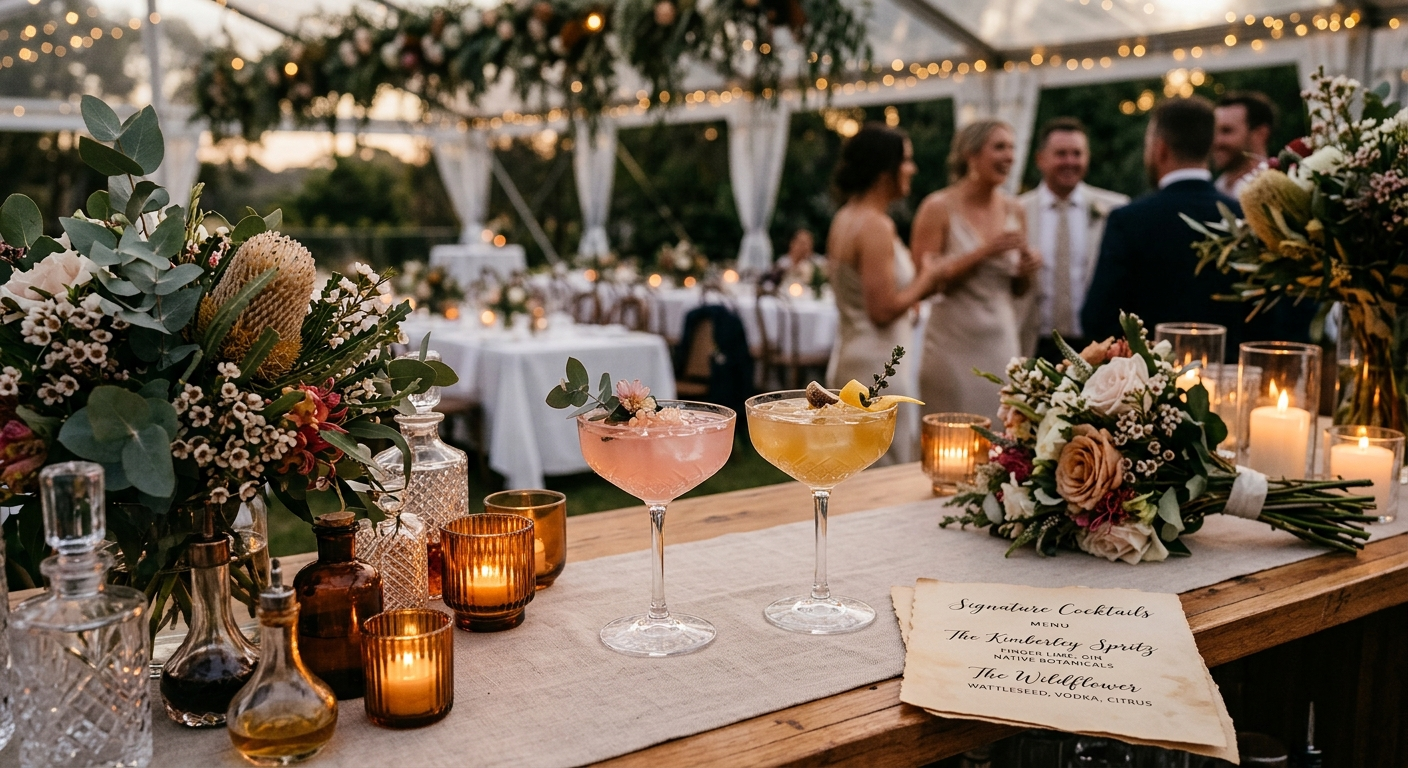
The open bar used to be the aspiration. If you could afford to keep the drinks flowing all night without a price ceiling, you had arrived. In 2026, that aspiration has quietly inverted. Australian couples are discovering that an open bar, while generous, is also anonymous. It says nothing about who you are as a couple. It does not tell the story of how you met over gin and tonics at a Melbourne rooftop bar, or how your proposal happened over a bottle of Margaret River chardonnay at sunset. The open bar is generous. The signature drinks experience is personal.
The shift toward personalised wedding bars has been building for several years, but 2026 is the year it has become a mainstream expectation rather than a boutique curiosity. The driving forces are the same ones reshaping Australian wedding culture more broadly: a desire for authenticity over spectacle, a commitment to quality over quantity, and a recognition that the details guests remember are the ones that feel specific to them. A signature cocktail named after the suburb where you had your first date, made with a local distillery's flagship gin and a homegrown shrub, is a story in a glass. That story is what guests take home in a way that an open tab never quite manages.
This guide covers everything you need to know to design and execute a signature drinks experience for your Australian wedding in 2026. It walks through the creative process, the Australian spirit and ingredient landscape, the mocktail question, staffing and logistics, budgeting, styling the bar itself, and the RSVP mechanics that ensure your guests arrive knowing what to expect and leave remembering the experience.
Why Australian Couples Are Choosing Signature Drinks Over Open Bars in 2026
The open bar's fundamental problem is that it optimises for volume rather than experience. Every drink is the same, regardless of who is drinking it or what the occasion means to them. The bar staff are trained to pour efficiently rather than to engage with guests about what they might enjoy. The result is a technically unlimited supply of drinks that somehow fails to feel special. The open bar solves the quantity problem while creating a quality and personality vacuum that the signature drinks approach directly fills.
Australian couples who have chosen signature drinks consistently report a different kind of guest response. Where an open bar produces queues and generic gratitude, a well-executed signature drinks experience produces genuine delight, conversation, and memory. Guests ask about the cocktails. They photograph the bar. They ask for recipes. They remember the drinks as part of the wedding experience in a way that simply did not happen when every drink came from the same limited tap list. The personalisation creates a talking point that ripples through the entire evening.
The cost argument also runs in the signature drinks favour, which surprises many couples initially. An open bar with premium spirits, beer, and wine for 100 guests over a six-hour reception can easily cost $12,000 to $20,000 depending on consumption rates and venue pricing structures. A curated signature bar programme with two cocktails, a custom mocktail, a premium beer and wine selection, and a dedicated bar team typically costs between $4,500 and $9,000 for the same guest count. The saving is not the point, but it is a meaningful secondary benefit that makes the quality upgrade affordable.
Designing Your Signature Cocktails: Process, Inspiration, and Australian Ingredients
The starting point for any signature drinks programme is the story you want the drinks to tell. The best signature cocktails are not arbitrary selections from a cocktail menu; they are expressions of something specific about the couple. This might be a shared favourite drink from a significant moment in the relationship. It might be a location — a cocktail built around native Australian ingredients that evokes the place where the couple lives or where the proposal happened. It might be a cultural reference — a family recipe, a heritage ingredient, a nod to each partner's background. The story does not need to be elaborate. It needs to be genuine.
Once you have the story, the next step is working with a bartender or mixologist to translate it into drinkable form. Many couples make the mistake of designing cocktails based purely on what sounds romantic rather than what drinks well in a large-format serving context. A cocktail that tastes exceptional in a 120-millilitre serve at a bar may not translate well to a 180-millilitre serve at a wedding where the drink needs to hold up for 15 minutes at room temperature while guests chat. Working with a professional ensures the recipes are designed for the serving conditions rather than adapted after the fact.
Australian native ingredients have become a defining feature of signature cocktail design in 2026, and for good reason. Finger lime — the caviar-like citrus pearl that grows in Queensland and Northern NSW — adds textural intrigue and a citrus note that pairs beautifully with gin. Wattleseed provides a roasted, nutty, chocolate-adjacent flavour that works remarkably well in espresso martinis and digestif-style cocktails. Lemon myrtle is one of the most versatile native ingredients, functioning as a flavouring in everything from sours to spritzes. Davidson plum, quandong, and native thyme each offer distinct flavour profiles that create genuine conversation-starting drinks. These ingredients signal Australian provenance without being gimmicky, and they genuinely taste exceptional when used well.
Sourcing Australian Spirits: Distilleries and Producers to Know
Australia's craft spirit industry has matured dramatically over the past five years, and 2026 finds Australian couples with an embarrassment of riches when selecting a base spirit for their signature cocktails. Melbourne's Four Pillars has established itself as one of the world's respected gin producers, and its benchmark gin, bloody yuzu gin, and spiced negroni provide exceptional foundations for wedding cocktails. Sydney's Archie Rose is equally respected, with a range of gins, vodkas, rums, and whiskies that have become go-to choices for premium cocktail programmes.
The regional distillery landscape adds another dimension to the sourcing conversation. In Western Australia, Busselton's Oh! Spirits produces award-winning rums and gins that work beautifully in tropical and citrus-forward cocktails. South Australia's KIS (Keep It Simple) Spirits and Adelaide's Prohibition Liquor Co offer alternative options with distinctly South Australian character. In Queensland, Husk Farm Distillery in the Tweed Valley produces its signature Ink gin — a distinctive purple gin made with butterfly pea flower that has become a wedding favourite for its visual drama and smooth flavour profile. Using a regional distillery's product as the centrepiece of your signature cocktail is both a quality choice and a story that guests enjoy hearing.
Designing a Signature Mocktail Programme: Non-Drinkers as First-Class Guests
A signature drinks programme that neglects non-drinking guests is incomplete. Approximately 20 to 25 percent of Australian adults do not drink alcohol, according to the Australian Institute of Health and Welfare, and an additional portion may choose not to drink on a given occasion. For these guests, a wedding reception that offers only beer, wine, and cocktails — even exceptional cocktails — can feel exclusionary in a way that is hard to articulate but deeply felt. The couples who have redesigned their drinks programme around this reality consistently report that the mocktail element was the single most appreciated detail of the entire bar experience.
The principle that defines an excellent signature mocktail is the same one that defines an excellent signature cocktail: specificity and intention. A mocktail named and designed around the couple's story, using quality ingredients and professional technique, communicates the same message of care and inclusion as the cocktails. A glass of pre-mixed cordial served from a bulk jug communicates the opposite, regardless of the quality of the cordial itself. The investment in a proper mocktail programme is not primarily financial — it is a matter of thought and craft.
Australian native ingredients are arguably even more important in mocktails than in cocktails, because the absence of spirits creates a blank canvas where native flavours can express themselves without competition. A sparkling mocktail built around finger lime, native thyme, and a house-made wattleseed syrup captures the Australian landscape in a glass in a way that feels entirely intentional rather than like an afterthought. Lemon myrtle, Kakadu plum, and Davidson plum each offer mocktail potential that has barely been explored by most wedding planners, which means the couples who commission these drinks are genuinely creating something their guests have not tasted before.
Staffing, Setup, and Logistics: Running a Signature Bar on the Night
The gap between a cocktail that tastes exceptional in development and one that delivers consistently across 150 serves on a wedding night is bridged by professional staffing and careful logistics planning. The rule of thumb for a signature cocktail bar at an Australian wedding is one trained bartender per 40 to 50 guests for a cocktail-only programme, or one bartender per 30 to 35 guests when a full drinks menu including wine and beer is also on offer. Understaffing is the most common cause of signature bar failures — guests wait too long, the cocktails are inconsistent, and the experience loses the magic that made it appealing in the first place.
Equipment requirements for a signature cocktail bar are modest but specific. A dedicated bar space — even a temporary setup using a hired portable bar — should include a speed rail, a proper shaker set, a Hawthorne strainer, a jigger set, a muddler, an ice bucket and tongs, a garnish tray, and a basic syrup and juice setup. Most cocktail hire companies provide equipment packages as part of their staffing service, which simplifies procurement significantly. Confirm with your bar team what is and is not included before the event to avoid last-minute gaps.
Garnish quality is an element that separates professional execution from amateur attempts. A cocktail garnished with a hand-cut twist of lemon peel and a single brandied cherry looks and tastes different from one garnished with a pre-packaged plastic cocktail cherry. The garnish is the first thing a guest sees when a drink is placed in front of them, and it sets the expectation for what follows. For a wedding, the garnish should be wedding-appropriate — which does not mean elaborate or fussy, but it does mean fresh, considered, and in keeping with the aesthetic of the day.
What a Signature Drinks Programme Costs in 2026
The cost of a signature drinks programme varies based on guest count, cocktail complexity, staffing requirements, and whether you are working with a boutique mobile bar company or integrating the programme into an existing venue bar. The following breakdown represents 2026 Australian market rates for a 100-guest evening reception with two signature cocktails, one signature mocktail, premium beer, and a curated wine selection.
Bar staffing for a 100-guest event typically requires two bartenders for a four-to-five-hour service period, at approximately $350 to $500 per bartender per event. Cocktail hire equipment — a portable bar, glassware, garnishes, and basic supplies — typically costs between $400 and $900 depending on the supplier and the equipment package. Cocktail ingredients for 100 guests across two cocktails and one mocktail — spirits, syrups, fresh juices, native ingredients, and garnishes — typically range from $800 to $1,600 depending on the spirit quality and the complexity of the recipes. Venue service fees and beverage markups, if applicable, add a further $2,000 to $5,000 depending on the venue's policy.
The total investment for a properly executed signature drinks programme for 100 guests in 2026 typically ranges from $4,500 to $9,500. Compared to a full open bar at the same guest count — which can cost $12,000 to $20,000 or more at premium venues — the signature programme delivers a more personalised and more memorable experience at a meaningfully lower cost. The saving, if one is achieved, can be redirected to cocktail-specific photography, a dedicated bar styling service, or simply retained as a welcome budget buffer.
Styling the Signature Bar: From signage to glassware
The bar itself is a visual centrepiece of the reception — one of the few elements that every guest will approach and engage with during the evening. A well-styled bar elevates the entire event, while a bare or generic bar setup undermines the craft that has gone into the drinks. The styling investment is modest relative to the visual return.
The starting point is a custom menu board or card that lists your signature cocktails and mocktail by name, with a brief description of each — the couple's names, the story behind the drink, and the key flavour notes. This menu serves double duty: it helps guests choose their drink and it tells the story of why these drinks were selected. A well-designed menu card, printed on quality card stock or displayed on a styled mirror board, costs between $40 and $120 and delivers disproportionate impact.
The bar surface and surrounding area offer additional styling opportunities. Fresh flowers, botanical arrangements, and native Australian foliage in bud vases or low arrangements create a visual connection between the bar and the broader reception styling. Custom glassware — even something as simple as choosing a specific cocktail glass shape for each signature drink — elevates the perceived quality of the experience. Some couples choose to personalise glassware with the wedding date or initials, either through engraving or with removable sticker labels. The result is photographs that look intentional and editorial rather than improvised.
RSVP Considerations: Dietary Requirements and Drink Preferences
The RSVP process is an underutilised opportunity to gather information that improves the drinks experience for your guests. A well-designed wedding RSVP form should include a dietary requirements section — standard practice — but also a drinks preference question that gives guests the opportunity to indicate whether they drink alcohol, prefer non-alcoholic options exclusively, or have specific preferences that the bar team should be aware of. This information is invaluable for sizing the bar programme correctly and for ensuring that non-drinking guests are genuinely catered to rather than awkwardly accommodated.
Dietary requirements and religious considerations intersect with the drinks programme in ways that are not always obvious. Some guests do not drink alcohol for religious reasons and may have specific requirements about whether non-alcoholic alternatives can be served from the same equipment used for cocktails. Some guests have allergies or sensitivities to common cocktail ingredients — nuts, dairy, gluten — that need to be communicated to the bar team. Capturing this information through the RSVP and passing it to your bar team in advance ensures that the experience is genuinely inclusive rather than nominally so.
The invitation or wedding website should include a brief note about the signature drinks programme, giving guests a preview of what to expect and setting expectations appropriately. This is particularly important for guests who may have concerns about alcohol consumption — knowing that a thoughtful and well-designed mocktail is available removes anxiety and ensures that non-drinking guests arrive feeling included rather than as an afterthought. The transparency also adds to the anticipation and excitement for drinking guests, who will arrive already curious about the cocktails they will be sampling.
Frequently Asked Questions About Signature Wedding Drinks
Should We Offer an Open Bar Alongside the Signature Cocktails?
This is the most common question couples ask when designing their bar programme, and the answer depends on your budget, guest profile, and the level of personalisation you want to achieve. The signature drinks programme is most impactful when it is the primary offering — it tells the story clearly without dilution. Adding an open bar alongside the signature cocktails shifts the focus away from the personalisation and toward the consumption, which undermines the intention. The recommended approach for most couples is a curated beer and wine selection alongside the signature cocktails, with table service for wine during dinner and a dedicated bar for cocktails and beer throughout the evening. This covers all guests comprehensively while keeping the signature drinks at the centre of the experience.
How Do We Accommodate Guests with Allergies or Religious Restrictions?
Collect specific allergy and restriction information through the RSVP process and pass it to your bar team before the event. For guests with nut allergies, ensure that the bar team does not use garnishes or syrups containing the relevant allergens and that cocktails are prepared on a clean surface. For guests who do not consume alcohol for religious reasons, discuss with them directly what would make them feel genuinely included — some guests prefer that non-alcoholic drinks are prepared on completely separate equipment, while others are comfortable with shared preparation as long as the final product contains no alcohol. Direct communication with affected guests before the event is the only reliable way to get this right.
How Many Cocktails Should We Plan Per Guest?
For a reception with a full evening programme, plan for two to three cocktails per guest who drinks alcohol, across a three-to-four-hour cocktail service period. This accounts for the natural variation in consumption rates across your guest group — some guests will have two drinks, some will have four — and ensures that the bar does not run short toward the end of the evening. If the signature cocktails are served alongside a wine and beer selection, the per-guest cocktail count may be lower, as many guests will alternate between the cocktails and other drinks. Working with your bar team to size the ingredient quantities based on your specific guest count and programme structure is a standard part of professional event bar planning.
The signature drinks experience is one of the highest-impact personalisation decisions an Australian couple can make for their 2026 wedding, and it is also one of the most affordable. A thoughtfully designed cocktail programme tells a story, delights guests, and creates the kind of memorable moment that guests describe to their friends and share on social media. An open bar provides unlimited drinks. A signature drinks experience provides something to remember.
The execution is more accessible than many couples assume. Australian craft distilleries are producing exceptional base spirits that compete with the best in the world. Native Australian ingredients offer a flavour vocabulary that is distinctly ours and that creates drinks with genuine originality rather than regional imitation. Professional mobile bar companies have developed packages specifically designed for wedding signature cocktail programmes that remove the logistical complexity and allow couples to focus on the creative decisions rather than the operational ones.
The investment required is a conversation with your bar team, a creative brief about what you want the drinks to say, and a willingness to think about alcohol service not as a logistical necessity but as an extension of your wedding story. That willingness is what separates the couples who have a wedding that feels like them from the couples who have a wedding that could have been anyone. Your signature drinks are a story in a glass. Make sure they are worth telling.