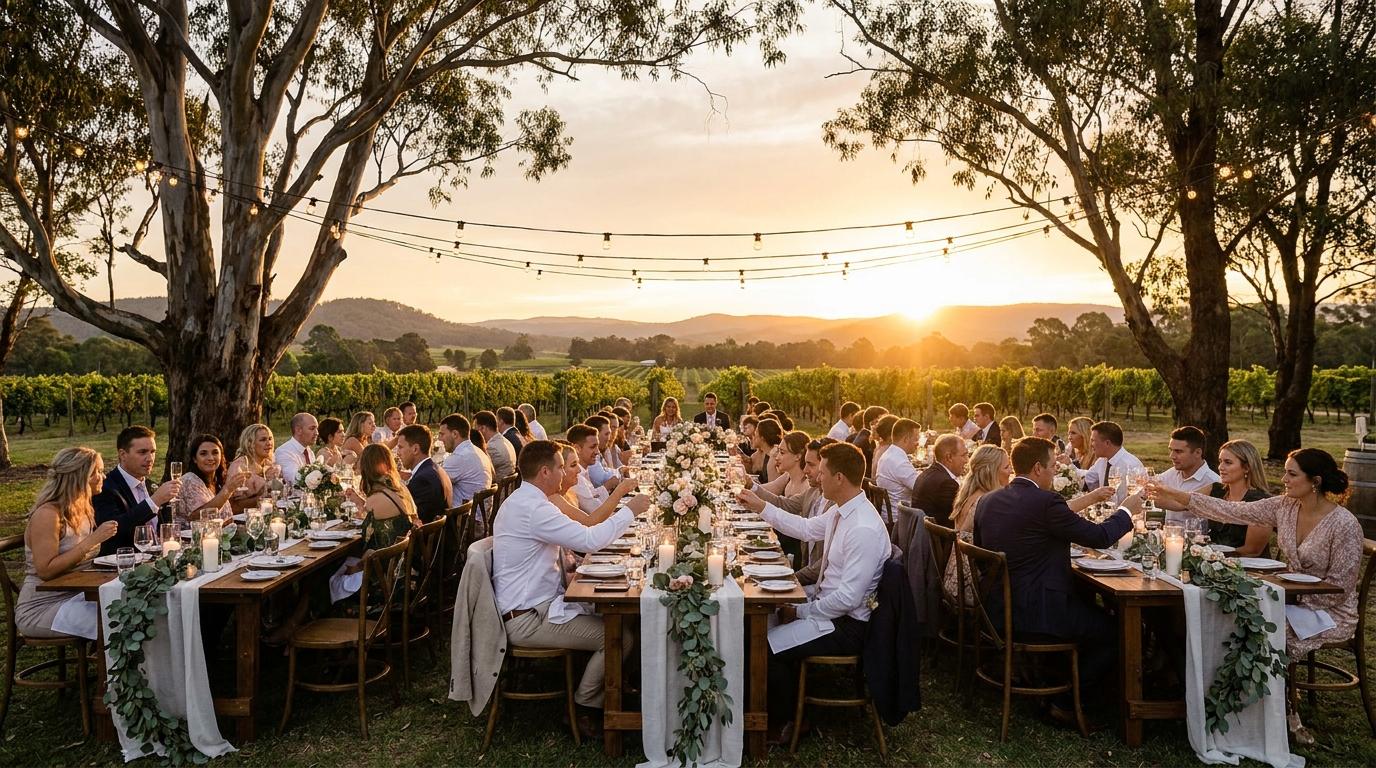
The traditional Australian wedding — a ceremony in the afternoon, a reception in the evening, a tired drive home at midnight — is undergoing its most significant transformation in decades. Across the country, from the vineyards of the Margaret River region in Western Australia to the coastal retreats of Byron Bay in New South Wales, from the mountain estates of the Dandenong Ranges in Victoria to the beachside venues of the Sunshine Coast in Queensland, Australian couples are choosing to stretch their wedding celebrations across multiple days rather than confining them to a single event. They are hosting welcome dinners on the night before the ceremony, recovery brunches on the day after, and everything in between: winery tours, beach barbecues, coastal hikes, cooking classes, and spa mornings that transform a single-day wedding into a fully immersive experience.
The trend toward multi-day weddings is not new — destination weddings have always implied an extended stay, and cultural wedding traditions in many Australian communities have long involved multiple days of celebration. What is new in 2026 is the mainstreaming of the multi-day format among couples who are not getting married abroad, who do not belong to cultures with multi-day traditions, and who are making a deliberate choice to structure their wedding as an extended experience rather than a single event. The motivation is not simply aesthetic. It is about something deeper: a desire to give their guests — and themselves — an experience that is richer, more present, and more memorable than a single day can contain.
This guide examines the multi-day wedding phenomenon in Australia in 2026. It explores why the trend has emerged when it has, which Australian destinations are best suited to extended celebrations, what the logistics of multi-day planning involve, and how to communicate the format to guests in a way that sets expectations appropriately. Whether you are already considering a multi-day wedding or simply curious about what the trend involves, the following pages cover everything you need to know about extended wedding celebrations in Australia.
Understanding why Australian couples are choosing to extend their wedding celebrations requires examining several interconnected factors: the desire for a more meaningful guest experience, the financial case for spreading costs across multiple days, the influence of social media and content creation on wedding planning, and the cultural shift toward valuing experiences over material displays. None of these factors operates alone — they reinforce each other, creating a momentum that is driving the multi-day wedding from niche to mainstream at a pace that has surprised even wedding industry professionals.
Why Multi-Day Weddings Are Growing in Australia
The most straightforward explanation for the growth of multi-day weddings in Australia is the mismatch between the traditional single-day format and what couples actually want from their wedding experience. A single day — no matter how perfectly planned — imposes strict constraints on the quality of the guest experience. Guests arrive, find their seats, watch the ceremony, move to the cocktail hour, sit down for dinner, watch the speeches, dance for two hours, and leave. The logistics of the day compress the time available for genuine connection between the couple and their guests, and between guests themselves, into a series of scheduled moments that leave little room for organic interaction. The couple who has been dreaming of a wedding where they spend meaningful time with every person in the room discovers, on the day itself, that the format does not allow for it.
The multi-day format removes these constraints. When your wedding celebration spans three days, there is time — genuine, unstructured time — for the couple to move through the room at a different pace, for guests to form connections with each other over multiple encounters, and for the celebration to evolve naturally across different settings and contexts. A welcome dinner on the Friday evening establishes relationships that deepen at the Saturday ceremony and reach their natural peak at the Sunday recovery brunch. The wedding becomes an experience rather than an event, and the memory of it is correspondingly richer.
The financial case for multi-day weddings is also more compelling than it first appears. The per-day cost of a multi-day celebration is not simply the per-day cost of a single-day wedding multiplied by the number of days. Many of the fixed costs of a wedding — venue hire, styling, coordination, photography — are absorbed across more events when you stretch the celebration across multiple days. A three-day wedding does not cost three times as much as a one-day wedding; it typically costs between 1.5 and 2 times as much, with each additional day costing substantially less per event than the main day. This means that couples who choose multi-day celebrations are often not spending dramatically more than they would on a single-day event — they are allocating the same budget differently, and getting a richer result in exchange.
The social media dimension has also contributed significantly to the trend. Multi-day weddings produce more content — more moments, more settings, more opportunities for photography and videography — than single-day events. Couples who are planning their wedding with an awareness of how it will look on Instagram, TikTok, and their wedding website recognise that a three-day celebration produces a richer, more varied content library than a single day. This is not vanity; it is a legitimate consideration that reflects how couples think about documenting and sharing their experience.
The Experience Economy and the Australian Wedding
The broader cultural shift toward valuing experiences over material possessions has had a significant impact on Australian wedding planning. Australian consumers in 2026 are more likely to spend on experiences — travel, dining, events — than on goods, and this shift has reshaped wedding expectations in ways that extend beyond the ceremony itself. The couple who chooses a multi-day wedding is making a statement about what they value: quality time with their guests, a genuine celebration rather than a logistical performance, and an experience that is remembered for its richness rather than its scale.
This shift is particularly pronounced among Australian couples in their late twenties and early thirties, who have grown up in an era of experiential consumption and who apply the same logic to their wedding that they apply to other significant life decisions. They have seen friends get married in extended celebrations abroad and domestically, they have followed multi-day wedding content on social media, and they have formed an expectation of what a wedding can be that the traditional single-day format cannot satisfy. When they begin planning their own wedding, the multi-day option is not a novelty — it is the obvious answer to a question they already know how to ask.
The Best Australian Destinations for Multi-Day Weddings
The multi-day wedding format requires a venue or destination that can accommodate multiple events across multiple days without requiring guests to relocate. This is the fundamental logistical constraint of the format, and it shapes the destination choices available to Australian couples. The destinations that have emerged as the most popular for multi-day weddings are those that offer a combination of high-quality venues, accommodation options for guests, and surrounding activities that justify an extended stay. Not every wedding destination in Australia meets these criteria — and the ones that do are commanding premium prices as a result.
The Margaret River region in Western Australia has established itself as one of the premier multi-day wedding destinations in Australia. The combination of world-class wineries, exceptional restaurants, stunning coastal scenery, premium accommodation options ranging from boutique hotels to luxury private villas, and a range of activities — wine tasting, beach walks, surfing, cave exploration, forest trails — creates the infrastructure for a three-day celebration that does not require guests to leave the region. Couples who choose Margaret River for a multi-day wedding typically host the welcome dinner at one of the renowned wineries, the main ceremony at a coastal or vineyard venue, and the farewell brunch at a farm-to-table restaurant or a beachside cafe. The logistics are manageable, the experience is coherent, and the setting is genuinely extraordinary.
The Hunter Valley in New South Wales is another destination that has adapted well to the multi-day wedding format. The region has a high density of wineries — many with on-site accommodation — as well as golf resorts, spa retreats, and a range of dining options that can accommodate multiple events without requiring guests to repeat the same venue. A typical Hunter Valley multi-day wedding might include a welcome dinner at a restaurant in Pokolbin, a ceremony at a vineyard estate, and a farewell brunch at a cafe in the nearby town of Cessnock or Maitland. The region is accessible from Sydney — approximately two hours by car or forty minutes by light aircraft — which makes it viable for guests travelling from the capital city.
Byron Bay in New South Wales has long been a wedding destination of choice for couples seeking a coastal, relaxed aesthetic, and it has become increasingly popular for multi-day celebrations as the accommodation and activity infrastructure has matured. The town's mix of luxury resorts, Airbnb-style private villas, wellness retreats, and beachside restaurants provides the variety needed for a multi-event itinerary. A Byron Bay multi-day wedding might include a welcome dinner at a beachfront restaurant, a ceremony at a clifftop or beach venue, and a farewell brunch at a cafe in town or at a nearby hinterland property. The presence of Byron Bay's famous lighthouse walk, the beaches of the Cape Byron Marine Park, and a range of wellness activities — yoga classes, surfing lessons, spa treatments — adds dimensions to the celebration that a single-day format could never accommodate.
The Mornington Peninsula in Victoria offers a different but equally compelling multi-day wedding proposition. The peninsula's combination of bay and ocean beaches, winery restaurants, golf courses, hot springs, and artisan food producers creates a itinerary that is both varied and cohesive. A Mornington Peninsula multi-day wedding might combine a welcome dinner at a winery restaurant in Red Hill or Main Ridge, a ceremony at a clifftop venue overlooking Port Phillip Bay, and a farewell brunch at a beachside cafe in Mount Martha or Flinders. The peninsula is within ninety minutes of Melbourne, making it accessible for guests flying in from interstate or overseas, and the range of accommodation options — from luxury resort suites to private beach houses — accommodates different guest preferences and budgets.
Queensland Multi-Day Wedding Destinations
Queensland offers several destinations that are well-suited to multi-day weddings, with the Sunshine Coast and the Gold Coast Hinterland leading the options. The Sunshine Coast — particularly the area around Noosa, Eumundi, and the Glass House Mountains — provides a combination of beach venues, hinterland estates, artisan food experiences, and natural scenery that works well for a two or three-day celebration. Noosa Heads, in particular, has a cluster of high-end restaurants and boutique accommodation options that can host multiple events across different venues without repetition.
The Gold Coast Hinterland — locations like Springbrook, Tamborine, and OReillys — offers a mountain and rainforest setting that is genuinely unlike anything available in other Australian wedding destinations. Venues like OReillys Rainforest Retreat and the various wineries and distilleries of the Tamborine Mountain wine region provide spaces for intimate welcome dinners and farewell gatherings that feel remote and special without requiring significant travel. For couples who want a destination that feels more exotic than the standard coastal or vineyard options, the Gold Coast Hinterland is increasingly attractive.
For couples willing to consider Far North Queensland, the Daintree Rainforest and the islands of the Great Barrier Reef offer a destination wedding experience that is truly extraordinary. Multi-day weddings in this region typically involve a welcome event at a resort or private property near Cairns or Port Douglas, a ceremony at a beach or island venue, and a farewell dinner at a restaurant with views across the reef or the rainforest. The logistics are more complex than in south-east Queensland — guest travel is more expensive and the infrastructure is less developed — but the setting is irreplaceable, and couples who choose Far North Queensland for a multi-day wedding are choosing something that no other Australian destination can replicate.
Planning the Logistics of a Multi-Day Wedding in Australia
Planning a multi-day wedding requires a fundamentally different approach to planning a single-day event. The number of decisions multiplies with each additional event, the coordination complexity increases non-linearly, and the budget implications require a more sophisticated framework than the standard per-head cost model that works for single-day weddings. The couples who navigate multi-day planning successfully are the ones who understand these complexities from the outset and build their planning process around them.
The first logistical decision in multi-day wedding planning is the number of events to include. The most common formats are two-day and three-day celebrations. A two-day wedding typically involves a welcome dinner on the evening before the ceremony and the ceremony and reception on the day itself. A three-day wedding adds a farewell event — brunch, lunch, or an afternoon gathering — on the day after the ceremony. Some couples extend to four days, particularly when the destination is remote or when the celebration involves a significant guest group that wants more time together. The choice of format should be driven by the experience you want to create, the budget you have available, and the tolerance of your guest group for extended events — not by the expectation that more days automatically means a better wedding.
The second logistical decision is the venue structure. In a multi-day wedding, you have two options: a single venue that hosts all events, or multiple venues across the destination. The single-venue approach is simpler logistically — guests have one location to navigate, coordination is more straightforward, and the venue can provide a consistent aesthetic across all events. Many of the premium Australian wedding venues — particularly the large winery and resort properties — are designed to accommodate multi-day events with dedicated event spaces for each component. The multi-venue approach offers more variety — different settings for the welcome dinner, the ceremony, and the farewell — but requires more coordination and a more detailed guest communication strategy to ensure everyone navigates between venues correctly.
Budget Planning for a Multi-Day Australian Wedding
The budget framework for a multi-day wedding differs from the single-day model in ways that are important to understand before you commit to the format. The most significant difference is the distribution of fixed and variable costs. In a single-day wedding, the major fixed costs — venue hire, styling, photography, videography, coordination — are spread across one event. In a multi-day wedding, the same fixed costs are spread across multiple events, which means the per-event cost of these elements is lower. However, the variable costs — catering, beverages, entertainment, additional styling — increase with each additional event. The net result is that a two-day wedding typically costs 1.4 to 1.6 times the cost of a single-day wedding at the same quality level; a three-day wedding typically costs 1.7 to 2.0 times the single-day cost.
For a three-day wedding for 80 guests in a premium Australian destination — Margaret River, Hunter Valley, Mornington Peninsula — in 2026, a realistic total budget ranges from $90,000 to $150,000 AUD, depending on the venue, the suppliers, and the level of styling. This figure includes venue hire across all three days, catering and beverages for all events, photography and videography for the full duration, styling and floristry, entertainment for the welcome dinner and the main reception, accommodation for the couple and key wedding party members, and coordination fees. For a comparable single-day wedding at the same venue with the same guest count, the budget would typically be in the range of $60,000 to $90,000 AUD. The multi-day format adds meaningful cost — but the experience is correspondingly richer.
Communicating the Multi-Day Format to Your Guests
The communication strategy for a multi-day wedding is more complex than the equivalent strategy for a single-day event, and getting it right is essential to the guest experience. Guests who arrive at a multi-day wedding without a clear understanding of what is expected of them — what to wear, when to arrive, where to go, what to bring — will not enjoy the experience as fully as guests who arrive fully briefed and prepared. The communication challenge is not just informational; it is experiential. You are asking your guests to commit to a particular mode of engagement — relaxed, present, open to whatever the itinerary offers — and you need to give them the context to do that.
The save-the-date is the first point of communication and must convey the multi-day nature of the celebration clearly. Do not assume that guests will understand what a multi-day wedding involves from the save-the-date alone — spell it out. Include the dates of all events, the location, and a brief note that the celebration will span multiple days. Something like: 'We would love for you to join us for a weekend of celebration in the Margaret River region from Friday 14 to Sunday 16 August. Further details and the official invitation to follow.' This approach sets expectations from the outset and gives guests the maximum possible notice to plan around the extended commitment.
The wedding invitation suite for a multi-day event should include a detailed itinerary card that outlines each event, the dress code for each event, the timing, the location, and any specific instructions — such as transport arrangements, accommodation booking information, or items to bring. The itinerary card is one of the most appreciated elements of a multi-day wedding invitation — guests who receive it feel informed and considered rather than confused and unprepared. The level of detail should be generous: a description of what each event involves, not just a timetable. For example, 'Friday evening: welcome dinner at Leeuwin Estate Winery. Smart casual. Australian summer cuisine. Standing tables and seated dining available. Drinks package included. Arrive from 6:30pm for a 7pm start.'
The communication does not end with the invitation. In the weeks leading up to the wedding, consider sending a pre-event email or message to your guest list with practical information about the destination, accommodation options, transport tips, and what to expect at each event. This is also the appropriate vehicle for communicating any changes to the itinerary, any requirements for guests (such as dietary information or specific dress code items), and any information about the social dimension of the celebration — for example, whether the welcome dinner is a structured event or a more casual gathering, and whether guests are expected to bring anything.
Managing Guest Expectations for an Extended Celebration
Not all of your guests will be able to attend every event in a multi-day wedding. Some guests will be able to join only for the main ceremony and reception; others will be able to attend the full weekend. Both patterns of attendance are legitimate, and your planning should accommodate them gracefully. The key principle is to avoid creating a two-tier guest experience where guests who attend the full celebration are obviously the preferred attendees while those who attend only one or two events feel like second-tier guests. The welcome dinner, in particular, should be designed to be inclusive — if budget allows, every invited guest should be welcome at the welcome dinner, even if they cannot attend the farewell.
One of the most effective strategies for managing the attendance complexity of a multi-day wedding is to design the welcome dinner as the most accessible event on the itinerary — casual in tone, affordable in terms of time commitment, and welcoming of guests who are arriving late or leaving early. A standing cocktail and dinner event from 7pm to 10pm is a lower bar to attend than a full dinner that runs until midnight. If your guest list includes guests who are travelling from interstate or overseas, they will appreciate the opportunity to attend at least one event even if they cannot make the farewell brunch on Sunday morning.
RSVP Management for Multi-Day Wedding Events
The RSVP process for a multi-day wedding is more complex than for a single-day event, and the complexity grows with each additional event on the itinerary. At a minimum, you need to know which events each guest is attending — not just whether they are coming to the wedding, but whether they are coming to the welcome dinner, which days they need accommodation for, and whether they have any requirements that affect any of the events. A digital RSVP platform that can capture this information in a structured format is not a luxury for a multi-day wedding — it is a necessity.
The RSVP form for a multi-day wedding should include a clear events selection section where guests can indicate which events they will be attending. This is more nuanced than a simple attendance checkbox. Some events — the ceremony and reception, for example — may be all-or-nothing for most guests. Other events — the welcome dinner, the farewell brunch — may be optional for some guests and mandatory for others. The RSVP form should capture these distinctions clearly, and should allow guests to indicate any constraints — for example, if they need to leave early on the Sunday or arrive late on the Friday. This information is essential for your catering numbers, your seating plan, and your coordination of transport and accommodation.
The dietary requirements section of the RSVP form also needs to capture information for each event separately, or at least to clarify whether the guest's dietary requirements apply to all events or only to specific ones. A guest who is vegetarian for the main dinner may be happy to have meat options at the welcome cocktail event; a guest with a coeliac condition will need coeliac-safe options at every meal. The RSVP design should prompt guests to think about this carefully, and should include a free-text field for specific requirements related to the multi-day format — for example, if they have a food allergy that requires a specific protocol at every event.
Confirming Attendance and Managing Changes in the Lead-Up
The confirmation process for a multi-day wedding should begin earlier than for a single-day event, and should be more systematic. With multiple events, multiple venues, and potentially multiple catering counts across different days, the cost of a last-minute cancellation or change is higher than for a single-day event. A guest who cancels from the welcome dinner the day before creates a different problem than a guest who cancels from the main reception — it affects a different catering count and a different event experience.
We recommend a two-stage confirmation process for multi-day weddings. The first confirmation should occur four weeks before the event, when guests confirm their overall attendance and indicate which events they are attending. The second confirmation should occur one week before the event, when guests confirm their final event attendance and flag any last-minute changes. This process gives you sufficient lead time to adjust your catering numbers, your seating plans, and your coordination logistics before each event. A digital RSVP platform that can capture these confirmations and communicate them to your venue and caterer in real time makes this process far more manageable than it would be with a paper-based system.
Designing the Guest Experience Across Multiple Days
The quality of a multi-day wedding is determined not just by the formal events — the welcome dinner, the ceremony, the reception, the farewell — but by the experience you create for guests between those events. The time between events is when the celebration becomes something more than a series of dinners — it is when guests form relationships with each other, explore the destination, and experience the setting that makes your wedding distinctive. Thinking carefully about how to fill this time — and how not to fill it — is one of the most important planning decisions for a multi-day wedding.
The most successful multi-day weddings in Australia offer a mix of optional and scheduled activities that give guests the choice of how much to engage. Optional activities might include a guided wine tasting at a partner winery, a morning yoga class, a beach walk or hike, a spa morning at a nearby retreat, or a cooking class at a local food producer. These activities are not part of the formal wedding itinerary — guests are not required to attend them — but they are available for guests who want more from the experience. The key is to ensure that the activities feel like genuine offers rather than obligations, and that guests who prefer to sleep in or explore independently are not made to feel that they are missing something they should have attended.
The welcome dinner is the event that sets the tone for the entire multi-day celebration, and it deserves more attention than most couples give it. The welcome dinner is not just the first event on the itinerary — it is the moment when your guest group begins to form the social dynamic that will define the weekend. A well-designed welcome dinner introduces guests to each other, establishes the aesthetic of the celebration, and gives the couple the opportunity to greet every guest before the formality of the ceremony day. The format should be designed to facilitate interaction — long tables, standing cocktails, or interactive food stations rather than rigid seated service. The more guests interact at the welcome dinner, the more alive the rest of the weekend feels.
Designing a Farewell That Sends Guests Home on a High
The farewell event is the final touchpoint of your multi-day wedding, and it should be designed to leave guests with a warm, relaxed, and genuinely satisfied feeling as they depart. The farewell should not try to replicate the scale of the main reception — it should be a different kind of event, with a different energy, that feels like a natural conclusion to the celebration rather than a lesser second reception.
The most popular farewell format for Australian multi-day weddings in 2026 is a long, relaxed brunch or lunch — typically running from 10am to 2pm or 11am to 3pm, with shared food, bottomless beverages, and an unhurried atmosphere. The venue should be different from the main reception venue if possible — a beachside cafe, a winery restaurant, a garden setting — so that the farewell feels like a distinct event rather than an extension of the previous night. The dress code should be smart casual, reflecting the relaxed tone, and the format should allow guests to come and go within the window rather than requiring everyone to arrive and depart at the same time.
Accommodation Strategies for Multi-Day Wedding Guests
The accommodation question is one of the most significant logistical challenges of a multi-day wedding, and it is often the dimension that couples underestimate most severely. When your wedding spans three days, your guests need somewhere to stay for two or three nights — and the cost, availability, and quality of that accommodation will significantly affect who can attend and how they experience the celebration. Managing this well requires more than sending guests a list of nearby hotels. It requires a structured approach to accommodation that considers the needs of different guest groups and provides genuine value.
The first decision is whether to block-book accommodation at specific properties on behalf of your guests. Block-booking — reserving a number of rooms at a specific hotel or resort at a discounted rate for your wedding dates — is the most guest-friendly approach because it provides guaranteed availability, often at a reduced rate, and creates a sense of collective experience as guests from your wedding stay at the same property. The cost of block-booking for the couple is typically the deposit and guarantee for unclaimed rooms, which means you are responsible for rooms that guests do not take up. This risk can be managed by setting a reasonable release date for unclaimed rooms and by selecting properties with cancellation policies that protect your deposit.
For Australian multi-day weddings in 2026, the block-booking approach is most effective at the following destination types: resort properties in Queensland (where group bookings are standard), winery estates in the Margaret River and Hunter Valley regions (many of which have on-site accommodation), and boutique hotels in regional centres like Byron Bay, Daylesford, and the Mornington Peninsula. The key is to select accommodation that is within walking distance or a short transfer from your main event venues — guests who need to drive or arrange transport between their accommodation and the wedding events will enjoy the experience less than guests who can walk to every venue.
Managing Accommodation Costs for Guests on a Budget
Not all of your guests will have the same accommodation budget, and a multi-day wedding that offers only premium accommodation options will exclude guests who cannot afford them. The solution is to provide a range of accommodation options at different price points, from luxury resorts to motels and Airbnbs, and to communicate these options clearly in your guest communication. Some couples choose to contribute to accommodation costs for out-of-town guests or for guests who are on lower incomes — this is a generous approach that has no obligation behind it but can meaningfully affect who is able to attend.
The communication of accommodation options should include a clear description of each option, the price range per night, the distance from the main wedding venue, and any booking code or special rate that applies to your wedding group. A dedicated section of your wedding website — or a printed accommodation guide included in your invitation suite — is the most effective way to present this information. Avoid the common mistake of simply listing hotel names without context — your guests need to understand what they are booking and why it makes sense for the weekend.
Is a Multi-Day Wedding Right for You?
The case for a multi-day wedding is strong for couples who value the guest experience above all else — who want their wedding to be remembered not just for the ceremony and the reception, but for the quality of the time spent together across multiple days and settings. The multi-day format is not inherently superior to the single-day format; it is a different approach that suits a different set of priorities and values. The couples who are happiest with multi-day weddings are the ones who made the choice because they genuinely wanted an extended celebration, not because they felt pressure to do something elaborate or because they were caught up in the logistics of planning without a clear sense of what they were building toward.
The couples who should think carefully before committing to a multi-day wedding are those who are primarily motivated by cost or logistics — who are choosing the format because they believe it will be cheaper or simpler in some way. Multi-day weddings are not cheaper than single-day weddings; they are differently expensive, and the cost per guest is often higher. They are also more complex to plan and coordinate, and they require a level of logistical sophistication that not all couples have the time or capacity to develop. If you are considering a multi-day wedding primarily because you think it will save money or reduce planning stress, reconsider. The format is best suited to couples who have the budget, the time, and the inclination to plan something genuinely special across multiple days — and who are excited by the prospect of hosting their guests in an extended, immersive celebration.
For Australian couples in 2026, the multi-day wedding represents one of the most significant opportunities to create something extraordinary. The destinations available, the suppliers who understand the format, and the cultural permission to break from the single-day tradition have never been better. If you are considering a multi-day wedding, the question is not whether it is possible — it clearly is. The question is whether it is right for you, your partner, and your guest list. This guide has given you the framework to answer that question with confidence. The decision is yours — and when made deliberately and with care, it is one of the most rewarding choices you will make in your wedding planning journey.
The rise of multi-day weddings in Australia reflects a generation of couples who are rethinking what a wedding can be. They are choosing depth over breadth, experience over spectacle, and time together over a single logistical event. The multi-day wedding is not for every couple — but for the couples it fits, it is one of the most meaningful celebration formats available in contemporary wedding culture.
If you are considering a multi-day wedding, start by choosing your destination, understanding your guest profile, and building a budget that reflects the true cost of the format. Communicate early and clearly with your guests about what you are planning and what you need from them. Use a digital RSVP platform to manage the complexity of multi-event attendance tracking. And remember that the quality of the experience is what matters, not the number of events on the itinerary. A two-day wedding that is perfectly planned will be more memorable than a four-day wedding that feels like an obligation. Plan with intention, communicate with care, and trust that your guests will appreciate the effort when they arrive to find a celebration that has been designed around their experience, not just yours.
For more guides on Australian wedding planning, explore the WeddingRSVP blog. From RSVP management to venue selection, dietary requirements to styling inspiration, we cover every dimension of planning an Australian wedding in 2026.