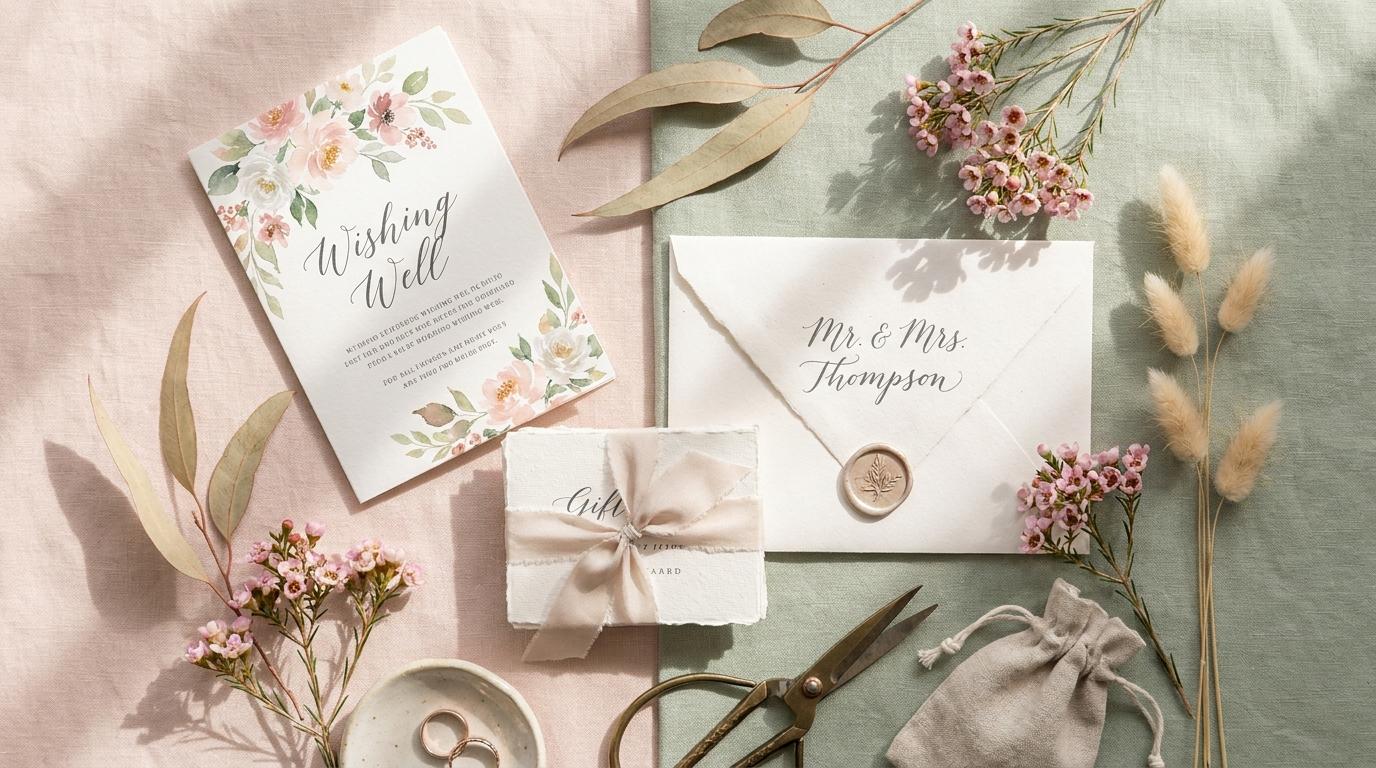
The Australian wedding gift landscape has transformed significantly over the past decade. Where once couples registered at department stores and guests debated over toasters versus dinner sets, the majority of Australian couples now ask for monetary contributions — whether to fund a home deposit, contribute to a honeymoon, or build a shared life without accumulating items they do not need. The data is clear: a 2024 survey by finder.com.au found that 68 percent of Australian couples prefer cash or gift cards as wedding gifts, yet the overwhelming majority report feeling uncomfortable writing wording that communicates this preference clearly and tastefully.
The discomfort is understandable. Asking for money carries a perceived social risk — it can feel demanding, transactional, or presumptuous, particularly for couples whose parents or older relatives hold more traditional views on wedding gift etiquette. Yet the social reality has shifted: cash gifts are now the cultural norm for Australian weddings, and guests generally expect couples to have a mechanism for contributing financially. The challenge is not whether to ask for cash — it is how to ask in a way that feels gracious rather than grasping, specific rather than vague, and aligned with your personality as a couple.
This guide addresses that challenge directly. It covers the cultural context for wishing well wording across different Australian contexts, the legal and practical considerations for managing gifted funds, 10 wording templates from formal to light-hearted, placement strategies for your wording (wedding website versus invitation versus both), and the digital RSVP tools that make managing your wishing well information seamless. Whether you are planning a formal Sydney harbour wedding, a relaxed Hunter Valley winery celebration, or a sunset beach ceremony on the Gold Coast, this guide has wording options and strategies that will work for your situation.
The central insight of this guide is that wishing well wording is not about hiding the ask. It is about framing it in a way that feels genuine and gracious. Guests who want to give a gift are looking for guidance on what you would appreciate. Your wording gives them that guidance in a way that removes awkwardness for both parties.
Why Australian Couples Are Choosing Cash Over Traditional Registries
The shift from physical gift registries to cash wishing wells in Australia reflects broader changes in how young Australian adults live. The average first-home buyer in Australia is now in their late thirties, compared to the early thirties a generation ago. Many couples in their late twenties and early thirties already live together, have established households, and have the domestic items they need. Asking guests to purchase items from a registry when you already have a toaster, linen, and a full kitchen is a mismatch that guests often recognise and feel uneasy about.
The financial realities of Australian housing add urgency to the cash gift preference. A wedding gift of $150 per couple contributes meaningfully to a household savings goal — whether that is a house deposit, a honeymoon fund, or an offset account that reduces mortgage interest. That same $150 spent on a blender or a set of glassware may be appreciated but does not address the financial priorities that most young Australian couples face. Guests increasingly understand this calculus, and many actively prefer to give cash because they know it will be used in a way that matters.
The honeymoon fund category has grown particularly strongly in Australia, driven partly by the increase in destination weddings and the post-pandemic recovery of international travel. A honeymoon in the Maldives, Japan, or Europe represents a meaningful shared experience that guests can contribute to in a way that feels personal rather than generic. Platforms like WeddingWire and Hitchd have made it easy to create visual honeymoon registries that show guests exactly what their contribution funds — a snorkelling trip, a fancy dinner, a scenic train journey. This transparency addresses one of the historical concerns about cash gifts: that the giver does not know what their money was used for. Modern wishing well platforms resolve this.
Regional Differences in Australian Wedding Gift Expectations
Australian wedding gift expectations vary somewhat by state and by community type, and understanding these nuances is useful when crafting your wishing well wording. Sydney and Melbourne couples — particularly those in professional careers and urban areas — operate with the most flexible gift expectations. Cash is widely accepted and often preferred; physical gift registries are less common and may feel slightly old-fashioned. Wishing well wording on a wedding website is typically sufficient, and guests do not expect an explicit mention on the invitation itself.
In Queensland and regional areas, physical gifts remain more common as a secondary option, particularly among older guests and family members who are less comfortable with digital giving. Couples in these contexts often frame their wishing well wording to acknowledge both preferences: asking for cash while noting that physical gifts are also welcome if guests prefer. This dual framing reduces social friction for older relatives who feel uncomfortable giving money, without making the cash option feel less legitimate.
Culturally and linguistically diverse communities in Australia often have distinct gift traditions that sit outside the mainstream wishing well model. Italian, Greek, Chinese, and Indian-Australian weddings, among others, may have established gift customs — including monetary envelopes presented at the ceremony — that are culturally specific and expected. Couples from these communities should honour their cultural traditions when setting guest expectations, rather than defaulting to the general Australian wishing well model. Your wording should reflect your community's practices, not abstract etiquette guidelines.
10 Wishing Well Wording Templates for Australian Weddings
The following templates cover a range of tones, from formal to casual, and are designed to be adapted to your specific situation. Each template can be used on your wedding website, your digital RSVP platform, or — in the more formal cases — on a card placed at your reception or included as a small insert with your invitation. The key principle across all templates: specify what the money is for, or at least make it feel purposeful, rather than asking for money without context.
Formal Wording Options
Template 1: The Classic Australian Formal We have established our home and our lives together with everything we need to start our marriage. Rather than gifts, we would be delighted if you would consider contributing to our wishing well, which will help us fund the honeymoon we have dreamed about. Your presence at our wedding is the greatest gift of all.
Template 2: The Explicit Honeymoon Focus For those who wish to honour us with a gift, we have a wishing well set up to help us build our dream honeymoon. Contributions of any size are warmly appreciated and will go directly towards creating the memories we will carry with us from our special time away together.
Template 3: The Home Fund Direct We are saving for our first home together and your contribution to our wishing well will help us take the first steps into our future. We are grateful for any support you feel able to give, and we look forward to celebrating with you on our wedding day.
Casual and Light-Hearted Wording Options
Template 4: The Aussie Humour Option We've been together long enough to know we do not need another blender. What we do need is a fantastic honeymoon — and your contribution to our wishing well will help make it happen. Think of it as buying us a sunset dinner, a scuba dive, or a very good bottle of wine. We cannot wait to celebrate with you.
Template 5: The Relaxed Modern Tone Your presence is what matters most to us. If you are looking to give a gift, we have a wishing well set up — we are saving for our honeymoon and every contribution, however small, brings us closer to those two weeks of bliss we have been planning.
Template 6: The Blunt and Friendly We know it's a bit awkward to ask for money, so we will just say it plainly: we do not need household stuff. We are saving for a house and a honeymoon, and any cash contribution to our wishing well will go directly into making those dreams real. Thank you for being part of our day.
Template 7: The Minimalist and Gracious Your presence at our wedding is gift enough. For those who have asked, we have a wishing well set up and any contribution is warmly appreciated. We look forward to celebrating with you.
Experience-Focused Wording Options
Template 8: The Honeymoon Visual Registry We are building our honeymoon one contribution at a time. If you would like to gift towards our special trip, we have set up a wishing well that funds specific experiences — our contribution page shows exactly where your gift goes. We cannot wait to toast to our adventure together.
Template 9: The Charity Alternative In lieu of gifts, we are asking guests to consider a donation to [Charity Name], which is close to our hearts. If you would still prefer to give a gift, our wishing well contributions will go towards our first home. We are grateful for any support you feel able to give.
Template 10: The Multi-Option Frame We are lucky enough to have a home we love and a life together we are grateful for. If you wish to give a gift, we have set up a wishing well for our honeymoon, or a contribution to our home fund — we leave the choice entirely to you. The most important thing is that you are there to celebrate with us.
Where to Place Your Wishing Well Wording in Australia
The placement of your wishing well wording is as important as the wording itself. In 2026, the majority of Australian couples use their wedding website as the primary home for wishing well information. This approach has several advantages: the website allows you to provide detailed context, multiple options (cash, charity, physical gifts), and links to your wishing well platform or registry — all without cluttering your invitation or creating an awkward moment when guests open their envelope.
The invitation itself should reference the website for wishing well information if your wording is on the formal side or if you need to communicate multiple options. A simple line — 'For those who have asked, our wishing well details can be found on our wedding website' — is sufficient and removes any demanding tone from the invitation while ensuring guests know the information is available. For more casual weddings, many couples add a light reference to the invitation itself: 'Your presence is our greatest gift — though if you are looking for ideas, we have a wishing well on our website.'
Physical wishing well wording cards placed at each table setting or on a dedicated card at the entrance are appropriate for weddings where a significant proportion of guests are older or less comfortable with digital platforms. These cards serve as a gentle reminder for guests who may not have visited the website and provide a physical reference for the giving process. The card should include your wishing well platform details, QR code if available, and a short sentence of thanks. Do not include bank account details on a physical card — this information should live on a secure digital platform.
Digital RSVP and Wishing Well Platforms for Australian Couples
The digital RSVP and wishing well platform landscape for Australian couples has matured significantly. WeddingWire (now part of The Knot Worldwide), Hitchd, and Wedds have all established strong Australian user bases and offer integrated RSVP and wishing well functionality that removes the need for separate platforms. These platforms allow you to send digital invitations, collect RSVPs, and manage your wishing well in one place, which reduces administrative complexity and keeps all your wedding information in one system.
The key feature to look for in an Australian wishing well platform is the ability to split contributions between multiple goals — for example, a honeymoon fund and a home savings fund — and to send automated thank-you messages to guests who contribute. Platforms that integrate with Australian banks and allow you to transfer gifted funds directly to your Australian bank account are preferable to those that require international transfers or complex currency conversions. Hitchd is particularly well-regarded in the Australian market for its local bank integration and its clean user interface, which makes it easy for guests who are not technically confident to contribute.
Some couples use a combination approach: a digital wishing well platform for cash contributions and a physical wishing well card at the wedding for guests who prefer to give an envelope on the day. This hybrid approach is common in Queensland and regional communities where physical gift-giving remains more expected, and it accommodates guests across the full spectrum of digital comfort. If you choose this approach, designate a trusted person — a family member or the MC — to manage the physical wishing well on the day and ensure it is kept secure.
Managing Gift Expectations and Common Questions
The most common question couples face in relation to wishing well wording is how much to say and how explicit to be about not wanting physical gifts. The general principle is: be clear about what you want, not apologetic about wanting it. A phrase like 'We have everything we need — your presence is the greatest gift' followed by a clear wishing well reference on your website is more effective and more gracious than a vague non-statement that leaves guests guessing.
Handling guests who insist on physical gifts requires a prepared response. A polite, brief reply that acknowledges their thoughtfulness while reiterating your preference is the standard approach. Something along the lines of 'That is so kind of you — we really do appreciate the thought. We have found a wishing well works best for us, but if you feel strongly about a physical gift, we would love something for our kitchen or garden.' If you genuinely do not need physical gifts, a donation to a charity you both support — in your name — is a graceful alternative that some guests prefer.
Guests who do not contribute to the wishing well should never be treated differently from those who do. The wishing well is an option, not an expectation, and guests who choose not to give should feel no social pressure or implied criticism. Your wording should make this clear: phrases like 'Your presence is the greatest gift' should be authentic, not performative. If your wedding includes a gift-giving moment — a formal presentation of gifts at the ceremony or reception — ensure that guests who are not contributing are not singled out or made to feel uncomfortable.
Practical and Legal Considerations for Australian Wishing Wells
Gifted money in Australia is generally considered a tax-free gift and does not need to be declared as income for tax purposes, provided it is a genuine gift (not a payment for services or a loan). However, if you deposit large sums into a bank account, your bank may flag the transaction under Anti-Money Laundering regulations, particularly if the deposits are from multiple different people into a single account over a short period. This is not a tax issue but a banking compliance issue. Using a registered wishing well platform that handles the aggregation of funds and the transfer to your bank account in a single transaction avoids this complication.
Wedding wishing wells set up by venues or event planners are subject to different regulations than personal wishing well platforms. A venue-managed wishing well — where cash is collected at the venue and remitted to the couple — may require the venue to report the aggregated amount as income. Couples who use a venue-managed wishing well should ask for a clear written agreement on how funds will be handled and remitted, and should follow up promptly to ensure the full amount is received. Digital platforms that are registered and compliant with Australian financial regulations are generally preferable to cash collection at the venue.
The Australian Consumer Law provides some protections for guests who contribute to a wishing well platform that fails to deliver the stated purpose. If you use a registered platform and clearly state the purpose of contributions (honeymoon, home fund, specific experiences), you have an obligation to use the funds as described. This is generally straightforward — most couples use wishing well funds for exactly what they stated — but it is worth being clear about the purpose in writing on your wedding website so that guests understand exactly what they are contributing to.
Traditional Australian Wedding Gift Customs to Be Aware Of
While the wishing well has become the dominant form of wedding gift in urban Australia, several traditional Australian customs remain relevant for couples whose families or communities hold more conservative views. The money tree tradition — where guests pin cards containing money to a decorated tree at the reception — was common in Australian weddings through the 1970s and 1980s and is still observed in some regional and multicultural communities. If your family has a history of this tradition, it is worth asking your parents or elders whether they expect a money tree at your wedding, even if you have a wishing well set up elsewhere.
The gift-opening timeline is another area where Australian customs have historically differed from international norms. In Australia, it has been traditional for couples to open gifts at a designated time after the wedding — sometimes at a gift-opening function the day after the wedding — rather than at the ceremony or immediately after receiving them. This custom arose from the practical consideration that couples needed to receive all gifts before knowing what they had received, but it has largely fallen away with the rise of wishing well platforms that provide an itemised record of contributions. Couples who still observe this tradition should communicate it clearly to guests so that physical gift-givers know when their gift will be opened and acknowledged.
The gift list from specific retailers — formerly dominated by David Jones and Myer in the Australian market — has been largely replaced by wishing well platforms for urban couples, but remains relevant in more formal or traditional communities. If you are facing pressure from family members to create a physical gift registry, a compromise approach — a small registry of physical items alongside a wishing well for cash contributions — allows you to honour both preferences without excluding either.
Your Wishing Well Is a Gift to Your Guests Too
The wishing well exists not just to help you receive money for your honeymoon or home fund. It exists to remove the guesswork from gift-giving for your guests. A guest who wants to give you something meaningful but does not know what you need is in a genuinely uncomfortable position. Your wishing well wording — clear, gracious, and specific — solves that problem for them. It tells them what you would appreciate, how to give it, and what it will be used for. In doing so, it reduces their anxiety and increases the likelihood that they will give something you actually want.
The best wishing well wording is honest, specific, and warm. It acknowledges that giving money is sometimes awkward. It removes the awkwardness by being direct. It tells guests what the money will be used for. And it thanks them genuinely for their contribution. That combination is more gracious than any amount of softening language or apologetic hedging. Australian couples in 2026 are comfortable asking for what they need — and the guests who love them are comfortable giving it. Your wording should reflect that comfort, not apologise for it.
For more guidance on Australian wedding RSVP etiquette, wording, and digital tools, explore the WeddingRSVP blog. From save-the-date timelines to plus-one management, we cover the questions Australian couples ask most as they plan their wedding day.
The wishing well is one of the most practical elements of your wedding planning, and it is also one of the most personal. The wording you choose tells your guests who you are as a couple — formal or casual, direct or subtle, humorous or sincere. Take the time to choose wording that actually reflects your personality, rather than copying something that does not fit. Your guests will respond to authenticity, and your wedding day will feel more cohesive for it.
For additional Australian wedding planning resources, explore the WeddingRSVP blog. From seasonal styling guides to digital RSVP tools, we provide the information Australian couples need to plan a wedding that reflects their values, their style, and their story.