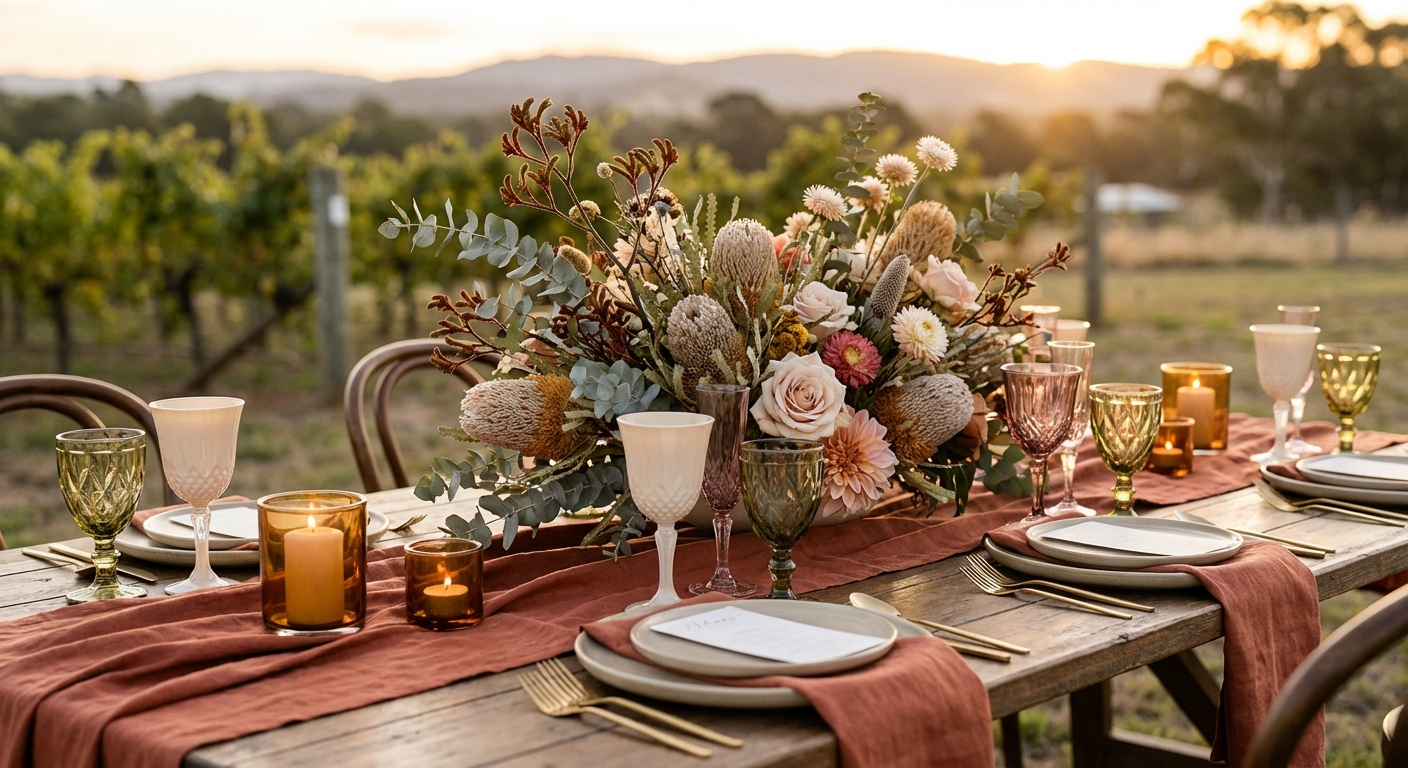
When the heat of an Australian summer begins to soften and the first cool evenings arrive, something shifts in the way couples approach their wedding styling. The bright whites, ocean blues, and tropical greens that dominate summer celebrations give way to something richer, warmer, and more grounded. Autumn, which stretches from March through May across Australia, brings with it a natural colour palette that many designers and stylists consider the most beautiful of any season.
In 2026, the trend towards earthy, muted wedding colour palettes has reached its peak. Australian couples are moving away from the stark minimalism that defined weddings in recent years and embracing warmth. Terracotta, dusty rose, olive green, warm ochre, burnt sienna, and deep burgundy are appearing in everything from bridesmaid dresses to table linens, floral arrangements to digital invitations. The result is weddings that feel intimate, considered, and deeply connected to the Australian landscape.
This guide explores the colour palettes that are defining autumn weddings across Australia in 2026. Whether you are planning a vineyard celebration in the Yarra Valley, a garden ceremony in the Adelaide Hills, or a coastal reception on the NSW South Coast, these palettes will help you create a cohesive visual story that runs from your first save-the-date through to the last dance.
Why Earthy Colour Palettes Work So Well for Australian Autumn Weddings
The appeal of earthy tones for autumn weddings is not simply a matter of fashion. These colours work because they are drawn directly from the environment that surrounds most Australian wedding venues during the cooler months. The golden grasses of regional Victoria, the terracotta soils of the Hunter Valley, the deep greens of Margaret River vineyards, and the soft blush of sunset over the Blue Mountains all contribute to a natural palette that earthy wedding colours echo and complement rather than compete with.
There is a practical advantage as well. Earthy tones are inherently flattering in photographs. Where stark whites can blow out in bright conditions and neon accents can look garish in natural light, muted tones like dusty rose, sage, and warm cream hold beautifully across every lighting scenario. Whether your photographer is capturing the golden hour ceremony or the candlelit reception, earthy colours maintain their depth and richness.
From a coordination standpoint, earthy palettes are also remarkably forgiving. Unlike a precise colour-matched palette where a slightly different shade of royal blue can look like a mistake, earthy tones naturally vary. A bridesmaid dress in terracotta sits comfortably next to a groomsman's tie in rust, and neither looks out of place beside table runners in burnt sienna. This tonal flexibility makes it far easier to source items from different suppliers while maintaining a cohesive look.
Finally, earthy palettes carry an emotional weight that lighter schemes sometimes lack. They evoke warmth, comfort, and intimacy. For couples who want their wedding to feel like a gathering of people they love rather than a curated showroom, these grounded tones set exactly the right mood.
Palette One: Terracotta and Dusty Rose
This is arguably the defining colour combination of the 2026 Australian autumn wedding season. Terracotta, with its warm, clay-like richness, pairs beautifully with the soft femininity of dusty rose. Together, they create a palette that feels both modern and timeless, grounded yet romantic.
How to Style This Palette
Start with terracotta as your anchor colour. This works beautifully for key structural elements: table runners, pillar candles, ceramic vases, and the groom's tie or pocket square. Dusty rose then operates as the softer counterpoint, ideal for bridesmaid dresses, napkins, floral highlights, and invitation suite accents.
For florals, this palette sings when paired with garden roses in soft pink, dried banksia pods, pampas grass, and eucalyptus foliage. The combination of fresh and dried elements has become a signature of Australian autumn weddings, and the terracotta-to-rose gradient provides the perfect canvas for this mixed approach.
Pair these two hero colours with warm cream or ivory for your base tones, and introduce subtle hints of gold through cutlery, candleholders, or signage. The overall effect is warm, inviting, and unmistakably autumnal.
This palette is particularly stunning at winery venues across the Yarra Valley, McLaren Vale, and Margaret River, where the terracotta tones echo the natural soils and the dusty rose complements the fading vine leaves of early autumn.
Budget Considerations
One advantage of this palette is its accessibility. Terracotta-toned homewares and decor items are widely available from Australian retailers, with ceramic vases starting from around $12 AUD and pillar candles from $8 AUD. Dusty rose bridesmaid dresses are stocked by most Australian bridal retailers, with options ranging from $149 AUD for off-the-rack styles to $350 AUD for custom designs. The dried floral elements that complement this palette also tend to be more cost-effective than entirely fresh arrangements, as they can be sourced weeks in advance and reused across the ceremony and reception.
Palette Two: Olive Green, Warm Cream, and Antique Gold
For couples drawn to the lush, botanical side of autumn, this palette captures the feeling of a garden that has matured through summer and settled into something richer. Olive green is the star here, a colour that has surged in popularity through 2025 and 2026 as couples look for alternatives to the overused sage and eucalyptus tones of recent years.
Bringing This Palette to Life
Olive green works as a bold, confident base. Consider it for bridesmaid dresses, groomsmen's suits, or large-scale decor elements like draped fabric backdrops and table linens. Unlike lighter greens, olive has enough depth to anchor a colour scheme without needing a darker companion. It reads as sophisticated and intentional rather than simply natural.
Warm cream provides the contrast and lightness the palette needs. Use it for tableware, your invitation suite, and the bride's gown if white feels too stark against the warmer surrounding tones. Antique gold, rather than bright or yellow gold, adds a layer of subtle luxury. Think gold-rimmed glassware, brass candlesticks, and metallic accents on signage and place cards.
Florally, this palette lends itself to lush greenery arrangements anchored by olive branches, Italian ruscus, and preserved autumn leaves, with cream-coloured roses, dahlias, or ranunculus providing the focal blooms. The effect is abundant without being overwhelming.
This combination is especially effective for garden weddings in the Blue Mountains, Daylesford, or the Sunshine Coast hinterland, where the surrounding foliage provides a natural extension of the palette. Indoor venues with exposed brick or timber also complement these tones beautifully.
The Details That Make It Work
The success of this palette lies in the small touches. Wax-sealed envelopes in olive green, handwritten place cards on cream stock with gold ink, olive branch sprigs tucked into each napkin setting, and a custom cocktail garnished with a sprig of rosemary all reinforce the theme without making it feel heavy-handed. The goal is consistency without repetition.
For your digital wedding website and RSVP page, carry the olive and cream through your colour scheme and typography choices. A well-designed online RSVP that matches your physical stationery creates a seamless experience for guests and reinforces the visual identity of your celebration from the very first interaction.
Palette Three: Rust, Sage, and Deep Burgundy
This is the palette for couples who want their autumn wedding to feel bold and dramatic without straying into territory that feels forced or theatrical. Rust provides the warmth, sage offers a cool, grounding counterpoint, and deep burgundy delivers the richness that makes the entire scheme feel celebratory.
Creating Drama Through Colour
The key to making this three-colour palette work is establishing a clear hierarchy. Burgundy is your accent colour, used sparingly but with impact: think velvet table runners, a statement floral installation, the groom's tie, or a signature red wine served at the table. Rust is your primary warm tone, appearing in bridesmaid dresses, candles, dried floral elements, and printed materials. Sage operates as the connective tissue, appearing in foliage, linen napkins, and subtle background elements.
This palette is particularly well suited to evening receptions where candlelight can bring out the depth in each colour. The burgundy deepens, the rust glows, and the sage recedes into a soft backdrop. For couples planning a ceremony at golden hour with a reception that extends into the evening, this palette transitions beautifully from daylight to candlelight.
Venue-wise, this combination is striking at heritage properties, converted warehouses, and homestead-style venues. Locations like Bendooley Estate in the Southern Highlands, The Refinery in Brisbane, or Mandoon Estate in the Swan Valley provide the architectural character that elevates these colours.
Floral Direction
For floral arrangements in this palette, work with your florist to incorporate burgundy dahlias or ranunculus as the hero bloom, complemented by rust-toned chrysanthemums, dried protea, and generous amounts of seeded eucalyptus and sage-toned foliage. Native Australian elements like leucadendron and kangaroo paw in deep red tones add texture and a distinctly local character.
Expect to budget between $2,500 and $5,000 AUD for a comprehensive floral package in this palette, depending on the scale of your arrangements and whether you opt for a feature installation. Dried elements can reduce costs while adding the textural variety that this colour scheme thrives on.
Palette Four: Warm Ochre, Cinnamon, and Soft Cream
This is the warmest of the trending palettes and one that draws directly from the Australian outback landscape. Ochre, a golden-brown tone with yellow undertones, paired with the spiced warmth of cinnamon and the softness of cream, creates a palette that feels uniquely Australian in a way that few imported trends can match.
Styling with Warmth
Ochre is a statement colour that works best when used with confidence. Consider it for your ceremony backdrop, whether that is a draped fabric arch or a painted timber panel. Cinnamon complements ochre without competing, making it ideal for bridesmaid dresses, groomsmen's accessories, and printed materials like menus and programs.
This palette is inherently cosy, which makes it perfect for smaller, more intimate weddings. A long table reception for sixty guests in a converted barn, styled with ochre linen, cinnamon-coloured candles, and cream tableware, creates the feeling of gathering around a family table. Add trailing greenery down the centre of the table and the effect is complete.
For venues, consider locations that echo these warm tones naturally. Homesteads and farmhouses in the Barossa Valley, rural properties in the Southern Highlands, and outback-inspired venues in regional Queensland all provide backdrops where this palette feels authentically at home.
Incorporating Native Australian Elements
This palette offers the strongest opportunity to incorporate native Australian botanicals and materials. Dried banksia pods, preserved kangaroo paw in golden tones, waratahs, and native grasses all sit comfortably within the ochre and cinnamon spectrum. Timber slices as charger plates, raw linen table runners, and hand-thrown ceramic tableware in earthy tones reinforce the connection to the Australian landscape.
Several Indigenous Australian artists and makers produce ceramics, textiles, and artworks that incorporate ochre tones and patterns. Where possible and appropriate, sourcing these elements for your wedding decor supports First Nations artists and adds a layer of cultural authenticity that guests will notice and appreciate. Always ensure that any Indigenous elements are sourced ethically and with proper attribution.
Carrying Your Colour Palette Into Your Digital Wedding Presence
A colour palette only reaches its full potential when it is applied consistently across every touchpoint, and in 2026, your digital presence is often the first place guests encounter your wedding's visual identity. Your wedding website, online RSVP, and digital save-the-dates are not afterthoughts. They are the opening act.
Your RSVP Page as a Design Statement
The best wedding RSVP platforms allow you to customise colours, fonts, and imagery to match your chosen palette. When selecting a platform, look for one that offers enough flexibility to carry your terracotta, olive, or ochre tones through the interface. Your RSVP page should feel like a natural extension of your physical stationery, not a generic web form with your names at the top.
Consider how your colour palette translates to screen. Earthy tones generally perform well digitally, but some adjustments may be needed. Deep burgundy can appear almost black on lower-quality screens, so ensure there is enough contrast between your background and text colours. Ochre and terracotta tones should be tested across both desktop and mobile to confirm they render consistently.
If your wedding website includes imagery, select photos that complement your palette. For a terracotta and dusty rose scheme, engagement photos taken during golden hour will integrate seamlessly. For an olive and cream palette, images captured in a garden or botanical setting reinforce the theme naturally.
Digital Save-the-Dates and Invitations
Your digital save-the-date is often the first glimpse guests have of your wedding's visual direction. Treat it as a design preview rather than a standalone piece. If your palette is rust, sage, and burgundy, your save-the-date should introduce at least two of these colours so that when your formal invitation arrives, whether digital or printed, guests recognise the visual language immediately.
Tools like Canva, Paperless Post, and dedicated wedding stationery platforms offer templates that can be customised to match earthy palettes. For a more polished result, consider commissioning a graphic designer to create a suite of digital assets including your save-the-date, invitation, RSVP confirmation email, and any event-specific graphics for multi-event celebrations.
Consistency across these digital touchpoints signals to guests that your wedding is thoughtfully planned and builds anticipation for what the day itself will look and feel like.
Common Mistakes When Working With Earthy Palettes
While earthy colour palettes are forgiving by nature, there are a few pitfalls that can undermine the effect you are aiming for.
Using Too Many Colours at Once
The most effective autumn palettes use two to three core colours with one or two supporting tones. When couples try to incorporate terracotta, olive, burgundy, ochre, dusty rose, and sage all at once, the result can feel muddled rather than curated. Choose your palette, commit to it, and let the natural environment provide any additional colour variation.
Neglecting Your Neutral Base
Every earthy palette needs breathing room, and that comes from your neutral tones. Warm cream, ivory, or soft white should make up at least forty to fifty per cent of your overall colour usage. Without this neutral base, the richer tones can feel overwhelming, particularly in photographs where every surface is competing for attention.
Ignoring the Venue's Existing Colour Story
Before finalising your palette, visit your venue and take note of its existing colours. A terracotta palette can clash with a venue that has cool-toned grey stone walls. Olive green may disappear in a venue surrounded by dense green gardens. The most successful colour schemes work with the venue rather than against it. Take fabric swatches and hold them against the venue's walls, floors, and surrounds before making your final decision.
Assuming Screen Colours Will Match Print
Colours render differently on screen than they do in print. A terracotta that looks perfect on your laptop may print with more orange than you intended, while a dusty rose can shift towards grey on certain paper stocks. If you are producing both digital and printed materials, always order physical samples before committing to a full print run. Most Australian stationery printers offer sample packs starting from $25 AUD.
Matching Your Palette to the Autumn Timeline
The Australian autumn spans three months, and the natural colour landscape shifts noticeably across that period. Choosing a palette that aligns with the specific month of your wedding can enhance the connection between your styling and the environment.
March: Late Summer Into Early Autumn
March sits at the transition point between summer and autumn. The light is still warm and golden, but the intensity of midsummer has softened. Palettes that bridge both seasons work well here. Terracotta and dusty rose, or warm ochre with cream, capture the lingering warmth while introducing the earthiness of the approaching season. Greens are still lush and vibrant, so olive and sage tones integrate naturally with the surrounding landscape.
April: The Heart of Autumn
By April, autumn has fully arrived. Leaves are turning in earnest across the southern states, the light takes on a softer, more amber quality, and the air has a crispness that changes the mood of outdoor gatherings. This is the month where richer, deeper palettes come into their own. Rust, sage, and burgundy feel perfectly calibrated to the April landscape. The deeper tones echo the changing foliage and complement the golden-hour light that many couples choose for their ceremony timing.
May: Late Autumn Approaching Winter
May weddings sit at the edge of winter, and the palette opportunities shift accordingly. Darker, moodier tones work beautifully in May. Deep burgundy, forest green, charcoal, and plum create a sense of richness and occasion that suits the shorter days and cooler evenings. For couples planning May weddings, embracing the drama of the season rather than fighting it produces the most striking results. Candlelight becomes essential rather than optional, and fabrics like velvet and wool feel perfectly at home.
Choosing the Palette That Tells Your Story
A wedding colour palette is not just a decorating decision. It is a storytelling tool that communicates who you are as a couple and what you want your guests to feel when they step into your celebration. The earthy palettes trending across Australian weddings in 2026 are popular precisely because they create atmospheres that feel genuine and welcoming rather than performative.
When choosing your palette, start with the colours that resonate with you emotionally rather than the ones that are generating the most engagement on social media. If you feel drawn to the warmth of terracotta, trust that instinct. If olive green reminds you of the vineyard where you got engaged, lean into it. The best wedding colour schemes are the ones that feel personal, and the earthy tones of an Australian autumn provide one of the most beautiful starting points imaginable.
Begin by selecting two to three core colours, visit your venue with samples in hand, brief your vendors clearly, and carry your palette consistently from your digital save-the-date through to the last detail of your reception styling. When every element speaks the same visual language, the result is a celebration that feels effortlessly cohesive and unmistakably yours.