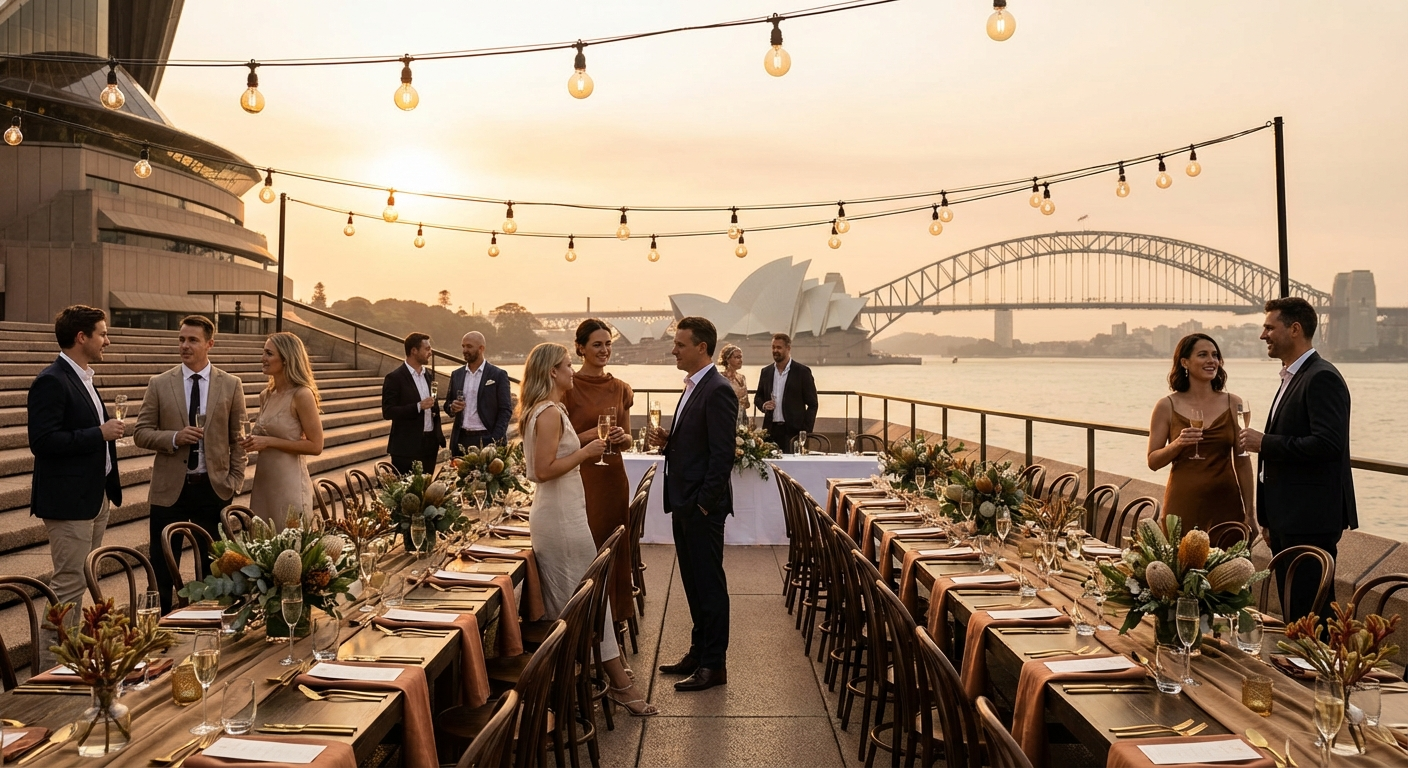
The conversation tends to begin quietly. A couple sits down with their venue contract and realises their dream location has a strict capacity of one hundred and twenty. They look at their guest list, already pushing one hundred and forty, and start doing the arithmetic that every Australian couple eventually confronts: if every family brings their children, the numbers simply do not work.
Or perhaps the motivation is different. Maybe the couple wants an evening of cocktails, loud music, and an atmosphere that leans more toward a sophisticated celebration than a family gathering. Maybe the venue itself is not child-friendly, with open water features, steep staircases, or a location that makes supervision difficult. Whatever the reason, the decision to host an adults-only wedding is becoming increasingly common across Australia in 2026.
According to Easy Weddings, nearly one in three Australian couples now choose to make their reception adults-only, a figure that has risen steadily over the past five years. The trend reflects broader shifts in how Australians approach weddings: smaller guest lists, more intentional experiences, and a willingness to prioritise the celebration they actually want over the one they feel obligated to host.
Yet for all its growing acceptance, the adults-only wedding remains one of the most socially delicate decisions a couple can make. It touches on family dynamics, cultural expectations, financial pressures, and deeply held beliefs about what weddings should look like. This guide walks you through every aspect of planning a child-free wedding in Australia, from the initial decision through to the RSVP process, communication strategies, and practical solutions that keep your relationships intact while honouring your vision for the day.
Why More Australian Couples Are Choosing Adults-Only Weddings
The reasons behind an adults-only wedding are rarely singular. Most couples arrive at the decision through a combination of practical constraints and personal preferences, and understanding your own motivations clearly will help you communicate them to guests with confidence.
Budget is often the most straightforward factor. The average cost per head at an Australian wedding reception in 2026 sits between $180 and $350 AUD depending on the venue, location, and catering style. For a couple with twenty children on their potential guest list, that represents an additional $3,600 to $7,000 AUD in catering costs alone, before considering the children's entertainment, supervision logistics, and additional venue requirements. In an era where the average Australian wedding costs between $35,000 and $45,000 AUD, trimming the guest list by excluding children can free up significant budget for other priorities.
Venue capacity is another common driver. Many of Australia's most sought-after wedding venues have firm capacity limits dictated by licensing, safety regulations, or the physical space itself. A heritage-listed homestead in the Southern Highlands might accommodate one hundred guests comfortably but become cramped and chaotic with an additional thirty children. Rooftop venues in Melbourne and Sydney frequently have strict headcount limits that include all attendees regardless of age.
Then there is the matter of atmosphere. Some couples envision an evening that runs late, features a cocktail-forward reception, and centres on dancing, speeches, and adult conversation. They want their guests to relax, drink freely, and enjoy themselves without the background awareness that children are present and potentially unsupervised. This is not a judgement on children or parents. It is simply a choice about the kind of evening the couple wants to create.
Safety concerns also play a role, particularly at outdoor and regional venues. A winery wedding in the Yarra Valley surrounded by working vineyards, a clifftop ceremony at a Great Ocean Road venue, or a reception at a converted warehouse in Brisbane with exposed industrial elements all present environments where young children require constant supervision. Couples who choose these venues often feel that an adults-only policy is the most responsible approach.
When and How to Communicate Your Adults-Only Policy
The single most important principle in managing a child-free wedding is early, clear, and consistent communication. Ambiguity is the enemy. Every piece of confusion you leave in a guest's mind will eventually become a conversation you have to have, and by then, assumptions may have already been made.
The Save-the-Date Stage
Your save-the-date is the first opportunity to signal the adults-only nature of your wedding, and while it does not need to carry the full weight of the message, a subtle indication here sets expectations early. The most common approach is to address the save-the-date exclusively to the adult members of a household. If you are sending to the Smith family, the envelope reads 'Mr David Smith and Ms Sarah Smith' rather than 'The Smith Family.' This small detail communicates that the invitation is specifically for the named adults.
Some couples choose to include a brief line on the save-the-date itself, such as 'We respectfully request an adults-only celebration' or 'This will be an adults-only event.' There is no need to over-explain at this stage. The goal is simply to plant the seed so that when the formal invitation arrives, the policy does not come as a surprise.
The Formal Invitation
The formal invitation is where your adults-only policy should be stated clearly and unambiguously. Australian wedding etiquette has evolved to accept several standard phrases that communicate this boundary with grace. The most widely used options include: 'We have reserved [number] seats in your honour' printed on the RSVP card, which specifies exactly how many people from each household are invited. 'We respectfully request that this be an adults-only celebration' placed on a details card or at the bottom of the invitation. 'Due to venue capacity, we are unable to accommodate guests under the age of eighteen' for couples who want to frame the decision around a practical constraint.
Avoid softening the language to the point where it becomes unclear. Phrases like 'We would prefer an adults-only evening' or 'We kindly ask that children not attend' can be interpreted as suggestions rather than firm policies, and some guests will take the ambiguity as permission to bring their children regardless. Be warm but definitive.
If you are using printed invitations, include the adults-only note on the details card rather than the main invitation itself. This keeps the primary invitation elegant and moves the logistical information to a supplementary card where it sits alongside other practical details like dress code, parking, and accommodation.
Your Wedding Website and RSVP Platform
Your wedding website is arguably the most powerful tool for communicating and enforcing an adults-only policy. Unlike a printed invitation, a website can explain the decision with context, provide resources for parents, and integrate directly with your RSVP system to ensure compliance.
Dedicate a section of your FAQ page to the adults-only policy. A thoughtful explanation might read: 'We have made the difficult decision to host an adults-only reception. This allows us to stay within our venue capacity and create the evening atmosphere we have envisioned. We understand this may require additional planning for families with young children, and we have included some childcare resources below to help.' This approach acknowledges the inconvenience, explains the reasoning, and offers practical help.
The real power comes from your digital RSVP system. Platforms like WeddingRSVP.org allow you to set the exact number of seats allocated to each household, meaning a couple invited without their children will see only two available seats when they RSVP online. This removes the awkward possibility of a guest adding their children's names to the response. The system enforces the policy automatically, without the couple needing to have individual conversations.
Handling the Pushback: Scripts for Difficult Conversations
No matter how clearly you communicate your adults-only policy, some guests will push back. This is normal, expected, and manageable. The key is to respond with empathy, consistency, and firmness. The moment you make one exception, word will spread, and the policy collapses.
When Close Family Members Object
The most challenging pushback typically comes from parents, siblings, or close family members who feel their children should be exempt. A sibling might say, 'But the kids are part of the family, they should be there.' A parent might express disappointment that their grandchildren will not witness the ceremony.
A helpful response framework is to acknowledge, explain, and hold firm. 'We completely understand how you feel, and we love [child's name] so much. We made this decision for all children, not just some, because we wanted to be fair and consistent. The venue has a strict capacity, and we also wanted to create a late-night atmosphere that works best for adults. We would love to celebrate with the whole family at [alternative event, such as a post-wedding brunch].'
The offer of an alternative gathering is powerful. Many Australian couples in 2026 are hosting a casual post-wedding brunch or barbecue the following day where children are explicitly welcome. This gives families a moment to celebrate together without compromising the reception atmosphere. A Sunday morning brunch at a local cafe in the Barossa Valley or a relaxed gathering at a park near the ceremony venue costs relatively little and goes a long way toward maintaining family harmony.
The Breastfeeding Baby Exception
One of the most commonly debated exceptions is breastfeeding babies. Australian anti-discrimination law protects a mother's right to breastfeed in public, and many couples feel uncomfortable excluding a mother and her nursing infant from the celebration. The pragmatic approach taken by most couples is to allow breastfeeding babies under twelve months as the sole exception to the policy, while making it clear that toddlers and older children are not included.
If you choose to make this exception, communicate it directly and privately to the relevant guests rather than broadcasting it broadly. A quiet message to a new mother saying 'Of course your baby is welcome, we understand completely' is far more graceful than a blanket announcement that invites other parents to argue that their child should also qualify.
Interstate and International Guests With Children
Guests travelling from Perth to a Sydney wedding, or flying in from overseas, face a genuine logistical challenge if they have young children. Acknowledging this difficulty and offering practical solutions demonstrates that you have thought about their situation and care about their experience.
Research reputable babysitting services in the area near your venue and include these recommendations on your wedding website. In major Australian cities, agencies like Rent-a-Grandma, Dial an Angel (operating across Sydney, Melbourne, and Brisbane), and local nanny networks offer evening and event-based childcare. Some venues, particularly larger resorts and estates, can arrange on-site childcare in a separate room, allowing parents to check on their children throughout the evening while still enjoying the adults-only reception.
For destination weddings in regional areas like the Hunter Valley, Byron Bay, or Margaret River, consider whether accommodation options include family-friendly units where older children can stay with a babysitter while parents attend the reception at a nearby venue. Providing this information proactively shows thoughtfulness and reduces the likelihood of guests declining the invitation entirely.
Setting Up Your RSVP System for an Adults-Only Wedding
A well-configured digital RSVP system is your greatest ally in managing an adults-only wedding. It removes ambiguity, automates enforcement, and provides you with clean data for your venue and caterer.
Per-Household Seat Allocation
The most effective approach is to pre-load your guest list into your RSVP platform with the exact number of seats allocated to each household. A couple without children receives two seats. A single guest receives one. When a guest accesses their RSVP link, they see only the number of seats available to them and can only confirm or decline for those specific people. There is no open text field where they might add 'plus little Timmy.'
WeddingRSVP.org supports this functionality natively, allowing you to set individual seat counts when uploading your guest list. Each household receives a unique RSVP link that displays their specific allocation, making it impossible for a guest to RSVP for more people than you have invited.
FAQ Integration and Automated Messaging
Integrate your adults-only policy into the automated confirmation message that guests receive after submitting their RSVP. A line such as 'Thank you for confirming your attendance. As a reminder, this is an adults-only celebration. We look forward to seeing you on the night' reinforces the message at every touchpoint.
If your platform supports custom fields, consider adding a question such as 'Do you require information about local childcare services?' This serves a dual purpose: it acknowledges that some guests have children and may need help arranging care, and it subtly reinforces that children will not be attending. Guests who select 'yes' can receive an automated follow-up email with your curated list of babysitting recommendations.
Tracking and Managing Exceptions
Despite your best efforts, some guests may contact you directly to request an exception. Keep a simple tracking document that records every exception request, your response, and the outcome. This ensures consistency across both sides of the couple and prevents the situation where one partner grants an exception without the other knowing.
If you do grant any exceptions, such as the breastfeeding baby scenario, update your RSVP system to reflect the accurate headcount. Your venue coordinator and caterer need precise numbers, and an unexpected infant at the table still requires a highchair, a place setting, and potentially a modified meal if the child is eating solids.
Legal and Cultural Considerations in Australia
Australian couples should be aware that while there is no legal obligation to invite children to a private event, cultural sensitivity is important. In many Australian communities, particularly those with Mediterranean, Middle Eastern, South Asian, or Pacific Islander heritage, weddings are multigenerational family events where the presence of children is considered essential and their exclusion may cause genuine offence.
If your guest list includes families from these cultural backgrounds, a personal conversation early in the planning process is more appropriate than a blanket policy communicated via invitation. Explain your reasons directly, acknowledge the cultural significance, and offer compromises where possible. Some couples with mixed cultural guest lists choose to invite children to the ceremony but not the reception, or to host a separate family celebration in addition to the adults-only reception.
From a venue and licensing perspective, adults-only receptions simplify compliance with responsible service of alcohol requirements. Licensed venues in Australia must ensure that alcohol is served responsibly, and a reception without children removes certain complexities around supervision and the proximity of minors to alcohol service areas. This is not a primary reason to go child-free, but it is a practical benefit worth noting, particularly for venues with complex licensing arrangements.
Day-of Logistics and Contingency Planning
Even with perfect communication, there is a small but real possibility that a guest will arrive with their children on the day. Having a plan for this scenario is essential.
Arrival and Check-In
If you have a wedding coordinator, brief them explicitly on the adults-only policy and empower them to handle any situations that arise at the door. The coordinator can gently redirect a guest who has arrived with children, offering to help them contact a babysitter or suggesting the children wait in a nearby area if the venue has a suitable space. This removes the burden from the couple entirely and ensures the situation is handled professionally.
For couples without a coordinator, designate a trusted friend or family member to serve this function. This person should be someone with diplomatic skills and the authority to make decisions on the spot. Brief them thoroughly before the day and provide them with a list of local babysitting contacts in case they are needed.
Venue Preparation
Discuss the adults-only policy with your venue coordinator well in advance. Some venues, particularly those offering on-site accommodation like Spicers Peak Lodge in Queensland, Chateau Yering in the Yarra Valley, or Pullman Bunker Bay Resort in Margaret River, may be able to designate a room for childcare where families with babysitters can settle their children during the reception. This option works particularly well for destination weddings where guests are staying on-site.
Ensure your venue removes or secures any children-specific items that might send mixed signals. If the venue normally provides highchairs or children's menus, confirm that these will not be visible during your reception. Small details like these reinforce the adults-only atmosphere and prevent confusion among guests.
Creating Alternative Celebrations for Families
The most successful adults-only weddings are those where the couple has thoughtfully created space for families to celebrate outside the main reception. This demonstrates that the policy is not about excluding children but about curating a specific experience for the reception itself.
A post-wedding brunch is the most popular alternative in Australia. Hosted the morning after the reception, typically at a casual restaurant, park, or the accommodation venue itself, it gives families the chance to gather, share stories from the night before, and celebrate together in a relaxed environment. Children can run around, babies can be held and admired, and the couple gets the joy of seeing their entire community in a low-pressure setting. Budget $25 to $60 AUD per person for a venue-hosted brunch, or significantly less for a DIY affair at a park or holiday house.
Some couples host a pre-wedding picnic or afternoon tea on the day before the ceremony, specifically designed as a family-friendly gathering. This works particularly well for destination weddings in areas like the Blue Mountains, Kangaroo Valley, or the Mornington Peninsula, where guests have often travelled for the weekend and appreciate structured social time. A casual picnic in a park costs very little to organise and creates beautiful, relaxed memories with children included.
For couples who want children present at the ceremony but not the reception, a clear transition point is essential. This typically means the ceremony finishes, the couple has their formal photos, and there is a defined moment where families with children depart and the reception begins. Having a planned activity for the children during this transition, such as a pizza dinner at a nearby restaurant supervised by a hired babysitter, makes the handover smooth and gives the children their own fun event to enjoy.
Your Wedding, Your Rules, Your Grace
Choosing an adults-only wedding is not a selfish decision. It is a practical, thoughtful choice made by couples who know what they want and are willing to navigate the social complexity that comes with it. The Australian wedding landscape in 2026 is remarkably accepting of this choice, and the vast majority of guests, once informed clearly and early, will respect it without issue.
The couples who navigate this most successfully are those who pair their boundary with genuine care. They communicate early and clearly. They explain their reasoning without over-apologising. They offer practical alternatives and resources. They hold their policy consistently while making individual exceptions with discretion where truly warranted. And they create moments, whether a post-wedding brunch, a pre-ceremony picnic, or a simple heartfelt note, that remind their guests with children that they are loved and valued even if their little ones are not at the reception.
Your RSVP system is the backbone of this entire process. Set it up correctly from the start, use per-household seat allocations, integrate your policy into every communication touchpoint, and let the technology handle the enforcement so you can focus on the relationships. A well-managed digital RSVP platform turns what could be weeks of awkward conversations into a smooth, automated process that respects both your vision and your guests' dignity.
Plan with intention, communicate with grace, and celebrate with joy. That is what every Australian wedding, adults-only or otherwise, deserves.
An adults-only wedding is one of the most personal decisions you will make during the planning process, and it deserves the same care and intention you bring to choosing your venue, your flowers, and your vows. By communicating clearly from the save-the-date through to the RSVP process, offering genuine alternatives for families, and using a digital RSVP system that enforces your policy with elegance, you can host the celebration you have envisioned without sacrificing the relationships that matter most. The key is consistency, empathy, and a willingness to hold your boundary with grace.