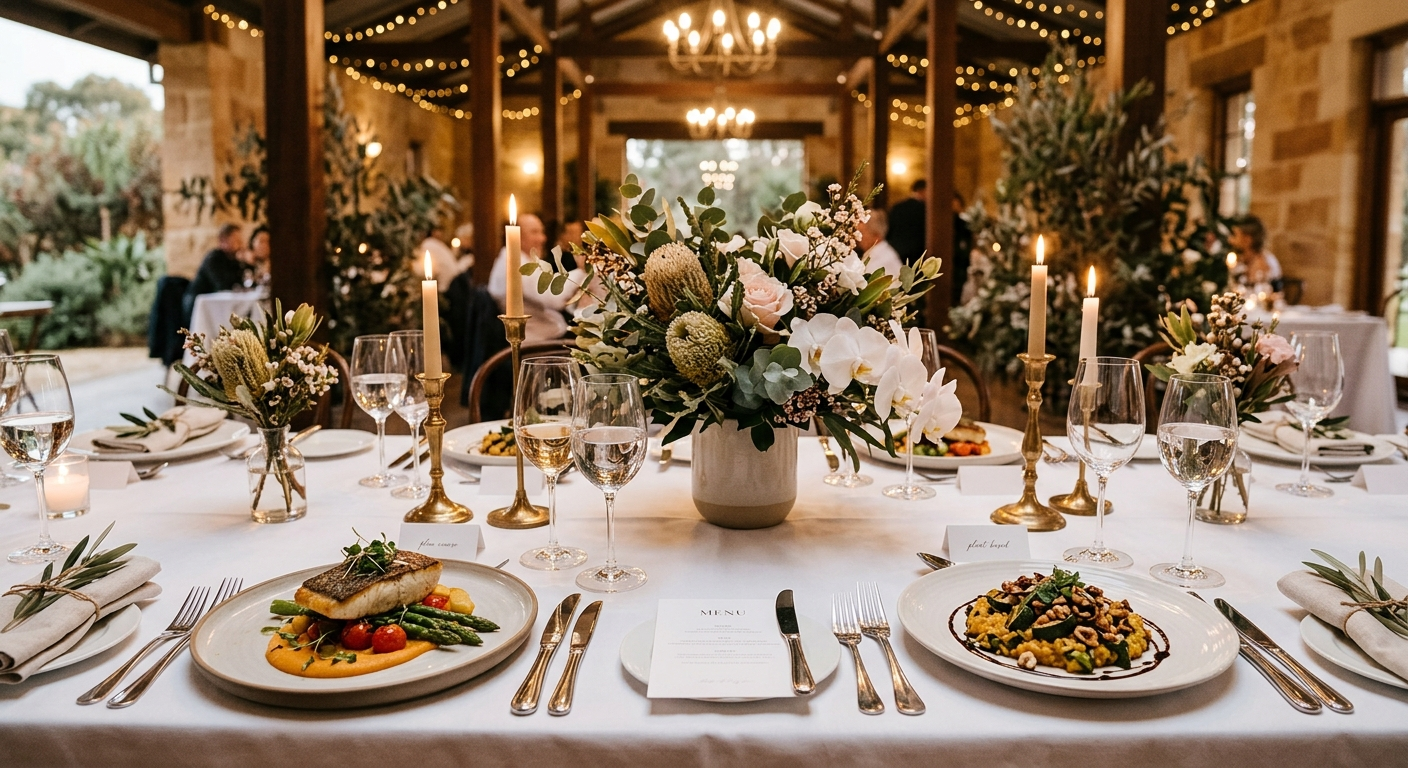
The dietary requirements section of your wedding RSVP form is one of the most consequential elements of your wedding planning process. Done well, it is a seamless mechanism for ensuring every guest is fed safely and appropriately. Done poorly, it is a source of confusion, anxiety, and potentially serious consequences on the day itself. In 2026, Australian couples are managing more dietary complexity than at any previous point in wedding history. The combination of rising rates of food allergies, the mainstreaming of plant-based diets, increased cultural diversity in Australian wedding guest lists, and a generation of guests who are more articulate about their dietary needs than ever before means that the question of what to serve and how to ask about it has become one of the central planning challenges for Australian couples. This guide addresses it comprehensively.
The stakes are real. A guest with coeliac disease who is served gluten at your wedding is not merely inconvenienced — they are made unwell. A guest with a severe peanut allergy who detects a trace in their meal is experiencing a medical emergency. A guest who keeps halal and discovers that the lamb was not slaughtered according to Islamic requirements may feel excluded from a celebration they travelled interstate to attend. These are not edge cases or sensitivities to be managed lightly. They are legitimate, deeply held requirements that guests have every right to hold, and that Australian couples have an obligation to take seriously. The good news is that managing dietary requirements through your RSVP process and your catering arrangements is not complicated — it just requires clarity, specificity, and systematic follow-through. This guide covers everything you need to know.
Whether you are planning a standing cocktail reception at a venue in the Melbourne CBD, a shared-table dinner at a winery in the Margaret River region, a buffet-style celebration at a farm in the Adelaide Hills, or a formal sit-down banquet at a waterfront venue on the Gold Coast, the principles of dietary management are the same. Understand what your guests need, communicate it accurately to your caterer, and build a system that catches gaps before they become problems. That system starts with your RSVP.
Understanding the Australian Wedding Dietary Landscape in 2026
Australian wedding guest lists in 2026 reflect the full diversity of contemporary dietary culture in this country. The couple sending invitations to a 100-guest wedding in Sydney, Melbourne, Brisbane, or Perth is as likely as not to have guests who identify as vegan, vegetarian, pescatarian, or flexitarian. They are likely to have at least one guest with a diagnosed food allergy — to peanuts, tree nuts, shellfish, dairy, or gluten — that ranges from inconvenient to life-threatening. They are likely to have guests with medical dietary requirements: diabetes management, low-FODMAP needs, histamine intolerance, or autoimmune conditions that require specific eating protocols. And depending on the cultural background of the couple and their families, they may have guests who keep halal, kosher, or Hindu dietary requirements. The era of the simple 'vegetarian or meat' RSVP option is over.
What has changed is not just the range of dietary requirements but the sophistication with which guests communicate them. In 2026, a guest with coeliac disease is not going to write 'coeliac' on your RSVP form and trust that it will be understood and actioned. They are going to expect a process: a specific question on the RSVP form, a confirmed conversation with the caterer, a clearly labelled dish on the day, and ideally a briefing from the venue about their protocols for avoiding cross-contamination. This is not entitlement — it is self-advocacy, and it is entirely reasonable. A guest with a serious food allergy has likely experienced the consequences of ambiguity and miscommunication at social events before, and they have learned to be explicit about their needs. Your role as a couple is to build a system that respects that explicitness and acts on it.
The shift in dietary culture has also been driven by the mainstreaming of plant-based eating. In 2026, approximately one in ten Australian adults identifies as vegetarian or vegan, and a substantially larger proportion describes themselves as 'mostly plant-based' or 'reducing their meat consumption'. For wedding caterers in Australia, this has meant a significant change in how they approach menu planning. A caterer who in 2018 would have considered a vegetarian main course as an afterthought or a secondary option is now expected to offer a vegan main that is genuinely compelling — not a limp piece of roasted vegetable on a bed of lettuce, but a considered, interesting dish that stands alongside the meat options in quality and presentation. Australian couples who are not offering a genuinely good vegan option on their wedding menu are increasingly seen as out of step with their guests' values.
The Most Common Dietary Requirements in Australian Wedding Guest Lists
When planning your RSVP form and your catering approach, it helps to have a clear picture of the categories of dietary requirements you are most likely to encounter. The first category is life-threatening allergies, which require the most rigorous management. Peanut and tree nut allergies, shellfish allergies, and severe dairy or egg allergies can result in anaphylaxis — a medical emergency that requires immediate treatment with adrenaline. Guests with these allergies will typically carry an EpiPen and will be highly proactive about communicating their requirements. Treat these requirements with the seriousness they deserve: your caterer needs to know about them before the event, and your venue needs protocols for managing a reaction if one occurs.
The second category is medical dietary requirements, which includes coeliac disease, diabetes management, irritable bowel syndrome managed through low-FODMAP diets, and histamine intolerance. These conditions are not allergies in the traditional sense but they require equally careful management, particularly coeliac disease where even trace gluten exposure causes significant health damage. Guests with these conditions are accustomed to managing their own dietary needs and will be clear about what they require. The challenge for couples is ensuring that the information they provide to caterers is both accurate and sufficiently detailed — 'coeliac' is a useful shorthand but it needs to be translated into specific menu decisions by your caterer.
The third category is ethical and lifestyle dietary requirements: vegetarian, vegan, pescatarian, and plant-based eating. These are not medical requirements but they are deeply held values for many guests, and a vegan guest who discovers that their 'vegetarian' main option was cooked in the same pan as meat products will feel disappointed and excluded. The standard for plant-based options at Australian weddings has risen significantly in recent years, and couples who treat vegan options as an afterthought will be called out — politely but firmly — by guests who have seen better food at other weddings they have attended.
The fourth category is religious and cultural dietary requirements: halal, kosher, Hindu dietary laws (no beef), Buddhist dietary restrictions, and the specific food requirements of various cultural communities represented in the Australian wedding landscape. These requirements are often more complex to manage than they first appear — halal certification, for example, requires a specific process for meat that not all caterers can provide, and the definition of halal can vary between different Islamic communities. When in doubt, ask the guest directly what they require and ensure your caterer understands and can deliver it.
Designing Your RSVP Form to Capture Dietary Information Accurately
The RSVP form is the first point of contact between your dietary management system and your guests. A well-designed RSVP dietary section does three things: it prompts guests to think about their dietary requirements before the event, it captures information in a structured format that can be communicated directly to your caterer, and it flags requirements that require a direct conversation between you and the guest before the event. A poorly designed dietary section collects vague, unusable information that your caterer cannot act on, creates confusion on the day, and potentially leaves guests without appropriate food.
The first principle of dietary RSVP design is specificity. Do not ask 'Do you have any dietary requirements?' and provide a free-text field. This approach collects information that is useless for catering purposes — a guest who writes 'I try to eat healthy' or 'I am a bit lactose intolerant' has not given your caterer anything actionable. Instead, ask specific questions that yield structured, usable responses. For allergies, provide checkboxes for the most common life-threatening allergens: peanuts, tree nuts, shellfish, dairy, eggs, gluten. Add a free-text field for 'other allergies or medical dietary requirements' and specify that guests with serious allergies should contact the couple directly. For dietary preferences, provide checkboxes for vegetarian, vegan, and pescatarian. For religious or cultural requirements, provide a field for guests to specify their requirements in their own words.
The second principle is mandatory responses. Every guest who submits an RSVP should be required to complete the dietary section. Do not make it optional, because optional fields are skipped by the majority of guests — including many who have genuine dietary requirements that you need to know about. If you are using a digital RSVP platform like WeddingRSVP, configure the dietary questions as mandatory fields that cannot be skipped. A guest who has no dietary requirements should be able to select 'No dietary requirements' and submit. A guest who has a serious allergy should be able to flag it clearly and add detail. The system should make it impossible to submit an RSVP without engaging with the dietary question.
Sample RSVP Dietary Questions That Work for Australian Weddings
The following is a model dietary section for an Australian wedding RSVP form, designed to capture structured information across all common requirement categories. Use this as a template and adapt it to your specific guest list and catering arrangements.
Section heading: 'Dietary Requirements and Preferences'. Introductory text: 'We want to make sure everyone has delicious food they can enjoy safely. Please complete this section carefully — all information will be shared with our caterer to ensure every guest is catered for.'
Question 1 (checkboxes, multi-select): 'Do you have any of the following allergies or medical dietary requirements?' Options: No allergies or medical requirements / Peanut allergy / Tree nut allergy / Shellfish allergy / Dairy allergy / Egg allergy / Coeliac disease (gluten-free) / Other medical dietary requirement (please specify below).
Question 2 (checkboxes, multi-select): 'What is your dietary preference?' Options: No preference / Vegetarian / Vegan / Pescatarian / Other (please specify below).
Question 3 (free text, optional but encouraged): 'Do you have any religious or cultural dietary requirements we should know about?' Placeholder text: 'e.g., halal, kosher, Hindu dietary requirements, Buddhist diet, etc.'
Question 4 (free text, optional): 'Is there anything else we should know about your dietary requirements?' Placeholder text: 'Please share anything that will help us ensure you have a great dining experience on the night.'
Question 5 (conditional, shown if Question 1 has any option selected): 'Please provide any additional details about your allergy or medical dietary requirement that would help our caterer keep you safe.' Placeholder text: 'e.g., severity of reaction, specific foods to avoid, medication carried.'
This structure yields structured data that your caterer can import directly — checkboxes give categorised counts, free-text fields give detail. It is not overly burdensome on the guest (it takes approximately 90 seconds to complete if you have no requirements), and it captures the information you need without asking intrusive questions.
Communicating Dietary Information to Your Caterer
Collecting dietary information from guests is only the first step. The information needs to be communicated to your caterer in a format that is actionable, specific, and unambiguous. The most common failure point in wedding dietary management is not the collection of information — it is the translation of that information into catering decisions. A caterer who receives a guest list that says 'one vegan, two coeliacs, one halal' without more detail cannot do their job properly. They need to know what these requirements mean in the context of the menu they are preparing, and they need to know it with enough lead time to plan accordingly.
The format in which you send dietary information to your caterer matters. A spreadsheet with one row per guest and columns for name, RSVP status, dietary category, and detailed requirements is significantly more useful than a verbal briefing or a general summary. Most digital RSVP platforms — including WeddingRSVP — allow you to export dietary information in a structured format that can be sent directly to your caterer. Use this export function. The investment of time required to set up the export is minimal, and the result is a document that your caterer can use to verify every dish against every guest's requirements before the event.
When briefing your caterer on dietary requirements, there are three levels of communication that need to happen. The first is an overall summary: the number of vegetarian meals, the number of vegan meals, the number of coeliac-friendly meals, the number of halal requirements, and any life-threatening allergies that require venue-level protocols. The second is a dish-by-dish confirmation: for each menu item, verifying that it is safe for every dietary category (for example, confirming that the vegetarian main course is also vegan and coeliac-friendly, or noting that it contains dairy so it is not suitable for dairy-free guests). The third is a specific protocol for life-threatening allergies: if a guest has a severe peanut allergy, your caterer needs to confirm that the kitchen has a protocol for preventing cross-contamination with peanuts, and your venue needs to know where the guest's EpiPen is located and who is trained to administer it.
The Menu Card Approach: How Top Australian Venues Handle Dietary Labelling
The gold standard for dietary management at Australian weddings is a venue that produces a menu card for each guest place setting — or at least a menu card per dietary category table — which clearly labels each dish with the dietary designations it satisfies. This is standard practice at most quality wedding venues in Australia in 2026, and it is worth requesting explicitly when you are negotiating with your caterer or venue.
A well-designed menu card lists each course and includes symbols or clear labels indicating: vegan, vegetarian, coeliac-friendly (GF), halal, and peanut/tree nut free. Some venues use a colour-coded system that makes the designations immediately visible. This approach serves multiple purposes: guests with dietary requirements can see at a glance which dishes are safe for them, guests without dietary requirements understand the choices being offered, and the caterer's commitment to dietary inclusion is demonstrated visibly on the night.
Not all venues do this automatically. When you are evaluating venues and caterers, ask specifically about their approach to dietary labelling on the night. A venue that has a standard system for menu cards and dietary labelling is a venue that has managed dietary requirements before and knows what is required. A venue that does not have a system — and does not seem to understand why you are asking — is a venue that may require more hands-on management of dietary issues in the lead-up to your event. The difference matters.
Common Dietary Management Pitfalls and How to Avoid Them
The most common pitfall in wedding dietary management is the assumption that one size fits all. A couple who offers a single vegetarian main course and assumes it will satisfy all non-meat-eating guests — including vegans, coeliac guests, and guests with multiple dietary requirements — will almost certainly fall short on the night. A dish that is vegetarian is not automatically vegan (it may contain dairy or eggs), coeliac-friendly (it may be based on wheat pasta or bread), or halal (if it contains alcohol-based sauces or non-halal cheese). The dietary categories are not interchangeable, and your menu planning needs to account for each one individually.
The second most common pitfall is the late RSVP. Dietary requirements need to be communicated to your caterer before they finalise their menu and purchase their ingredients — typically at least two weeks before the event, and earlier for venues that require advance counts. If you have guests who have not submitted their RSVP by ten days before the event, you need to follow up specifically about dietary requirements, not just attendance. Do not let guests who have not responded hold up your dietary briefing to your caterer. Follow up directly and capture the information before you finalise your catering numbers.
The third pitfall is failing to brief the venue staff who will be serving your wedding. Dietary management on the night requires that the venue's event staff — the servers, the floor managers, the kitchen team — know which guests have which requirements and which dishes are safe for which dietary categories. A detailed briefing from your caterer to the venue's event manager, with a clear written reference document for the serving staff, is not optional. Without it, the protocol for a guest with a severe allergy may break down at the critical moment — when a server who does not know about the allergy is clearing plates and accidentally places a dish containing the allergen within reach of the affected guest.
Cross-Contamination: The Issue Most Couples Forget Until It Is Too Late
Cross-contamination is the most overlooked issue in Australian wedding dietary management. It refers to the transfer of an allergen or dietary problem from one food or surface to another — for example, chopping vegetables on the same board that was used to cut meat, or serving a 'gluten-free' dish with a sauce that was thickened with wheat flour. For guests with life-threatening allergies or coeliac disease, cross-contamination is not a minor inconvenience — it is a health risk.
For coeliac guests specifically, cross-contamination is a serious concern. A dish that is made with naturally gluten-free ingredients is not automatically safe for a coeliac guest if it is cooked in the same oil as crumbed foods, prepared on a surface that has not been thoroughly cleaned, or garnished with a sauce that contains a gluten-based thickener. Your caterer needs to understand what coeliac-safe means in practice, not just in theory. When briefing your caterer on coeliac requirements, be specific: the dish must be prepared in a dedicated coeliac-safe environment, with no shared cooking surfaces or oils with gluten-containing foods. If your caterer does not have a clear protocol for this, it is worth asking them directly how they manage coeliac-safe preparation — and if they cannot answer confidently, reconsider whether they are the right caterer for your event.
For peanut and tree nut allergies, the cross-contamination risk extends to the venue's wider kitchen operations. Many venues cook with nut oils, use nut-based sauces, or have nut products in the same kitchen environment. Ask your venue specifically about their protocols for nut allergy management — whether they can completely exclude nut products from your event's food preparation, and what their emergency protocol is if a reaction occurs despite their precautions. You should also ask your guests with severe nut allergies to provide a copy of their emergency action plan, which they should have from their doctor, and ensure this is available to the venue on the night.
Managing Cultural and Religious Dietary Requirements with Sensitivity
Australian wedding guest lists in 2026 are culturally diverse, and many couples are navigating religious and cultural dietary requirements that they may not be personally familiar with. The key to managing these requirements well is simple: ask the guest directly what they need, rather than making assumptions. A guest who keeps halal does not necessarily have the same requirements as another guest who keeps halal — the specifics depend on their community, their level of observance, and their personal interpretation. Direct communication is always better than generalised research.
Halal requirements are among the most common cultural dietary requirements in Australian weddings, and they require specific attention to sourcing. A halal-certified dish requires meat that has been slaughtered according to Islamic law, and in many cases alcohol-based ingredients (including some sauces, marinades, and desserts) are also excluded. Not all Australian caterers have halal-certified menu options, and those that do may have limited choices. When you have guests who keep halal, raise this with your caterer early — ideally at the same time you brief them on the menu — and ask specifically what halal options they can provide. If your caterer cannot provide certified halal options, ask them to recommend a specialist supplier they have worked with before. The investment in getting this right is significant for your guests, and it is not something you want to discover is impossible two weeks before the event.
Kosher requirements are less common in mainstream Australian wedding catering but are important for Jewish guests. Full kosher compliance for a wedding event is complex and expensive — it typically requires a kosher caterer, separate kitchen facilities, and rabbinical supervision. For a wedding where only one or two guests keep kosher, the practical solution is usually to provide clearly labelled dishes that exclude pork and shellfish and to confirm with the guest what their specific requirements are. A guest who keeps kosher will appreciate your effort to accommodate their requirements and will typically be reasonable about what is feasible in a non-kosher venue.
Hindu dietary requirements — most commonly the exclusion of beef — require straightforward menu management once you are aware of them. Most Australian wedding caterers are familiar with Hindu dietary requirements and will be able to ensure that no beef appears in the menu for guests who have flagged this requirement. The issue is more complex when you have guests from multiple Hindu traditions — some may also exclude pork, or may be fully vegetarian — so always confirm the specific requirements with each guest rather than applying a general rule.
Special Considerations for Chinese and East Asian Dietary Traditions
For Australian couples with Chinese or broader East Asian heritage, or with guests from these communities, there are additional dietary considerations that are less commonly addressed in mainstream Australian wedding catering. The most important is the concept of 'hot' and 'cold' foods in traditional Chinese dietary theory — a framework that is not about temperature but about the energetic properties of food. Some guests from these communities will have preferences based on this framework that are not covered by standard dietary categories.
The more universally relevant consideration is the management of seafood allergies in communities where seafood is a prominent part of the cuisine. Guests from Chinese and East Asian backgrounds may have severe shellfish or seafood allergies that are easy to overlook when the menu is centred around seafood-heavy dishes like prawn cocktails, seafood platters, and fish courses. When collecting dietary information from guests in this context, ensure your RSVP form captures seafood allergies explicitly, and brief your caterer on which dishes contain seafood so they can confirm safe alternatives for affected guests.
Monosodium glutamate (MSG) sensitivity is also more commonly reported in East Asian communities and may be relevant for some guests. This is typically a less severe reaction than a true allergy but can cause significant discomfort. If you have guests who have flagged MSG sensitivity, ask your caterer whether they use MSG in their menu preparation and whether they can accommodate a reduction or elimination.
Managing Dietary Requirements on the Wedding Day
The work of dietary management does not end when your RSVP deadline passes and your catering numbers are confirmed. On the day itself, there are practical steps that need to be taken to ensure the system you have built functions correctly under the pressure of a live event. Venue coordinators who are managing multiple events simultaneously, servers who are working from memory, and kitchen staff who are preparing large quantities of food simultaneously are all operating in a high-pressure environment where errors can occur. Your role is to reduce the probability of those errors through clear preparation and communication.
Before the event, confirm with your venue coordinator that they have received and understood the dietary brief. Walk through the list of guests with life-threatening allergies and confirm that every relevant member of the serving team knows which guests these are, which dishes they can safely eat, and what the protocol is if an allergic reaction occurs. This walkthrough should happen on the morning of the event or the day before — not three weeks before, when the information may have been recorded but not retained.
On the night, position guests with life-threatening allergies at a table that is closest to the kitchen or the venue coordinator's station, so that any issue can be responded to quickly. If your venue has a head sommelier or floor manager who is overseeing service, brief them specifically on these guests and confirm they have the authority to act immediately if an allergic reaction is suspected. For guests with severe peanut or tree nut allergies, confirm that the kitchen has not used any nut products in the preparation of any dish that will be served to those guests — this should be confirmed in writing by the caterer, not assumed from a verbal briefing.
What to Do If a Dietary Emergency Occurs on Your Wedding Day
Despite the best preparation, dietary emergencies can occur. A guest who has an allergic reaction to a dish they believed was safe, a guest who discovers a non-halal ingredient in their meal, or a guest who becomes ill from a cross-contamination issue — these situations require immediate, calm action from the venue team, and the couple should not be the primary responders on their own wedding night.
The venue's duty of care to guests at an event supersedes everything else. If a guest has a severe allergic reaction, the venue's staff must call emergency services immediately, administer first aid if trained to do so, and locate the guest's EpiPen if one has been provided. The couple's role in this situation is to support their guest emotionally, to ensure their close family and friends are with them, and to trust the venue team to manage the emergency response. Do not try to manage a medical emergency personally while also trying to enjoy your wedding night — delegate to your venue coordinator and support your guest from a loving, present distance.
If a guest has a less urgent dietary issue — they discover a dish contains an ingredient they were trying to avoid but they are not experiencing a medical emergency — the response is simpler. Acknowledge the oversight sincerely, arrange for an alternative dish from the kitchen, and follow up after the event to ensure the issue is resolved to the guest's satisfaction. A genuine, prompt response to a minor dietary issue can actually strengthen your relationship with the affected guest. It shows that you care about their wellbeing and that you take their requirements seriously — even if you got it wrong on the night.
Building a Dietary Management System That Gives You Peace of Mind
Managing dietary requirements at an Australian wedding is not a single decision — it is a system, built across multiple touchpoints from the design of your RSVP form to the briefing of your venue's serving staff on the night itself. The couples who get this right are not the ones who spend the most money or choose the most elaborate caterer. They are the ones who think systematically about the process: what information they need from guests, how to collect it in a structured format, how to translate it into actionable instructions for caterers, and how to ensure those instructions are followed on the night.
The framework is straightforward. Design your RSVP to capture structured, specific dietary information from every guest. Export that information in a format your caterer can use and brief them specifically on each requirement category. Confirm your caterer's protocols for cross-contamination prevention and life-threatening allergies before the event. Brief your venue's serving team on the morning of the event, with a written reference document and a clear protocol for emergencies. And follow up after the event to learn what worked and what did not — because the feedback from your guests with the most complex dietary requirements is the most valuable data you will ever receive about your wedding catering.
Australian couples in 2026 have more resources, more information, and more support for managing wedding dietary requirements than at any previous point in history. Digital RSVP platforms make structured data collection effortless. Caterers with experience in the Australian wedding market know what is required. And your guests, who have lived with their dietary requirements for their entire lives, will be grateful for any effort you make to accommodate them. The goal is not perfection — it is genuine care, communicated through a system that works. When you get that right, every guest at your wedding feels that they were welcomed, fed, and considered. And that is the foundation of a celebration that everyone remembers warmly.
Dietary management at an Australian wedding is a topic that too many couples approach with anxiety rather than confidence. But it does not need to be daunting. The principles are clear, the tools are available, and the expectations of your guests are reasonable. Design a good RSVP form, brief your caterer properly, confirm your venue's protocols, and trust that your guests will appreciate the effort even if the execution is not absolutely perfect. The couples who manage dietary requirements best are the ones who communicate early, specifically, and with genuine care — not the ones who have unlimited budgets or flawless execution. Start the process early, work systematically through each step, and remember that every guest who feels safe and catered for at your wedding is a guest who will be fully present for the celebration you have worked so hard to create. For more RSVP management guides for Australian couples, explore the WeddingRSVP blog.