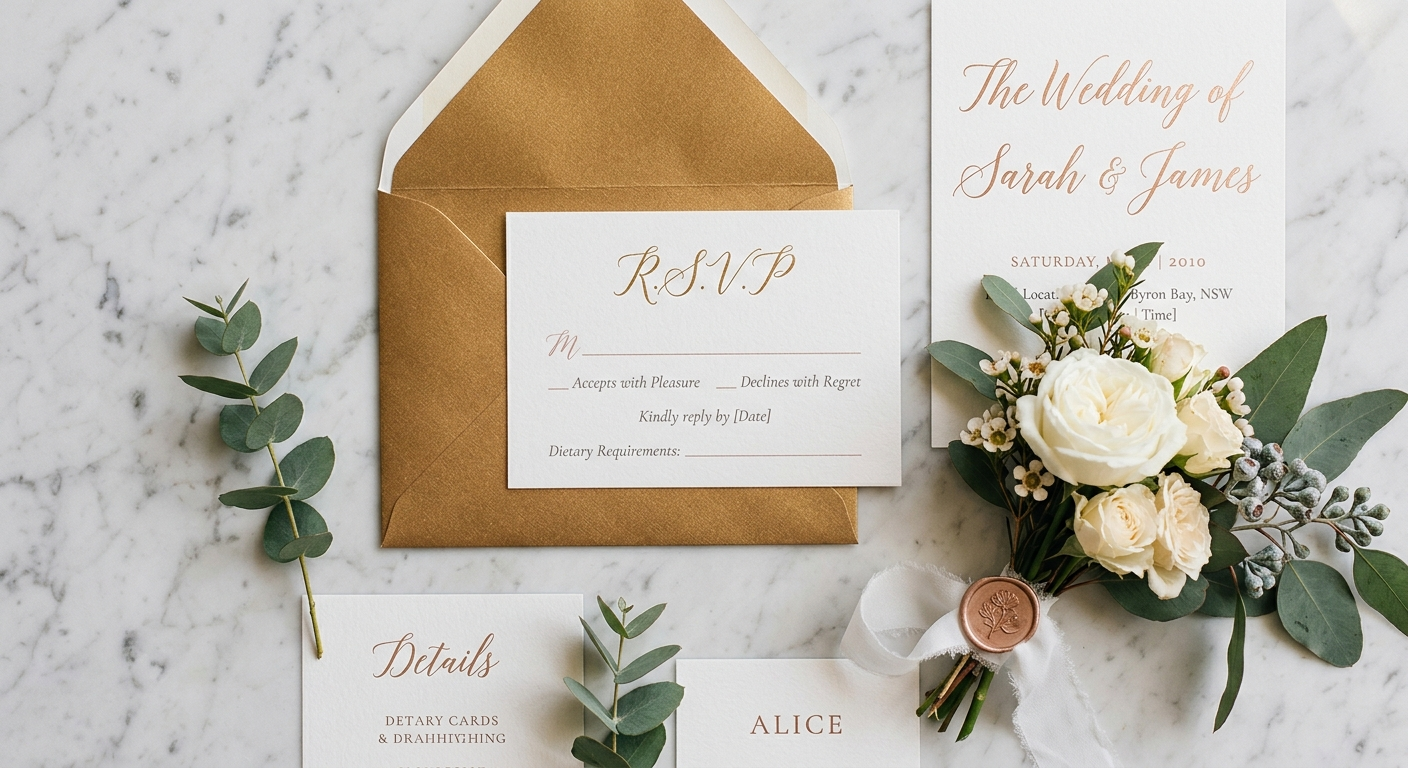
The silence after your wedding invitations go out is one of the most predictable and yet most anxiety-inducing experiences in Australian wedding planning. You sent beautiful invitations eight weeks ago. You included a clear RSVP date on the response card. You invested in a wedding website that made responding effortless. And yet here you are, three weeks from your wedding at a winery in the Hunter Valley or a beachside venue on the Gold Coast, with forty percent of your guest list having responded and sixty percent having vanished into a void of non-responsiveness. This is not a reflection of your wedding planning skills. It is the universal experience of every couple who has ever planned a wedding in Australia, and it is the problem that this guide exists to solve.
Following up on late RSVPs is not rude. It is not aggressive. It is not an imposition. It is a normal, expected, entirely reasonable part of wedding planning that responsible guests understand and expect. The couples who never follow up are the couples who either have unusually diligent friends and family, or who end up significantly over- or under-catering on the day. Following up is how you get accurate numbers. And getting accurate numbers is how you avoid the financial and logistical consequences of guessing wrong.
The challenge is that following up requires a particular kind of communication skill: warm but direct, friendly but firm, gracious about the oversight while clear that a response is needed. This is a narrow band of tone that many couples find difficult to navigate, particularly when the person they are following up with is a relative they see at family Christmas and have never had a direct conversation with about money or commitment. This guide gives you the scripts, the timing, and the approach to follow up on late RSVPs in every situation, from your most casual university friend to your most formidable future mother-in-law.
Why Guests Do Not Respond: Understanding the Silence
Before you can effectively follow up with non-responsive guests, it helps to understand why they have not responded in the first place. The silence is almost never malicious. It is almost never a statement about how much they care about your wedding or whether they plan to attend. It is usually one of four things.
The first and most common reason is simple forgetting. Life is busy. The invitation sat on the kitchen counter for two weeks while other things competed for attention. Then it got moved to the fridge, then to a stack of papers, and now the RSVP date has passed and the guest has not consciously thought about it since they opened the envelope. This guest will respond cheerfully the moment you remind them, and they will have no negative feelings about the follow-up whatsoever.
The second reason is decision fatigue or competing priorities. Australian adults in their late twenties and thirties are managing mortgages, careers, health concerns, family obligations, and social commitments at a rate that would have seemed extraordinary to previous generations. For a guest who is genuinely uncertain about whether they can attend - because of work commitments, family obligations, or financial constraints - it can feel easier to not respond than to make a decision they are not sure about. These guests are not avoiding the invitation; they are procrastinating on a decision they have not yet made.
The third reason is uncertainty about the invitation's scope or the expectation around a response. Some guests who have received a digital invitation or a wedding website link may assume that the invitation is less formal than a physical card, or may not understand that a response is required even if they have not received a physical RSVP card. These guests need a gentle reminder that a response is needed and that the RSVP process is straightforward.
The fourth reason - which accounts for a small but significant proportion of non-responses - is that the guest is uncomfortable with the invitation in some way: the distance they would need to travel, the cost of attending, an existing social conflict with other guests, or an event that conflicts with the date. These guests are avoiding a conversation they do not want to have, and a polite follow-up gives them the opening to decline gracefully rather than continuing to say nothing.
The Four Types of Non-Responsive Guests
Understanding which type of non-responsive guest you are dealing with helps you calibrate your follow-up tone and approach. The genuinely forgetful guest needs a gentle reminder with a clear call to action. The decision-fatigued guest may need additional information that helps them make their decision, such as the timeline for the venue, the accommodation options nearby, or the child-friendly nature of the celebration. The confused guest needs clarification about the RSVP process and the expectation of a response. The uncomfortable guest needs an exit door that allows them to decline without confrontation.
Most of your non-responsive guests will fall into the first two categories - the forgetful and the decision-fatigued - and a warm, direct follow-up will resolve the majority of these cases. The scripts in this guide are calibrated for these common situations. For the fourth category - the uncomfortable guest - the follow-up provides a graceful decline option that is designed to feel like a valid choice rather than an awkward obligation.
When to Start Following Up: Timing Matters
The timing of your follow-up is as important as the wording. Following up too early - before the RSVP deadline has passed - can feel presumptuous or pressuring. Following up too late - after your catering deadline has passed - means you have less leverage than you need to get a definitive answer. The optimal follow-up window is between two and five days after your stated RSVP deadline. This gives guests who are genuinely forgetful a chance to remember on their own, while still giving you enough time to chase stragglers before your catering numbers are due.
Your catering deadline with your venue is typically ten to fourteen days before your wedding date, and many venues apply significant surcharges or require firm numbers at this point. This means that if your RSVP deadline is six weeks before your wedding, you have approximately four weeks to chase late responders before your catering numbers are locked in. Working backwards from your catering deadline, you should have your final confirmed guest list at least ten days before the wedding, which means your last round of follow-ups should be completed at least twelve to fourteen days before the wedding date.
The practical implication is that you should plan your RSVP timeline deliberately. If your catering deadline is fourteen days before the wedding and you need ten days to chase late responders, your RSVP deadline should be at least twenty-four days before the wedding. Some couples set their RSVP deadline four to six weeks before the wedding specifically to create time for follow-ups without pressure. This is a sensible approach that more Australian couples should consider.
The Optimal Follow-Up Sequence
The most effective approach to following up on late RSVPs is a sequence of three touchpoints, each with slightly different wording and tone. Round one, sent two to five days after the RSVP deadline, is a gentle reminder. Round two, sent seven to ten days after the deadline, is a firmer but still warm reminder that references the catering deadline. Round three, sent twelve to fourteen days before the wedding, is a final call that makes clear a response is needed immediately or the guest cannot be accommodated.
This sequenced approach works because it respects the guest while protecting your planning process. The first reminder is friendly enough that forgetful guests can respond without embarrassment. The second reminder adds appropriate urgency without being aggressive. The third reminder is a genuine final call that gives guests every possible chance to respond while making clear that you have a logistical constraint that requires an answer. Most non-responsive guests will respond by round two. The remainder - typically a small percentage of your guest list - will respond to round three or decline.
Choosing the Right Channel for Your Follow-Up
The channel through which you follow up with a non-responsive guest matters as much as the wording. In general, use the same channel that the invitation was sent through. If you sent a physical invitation with an RSVP card, follow up by text message or phone call. If you sent a digital invitation through your wedding website, follow up by email or through the messaging function on your wedding website. If you sent a save-the-date through social media and the formal invitation through email, follow up via email.
Text message is the most effective channel for following up with friends and peers in 2026. Australian adults in their late twenties and thirties have largely moved personal communication to text and messaging platforms, and a well-crafted text message asking for an RSVP response is perceived as normal and efficient rather than intrusive. The key is to keep the message short - three to four sentences maximum - and to include a clear call to action with a link or instruction for how to respond.
Phone calls are appropriate for close family members and for situations where a text message feels insufficiently warm. A phone call from a member of the wedding party or a family member who is close to the non-responsive guest is often more effective than a text from the couple, particularly for older guests or for guests who have a close personal relationship with someone in the wedding party rather than with the couple themselves.
Email is the appropriate channel for formal or distant relationships - work colleagues, partner's parents' friends, or relatives you see infrequently. Email is also the right channel for guests who originally responded digitally, since they expect digital communication and an email follows the established pattern of your invitation.
Using Your Wedding Website for Automated Follow-Ups
If your wedding website or RSVP platform has automated reminder functionality, use it. An automated reminder sent automatically two days after your RSVP deadline - styled to match your wedding website, warm in tone, and including the link to respond - will resolve a significant proportion of your non-responsive guests without any manual follow-up required. Many of your forgetful guests will see the automated reminder, remember they had not responded, and respond immediately.
The limitation of automated reminders is that they are generic and cannot adapt to the specific circumstances of individual guests. They will not know that Uncle Robert is notorious for not checking his email, or that your colleague from Melbourne has a work trip that might be overlapping with your Adelaide wedding. For these specific cases, a personal follow-up through a more direct channel - a phone call from a family member who knows the guest well, or a text from a friend who can check in casually - is more effective than a blanket automated email.
Text Message Scripts for Following Up
Text messages are the workhorse of modern wedding RSVP follow-ups, and the key to a good text is brevity with warmth. You are not delivering a speech. You are sending a message that accomplishes three things: reminds the guest that their response is outstanding, tells them how to respond, and does so in a way that does not make them feel embarrassed or pressured. The following scripts are designed for different relationship contexts and tones.
Casual Friend Script (Close friends, university friends, casual social circle)
Hi [Name]! Just a heads up - our wedding RSVP deadline was [date] and we have not heard back from you yet. If you are still keen to come, you can RSVP here: [link]. No pressure at all if you can not make it - just let us know so we can sort the numbers. Can not wait to celebrate with you!
Standard Friendly Script (General friends, colleagues, mutual acquaintances)
Hey [Name], hope you are well! Just following up on our wedding RSVP - we need to confirm final numbers with our venue by [date] and we have not heard back from you yet. If you are able to come, the RSVP link is [link]. And if you can not make it, no stress at all - just need to know either way so we can sort the catering!
Warm Family Script (Aunts, uncles, extended family)
Hi [Name], hope this finds you well. We are just confirming final numbers for our wedding on [date] and our RSVP records show we have not received your response yet. We completely understand if you are not able to attend - we know life gets busy! But if you are able to make it, please let us know by [date] at [link] so we can include you in the catering numbers. Looking forward to celebrating with you!
Final Call Script (For third round of follow-up, firm but warm)
Hi [Name], reaching out one more time about our wedding on [date]. We need to give our venue our final guest numbers in the next few days, and we have not heard back from you yet. If we do not hear by [date], we will assume you can not make it and we will take you off the list - but we really hope you can come! RSVP here: [link]
Phone Call Scripts for Sensitive Follow-Ups
Phone calls are appropriate when a text message feels too impersonal for the relationship, when you have not received a response to multiple text follow-ups, or when the guest is in a category where direct conversation is the social norm - close family, parents of close friends, or older relatives. Phone calls are also appropriate when you suspect the non-response is due to an uncomfortable situation - a conflict with other guests, a financial constraint, or a date that is genuinely difficult.
Warm Phone Script (Close family, parents, wedding party)
Hey [Name], hope you are well! I am just calling because we are in the middle of sorting out the final numbers for our wedding and I wanted to check in personally about whether you are able to make it. I know the invitation went out a while ago and things get busy - but I wanted to make sure you had all the details and see if you had any questions about the day. Are you able to come?
If they say yes: Fantastic! The RSVP link is [link] and it just takes a minute to confirm your details. And if you have any dietary requirements, there is a spot on the form to note those. We would love to have you there!
If they say they are not sure: Totally understand - life gets busy! Just to help you decide, the wedding is at [venue name] starting at [time], and we would love to have you there. If you can make it, the RSVP link is [link]. Let us know by [date] if you can - and if you can not make it, we completely understand.
If they say no: No problem at all! We totally understand. It would have been great to celebrate with you, but we appreciate you letting us know. We will miss you on the day but completely understand.
Phone Script for Elderly Relatives Who May Be Unsure About Technology
Hi [Name], it is [your name] here! How are you going? I just wanted to give you a call personally because we are confirming our wedding numbers and I wanted to make sure you had all the information you need about our wedding. The wedding is on [date] at [venue name] in [location], starting at [time].
If they express interest in attending: Wonderful! I can send you the details by email or post if that is easier - which would you prefer? Or if you have someone who can help you with the computer, we also have an online RSVP at [link] which only takes a minute. If you would prefer, I can also just note your response right now - are you able to come? And would you like to bring a guest?
If they are uncertain or say they need to check: Of course, no rush at all! If you decide you can make it, just give me a call or send a text and I will sort it out. And if you can not make it, no problem at all - we completely understand. We just wanted to make sure you had all the information and the chance to come if you wanted to.
Email Scripts for Formal or Distance Relationships
Email is the appropriate channel for work colleagues, professional acquaintances, or relatives you see infrequently for whom a phone call or text would be an unusual form of contact. Email also works well when you have specific logistical information to share - venue directions, accommodation options, parking information - that goes beyond a simple reminder to respond.
Formal Email Script (Work colleagues, professional contacts)
Subject: Wedding RSVP Reminder - [Your Names] | [Wedding Date]
Dear [Name],
I hope this message finds you well. We are writing to follow up on our wedding invitation, which was sent to you in [month]. We have not yet received your RSVP, and as our final catering numbers are due to the venue shortly, we wanted to reach out to confirm your attendance.
Our wedding will be held on [date] at [venue name and full address], with the ceremony commencing at [time]. The reception will follow immediately after. Full details, including accommodation recommendations and venue directions, can be found on our wedding website at [link].
If you are able to attend, please RSVP by [date] using the link below. If you are unable to attend, we would also appreciate knowing, so that we can finalise our guest list accordingly.
We do hope you can make it, and we look forward to celebrating with you.
Warm regards,
[Your Name]
Friendly But Informative Email (Friends of parents, distant relatives)
Subject: Just a reminder about our wedding RSVP - [Date]!
Hi [Name],
Hope you are well! I wanted to reach out because we are finalising our wedding plans and our records show we have not received your RSVP yet. Our wedding is on [date] at [venue name] in [location], and we would love to celebrate with you if you are able to come.
The easiest way to respond is through our wedding website at [link] - it only takes a minute and you can also let us know about any dietary requirements or plus-one needs there. If you are not sure about coming, please do not stress - just let us know either way so we can sort out the catering numbers.
Looking forward to hearing from you, and happy to answer any questions you might have about the day!
[Your Name]
Handling Difficult Situations: Family Conflict, Budget Constraints, Plus-Ones
Some non-responsive guests are non-responsive because of uncomfortable situations that a simple reminder will not resolve. A guest who is going through a difficult separation may be uncomfortable about the social dynamics of your wedding. A guest who is experiencing financial hardship may be embarrassed about their situation. A guest who has an existing conflict with another guest may be avoiding attending the same event. In these situations, a standard follow-up message may not be enough, and a more thoughtful approach is required.
When a Guest Has Not Responded Because of a Plus-One Issue
One of the most common reasons a guest does not respond to a wedding invitation is that they are unsure about whether they can bring a partner or guest. Your invitation may have addressed this clearly - 'We have reserved two seats in your honour' or 'We welcome you to bring a guest' - but if the invitation was ambiguous on this point, a non-responsive guest may be sitting on the fence waiting for clarification.
If you suspect this is the issue, a follow-up message that directly addresses the plus-one question is appropriate. Something like: 'Just following up about our wedding RSVP - we wanted to check whether you would like to bring a partner? We have left it open on the invite, so just wanted to confirm.' This gives the guest permission to ask the question they may have been too awkward to raise on their own.
If you are unable to accommodate a plus-one that a guest is expecting, it is better to know now than to have an awkward conversation on the day. A direct but warm message - 'Unfortunately we are not able to accommodate additional guests due to venue capacity, but we would love to have you there on your own' - handles this situation more gracefully than leaving the question unanswered.
When Family Conflict Is the Underlying Issue
Family conflict is the most delicate reason a guest may not respond, and it requires the most careful handling. A guest who is estranged from a family member who is also on your guest list may be avoiding your invitation because they do not want to navigate the social dynamics of attending the same event. This is not a situation that a follow-up text can fully resolve, but a private, empathetic message from a close family member who understands the situation - rather than from the couple directly - is often the most effective way to surface and address the issue.
If you know about the conflict, a direct but empathetic message is better than pretending it does not exist. Something like: 'We know things have been complicated with [family member], and we completely understand if that makes attending difficult. We want you to know that you would be genuinely welcomed, and we would make sure the seating arrangements made the day comfortable for everyone. But if you would rather not come, we completely understand and no hard feelings.' This acknowledges the elephant in the room without making the guest feel pressured.
When Financial Constraints Are the Issue
Australian weddings are expensive to attend as well as to host. A guest who is experiencing financial pressure - particularly younger guests, guests in the early stages of their careers, or guests who are travelling from interstate - may be avoiding your invitation because attending is financially difficult and declining feels embarrassing.
If you suspect financial constraints are the reason a guest has not responded, a message that addresses this indirectly can be helpful. Something like: 'We just wanted to check in about the wedding - we know it is a big commitment with travel and everything, and we completely understand if you can not make it. But we also wanted to mention that we are having a fairly relaxed day and there is no expectation of a gift or anything formal. It would be great to have you there if you can make it work.' This gives the guest permission to attend on their own terms without the financial obligation they may be anxious about.
Managing Your Final Numbers When RSVPs Are Still Outstanding
Even with the most effective follow-up sequence, some guests will not respond by your catering deadline. This is a normal part of wedding planning, and it requires a decision about how to handle your final catering numbers. The原则 is straightforward: give your venue a confirmed number that represents the guests you are confident will attend, with a buffer for last-minute confirmations. The size of that buffer depends on your venue's policy and your own risk tolerance.
Most Australian venues will accept a final number within a range - for example, they may allow you to confirm between 90 and 100 guests with the final invoice based on actual attendance on the night. If your venue has this flexibility, use it. Confirm your core number - the guests who have responded plus an estimate of the guests you are confident will attend based on your follow-up results - and leave the buffer for the stragglers who confirm at the last minute.
If your venue requires a fixed number with no flexibility, you need to make a judgment call about how many of your non-responsive guests to assume will attend. A conservative approach is to assume that non-responsive guests who have not responded to two or three rounds of follow-up are not attending. An optimistic approach is to assume they are attending. Most couples find that a middle position - assuming approximately half of non-responsive guests will attend - is the most accurate.
Handling Last-Minute Changes and Cancellations
Even after your catering deadline has passed, some guests will cancel at the last minute due to illness, work emergencies, or changed circumstances. This is a normal part of wedding planning, and most venues have policies for managing last-minute attendance fluctuations. Ask your venue about their policy for final numbers and whether any credits or refunds apply for late cancellations.
The emotional dimension of last-minute cancellations is harder to manage than the logistical one. A guest who cancels on the day of your wedding or in the days before due to illness or emergency is not making a statement about your wedding or their commitment to your celebration - they are managing a circumstance that prevents them from attending. The appropriate response is graciousness and concern for their situation, not disappointment or frustration.
A small number of guests will cancel without a legitimate reason - not due to illness, emergency, or genuine circumstance change. These cancellations are frustrating and can feel like a personal rejection, particularly when a guest who was invited last-minute has declined. It is worth remembering that a guest who cancels without legitimate reason would likely have been an unenthusiastic or absent attendee even if they had confirmed - and that the seat and meal budget is better spent on guests who genuinely want to be there.
How a Digital RSVP Platform Changes the Follow-Up Game
One of the most significant advantages of using a digital wedding RSVP platform is the impact it has on the follow-up process. With a paper RSVP system, following up requires either a phone call or a handwritten note to every non-responsive guest, which is both labour-intensive and awkward. With a digital platform, your follow-up process can be substantially streamlined and your results substantially improved.
First, a digital platform gives you real-time visibility of who has and has not responded. Rather than guessing about your response rate or waiting until your RSVP deadline to assess the situation, you can check your dashboard at any time and see exactly which guests have responded and which have not. This visibility allows you to follow up earlier and more systematically than a paper RSVP system would permit.
Second, a digital platform allows you to send automated reminders to guests who have not responded. A reminder sent automatically two days after your RSVP deadline - warm in tone and including a direct link to the RSVP form - resolves a large proportion of forgetful non-responders without any manual intervention required. This automation alone can improve your response rate by twenty to thirty percent compared to a system without automated reminders.
Third, a digital platform gives your follow-up messages more impact. When you send a personal text message saying 'Hey, just realised we have not received your RSVP' to a guest who has the link in their inbox, the message is more likely to result in a response than a vague verbal follow-up to a paper RSVP card.
Exporting Guest Data to Manage Your Follow-Up Campaign
A quality digital RSVP platform allows you to export your guest list with RSVP status, dietary requirements, plus-one details, and any other information you have collected. This export functionality is particularly valuable when you are running a multi-round follow-up campaign, because it allows you to track who has been contacted in each round and who is still outstanding.
Create a simple spreadsheet - guest name, RSVP status, date of first follow-up, date of second follow-up, date of third follow-up, final RSVP status, and notes - and update it after each round of follow-ups. This tracking allows you to avoid accidentally following up with a guest who has already responded, and to identify patterns - for example, if all of your non-responsive guests are in a particular family or social group, which might indicate an invitation that was lost or a social dynamic you are not aware of.
The Last Word on Following Up Late RSVPs
Following up on late wedding RSVPs is not a conversation you should be embarrassed about having. It is not rude, aggressive, or an imposition on your guests. It is a normal, expected, entirely professional part of the wedding planning process that responsible adults navigate routinely. The couples who communicate clearly and follow up systematically get better response rates than the couples who send one round of invitations and hope for the best.
The key principles are these: follow up within two to five days of your RSVP deadline, use the same channel as your original invitation, keep your messages warm and direct, and make it easy for guests to respond. A well-crafted three-sentence text message is more effective than a vague email or an awkward phone call you have been dreading. Most non-responsive guests will respond by the second round of follow-ups. The ones who do not are either dealing with an uncomfortable situation or have decided not to attend but have not yet found the right moment to let you know.
Your wedding will be wonderful regardless of whether every single guest responds before your catering deadline. But the couples who manage their RSVP process proactively - with warm, clear communication and systematic follow-ups - are the couples who get accurate catering numbers, who have fewer logistical surprises on the day, and who spend their wedding week feeling prepared rather than anxious. That peace of mind is worth every follow-up message you send.
The art of following up on late wedding RSVPs is ultimately the art of communicating with care and clarity at a moment when your guests are likely juggling a dozen competing priorities. Your follow-up messages should reflect that you understand that your guests are busy people who may have genuinely forgotten rather than guests who do not care about your wedding. The warmth of your communication is what makes the difference between a follow-up that strengthens relationships and one that creates awkwardness.
If you are looking for a wedding RSVP platform that makes the follow-up process as streamlined as possible - with automated reminders, one-click follow-up messaging, and real-time guest list management - explore WeddingRSVP. Our platform is designed for Australian couples planning weddings in 2026, with features specifically built for the Australian wedding context.