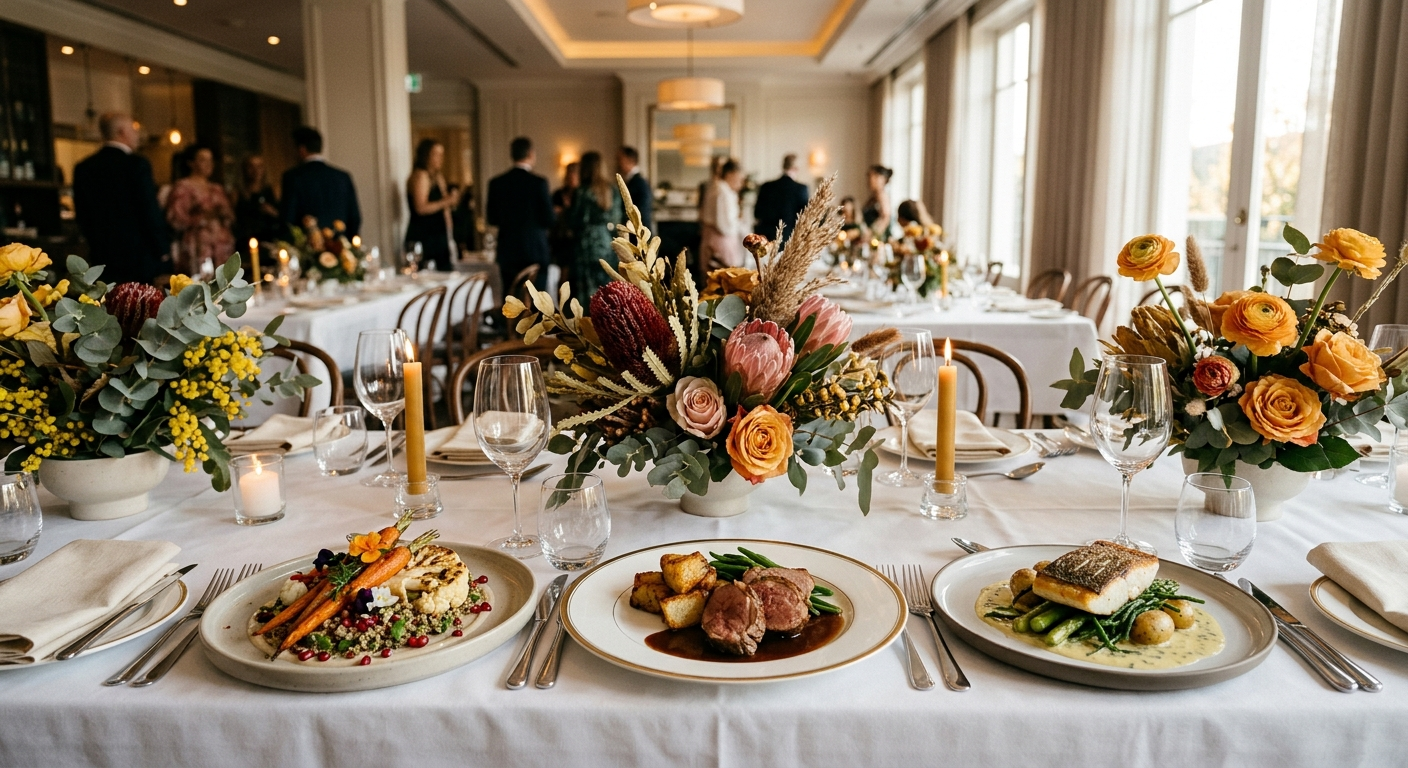
Australian wedding catering has never been more complex. The days when a couple could offer a single chicken or beef option and expect all guests to fit one of those choices are long gone. Australian wedding guests in 2026 arrive at celebrations with a wide range of dietary requirements, preferences, and restrictions that reflect the diversity of modern diets, the prevalence of food allergies, and an increased awareness of the relationship between food and wellbeing. A guest list of 80 people in Melbourne or Sydney might include vegans, coeliacs, guests with shellfish allergies, Muslim guests who require halal certification, Jewish guests who need kosher options, guests who are lactose intolerant, and guests who simply prefer plant-based meals. Ignoring these requirements is not an option. Misunderstanding them is also not an option - a coeliac guest served gluten when they have explicitly requested gluten-free is a serious health issue, not a service failure.
The challenge for Australian couples is that asking about dietary requirements is deceptively difficult. Ask in a vague way and you will receive vague answers that are useless to your caterer. Ask in a clinical way and you risk making guests feel reduced to a medical condition or a diet label. Ask in a way that does not distinguish between a preference and a medical requirement and you will underprepare your caterer for the genuine emergencies. The solution is a well-designed question or set of questions that collects the information you actually need - including the distinction between a severe allergy and a preference - without making any guest feel uncomfortable, judged, or singled out.
This guide covers every stage of the dietary requirements process for Australian weddings. It explains what questions to include on your RSVP form, how to interpret the answers your guests provide, how to communicate those answers to your caterer with precision, how to manage guests who request highly specific or unusual meals, and how to ensure that your approach makes every guest feel welcomed and considered rather than processed and categorized. Whether you are planning a beach wedding on the Gold Coast, a vineyard celebration in the Yarra Valley, or a city wedding in Brisbane, the principles in this guide will help you manage your dietary requirements process with clarity and confidence.
Why Dietary Requirements Have Become a Central Wedding Planning Challenge
The prominence of dietary requirements in Australian wedding planning reflects broader shifts in how Australians relate to food. Veganism has grown substantially in Australia, with estimates suggesting that approximately 10 percent of the Australian population now identifies as vegan or actively reducing their animal product consumption. Coeliac disease affects roughly 1 in 70 Australians, the majority of whom are undiagnosed. Food allergies - particularly to shellfish, peanuts, and tree nuts - affect a significant minority of the population, with anaphylaxis risks that make accidental exposure a genuine medical emergency. Religious dietary requirements - halal, kosher, and Hindu vegetarian requirements - are common across Australian multicultural communities and their extended families and friendship networks.
These statistics are not abstract when you are planning a wedding. When you send invitations to 100 guests in 2026, the probability that at least one guest has a genuine, potentially severe food allergy is high. The probability that several guests identify as vegetarian or vegan is very high. The probability that your guest list includes guests with religious dietary requirements, particularly in major cities with diverse populations, is substantial. The couple who assumes that chicken-or-beef is an adequate response to this diversity is not making a planning error - they are making a hospitality failure.
The financial dimension also matters. Dietary requirements that are not anticipated or communicated properly can result in expensive last-minute catering changes. A caterer who is not informed that 15 of your 80 guests are vegan will produce a menu that is overwhelmingly not vegan, and the cost of producing separate vegan meals for 15 guests at the last minute is significant. A caterer who is informed in advance can incorporate those requirements into their menu planning from the start, often at no additional cost or at a substantially reduced premium compared to a last-minute accommodation.
The Critical Distinction Between Allergies, Intolerances, and Preferences
The single most important conceptual distinction in dietary requirements management is the difference between a medical requirement and a preference. This distinction is not always visible in the language guests use, and failing to understand it can create serious problems.
A food allergy - particularly anaphylactic allergies to shellfish, peanuts, and tree nuts - is a potentially life-threatening medical condition. Exposure to even trace amounts of an allergen can trigger an anaphylactic reaction that requires immediate medical treatment. For guests with these allergies, the stakes of being served food that contains their allergen are not inconvenience - they are medical emergencies. This means that a guest who tells you they are allergic to shellfish needs to be treated very differently from a guest who tells you they prefer not to eat shellfish.
A food intolerance - such as lactose intolerance or non-coeliac gluten sensitivity - is a digestive condition that causes discomfort and illness when the triggering food is consumed but does not typically cause anaphylaxis. The health stakes are real but the risk is different in character from an allergy. A guest with lactose intolerance who is served a cream-based sauce will be ill but not in anaphylactic shock. The requirement still needs to be taken seriously, but it requires different communication to your caterer than a severe allergy.
A dietary preference - such as choosing to eat vegetarian, vegan, or pescatarian - is a personal choice that does not carry the same health stakes as an allergy or intolerance. A guest who identifies as vegan is making a values-based choice about what they eat. If they are accidentally served a dish that contains animal products, they will be disappointed and potentially upset, but they will not have a medical emergency. This distinction matters for how you communicate their requirements to your caterer: a severe allergy requires your caterer to take active steps to prevent cross-contamination, while a preference is about menu composition rather than contamination risk.
The Australian Dietary Landscape in 2026
Australian dietary culture has evolved significantly in ways that directly affect wedding catering. Plant-based eating has moved from a niche lifestyle choice to a mainstream option that is represented across age groups, cities, and demographics. Melbourne and Sydney in particular have established themselves as destinations for high-quality plant-based dining, which means that vegan guests in these cities have elevated expectations about what vegan food can and should be. A rubbery, anemic-looking vegetable patty served as a afterthought to the main course will not satisfy these guests the way a thoughtfully designed vegan main course will.
The multicultural dimension of Australian wedding dietary requirements deserves specific attention. Australian cities are among the most culturally diverse in the world, and wedding guest lists in Melbourne, Sydney, and Brisbane frequently include guests from Chinese, Indian, Lebanese, Greek, Italian, Vietnamese, Filipino, and many other cultural backgrounds. Each of these communities may have specific dietary requirements that are tied to religious or cultural practice. Muslim guests require halal-certified meat. Jewish guests may require kosher catering or at minimum vegetarian options prepared without meat and dairy together. Hindu guests may be vegetarian and may also avoid beef. These requirements are not preferences - they are deeply held beliefs that deserve the same respect and attention as medical requirements.
The cost-of-living pressure on Australian households has also influenced dietary habits in ways that affect wedding expectations. Guests who are used to cooking plant-based meals at home because of budget constraints may arrive at your wedding with the expectation that similar options will be available. The expectation is not that every dish should be affordable - it is that the dietary consideration should be taken seriously as a legitimate way of eating, not as a trend or a novelty.
How to Ask About Dietary Requirements on Your RSVP Form
The design of your dietary requirements question or set of questions on your RSVP form is the highest-leverage point in the entire process. A well-designed question captures the information your caterer needs, distinguishes between medical requirements and preferences, and does so in a way that makes guests feel respected rather than processed. A poorly designed question either collects no useful information, creates confusion about what is required, or makes guests feel clinical and uncomfortable.
The first principle is to ask about the condition, not the diet label. Rather than asking guests to self-identify as vegan or coeliac, ask them to describe their requirements in their own words. This approach is more likely to capture the actual information your caterer needs - including the distinction between a preference and a medical requirement - than a pre-defined list of checkboxes.
A good approach is to include an open text field with a brief prompt: 'Please share any dietary requirements, allergies, or special dietary needs we should know about.' This gives guests the space to tell you what matters to them in their own language. Follow this with a checkbox or radio button section that asks specifically about severe allergies: 'Do you have any severe food allergies (anaphylaxis risk)?' with a yes/no response, and a prompt to list the specific allergens if yes. This two-part structure - an open field for general requirements and a specific question about anaphylactic allergies - captures the information that most caterers need while giving guests the space to communicate in their own way.
Sample Dietary Requirements RSVP Questions
A well-designed dietary section on your RSVP form might look like this, broken into three components:
Component one: a check-all-that-apply section for common dietary patterns: 'Which of the following best describes your general dietary approach? (Select all that apply)' with options including 'No dietary restrictions - I eat everything', 'Vegetarian', 'Vegan', 'Pescatarian', 'Gluten-free', 'Dairy-free', 'Halal', 'Kosher', 'Other (please specify below)'.
Component two: an open text field: 'Please share any specific dietary requirements, food allergies, intolerances, or other special dietary needs we should know about. Include as much detail as you are comfortable sharing.'
Component three: a specific anaphylaxis question: 'Do you have any severe food allergies that could cause anaphylaxis? (For example: peanuts, tree nuts, shellfish)' with a yes/no response and a prompt for specifics: 'If yes, please list your allergens so we can ensure they are not present in any meal options.'
This three-component structure works because it captures quantitative data (the checkboxes give you a count of how many vegetarians, vegans, gluten-free guests you have), qualitative data (the open field gives guests space to explain in their own words), and critical safety information (the anaphylaxis question surfaces the most medically significant requirements without making any guest feel that their medical history is being interrogated).
Why the Wording of Your Dietary Question Matters
The language you use in your dietary question signals to guests how their response will be received. Clinical or bureaucratic language - 'Medical dietary requirements', 'List all known food allergies' - makes the interaction feel transactional and potentially intimidating. Guests who are sensitive about their dietary requirements or ashamed of their food allergies may be discouraged from responding accurately if the language feels like a medical intake form.
Welcoming, inclusive language produces better information. Phrases like 'help us look after you' or 'we want to make sure you are well catered for' signal that you are asking because you care, not because you need to process a data set. This framing is particularly important for guests with eating disorders or a complicated relationship with food, for whom a wedding can already be an anxiety-inducing dietary environment.
Avoid making assumptions in your language. Do not write 'Please let us know if you have any allergies' as though allergies are unusual or exceptional. Approximately 10 percent of your guest list may have some form of food allergy - this is not an edge case. Write your question as though you fully expect a substantial proportion of your guests to have requirements, because they will.
Cultural Sensitivity in Dietary Questions
Religious dietary requirements deserve specific, respectful acknowledgment on your RSVP form. Rather than lumping halal and kosher requirements into a generic 'other dietary requirements' category, name them specifically to signal to guests that you understand these are legitimate, practiced dietary frameworks, not eccentric preferences.
Include options for 'Halal' and 'Kosher' as distinct checkboxes alongside your vegetarian and vegan options. This specificity does two things: it allows Muslim and Jewish guests to identify themselves without having to explain their dietary requirements, and it gives you a clear count that you can communicate directly to your caterer.
For guests from Hindu backgrounds, a vegetarian option that also excludes beef is the appropriate standard. Many Hindu guests will self-identify as vegetarian, but some who eat fish may not tick the 'pescatarian' box if they do not think of their diet in those terms. The open text field is your backup here - a guest who describes their requirements in their own words will tell you what they need even if they do not fit a pre-defined checkbox category.
Interpreting What Your Guests Tell You
Collecting dietary information is only valuable if you interpret it correctly. The answers guests provide in your open text field will vary enormously in their clarity and detail, and your job is to extract the actionable information while understanding which guests have medical requirements that need special handling.
The most important interpretation principle is to assume that any statement about a severe allergy is a medical emergency until proven otherwise. A guest who writes 'I am anaphylactically allergic to shellfish - even trace amounts can cause a reaction' needs to be treated as having a potentially life-threatening condition. Your caterer needs to know this before they finalise their menu, and your seating plan should consider whether a guest with a severe shellfish allergy might be seated near a seafood station. These are not paranoid precautions - they are basic hospitality for guests whose safety depends on your attention.
The harder interpretation challenge is the middle ground: guests who describe their requirements in ways that are ambiguous about the severity. A guest who writes 'I am gluten intolerant' is communicating a real condition, but it is not the same as coeliac disease, which requires strict elimination of gluten to avoid long-term health damage. A guest with non-coeliac gluten sensitivity may be able to tolerate small amounts of gluten without serious medical consequences, while a coeliac guest cannot. Without asking a follow-up question - which is not always practical when you are managing a guest list of 80 or 100 people - you may not know which interpretation applies.
The practical solution is to treat all dietary requirements as genuine and important, while distinguishing in your catering brief between requirements that carry anaphylaxis risk (which require active contamination prevention) and requirements that do not. Your caterer will understand this distinction and can plan accordingly.
Common Dietary Requirement Interpretations
When a guest writes 'vegetarian', they typically mean they do not eat meat or fish. Many vegetarians also avoid gelatin (used in some marshmallows and desserts), rennet (used in some cheeses), and fish sauce (a common flavouring in Southeast Asian cooking that is not always obvious). For Indian vegetarian guests, the additional consideration is that they may also require meals prepared without onion and garlic, which are excluded in some Hindu dietary traditions.
When a guest writes 'vegan', they avoid all animal products including meat, fish, dairy, eggs, honey, gelatin, and in some cases refined sugar processed with bone char. A vegan guest at a wedding may also be vegan for ethical reasons related to animal welfare, which means that having a thoughtful, interesting vegan option matters to them in a way that goes beyond simply not wanting meat.
When a guest writes 'gluten-free', you need to determine whether they mean coeliac-safe gluten-free or preference-based gluten-free, because the stakes are different. For a coeliac guest, cross-contamination - gluten from shared cooking equipment, flour dust in the kitchen, or sauces thickened with flour - is a genuine health risk. For a preference-based gluten-free guest, a dish that has been made with care but may contain trace gluten is likely acceptable. Unless a guest has specifically identified themselves as coeliac, treat their gluten-free requirement as a preference for menu planning purposes but flag it to your caterer so they can be aware of the potential severity.
When a guest writes 'nut allergy', the distinction between peanut allergy (a legume, not a tree nut) and tree nut allergy (almonds, cashews, walnuts, etc.) matters because the sources are different. A guest who is allergic to peanuts is not necessarily allergic to tree nuts. Your caterer needs to know specifically what the allergen is, not just that the guest has a nut allergy.
When to Follow Up With Guests Directly
Most dietary requirements can be managed through your RSVP form without individual follow-up. However, there are situations where a direct conversation - by phone or message - is more appropriate than relying on the text field in your RSVP form.
Follow up directly when a guest mentions a severe allergy in a way that suggests they understand it to be a medical emergency, but has not provided enough specificity for your caterer to work with. A response like 'I have a severe food allergy' without naming the allergen needs clarification before your catering numbers are finalised.
Follow up directly when a guest's response is ambiguous or contradictory. A guest who checks 'vegetarian' but then writes 'I eat fish sometimes' needs clarification about whether they should be counted as vegetarian or pescatarian for your caterer.
Follow up directly when a guest requests an extremely specific or unusual diet that your caterer may not be familiar with - for example, a guest following a low-FODMAP diet for irritable bowel syndrome management, or a guest with multiple chemical sensitivity. These requirements are legitimate but not well understood by all caterers, and a direct conversation allows you to explain the requirement to your caterer accurately.
The tone of any follow-up should be warm and practical, not interrogative. A message along the lines of 'Thanks for letting us know about your dietary requirements - we want to make sure our caterer understands exactly what you need. Could you tell us a bit more about what you can and cannot eat?' signals that you are taking the requirement seriously and gives the guest space to explain in their own words.
How to Communicate Dietary Requirements to Your Caterer
The quality of the communication between you and your caterer about dietary requirements is the decisive factor in whether your guests are properly catered for. Your caterer cannot read your guests' minds, and they cannot read your mind. Your job is to translate the raw data from your RSVP form into clear, actionable brief that your caterer can use to design and execute a menu.
Before you brief your caterer, do the analysis yourself. Count the number of guests in each dietary category based on your RSVP responses. Identify which guests have severe anaphylaxis-risk allergies and what their specific allergens are. Identify which guests have specifically mentioned coeliac disease or coeliac symptoms. Identify any guests who have indicated religious requirements that your caterer needs to source certified products for. The brief you give your caterer should be a summary of this analysis, not a raw dump of every text field response.
Your caterer brief should include the number of guests in each dietary category (for example: 'approximately 12 guests require vegetarian options, including 3 who are vegan' or 'approximately 4 guests require halal-certified meat'), any anaphylaxis-risk allergens that must be excluded from specific dishes or zones (for example: '2 guests have severe anaphylactic shellfish allergy - please ensure no shellfish is used in any dish served to the main dining room'), and any religious certification requirements that need to be sourced (for example: '3 guests require halal - please source halal-certified chicken for the main course option').
Creating a Dietary Requirements Spreadsheet for Your Caterer
For larger weddings with complex dietary requirements, a dietary requirements spreadsheet is an invaluable tool. This is a simple document - ideally exported directly from your RSVP platform if it supports custom field exports - that lists each guest with dietary requirements alongside their specific needs.
The spreadsheet should include the guest name, their dietary category or categories (vegan, vegetarian, gluten-free, halal, etc.), their specific allergens if any, and any notes about severity or special requirements. A column for 'seated at table' allows you and your caterer to cross-reference the dietary list with your seating plan if needed for anaphylaxis management.
Share this spreadsheet with your caterer as a live document that you update as RSVPs come in. Many couples make the mistake of sending a final dietary brief once, six weeks before the wedding, and then not updating it as late RSVPs come in. If a guest with a severe shellfish allergy RSVPs three weeks before the wedding and your caterer has not been informed, the brief is incomplete. Update and re-share your spreadsheet every time you receive a new RSVP with dietary implications.
Planning for Anaphylaxis Risk at Your Wedding
For guests with anaphylaxis-risk allergies, the stakes of your planning extend beyond menu design into the physical environment of your wedding. The conversation with your caterer about anaphylaxis-risk guests should include specific discussion about how their kitchen will manage cross-contamination risk - whether they can prepare allergen-free dishes in a separate preparation area, whether they can label dishes with allergen information, and whether they have protocols for managing a medical emergency if one occurs.
At the venue level, consider whether anaphylaxis-risk guests need to be seated away from specific food stations. A guest with a severe shellfish allergy should not be seated adjacent to a seafood station where cross-contamination through serving utensils is possible. This is not about exclusion - it is about practical risk management.
Your first aid planning should also account for anaphylaxis risk. If your venue does not have a first aid officer, consider engaging one for the evening, particularly if you have guests with known anaphylaxis-risk allergies. Ensure that your MC or venue coordinator knows which guests have anaphylaxis risks and where those guests are seated, so that if an emergency occurs, response can be immediate and targeted.
Menu Design Tips for Multiple Dietary Requirements
The most effective approach to menu design for multiple dietary requirements is to design your menu from the perspective of the most restrictive guests and work outward. This sounds counterintuitive, but it produces better results than designing for the general guest list and then adding special dishes for specific requirements.
If you start with the vegan requirement and design dishes that are naturally vegan - salads with dressings that do not contain dairy, mains that are built around vegetables, grains, and legumes rather than meat substitutes - you will produce a menu that is interesting and varied for vegans while also being gluten-free and dairy-free for guests with those requirements. You can then add specific non-vegan or non-gluten-free dishes for guests without those restrictions.
For weddings with halal requirements, work with your caterer to identify one or two main course options that are halal-certified. Most caterers who work in multicultural Australian cities are experienced in sourcing halal-certified proteins, and this should not require a significant premium if planned in advance.
Labeling is one of the most practical tools for managing dietary complexity. Clearly labeled dishes at the buffet or service station - indicating which dishes are vegan, gluten-free, dairy-free, nut-free, or halal - allow guests to self-identify the foods they can safely eat without needing to interrogate your caterer at the event itself. This labeling also removes the awkwardness that some guests feel when they have to ask about ingredients at a celebration.
Managing Guest Expectations About Dietary Requirements
Even with the most thoughtful dietary management, some guests will have expectations that exceed what is practical or affordable for your wedding. A guest who follows a strict raw vegan diet and expects every dish to be raw, vegan, and prepared below 42 degrees Celsius will be disappointed by a standard cooked vegan option. A guest who is on the specific carbohydrate diet for a medical condition will not be satisfied by a general gluten-free label. Managing these expectations - before the wedding, not on the night - is part of your role as a host.
The principle that guides expectation management is honesty about what you can provide, communicated warmly and in advance. If your RSVP form includes a text field where guests describe their requirements, and a guest writes something that is significantly beyond what your caterer can reasonably provide, it is appropriate to follow up directly and explain what you can offer. This is not a rejection of their requirement - it is a realistic acknowledgment of what your catering budget and kitchen setup can accommodate.
For guests with extremely restricted diets, consider whether there is a practical compromise. A guest who cannot eat anything prepared in a kitchen that also handles gluten may need to bring their own food, which is a conversation that is better had before the wedding than on the day. A couple who is straightforward about this limitation - 'We want to be honest with you - our caterer's kitchen handles gluten, and we cannot guarantee a completely gluten-free environment. Would you be comfortable if we arranged for you to have a dedicated meal that you are confident is safe?' - is being a better host than a couple who overpromises and underdelivers.
The majority of your guests with dietary requirements are not expecting restaurant-quality bespoke meals. They are expecting to be able to eat something that is clearly intended for them, that looks and tastes like it was considered, and that does not make them feel like an afterthought. A thoughtfully designed vegan main that is as interesting and well-presented as the beef option will satisfy your vegan guests more effectively than a rubbery alternatives patty that signals they were not really thought about. The investment in quality across your dietary requirement options is one of the highest-leverage spending decisions you can make.
Budgeting for Dietary Requirements in Your Catering
Dietary requirement accommodation does add cost to your catering, but the incremental cost is often lower than couples assume. When caterers know in advance that they need to produce, say, 12 vegan meals and 4 gluten-free meals alongside the general menu, they can often incorporate these into their production planning rather than treating them as entirely separate operations. The premium for dietary accommodation is typically highest for last-minute changes, religious certification requirements (halal or kosher proteins can cost more and may need to be sourced from specialty suppliers), and very specific medical requirements that require a completely separate kitchen operation.
A reasonable budget allocation for dietary accommodation in a 100-guest Australian wedding is approximately 10 to 15 percent above your base per-head catering cost for guests with specific requirements. This premium covers the additional ingredients, preparation complexity, and labeling that dietary accommodation requires. It is a worthwhile investment that avoids the much higher cost - both financial and social - of having guests who cannot eat what is served.
Communicating Your Dietary Options to Guests Before the Wedding
Your wedding website is the appropriate place to communicate what you are offering for guests with dietary requirements. This is not about revealing your full menu - it is about giving guests confidence that they will be catered for.
A simple statement on your wedding website - 'We are committed to ensuring every guest is well catered for. We have guests with a range of dietary requirements attending our wedding, and we have designed our menu accordingly. If you have a severe allergy or a dietary requirement that is not captured in our RSVP form, please reach out to us directly' - provides reassurance without overpromising. This is also where you should direct guests who may have missed the dietary question on your RSVP form or who have developed a new requirement since they responded.
Working With Australian Caterers on Dietary Requirements
Australian caterers working in the wedding industry have developed increasingly sophisticated capabilities for managing dietary requirements. Melbourne and Sydney caterers in particular have experience with diverse dietary requirements given the cultural diversity of those cities, and most established wedding caterers will have standard protocols for how they manage allergen-free dish preparation, halal and kosher certification, and complex multi-requirement menu design.
When interviewing caterers for your wedding, ask specifically about their experience with dietary requirements. A caterer who can describe their approach to cross-contamination prevention, their process for sourcing certified proteins, and their standard labeling practice for allergen information has the operational framework to manage your requirements effectively. A caterer who is vague or dismissive about dietary requirements should be approached with caution.
For regional weddings - in the Yarra Valley, Hunter Valley, Margaret River, or Byron Bay - the catering landscape may be more limited, and caterers may have less experience with certain dietary requirements. However, regional caterers who work in wedding destinations are typically experienced with the diversity of dietary requirements that destination wedding guests bring. The key is to brief them early and in detail, and to give them enough lead time to source specialist ingredients if needed.
Sydney and Melbourne Caterers for Complex Dietary Requirements
Sydney and Melbourne have the highest concentration of caterers in Australia with specific experience in complex, multi-requirement dietary menus. In Melbourne, caterers with demonstrated vegan and vegetarian expertise are common given the city's plant-based dining culture. In Sydney, caterers experienced in halal and multicultural dietary requirements reflect the city's demographic profile.
When selecting a caterer in either city, ask to see examples of menus they have designed for weddings with similar dietary complexity to yours. A caterer who can show you a recent wedding menu that managed vegan, halal, and coeliac guests effectively has demonstrated the operational capability you need. A caterer who cannot provide this should not be assumed to be capable simply because they are well-reviewed for taste and presentation.
Regional Venue Catering for Dietary Requirements
Regional wedding venues in popular destinations like the Yarra Valley, Hunter Valley, Margaret River, and the Gold Coast hinterland typically have in-house catering teams or preferred caterer relationships that come with experience in destination wedding requirements. These caterers are accustomed to receiving dietary briefs for guests who have traveled from metropolitan areas and brought their dietary requirements with them.
The lead time consideration is more important for regional venues, where caterers may need to source specialist ingredients - such as halal-certified proteins or specific gluten-free products - from suppliers in Melbourne or Sydney. Briefing your regional caterer at the earliest possible stage gives them the time to source what they need without paying express shipping premiums or settling for alternatives that may not meet your guests' requirements.
Managing Dietary Requirements on the Wedding Day
The management of dietary requirements on the wedding day itself requires a designated point of contact who understands the dietary plan and can respond to issues as they arise. This is typically your MC or your day-of coordinator, and they should have a copy of your dietary spreadsheet with them on the night.
The key moment for dietary management is service. Your caterer's front-of-house team needs to understand which dishes contain which allergens and dietary information, so that when a guest asks about a dish, they can answer accurately. This is not a job for an uninformed server - it is a specific briefing point for the service team.
If you are having a plated meal rather than a buffet, your MC or coordinator should confirm with the kitchen that all dietary meals have been prepared and are being served to the correct tables before service begins. A guest with a severe shellfish allergy who receives a dish containing shellfish because their plate was served from the wrong kitchen station is a service failure that is entirely preventable with a simple pre-service check.
Clear Labelling at Buffet and Cocktail Events
For cocktail-style weddings, canape events, and buffet receptions, clear labeling of dishes is the single most effective dietary management tool available to you. Each dish should have a discrete label indicating its dietary characteristics: 'V' for vegetarian, 'VG' for vegan, 'GF' for gluten-free, 'DF' for dairy-free, 'N' for nut-free, 'H' for halal, and so on.
This labeling system - widely used in Australian hospitality - allows guests with dietary requirements to identify what they can safely eat at a glance, without needing to ask a server or interrogate the kitchen. It also removes the social awkwardness of having to ask, which many guests with dietary restrictions experience as a form of unwanted attention.
Work with your caterer to agree on a standard labeling system before the event. Most professional caterers will have standard labels they use, and these can typically be printed in a style that matches your wedding aesthetic. The key is to agree on the system in advance so that your caterer knows exactly what to label and how.
Being Prepared for a Dietary Emergency
While the probability of a anaphylactic reaction at your wedding is very low, the consequences of not being prepared are severe enough that preparation is warranted. Ensure that your venue has an accessible first aid kit and that your MC or coordinator knows where it is located. If any of your guests have known anaphylaxis allergies, your MC should know who those guests are, where they will be seated, and how to contact emergency services.
Many venues in Australia now have staff trained in anaphylaxis response as part of their standard hospitality certification, but this is not universal. For outdoor weddings, remote venues, or marquee events where venue first aid capability may be limited, engaging a first aid officer for the evening is a reasonable precaution that costs very little relative to the stakes.
The practical emergency response for anaphylaxis is an EpiPen, which should be administered immediately if a guest shows signs of an anaphylactic reaction. Ensure that emergency services (000 in Australia) are called at the same time as the EpiPen is administered. Your MC or coordinator should be the person who calls 000 while another staff member administers the EpiPen, so that neither step is missed in the stress of the moment.
Showing Appreciation for Guests Who Shared Their Dietary Requirements
A wedding that manages dietary requirements well is a wedding that guests remember with genuine gratitude. For guests who live with food allergies, coeliac disease, or strict religious dietary requirements, attending a wedding where they are properly catered for is not guaranteed - it is the exception rather than the rule. When it happens, it is noticed and appreciated in ways that go beyond the quality of the food.
A simple note in your wedding thank-you messages - 'We were so glad we could cater for your dietary requirements and hope the meal was everything you needed' - acknowledges that you took their requirement seriously and signals that you understand the significance of proper dietary accommodation. This is a small gesture that lands meaningfully for guests who have spent years navigating a world where their dietary requirements are treated as inconvenient.
The emotional dimension of dietary hospitality is not small. Guests who feel welcomed and looked after at your wedding - who feel that their requirements were not just tolerated but genuinely accommodated - leave the event with a different relationship to you and to your celebration than guests who spent the evening wondering if they would be able to eat anything. This difference is the real return on the investment in dietary management, and it is one of the most powerful expressions of hospitality that a couple can offer.
Managing dietary requirements for an Australian wedding is not a box-ticking exercise. It is a genuine act of hospitality that communicates to every guest - particularly those with the most complex or restrictive requirements - that they are seen, welcomed, and looked after. The couples who invest time and thought in getting this right are not doing something extraordinary. They are doing something that should be standard: treating their guests' needs as matters of real importance rather than administrative inconveniences.
The process is not as complex as it can initially seem. A well-designed RSVP question, a clear brief to your caterer, a simple labeling system at the event, and a pre-service check that confirms all dietary meals are prepared and plated correctly will cover the vast majority of what is needed to manage dietary requirements well. The incremental cost over a menu that ignores dietary requirements is modest, and the return - in guest satisfaction, in safety, and in the quality of the experience for everyone - is substantial.
Australian caterers and venues are increasingly well-equipped to support dietary requirement management, and purpose-built digital RSVP platforms make collecting and exporting the information your caterer needs easier than ever. The infrastructure to do this well exists. What is required is the intention to use it well, and the understanding that every guest who receives a meal that is clearly designed for them - rather than an afterthought or an inconvenience - will remember your wedding for the right reasons.