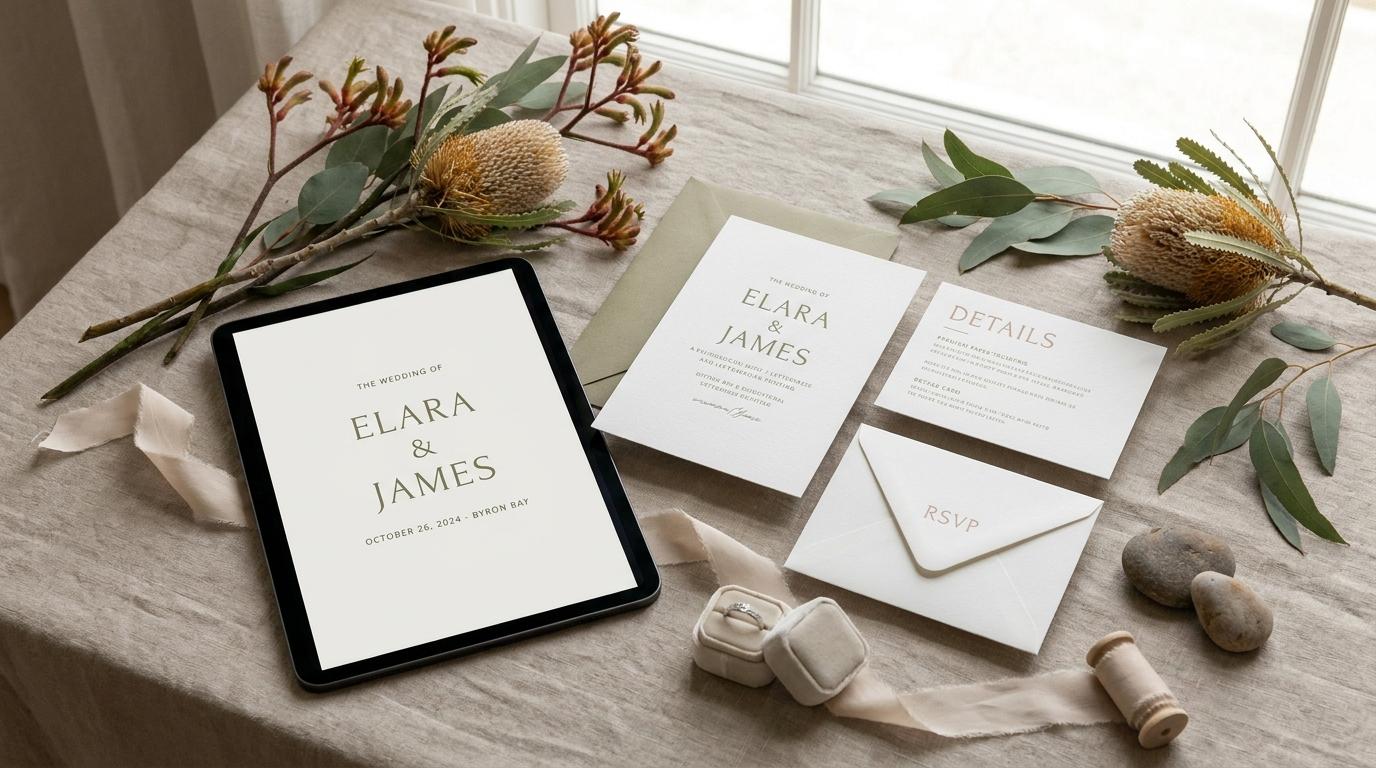
The invitation is the first thing your guests see of your wedding. It is the thing they keep, photograph, share with friends, and remember in the years that follow. In 2026, Australian couples are navigating a choice that did not exist in the same way a decade ago: paper or digital. The traditional printed invitation still carries a weight and a ceremony that many couples prize. But the digital invitation has evolved from a pragmatic compromise into a sophisticated product in its own right, with custom design options, seamless RSVP integration, and real-time guest management that paper simply cannot match. This guide cuts through the noise to compare both approaches honestly, helping Australian couples make the decision that is right for their wedding, their guests, and their circumstances.
The question of invitations is not just an aesthetic one. It is a logistical one, a financial one, and increasingly an environmental one. Australian couples in 2026 are more informed, more budget-conscious, and more environmentally aware than previous generations, and they are bringing that consciousness to every decision in their wedding planning process. The invitation is no exception. This guide examines digital and paper invitations across the dimensions that actually matter: cost, environmental impact, convenience, guest experience, and aesthetic range. By the end, you will have a clear framework for making the decision that works best for your celebration.
Whether you are planning a grand wedding at a vineyard in the Hunter Valley, a beachside ceremony on the Gold Coast, a city celebration in a heritage venue in Melbourne, or an intimate backyard gathering in Adelaide, the invitation choice is one of the first decisions you will make and one of the most consequential. This guide is designed to help you make it with confidence.
Understanding the Two Approaches in 2026
Before comparing costs and logistics, it is worth being precise about what we mean by digital and paper invitations, because both categories have broadened significantly in recent years.
A paper invitation in 2026 is rarely just a card in an envelope. The modern paper suite typically includes multiple elements: an outer envelope, an inner envelope, a ceremony card, an RSVP card, a reception card, accommodation information, and potentially a directions card or a map. Each element adds to the cost and the environmental footprint. Premium paper suites from Australian stationery designers can cost between $8 and $25 AUD per guest when all elements are included, and that is before postage.
A digital invitation in 2026 is also rarely just an email. The modern digital invitation is a custom-designed web page that carries your wedding aesthetic, integrates with your RSVP platform, and can be accessed via a link or a QR code on a save-the-date card. Many couples now send a single physical save-the-date with a QR code that links to a digital invitation, combining the ceremonial weight of paper with the convenience of digital. Others go fully digital, sending their invitation via email or wedding website with no physical element at all.
Common Misconceptions About Both Formats
One of the most persistent misconceptions about digital invitations is that they are less formal or less beautiful than paper. This was more true five years ago than it is in 2026. Digital invitation platforms now offer templates designed by professional stationery designers, with custom typography, illustration, and animation that rival the aesthetic quality of printed invitations. The constraint is not quality - it is the fact that digital invitations are viewed on screens, which changes the experience of them. A beautifully designed digital invitation is impressive on a phone or laptop; it simply does not have the tactile weight of a physical suite.
The corresponding misconception about paper invitations is that they are inherently more personal or more meaningful because they are physical. This is true in some cases - a handwritten note inside a beautifully letterpressed envelope does carry a ceremony that digital cannot replicate. But it is not automatically true of all paper invitations. A mass-produced paper suite from a high-street stationer can feel less personal than a thoughtfully designed digital invitation with a personal message from the couple. The personal touch comes from the content and the intention, not the medium.
The Real Cost Comparison for Australian Couples
Cost is often the first consideration for Australian couples comparing digital and paper invitations, and it is a genuinely complex comparison because the costs are structured differently.
Paper invitation costs in Australia include design or template purchase, printing (including premium printing techniques like letterpress, foil stamping, or digital printing on specialty paper), materials (envelopes, RSVP cards, inner envelopes), assembly (time or professional assembly service), and postage. For a guest list of 100, a mid-range paper suite at $12 per guest costs $1,200 AUD before postage. Add professional assembly at $150 to $300 AUD, and postage within Australia at $1.20 to $2.40 AUD per suite, and the total cost for a 100-guest paper invitation project is typically $1,500 to $2,000 AUD. Premium suites at $20 or $25 per guest can push this to $3,000 to $4,000 AUD.
Digital invitation costs are structured differently. Many digital invitation platforms charge a flat subscription fee that includes unlimited invitations, RSVP management, and guest communications. WeddingRSVP, for example, offers plans that cover the full invitation and RSVP workflow for a flat annual fee that is typically between $99 and $199 AUD, regardless of guest count. The marginal cost of adding another guest is zero. This makes digital invitations substantially more cost-effective for larger guest lists, where paper costs scale linearly with every additional guest.
Hidden Costs of Paper Invitations to Account For
Beyond the direct costs of the invitation suite, paper invitations carry hidden costs that are easy to overlook. Postage for guests who are interstate or overseas can be substantial - international postage to New Zealand or the United Kingdom starts at $3.50 to $5 AUD per suite and can rise significantly for destinations beyond Asia-Pacific. Guests who misplace their RSVP card and request replacements incur additional postage costs. Changes to the invitation after it has been printed - a change of venue, a date adjustment - require reprinting and re-posting, at full cost.
RSVP card handling also carries costs that are less visible. Physical RSVP cards must be collected, sorted, and manually entered into a tracking system. Every manual process is a vector for error, and the time spent on this work has an opportunity cost. A couple spending two hours manually entering 80 RSVP responses into a spreadsheet is spending two hours on administrative work that a digital RSVP system automates entirely.
Sustainability: The Environmental Dimension
Australian couples in 2026 are more environmentally conscious than previous generations, and the environmental impact of weddings is an increasingly prominent consideration in planning decisions. The invitation is one of the more visible points of environmental impact in a wedding.
Paper invitations consume natural resources at every stage of their lifecycle. The paper itself, even when sourced from sustainable forestry certifications like FSC or PEFC, requires water, energy, and chemicals to produce. The printing process adds further energy consumption and chemical use, particularly for premium printing techniques like letterpress and foil stamping. The transportation footprint - from mill to printer to couple to post office to guest - adds carbon emissions at each step. And ultimately, most paper invitation suites are not kept indefinitely. They are placed in a box, occasionally looked at in the years after the wedding, and eventually discarded.
Digital invitations eliminate paper production, printing, and physical transportation entirely. A digital invitation transmitted via email or hosted on a wedding website has a carbon footprint, but it is a fraction of the paper equivalent - primarily the energy consumed by the devices that view it. For couples who are prioritising the environmental dimension of their wedding, digital invitations represent a meaningful reduction in their event's footprint. Some platforms, including WeddingRSVP, have also taken steps to offset their digital infrastructure carbon footprint, adding an additional layer of environmental consideration.
The Compromise: A Physical Save-the-Date with Digital RSVP
The either-or framing of digital versus paper invitations does a disservice to the hybrid approach that many Australian couples are now choosing. The most considered approach in 2026 combines a physical save-the-date card - which functions as a beautiful keepsake and establishes the ceremony and formality of the occasion - with a QR code linking guests to a digital invitation and RSVP portal. This approach preserves the tactile, ceremonial element of paper while capturing the convenience, cost-efficiency, and environmental benefits of digital.
This hybrid approach is particularly well-suited to Australian weddings for cultural reasons. Australian wedding culture retains stronger ties to formal traditions than some other markets, and the presence of a physical card in the mail signals seriousness and ceremony in ways that a text message or email cannot. By limiting the physical element to a single card rather than a full suite, couples reduce their paper consumption by 70 to 80 percent while preserving the ritual of the formal announcement.
Guest Experience: What Australian Guests Actually Want
The guest perspective on invitations has shifted substantially in recent years, and the data from Australian wedding platforms suggests that digital is increasingly the expected format - particularly for guests in their late twenties and thirties who constitute the core of the Australian wedding guest demographic.
For younger guests, a digital invitation is not a compromise - it is a convenience. Australian adults in this age group manage invitations, events, and communications primarily through their phones. A digital invitation that arrives in their inbox or via a wedding website link and integrates with their calendar is more likely to be seen and acted upon than a physical card that sits on a kitchen counter for a week. The friction of physical RSVP - finding a stamp, going to the post office, remembering to post the card before the deadline - is genuinely annoying to guests who are accustomed to one-tap digital responses.
For older guests, the picture is more nuanced. Guests over sixty are more likely to prefer a physical invitation, more likely to be comfortable with the RSVP card format, and more likely to experience a digital invitation as less formal or less significant. This does not mean older guests cannot adapt to digital - many have - but it does mean that a fully digital approach requires more considered communication with older guests to ensure they are comfortable with the process.
Managing Interstate and Overseas Guests
Australia’s geography makes the invitation choice more consequential than it might be in smaller countries. Guests who are travelling from interstate or overseas for your wedding face significant logistical and financial barriers to attendance. Anything that reduces friction in the invitation and RSVP process makes it more likely that these guests will engage promptly with your invitation.
For interstate guests, digital invitations eliminate the risk of physical invitations being lost in the post, delayed by weather, or arriving after the guest has already departed for their journey. Digital invitations arrive instantly, regardless of the guest’s location. For overseas guests, the advantage is even more pronounced: international postage costs can be substantial, and the carbon footprint of posting physical suites overseas is significant.
A digital invitation also makes it substantially easier to communicate updates as your wedding approaches. A change of venue, a timing adjustment, a new accommodation option - these updates can be pushed to guests instantly through the same digital channel. With a physical invitation, each update requires a new communication, adding to your already substantial postage costs.
RSVP Integration: The Hidden Advantage of Digital
The most consequential difference between digital and paper invitations is not aesthetic or environmental - it is logistical. A digital invitation that is integrated with an RSVP platform changes the entire management structure of your guest list. A paper invitation that requires a separate RSVP card introduces friction, delay, and error at every step of the confirmation process.
With a digital invitation and RSVP platform, your guest list is managed in real time. You can see who has responded, who has not, what their meal preferences are, whether they have dietary requirements, whether they are bringing a plus-one, and what their attendance intentions are for multi-day events. This data is updated continuously as guests respond, and it can be exported to your caterer, your venue, and your wedding planner in a format that is immediately actionable. The administrative burden of managing a guest list of 80 or 100 people drops dramatically when the RSVP process is digital.
With a paper RSVP card, every response requires manual collection, manual entry, and manual tracking. RSVP cards get lost in the mail. They get filled out incorrectly - guests forget to check boxes, write their names in different formats, or omit information you needed. They arrive after the deadline. They arrive not at all. Managing these errors and omissions requires time and emotional energy that is better spent on other aspects of your wedding.
Automated Reminders and the Follow-Up Advantage
One of the most valuable features of a digital RSVP platform is automated reminder functionality. When your RSVP deadline approaches and a portion of your guest list has not responded, an automated reminder - styled to match your invitation and wedding website - can be sent to all outstanding guests without any manual intervention. This single feature can improve your response rate by twenty to thirty percent compared to a paper RSVP system that relies on guests remembering to mail their cards.
The reminder functionality is also more precise with digital. You can send targeted reminders to specific segments of your guest list - guests who have not responded at all, guests who indicated they would attend but have not yet confirmed their dietary requirements, guests who have RSVP’d yes but not yet submitted their plus-one details. This targeted approach is impossible with paper RSVP cards, where your only follow-up option is a physical letter or a phone call to each non-responsive guest.
When Paper Invitations Are Still the Right Choice
Despite the many advantages of digital invitations, there are genuine situations where paper remains the more appropriate choice. Australian couples should assess their specific circumstances rather than assuming digital is always superior.
The clearest case for paper invitations is a formal or traditional wedding where the invitation itself is a significant ceremonial element. A black-tie wedding in a heritage venue in Melbourne, a ceremony at a historic property in Sydney, or a celebration with strong traditional elements from a cultural community that values formal stationery - these are contexts where a beautifully printed paper suite contributes to the overall experience in ways that digital cannot replicate. The physical invitation in these contexts is not just a communication device; it is part of the ritual.
Another case for paper is when your guest list skews older or when significant portions of your guest list are not comfortable with digital communication. If a substantial proportion of your guests are over sixty and less comfortable with technology, a paper invitation with a clear and simple RSVP process - including a phone number or email address for responses - may be more effective than a fully digital approach that excludes or confuses these guests.
Budget and Timeline Considerations
Paper invitations require a longer lead time than digital ones. From design to delivery, a custom paper invitation project typically takes eight to twelve weeks. If you are planning your wedding on a compressed timeline - less than four months from engagement to wedding - a paper invitation project may not have enough time to be executed properly. Digital invitations can be designed and deployed in a matter of days, making them the practical choice for shorter planning timelines.
Budget constraints also favour digital in most cases, but not always. If your paper invitation budget is modest - say $500 to $800 AUD total - you may be able to achieve a better quality result with a digital invitation than with a paper one, since the digital platform cost is fixed and the design quality of templates is high. But if you have allocated $2,000 or more for invitations and you value the aesthetic and ceremonial qualities of paper, that budget can produce a result that digital simply cannot match in tactile terms.
Making the Decision: A Framework for Australian Couples
The choice between digital and paper invitations is ultimately a personal one, but it is one that benefits from a structured framework rather than intuition. Ask yourself these questions in order.
First, what is the formality and aesthetic of your wedding? A formal, traditional wedding in a grand venue will be better served by a paper suite that carries the weight and ceremony the occasion deserves. A relaxed celebration, a backyard wedding, a destination event at a beachside venue on the Gold Coast or a winery in the Margaret River region - these are contexts where a digital invitation or a hybrid approach is entirely appropriate and may actually align better with the overall character of the event.
Second, what is your guest list composition? If your guests are predominantly in their late twenties and thirties, comfortable with technology, and distributed across multiple cities or countries, digital is almost certainly the more practical and more convenient choice. If your guest list includes a significant proportion of older guests who are less comfortable with digital platforms, a paper invitation or a hybrid approach that explicitly supports both formats is more appropriate.
Third, what is your budget and timeline? If you are working with a tight budget and a compressed timeline, digital invitations deliver more value per dollar spent and can be executed faster. If you have allocated a meaningful budget for your stationery and have the lead time to do it properly, a paper invitation can be one of the most beautiful and memorable elements of your wedding.
Setting Up a Hybrid Invitation System
If you have decided on a hybrid approach - physical save-the-date with digital invitation and RSVP - the setup is more involved than either purely digital or purely paper, but the complexity is manageable. The save-the-date card should be designed first, with the QR code and URL for your wedding website featured prominently. The digital invitation should be designed to complement the save-the-date aesthetically, using the same colour palette, typography, and visual language.
Your wedding website or RSVP platform should be configured to receive guests who arrive via the QR code, with the full invitation details and RSVP form accessible immediately. Any updates to the invitation - timing changes, venue updates, new information - should be communicated through the same digital channel, so that guests who have received a QR code can always access the most current information. This approach gives you the best of both worlds: the ceremony of physical stationery and the convenience and flexibility of digital.
The Final Word on Invitation Choice
Digital versus paper is not a binary choice with a correct answer. It is a spectrum of options, each with distinct advantages, and the best choice depends on your specific wedding, your guest list, your budget, and your values as a couple. The goal is not to follow a trend or to satisfy an arbitrary notion of what a wedding invitation should look like. The goal is to communicate the essential information about your wedding - the who, what, when, where, and how of your celebration - in a way that serves your guests and reflects who you are.
For most Australian couples in 2026, a digital or hybrid approach delivers more value, more convenience, and a better guest experience than a purely paper approach. But for a formal wedding with a traditional aesthetic, or a guest list that skews older, or a couple that has specifically prioritised the ceremonial role of stationery in their celebration, a paper invitation remains the more appropriate choice. There is no universal right answer. There is only the answer that is right for you.
Whatever you choose, invest in the quality of your communication. A beautifully designed digital invitation is more effective than a poorly designed paper one. A warm, clear, informative RSVP process matters more than the medium through which it is delivered. Your guests want to celebrate with you. Make it easy for them to say yes, to understand the details, and to feel genuinely invited to one of the most important days of your life.
The invitation is the first chapter of your wedding story. In 2026, Australian couples have more options than ever to tell that chapter in a way that reflects their values, their aesthetic, and their practical circumstances. Digital invitations offer convenience, real-time management, and cost-effectiveness that is hard to match. Paper invitations offer ceremony, tactile beauty, and a tradition that many couples and guests still treasure. The hybrid approach offers a considered middle ground that captures the benefits of both. Whatever path you choose, make it deliberately. Your invitation is the opening statement of your wedding. Make it count.
For more guides on Australian wedding planning, RSVP management, and digital wedding tools, explore the WeddingRSVP blog. And when you are ready to manage your invitations and RSVPs in one place, get started with a free WeddingRSVP account today.