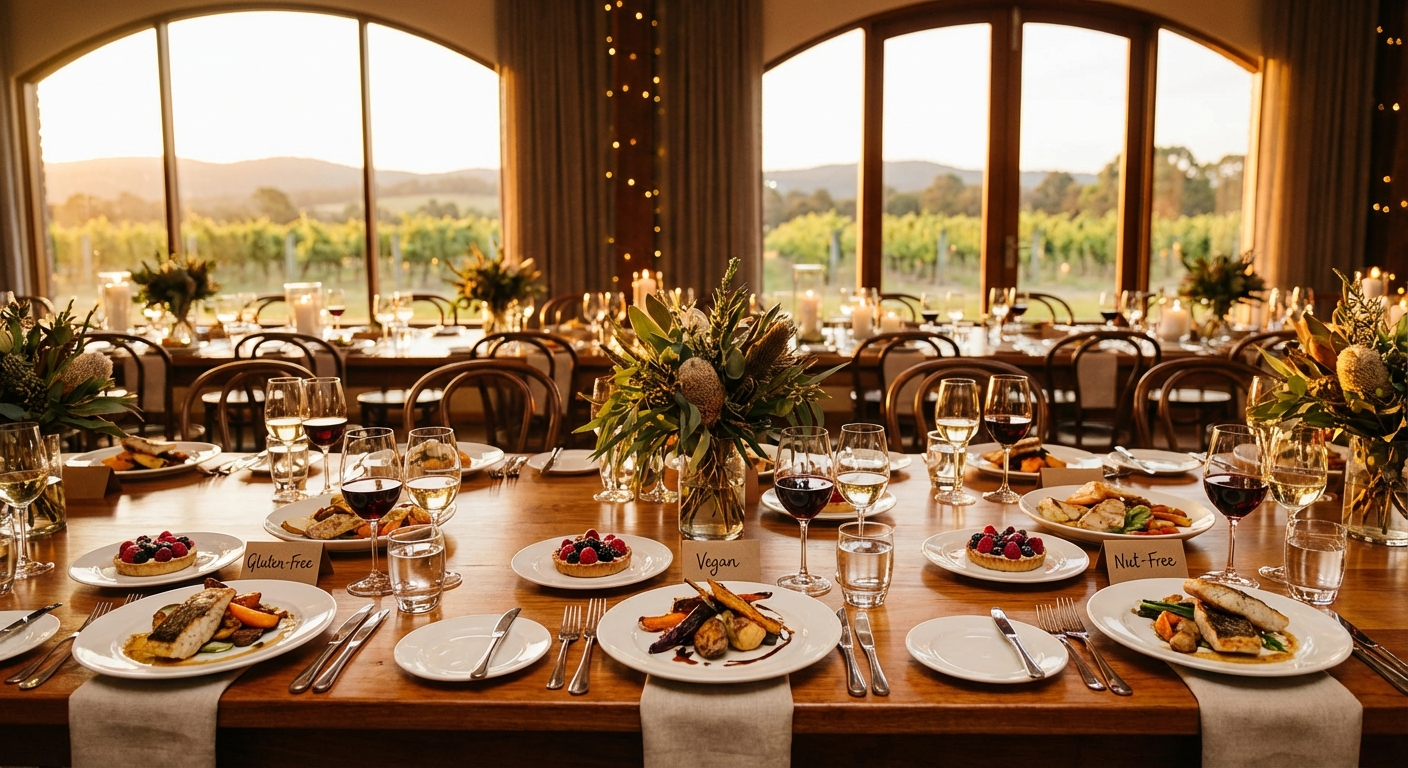
If you have ever attended an Australian wedding where the kitchen ran out of the gluten-free option by the third table, or where a guest with a severe shellfish allergy discovered prawn oil in the entree dressing, you understand why tracking dietary requirements is one of the most important logistical tasks in modern wedding planning. It is not a nice-to-have detail. It is a duty of care that directly affects your guests' health, comfort, and enjoyment of your celebration.
The reality is that dietary diversity in Australia has never been greater. According to Food Standards Australia New Zealand, approximately one in fifty Australians has a diagnosed food allergy, while coeliac disease affects around one in seventy. Add to that the rapidly growing number of Australians following plant-based, halal, kosher, low-FODMAP, or other specific dietary patterns, and it becomes clear that the average wedding guest list of 100 to 150 people will include a significant number of guests with requirements that go well beyond a simple choice between chicken and beef.
The challenge is not just knowing that dietary needs exist. It is collecting accurate, detailed information from every guest, organising it into a format your venue or caterer can actually work with, and ensuring nothing falls through the cracks between the RSVP and the plate. This guide walks Australian couples through exactly how to handle dietary requirements with confidence, using digital RSVP tools that turn a traditionally stressful process into something genuinely manageable.
Why Dietary Tracking Matters More Than Ever at Australian Weddings
Australian food culture has undergone a dramatic transformation over the past decade. The multicultural nature of Australian society means that any given wedding guest list is likely to include people from diverse cultural and religious backgrounds, each with their own food traditions and restrictions. A couple getting married in Melbourne, Sydney, or Brisbane in 2026 might have guests who observe halal requirements, others who keep kosher, vegetarians, vegans, and several people managing medically diagnosed allergies or intolerances.
The legal dimension adds urgency. Under Australian Consumer Law and food safety regulations, venues and caterers have a legal obligation to accurately represent the ingredients in the food they serve. If a guest with a declared peanut allergy is served a dish containing peanut traces, the consequences extend beyond a ruined evening. They can involve serious medical emergencies and significant legal liability. Professional caterers and venue chefs take this extremely seriously, but they can only manage what they know about.
The financial dimension is equally significant. Wedding catering in Australia typically costs between $120 and $250 AUD per head for a sit-down reception, and between $80 and $180 AUD per head for cocktail-style events. When a caterer receives vague or incomplete dietary information, they tend to over-prepare special meals as a safety measure, which inflates costs. Conversely, under-preparation leads to unhappy guests and awkward conversations on the night. Accurate dietary data, collected well in advance, allows caterers to plan efficiently, which often translates to better food and lower waste.
Beyond the practical considerations, there is a hospitality element that matters deeply. When a vegan guest sits down and receives a beautifully plated, thoughtfully prepared plant-based meal that clearly was not an afterthought, it communicates care and inclusion. When a guest with coeliac disease can eat the same dessert as everyone else because the couple chose a naturally gluten-free option, it sends a powerful message. Getting dietary requirements right is an act of generosity that your guests will remember long after the last dance.
Common Dietary Requirements at Australian Weddings
Understanding the landscape of dietary needs helps couples design better RSVP questions and have more productive conversations with their caterers. Here are the most common dietary requirements Australian couples encounter when planning their weddings.
Medical Allergies and Intolerances
Food allergies represent the highest-risk category because they can trigger anaphylaxis, a potentially life-threatening reaction. The most common food allergens in Australia, as identified by the Australasian Society of Clinical Immunology and Allergy (ASCIA), include peanuts, tree nuts, shellfish, fish, eggs, cow's milk, wheat, soy, sesame, and lupin. These are the allergens that require the most careful handling by your caterer, including measures to prevent cross-contamination during preparation and service.
Coeliac disease, which requires strict avoidance of gluten found in wheat, barley, rye, and oats, affects a growing number of Australians. Unlike a preference or mild sensitivity, coeliac disease is an autoimmune condition where even trace amounts of gluten can cause serious intestinal damage. Caterers experienced with coeliac requirements will use separate preparation areas, dedicated utensils, and certified gluten-free ingredients.
Lactose intolerance is another common medical requirement, affecting an estimated four per cent of Australians. While less dangerous than allergies, serving dairy-heavy dishes to lactose-intolerant guests will cause genuine physical discomfort. Many Australian caterers now routinely offer dairy-free alternatives as part of their standard menu planning.
Lifestyle and Ethical Dietary Choices
Vegetarianism and veganism have moved firmly into the mainstream in Australia. Research from Roy Morgan shows that approximately 2.5 million Australians now identify as vegetarian or mostly vegetarian, with plant-based eating growing fastest among the 25 to 39 age group, which happens to be the demographic most likely to be attending weddings. Couples can expect that ten to twenty per cent of their guest list may prefer or require a plant-based option.
Pescatarian diets, where guests eat fish and seafood but not meat, are also increasingly common and straightforward for most caterers to accommodate, particularly at coastal or waterfront venues across Australia where seafood is already a menu highlight.
Religious and Cultural Requirements
Halal dietary requirements are significant for Muslim guests and involve specific rules about how meat is sourced, slaughtered, and prepared. Many Australian caterers, particularly in Sydney, Melbourne, and Brisbane, have established relationships with halal-certified suppliers and can accommodate these requirements with advance notice. It is worth noting that halal requirements extend beyond meat to include the avoidance of alcohol in cooking and certain food additives.
Kosher requirements, while less common at most Australian weddings, involve detailed rules about food preparation, the separation of meat and dairy, and the use of kosher-certified ingredients. Fully kosher catering typically requires a specialised kosher caterer rather than modifications to a standard menu. Couples with kosher-observant guests should discuss this with their venue early, as some venues have restrictions on bringing in external caterers.
Hindu vegetarianism, Jain dietary restrictions, and Buddhist dietary preferences may also be relevant depending on your guest list. The key with all religious and cultural requirements is respectful communication. Ask specifically, listen carefully, and communicate clearly with your caterer.
The Problem with Paper RSVPs for Dietary Tracking
Traditional paper RSVP cards have served Australian weddings for generations, but they are genuinely poorly suited to collecting dietary information. Understanding why helps illustrate the advantages of digital alternatives.
The typical paper RSVP card includes a single line, often labelled 'Dietary Requirements,' where guests are expected to summarise their needs in a space barely large enough for a few words. The result is responses like 'no dairy,' 'vegetarian (but eats fish),' 'allergic to nuts I think,' or simply a question mark. These responses are better than nothing, but they leave couples and caterers guessing about the severity, specificity, and scope of each requirement.
Then there is the aggregation problem. Paper RSVPs arrive over weeks, sometimes months. Each card needs to be opened, read, and manually entered into a spreadsheet or list. Handwriting varies in legibility, critical details can be misread, and cards can go missing in the post. Australia Post's standard letter service, while reliable, adds transit time and cost, with stamps currently priced at $1.20 AUD for domestic standard letters. For a guest list of 150, that is $180 AUD in return postage alone, assuming every guest actually posts their reply.
The biggest issue, however, is the follow-up problem. When a paper RSVP arrives with ambiguous dietary information, the couple needs to contact the guest to clarify. This means tracking down phone numbers, sending texts or emails, and keeping track of who has responded to the follow-up and who has not. For couples managing full-time jobs, other wedding planning tasks, and the general stress of an approaching wedding date, this additional administrative burden is significant.
Perhaps most critically, paper RSVPs create a static record. If a guest's dietary situation changes between sending their RSVP and the wedding day, perhaps due to a new medical diagnosis or a decision to adopt a plant-based diet, there is no easy mechanism for updating their information. The couple may not even know an update is needed until the guest arrives and mentions it at the table.
How Digital RSVP Tools Transform Dietary Tracking
Digital RSVP platforms have fundamentally changed how Australian couples collect and manage dietary information. The shift from a single handwritten line on a paper card to a structured, guided digital form represents a genuine improvement in data quality, organisation, and communication with caterers.
Structured Questions That Get Better Answers
The most significant advantage of digital RSVP tools is the ability to ask structured, specific questions rather than relying on a blank line. Instead of 'Dietary Requirements: ___________,' a digital form can present a series of clear options that guide guests through the process of accurately describing their needs.
A well-designed digital RSVP dietary section might include a primary question like 'Do you have any dietary requirements?' with checkbox options for common categories such as vegetarian, vegan, gluten free, dairy free, nut allergy, shellfish allergy, halal, and kosher. Following this, a conditional text field can ask guests to provide additional details about the severity or specifics of their requirement.
This structured approach dramatically reduces ambiguity. A guest who selects 'Nut Allergy' and then specifies 'anaphylactic to peanuts and cashews, carry an EpiPen' gives the caterer precisely the information they need to manage that guest's meal safely. Compare this to a paper card that simply reads 'no nuts,' which tells the caterer nothing about severity or which specific nuts are involved.
Digital RSVP platforms like WeddingRSVP.org allow couples to customise these questions to match their menu and venue setup. If the caterer has already confirmed they can accommodate vegetarian, vegan, and gluten-free options, the form can reflect those specific choices. If the venue kitchen cannot safely prepare nut-free meals due to shared preparation areas, this can be communicated on the RSVP form itself, prompting affected guests to contact the couple directly.
Real-Time Dashboard and Instant Aggregation
Every digital RSVP response is instantly recorded, categorised, and available in a centralised dashboard. There is no envelope to open, no handwriting to decipher, and no spreadsheet to manually update. Couples can log in at any point and see exactly how many vegetarian meals are needed, how many guests have nut allergies, and who still has not responded.
This real-time visibility is transformative for communication with caterers. Instead of compiling dietary information into a list the week before the wedding, couples can share an up-to-date summary with their caterer at any point during the planning process. Many Australian venues request preliminary catering numbers eight to twelve weeks before the event, with final numbers confirmed two to four weeks prior. A digital dashboard makes both of these milestones straightforward.
The export functionality built into most digital RSVP platforms allows couples to download their guest data as a spreadsheet or PDF, formatted specifically for caterer handover. Columns for guest name, table assignment, and dietary requirements can be sorted, filtered, and printed in whatever format the venue prefers. This level of organisation impresses caterers and venue coordinators, and it reduces the risk of errors during meal preparation and service.
Guest Updates and Ongoing Flexibility
Life changes between the RSVP deadline and the wedding day. A guest might discover a new food sensitivity, become pregnant and develop new dietary needs, or decide to bring a partner who has their own requirements. Digital RSVP platforms allow guests to update their responses right up until the couple locks the form, ensuring that the information caterers receive is current and accurate.
This flexibility is particularly valuable for Australian autumn weddings in March, April, and May, where RSVPs might be collected during the summer holiday period (December to February) when guests are travelling, distracted, or not yet sure of their plans. A guest who RSVPs quickly in January with incomplete dietary information can easily update their response in February once they have had time to think it through.
How to Craft the Perfect Dietary Questions for Your RSVP
The quality of dietary information you receive depends entirely on the quality of the questions you ask. Here are best practices for structuring your digital RSVP dietary section, informed by feedback from Australian caterers and venue coordinators.
Start with a Primary Category Selection
Begin with a clear, direct question: 'Do you have any dietary requirements or food allergies?' Provide a simple yes or no option. If the guest selects 'No,' they skip the remaining dietary questions entirely, keeping the RSVP process quick for guests with no special needs.
For guests who select 'Yes,' present a list of common dietary categories as checkboxes, allowing multiple selections. A comprehensive list for Australian weddings should include: vegetarian, vegan, gluten free or coeliac, dairy free or lactose intolerant, nut allergy, shellfish or seafood allergy, egg allergy, halal, kosher, and an 'other' option with a text field.
This approach is superior to a single dropdown menu because many guests have overlapping requirements. A guest might be both vegetarian and gluten free, or have a nut allergy and follow a halal diet. Checkboxes capture this complexity accurately.
Ask About Severity and Specifics
For allergy selections, include a follow-up question about severity. Something like: 'Please describe the severity of your allergy and any specific foods to avoid. This helps our caterer ensure your safety.' The distinction between 'I prefer to avoid dairy' and 'I am anaphylactic to dairy protein' is critical for kitchen planning.
Encourage detail without making the form feel burdensome. A brief note explaining why you are asking, such as 'We want to make sure every guest enjoys a delicious meal that is safe for them,' reassures guests that their information will be used thoughtfully and is not just a checkbox exercise.
Collect Information Per Guest, Not Per Invitation
If your RSVP allows guests to respond for themselves and a partner or family members, ensure that dietary questions are asked for each individual attendee, not just the primary respondent. A couple where one partner is vegan and the other has no requirements needs two separate dietary records, not a single combined response.
This per-guest approach aligns with how caterers actually work. Venue chefs prepare individual plates or allocate specific meals to specific seats. They need to know that Guest A at Table 7 requires the vegan entree and dairy-free dessert, while Guest B at the same table has no requirements. Digital RSVP tools that support per-guest dietary collection make this mapping straightforward.
Communicating Dietary Information to Your Australian Caterer
Collecting dietary information is only half the equation. The other half is communicating it to your venue or caterer in a format they can use effectively. Australian catering professionals have shared the following preferences for receiving dietary data from couples.
Timing the Handover
Most Australian wedding venues and caterers work on a two-stage timeline. The first stage, typically eight to twelve weeks before the wedding, involves preliminary numbers and a general overview of dietary requirements. This allows the kitchen to plan their ordering, source specialty ingredients, and design alternative dishes that complement the main menu.
The second stage, usually two to four weeks before the event, involves final confirmed numbers with detailed, guest-by-guest dietary information tied to the seating plan. At this point, the caterer needs to know exactly which guest at which table receives which meal variation. Premium venues in Sydney, Melbourne, and Brisbane increasingly request this information in spreadsheet format, sorted by table number.
Digital RSVP platforms make both stages effortless. The preliminary overview can be generated at any time from the dashboard, while the final detailed export can be produced once the seating plan is finalised and the RSVP deadline has passed.
The Format Caterers Prefer
After consulting with catering teams across Australian capital cities, the ideal dietary handover document includes: a summary page showing total counts for each dietary category, followed by a detailed guest list sorted by table, with columns for guest name, table number, dietary category, and specific notes.
For example, a summary might read: '6 vegetarian, 3 vegan, 4 gluten free, 2 nut allergy (anaphylactic), 1 halal, 1 dairy free.' The detailed list would then provide the individual names and table assignments for each of those guests, along with any specific notes captured during the RSVP process.
Avoid sending dietary information as a long email or unformatted text message. Kitchens are busy, fast-paced environments where clear, structured information reduces errors. A well-formatted spreadsheet exported from your digital RSVP platform will be received with gratitude by any professional catering team.
Smart Menu Planning for Dietary Diversity
While collecting and communicating dietary information is essential, thoughtful menu planning can dramatically reduce the complexity of catering for diverse dietary needs. Many of Australia's top wedding caterers recommend the following strategies.
Design Naturally Inclusive Menus
The most elegant solution to dietary diversity is to design a menu where several courses are naturally free from common allergens and suitable for multiple dietary categories. A shared entree of roasted seasonal vegetables with native pepperberry and lemon myrtle, for instance, is simultaneously vegan, gluten free, dairy free, nut free, and halal. When the main menu itself accommodates many requirements, fewer individual modifications are needed.
Australian caterers are increasingly embracing this approach, drawing on the country's exceptional produce and multicultural culinary traditions. A main course of slow-roasted lamb shoulder with harissa, served family-style with grain salads and roasted root vegetables, can be paired with an equally impressive plant-based main, such as a cauliflower steak with chimichurri and smoked eggplant, that feels like a genuine menu highlight rather than a compromise.
Cocktail-style receptions and grazing stations are particularly well-suited to dietary inclusivity. By offering a wide variety of small bites, couples can ensure that every guest finds multiple options that suit their needs without requiring individual plated modifications. This format is popular at Australian winery and outdoor weddings, where the relaxed atmosphere complements a grazing approach.
Working with Australian Seasonal Produce
Autumn weddings in March, April, and May benefit from an abundance of seasonal Australian produce that lends itself to inclusive menu design. Figs, quinces, pomegranates, persimmons, and late-season stone fruits are naturally allergen-free and work across dietary categories. Root vegetables like sweet potato, beetroot, and parsnip are at their peak, providing hearty, satisfying options for plant-based guests.
Australian native ingredients are another tool for inclusive menu design. Lemon myrtle, wattleseed, finger lime, Davidson plum, and Kakadu plum add distinctive flavours while being naturally free from the major allergens. Venues in regions like the Barossa Valley, Hunter Valley, Yarra Valley, and Margaret River often have strong relationships with local producers and can source these ingredients easily.
Discussing seasonal availability with your caterer early in the planning process allows them to design a menu that is both inclusive and showcases the best of what the season offers. Many couples find that constraints around dietary requirements actually lead to more creative, interesting menus than they would have chosen otherwise.
On-the-Day Dietary Management
Even with perfect RSVP data and excellent caterer communication, the wedding day itself requires attention to ensure dietary requirements are handled smoothly.
Table place cards or escort cards that include a discreet dietary indicator, such as a small coloured dot or symbol, help waitstaff identify which guests receive modified meals without drawing attention to individual dietary needs. Most Australian venue coordinators recommend this approach, and it can be easily set up using the guest data exported from your digital RSVP platform.
Brief your venue coordinator or wedding planner on the specific high-risk dietary requirements, particularly severe allergies. The coordinator should know which guests carry EpiPens, what their allergens are, and where they are seated. This information should be shared discreetly and professionally, respecting the guest's privacy while ensuring their safety.
For buffet or grazing-style receptions, clear labelling of every dish with its allergen status is essential. Australian food labelling standards require disclosure of the major allergens, and your caterer should apply the same rigour to a wedding buffet that they would to any commercial food service. Labels should list what each dish contains, not just what it is free from, giving guests with complex requirements the information they need to make safe choices.
Finally, consider having your venue or caterer prepare two or three extra meals in the most common dietary categories. Despite the best RSVP processes, last-minute changes do happen. A guest might bring an unexpected plus-one with dietary needs, or someone might have provided incomplete information. Having a small buffer of vegetarian, gluten-free, and dairy-free options available in the kitchen provides a safety net that costs relatively little but can prevent significant stress on the night.
Costs and Budgeting for Dietary Catering in Australia
Understanding the cost implications of dietary requirements helps couples budget more accurately and have informed conversations with their caterers.
Most reputable Australian wedding caterers include a reasonable number of dietary modifications within their standard per-head pricing. Vegetarian and vegan alternatives, gluten-free substitutions, and dairy-free options are generally considered standard and should not incur additional charges. If a caterer quotes a significant surcharge for basic dietary modifications, it may be worth seeking alternative quotes.
More complex requirements, such as fully kosher catering, certified halal preparation with a separate kitchen area, or meals for guests with multiple severe allergies requiring dedicated preparation equipment, may involve additional costs. These typically range from $20 to $60 AUD per affected guest, depending on the complexity of the requirement and the caterer's existing capabilities.
The overall impact on the catering budget is usually modest. For a wedding with 120 guests where fifteen have dietary requirements, the additional cost might range from $300 to $900 AUD in total, representing a small fraction of the overall catering spend. This is a worthwhile investment in guest comfort and safety, and it is significantly less than the cost of getting it wrong, whether through wasted over-prepared meals, unhappy guests, or, in the worst case, a medical incident.
Couples working with a tighter budget should note that some of the most inclusive menu approaches, particularly shared platters, family-style service, and grazing tables, can actually be more cost-effective than individually plated courses with multiple dietary variations. Discuss this with your caterer when exploring menu options.
Tracking dietary requirements at an Australian wedding has evolved from a stressful afterthought into a streamlined, manageable process, thanks largely to digital RSVP tools that collect better data, organise it automatically, and make communication with caterers effortless. The combination of structured dietary questions on your RSVP form, real-time tracking through a digital dashboard, and clean data exports for your caterer creates a system where nothing falls through the cracks.
For couples planning autumn weddings in 2026 across Sydney, Melbourne, Brisbane, Perth, Adelaide, and beyond, the key takeaway is simple: invest a few minutes in setting up thoughtful dietary questions on your digital RSVP, and you will save hours of follow-up phone calls, reduce catering costs through accurate planning, and ensure that every guest, regardless of their dietary needs, enjoys a meal that was prepared with care and intention.
Your guests will notice. And your caterer will thank you.