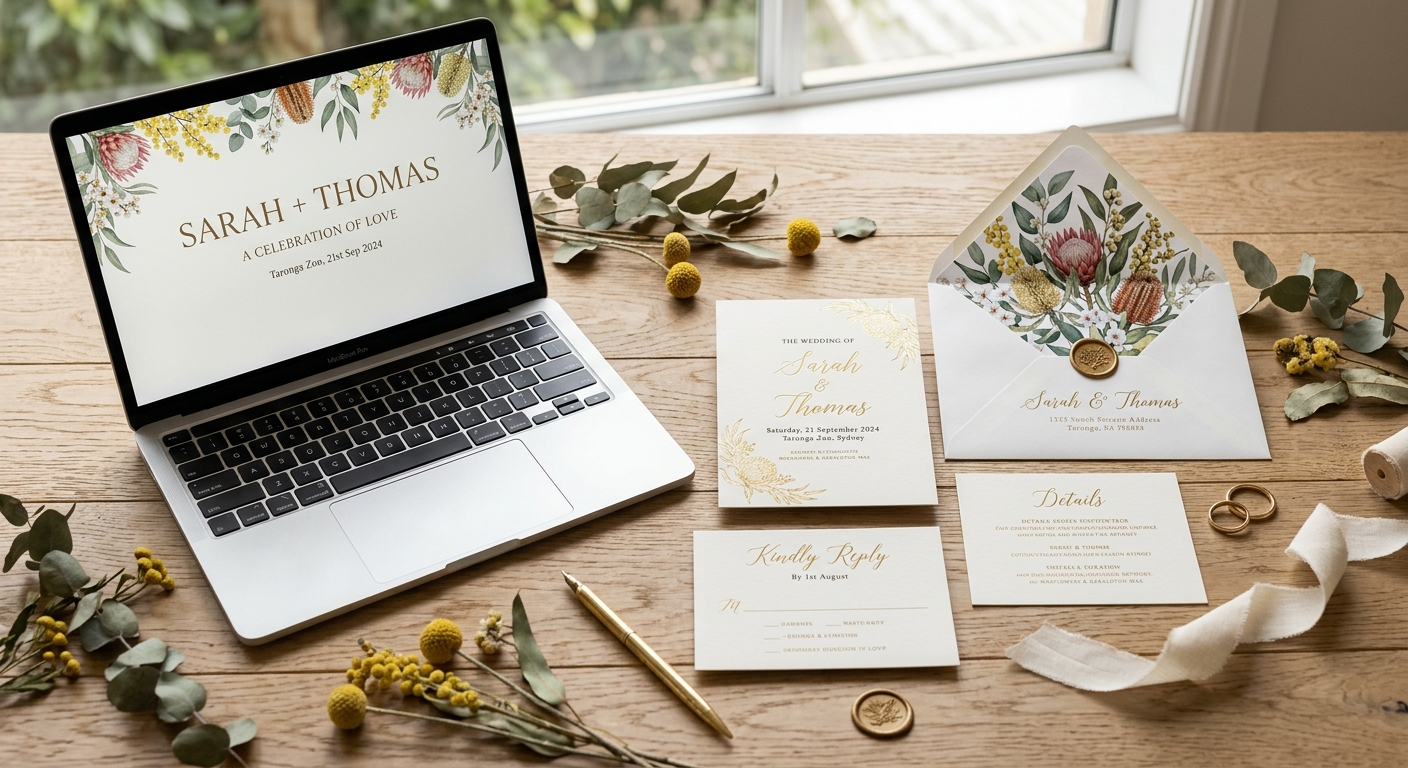
The traditional paper wedding invitation has served Australian couples for generations. Bought from a printer, addressed by hand, stamped and posted, then chased with phone calls when the responses did not arrive. It was the system, and for a long time it was the only system. That is changing. Australian couples in 2026 are making a deliberate and increasingly widespread choice to move their wedding communications online, and the data strongly suggests the shift is not a trend — it is a permanent reorientation of how weddings are planned and managed.
The appeal of digital wedding invitations is immediate and practical. They eliminate postage costs that have risen sharply with Australia Post price increases. They arrive instantly regardless of postal delays, which remain inconsistent across the country. They allow couples to track RSVP responses in real time, send automated reminders to non-respondents, and collect dietary requirements without manual data entry. For couples planning a wedding in an era of rising costs and compressed timelines, these advantages are compelling and increasingly difficult to ignore.
This guide covers everything Australian couples need to know about digital wedding invitations in 2026. It explains the case for switching, addresses the common concerns about going digital, walks through how digital RSVP platforms work, provides guidance on wording and etiquette, and offers a practical framework for couples who are ready to make the transition. Whether you are planning a beach ceremony on the Gold Coast, a vineyard celebration in the Yarra Valley, or a city wedding in Melbourne, digital invitations can work for your celebration.
The transition to digital does not require abandoning every tradition. Many couples use a beautiful digital invitation as their primary announcement while retaining a single physical keepsake — a printed card or a framed version of their invitation — that they display or keep as a memento. The key is understanding what digital tools offer and choosing the combination that works for you, your partner, and your guest list.
Why Australian Couples Are Choosing Digital Invitations
The case for digital wedding invitations in Australia is built on four converging pressures: cost, reliability, convenience, and sustainability. Each of these factors has intensified in recent years, and together they have created a compelling practical argument for going online that was less convincing even three years ago.
Australia Post pricing has increased significantly, with standard letter postage now at $1.50 AUD per stamp and express options reaching $12.95 AUD. For a guest list of 150 people, sending save-the-dates and formal invitations — each requiring an envelope, stamp, and response card — can easily cost $400 to $600 AUD in postage alone, before accounting for the printing costs of the cards themselves. Digital invitations eliminate this cost entirely. The savings are real and immediate.
Australia Post delivery times, even for standard letters within major cities, have become unreliable. A save-the-date posted six months before the wedding should arrive comfortably. In practice, many couples report responses from guests who say they never received their invitation, or who received it only days before the event. Digital invitations sent by email, messaging apps, or shared via a wedding website link arrive within seconds of being sent, with confirmed delivery receipts available. There is no ambiguity about whether your guests received the information.
The third pressure is the most modern: a generation of Australian couples who manage their lives online are increasingly comfortable with digital-first communication for significant events. The assumption that a wedding invitation must be physical is weakening as digital literacy increases and as the environmental case for reducing paper waste becomes more compelling. Couples who would not dream of posting a birthday party invitation are increasingly questioning why a wedding invitation should be any different.
The Financial Case in a Cost-of-Living Environment
Australian couples are navigating a wedding cost environment that has increased substantially over the past five years. The average cost of a traditional wedding in Australia now sits between $36,000 and $55,000 AUD, with venue catering, photography, and florals representing the largest line items. Within this landscape, every dollar saved on stationery and postage can be redirected toward the elements that create the most impact on the day itself.
A complete set of wedding stationery — save-the-date cards, formal invitations, ceremony programs, menu cards, response cards, and thank-you notes — from a quality Australian printer typically costs between $800 and $2,500 AUD depending on the level of design and printing quality. Postage adds another $300 to $600 AUD for a 150-guest list. The combined stationery and postage budget for a traditional paper invitation suite can reach $3,000 AUD or more. For a digital wedding invitation platform, the equivalent functionality — including a custom design, unlimited guests, and a full-featured RSVP management system — costs between $0 and $150 AUD per year at most providers.
The practical value of this saving is straightforward. A couple who eliminates $2,500 AUD in paper stationery and postage costs can redirect those funds toward an extra hour of photography, a premium live musician during the cocktail hour, or a contribution toward their honeymoon fund. The trade-off is not a lesser experience — it is a different allocation of resources.
Digital platforms also reduce hidden costs that are rarely accounted for in the initial wedding stationery budget. Reply envelopes require postage for guests to respond. Reminder phone calls and text messages take time that has real value. Manual RSVP data entry — transferring response cards into a spreadsheet — is tedious, error-prone, and time-consuming. Each of these costs is eliminated when guests respond digitally through a structured form.
The Reliability Problem with Australia Post
Australia Post letter delivery performance has been inconsistent in recent years, with on-time delivery rates fluctuating particularly during peak periods and in regional areas. A save-the-date card posted from Melbourne to a guest in Perth should arrive within three to five business days under standard delivery guidelines. In practice, delivery times during the October-to-December peak wedding season can extend to seven to ten business days, and sometimes longer for regional addresses.
This creates a specific problem for save-the-dates, which are most effective when sent six to twelve months before the wedding. A save-the-date posted in January for an August wedding should arrive comfortably. But if the card is delayed by a week or two in the January post rush, guests may receive it with less notice than intended, creating anxiety for both the couple and their guests. Digital save-the-dates eliminate this uncertainty entirely — they are delivered the moment you press send.
The guest address problem compounds the reliability issue. Australia requires residents to update their address when they move, but postal mail forwarding requests expire after twelve months. Guests who have moved and not updated their address with Australia Post will not receive forwarded stationery — it will be returned to sender or simply discarded. A digital invitation to an email address or a link shared via a messaging app does not have this problem. If a guest changes their email address, they are more likely to notify you directly, and digital RSVP platforms allow you to update contact details in real time.
International guests present an even stronger case for digital. Guests attending a destination wedding in Australia from overseas may not have reliable postal addresses in the Australian system, and international postage from some countries is unreliable or expensive. A digital invitation arrives at their email inbox regardless of geography, and a wedding website link works from any country with internet access.
The Sustainability Argument
Sustainability has become a primary consideration for Australian couples planning weddings in 2026. The environmental case for digital invitations is not abstract — it is quantifiable and significant. A single traditional wedding invitation suite for a 100-guest wedding consumes approximately 1.2 kilograms of paper, including the invitation, envelope, response card, and reply envelope. When you factor in save-the-dates, ceremony programs, menu cards, and thank-you notes, the paper consumption can reach 4 to 6 kilograms for a single wedding.
The carbon footprint of this paper extends beyond the material itself. It includes the manufacturing and transportation of the paper, the printing process, and the delivery of each item by road or air. Digital communication eliminates each of these inputs entirely, replacing them with a negligible data transfer that represents a fraction of the environmental cost.
Australian wedding vendors are increasingly incorporating sustainability into their service offerings, and digital-first communication aligns with a broader environmental ethic that many couples are adopting across their celebrations. From locally sourced flowers to zero-waste catering, the sustainable wedding is no longer a niche concept — it is a mainstream value that digital invitations support as a foundational practice.
Addressing Common Concerns About Digital Invitations
The shift toward digital invitations is not without its objections, and couples considering the transition deserve honest answers to the questions they are likely to encounter from themselves, their partners, and older family members. The most common concerns fall into three categories: the perceived informality of digital communication, the challenge of reaching guests who are less digitally connected, and the question of whether a digital invitation feels like a less significant announcement.
Each of these concerns deserves a direct response. The perception that digital invitations are informal is increasingly outdated. Digital platforms in 2026 offer design capabilities and customisation options that rival traditional print design. Custom fonts, colours, layouts, and imagery can create a digital invitation that is visually indistinguishable from a printed card when viewed on a device — and for a generation that reads its most important communications on screens, this equivalence is meaningful. Platforms like weddingrsvp.org offer templates designed to match the sophistication of traditional stationery while providing the functionality of a digital platform.
Reaching Guests Who Are Less Digitally Connected
The concern that older guests will struggle with digital invitations is real but manageable. Grandparents who do not use email regularly, or who find websites confusing, represent a segment of any guest list that requires thoughtful consideration. The practical solution is a hybrid approach: digital invitations for the majority of guests, with a physical version — or a phone call — for guests who genuinely cannot engage digitally.
In practice, this means very few physical cards. In most cases, a couple sending digital invitations to a 100-guest list might need to produce five to ten physical cards for guests without email access or digital literacy. This is a fraction of the stationery cost of a fully paper-based approach, and it allows you to retain a digital-first workflow for the majority of your guest list without excluding anyone.
The key communication principle is the same regardless of the invitation format: ensure every guest, regardless of their digital comfort, understands the essential information about your wedding, knows how to respond, and feels included in the celebration. Digital tools support this goal as effectively as — and often more effectively than — their paper equivalents.
The Question of Formality and Significance
Some couples and families worry that a digital invitation diminishes the significance of the wedding announcement. This concern reflects a genuine cultural norm — formal announcements feel important, and physical objects carry emotional weight that digital communications sometimes lack. The response is not to dismiss this concern but to reframe the question.
The significance of a wedding announcement comes from the relationship between the sender and the recipient, not from the medium. An email from a close friend announcing their wedding carries more emotional weight than a printed invitation from a distant acquaintance. Digital invitations sent personally — with the couple's names, a personal message, and a direct link — feel different from bulk email invitations in exactly the same way that a handwritten letter feels different from a printed response card.
Many couples address the emotional dimension of the announcement by creating a wedding website as a digital hub that goes beyond a simple invitation. The website becomes a place where guests can learn about the couple, see the venue, browse the registry, and access all the information they need leading up to the event. This depth of communication — impossible in a printed invitation — creates a sense of inclusion and anticipation that many couples find more satisfying than the one-directional nature of paper stationery.
How Digital RSVP Platforms Work for Australian Couples
A digital RSVP platform is more than a digital invitation delivery service. It is a comprehensive guest management system that handles everything from the initial invitation through to the day-of logistics and post-event follow-up. Understanding the full scope of what these platforms offer helps couples appreciate why the transition from paper to digital represents a fundamental change in how wedding planning works, not just a different format for the same information.
At its core, a digital RSVP platform receives guests via a link or email, presents them with a styled digital invitation, and collects their response through a structured form. But the difference between this and a paper RSVP card is the richness of the data collected, the speed with which it is available, and the automated follow-up workflows that ensure no response is lost.
Setting Up Your Digital Invitation
The first step is selecting a platform that meets your needs. WeddingRSVP.org and comparable platforms offer Australian couples a purpose-built system for managing digital invitations and RSVPs. Most platforms allow you to customise the design of your digital invitation using templates or by uploading your own branding, colours, and imagery. The result is a digital card that maintains your wedding aesthetic across every piece of communication.
The platform then provides you with a unique wedding website URL that serves as the hub for all guest communications. This URL can be shared via email, social media, or messaging apps, or embedded in a QR code on physical elements if you are using a hybrid approach. Guests visit the website, find their invitation, and are guided through the RSVP process in a structured, intuitive flow.
Most platforms allow you to set up multiple invitation waves: a save-the-date version, a formal invitation, and any follow-up communications. Each wave can be customised separately while maintaining consistent branding. Automated workflows can be configured to send reminders to guests who have not responded within a set period — typically three to seven days before the response deadline.
Real-Time RSVP Tracking and Guest Management
The most immediate practical advantage of a digital RSVP platform is the real-time dashboard that shows you exactly who has responded, who has not, and what they have indicated in terms of dietary requirements, plus-ones, song preferences, and other custom questions. This dashboard updates the moment a guest submits their response — no waiting for response cards to arrive in the mail, no manual data entry, no spreadsheet errors.
For a couple managing a 120-guest wedding with complex dietary requirements — which is increasingly common in multicultural Australian cities like Sydney, Melbourne, and Brisbane — this real-time accuracy is invaluable. Dietary responses can be exported directly to your caterer in a clean format, eliminating the transcription errors that occur when response cards are manually transferred. The difference between 100 percent accurate dietary data and 90 percent accurate data can be the difference between a guest being properly catered for and a potentially serious dietary incident at the reception.
The dashboard also provides aggregated views of your response data. You can see at a glance how many guests have confirmed, how many are tentative, and how many have declined. You can track these numbers over time and see your confirmation curve — which guests responded immediately, which needed a reminder, and which required a personal follow-up. This data informs your catering numbers, seating plan, and overall logistics in ways that are simply not possible with paper response tracking.
Automated Reminders and Follow-Up Workflows
Non-response is one of the most persistent challenges in wedding planning. With paper RSVPs, the standard approach is a phone call to the non-responding guest — a task that is both time-consuming and occasionally uncomfortable. Digital platforms eliminate this burden through automated reminder workflows that send polite, timely follow-up messages to guests who have not responded.
These workflows are configurable to match your timeline. You can set a reminder to go out automatically three days after the initial invitation for guests who have not responded, a second reminder seven days later, and a final personal follow-up reminder at the two-week mark. Each reminder is sent from the platform using your wedding branding and contact details, maintaining the formality of your invitation suite while taking the awkwardness out of the follow-up process.
For destination weddings where guest logistics are complex — particularly regional Australian weddings where guests need to book accommodation, arrange transport, and potentially take time off work — automated reminders are particularly valuable. They ensure guests have the information they need well in advance of the deadlines for each logistical element, reducing the volume of individual queries that would otherwise flow to the couple in the final weeks before the wedding.
Digital Invitation Etiquette: What Australian Couples Need to Know
The etiquette of wedding invitations in Australia has evolved alongside the practical shift to digital formats. Australian couples are navigating questions of wording, timing, and protocol that do not have simple answers, because the culture is still settling on norms for digital wedding communication. The key principle is the same regardless of format: the invitation should communicate essential information clearly, maintain the formal tone appropriate to the celebration, and make responding as easy as possible for the guest.
Wording Your Digital Invitation
The wording of a digital invitation follows the same conventions as a paper invitation, adapted for the digital medium. The essential elements remain consistent: who is hosting, the names of the couple getting married, the request to attend, the date and time, the venue with enough detail to allow guests to locate it, and the requested response. These elements have been standard for decades and guests expect to find them in your invitation regardless of format.
The key stylistic difference is in the call to action. A paper invitation requests a response by enclosing a response card with a stamped return envelope. A digital invitation requests a response by providing the URL or link to the RSVP platform and setting a response deadline. The language should reflect this: instead of 'Kindly reply by [date]', a digital invitation might say 'Please RSVP by [date] via our wedding website at [URL]' or 'We would love for you to join us — please confirm your attendance by [date] at [URL]'.
Australian couples have increasingly embraced a warm, conversational tone that feels more natural in digital format than the formal traditional phrasing of paper invitations. While 'The pleasure of your company is requested at the marriage of...' remains appropriate for formal black-tie weddings, many couples in 2026 are using language like 'We are getting married and we want you there!' as their opening line, then providing the formal details below in a clear, organised layout.
Timing: When to Send Digital Invitations
The timing of Australian wedding invitations follows a well-established cultural norm that digital platforms support rather than change. Save-the-dates are typically sent six to twelve months before the wedding, with formal invitations going out three to six months before. For a Saturday wedding in October 2026, a save-the-date in January or February is appropriate, with the formal invitation following in May or June.
The advantage of digital save-the-dates is their immediacy — they can be sent the moment you have a confirmed date and venue, without waiting for printing and posting. For couples who finalise their venue quickly or who need to communicate a date urgently to key guests who may be booking international travel, this immediacy is valuable. Many digital platforms offer separate save-the-date and formal invitation templates that maintain visual consistency while differentiating the two communications.
The response deadline for a digital invitation should typically be set at four to six weeks before the wedding, allowing sufficient time to confirm numbers with your venue and caterer. Digital platforms make it easy to track this deadline automatically and send reminders to guests who have not responded as the deadline approaches.
Asking for an Unplugged Ceremony Digitally
The unplugged wedding trend — where couples ask guests to switch off phones and cameras during the ceremony to allow professional photographers to capture the moment without interference — has become firmly established in Australia. Digital wedding websites are the ideal platform for communicating this request politely and effectively.
The key to an effective unplugged request is tone. Guests who are asked abruptly or told what to do can become defensive. A warm, positive framing that focuses on the experience rather than the restriction tends to work better. Phrases like 'We have hired an amazing photographer and we would love for you to be fully present in the moment with us — we kindly ask that phones are switched off during the ceremony' communicate the request clearly without sounding dictatorial.
Your digital invitation or wedding website is the right place to introduce this request early, rather than having your celebrant announce it during the ceremony or placing a sign at the entrance that surprises guests who did not know it was coming. Early communication lets guests prepare for the request and removes any sense of being caught off guard.
The Hybrid Approach: When to Use Paper and When to Use Digital
The most practical approach for most Australian couples in 2026 is not an either-or choice between digital and paper. It is a hybrid model that uses each format where it offers the greatest value. Understanding where each format excels helps couples make informed decisions about how to allocate their stationery budget and communication workflow.
Digital formats excel for save-the-dates, formal invitations, RSVP collection, dietary requirement gathering, logistical updates, accommodation information, and day-of schedules. These communications benefit from speed, data collection capability, and the ability to update information in real time if circumstances change. A venue change, a schedule update, or a weather contingency plan can be communicated instantly to all guests through a digital platform.
Paper formats retain value for physical keepsakes and for guests who genuinely cannot engage digitally. Some couples create a single formal printed invitation for each household that serves as a memento — framed or kept in a wedding memory box alongside other keepsakes. Others use a physical card at the reception table listing the day-of schedule, menu, and thank-you message. The key is making the paper element intentional rather than default: a deliberate choice to include a physical piece because it adds value, not because the digital option was never considered.
When a Physical Invitation Still Makes Sense
There are specific situations where a physical invitation remains genuinely appropriate. Grandparents and older relatives who are not digitally connected deserve a format they can engage with, and a physical invitation ensures they are included in the celebration without requiring a family intermediary to relay information. Some families also have strong cultural expectations around formal announcements that a digital invitation may not satisfy. Honouring these expectations while using digital tools for the majority of your guest list is a reasonable hybrid approach.
A formal wedding with a black-tie dress code, a premium venue, and a highly traditional guest list may also benefit from a physical invitation suite that sets the tone for the event. The tactile quality of heavy cardstock, foil printing, and hand-addressed envelopes communicates the formality and intention of the celebration in a way that a digital invitation cannot fully replicate. This is a design and aesthetic consideration, not a functional one — but it is a real consideration for couples for whom the visual language of their invitation matters.
The practical approach in these situations is to identify the guests for whom a physical invitation is genuinely appropriate — typically five to fifteen guests per 100 — and produce a small run of formal printed invitations for that group while sending digital invitations to everyone else. This is dramatically more cost-effective than printing a full run of paper invitations for an entire guest list, and it ensures every guest receives their invitation in a format they can engage with.
Using Your Wedding Website as the Information Hub
A wedding website serves a purpose beyond the invitation itself: it is the central information hub for your entire guest list in the period leading up to the wedding. Every piece of information guests need — directions, accommodation options, the day schedule, dress code guidance, registry details, RSVP access — should be accessible through the website, regardless of whether they received a digital or physical invitation.
For a regional destination wedding in Australia — a Yarra Valley winery, a Hunter Valley estate, a Margaret River property, or a Byron Bay beachfront venue — the wedding website becomes particularly valuable. Guests unfamiliar with the area need practical information about transport, parking, and accommodation that would be unwieldy to include in an invitation but is easy to present on a dedicated website page. A digital invitation that directs guests to this hub for all their questions is far more effective than attempting to include every logistical detail in the invitation itself.
The website also provides a channel for updates that would be difficult to communicate through paper. If a venue changes its start time, if a supplier needs to revise the schedule, or if weather requires a contingency plan, these updates can be communicated instantly to all guests through the website and any associated notification system. This real-time communication capability is one of the strongest practical arguments for a digital-first wedding communication workflow.
Choosing the Right Digital Platform: Features That Matter
Australian couples have an increasing range of digital RSVP and wedding website platforms to choose from, and the feature sets vary significantly across providers. Understanding which features genuinely matter — and which are marketing frills — helps couples make an informed decision about which platform to use for their celebration.
The core features that every digital wedding RSVP platform should offer are: a customisable digital invitation template, a dedicated wedding website URL, an RSVP form with customisable fields, real-time response tracking, automated email reminders, dietary requirement collection, and mobile-responsive design that works on every device. These features are not optional — they represent the baseline functionality that makes a digital platform genuinely useful. Platforms that do not offer all of these should be approached with caution.
Essential Features to Look For
Beyond the core features, there are several capabilities that distinguish a premium digital wedding platform from a basic one. Custom domain support — the ability to use your own wedding URL rather than a generic platform subdomain — adds polish and professionalism that guests notice. WYSIWYG design editing means you do not need technical skills to create a beautiful invitation and website. Multiple RSVP waves allow you to manage save-the-dates, formal invitations, and day-of communications in one place.
The ability to export clean data to spreadsheet or PDF format is critical for working with your venue and caterer. Your caterer needs a clean dietary requirements list in a format they can use, and your venue needs an accurate final guest count. If your platform cannot export this data cleanly, you will find yourself re-entering information manually — which defeats much of the purpose of going digital.
Gift registry integration is increasingly expected by Australian couples. The ability to link directly to one or more registry platforms — whether a wishing well, a gift registry, or a honeymoon fund — from within the wedding website provides a seamless experience for guests and eliminates the awkwardness of requesting physical gifts.
What Australian Couples Should Expect to Pay
The digital wedding platform market in Australia spans a wide price range, from free tiers with basic functionality to premium packages at $150 to $300 AUD per year. The free tiers offered by most platforms are genuinely useful for small, simple weddings with a limited guest list. They typically include core invitation and RSVP functionality with platform branding included.
The paid tiers, which range from approximately $50 AUD per year for a basic paid plan to $150 to $300 AUD per year for premium packages with advanced features, are worth the investment for couples with larger guest lists or more complex requirements. The premium features that matter most — removing platform branding, enabling custom domains, unlocking advanced customisation, and providing white-glove support — are typically bundled at the upper tiers.
A useful framework: if you are spending more than $2,000 AUD on wedding stationery and postage with a paper-based approach, the equivalent digital platform investment is so small as to be effectively free by comparison. If you are spending $500 AUD or less on paper stationery, a digital platform may represent a similar or slightly higher cost — but the functional benefits, particularly around RSVP management, will almost certainly justify the investment.
Setting Up Your Digital Invitations: A Step-by-Step Guide
The process of setting up digital invitations for your Australian wedding follows a logical sequence that, once understood, makes the entire workflow manageable. Whether you are setting up your first digital invitation or migrating from a previous platform, the steps below provide a practical framework for getting your digital wedding communication system live and working effectively.
Step 1: Choose Your Platform and Set Up Your Account
Start by selecting a platform that meets your needs. Create your account and claim your wedding website URL early — before you finalise anything else. Your wedding URL will be shared in every communication, so take time to choose something memorable, easy to spell, and representative of your names. Avoid hyphens and unusual spellings that create confusion when shared verbally.
Set up your basic profile: your names, your wedding date, your venue, and your planned tone and design aesthetic. This foundation will be referenced every time a guest visits your website, so ensure it is accurate and complete from the outset.
Step 2: Design Your Digital Invitation
Choose or design your invitation template. Most platforms offer a library of pre-designed templates that cover the range of Australian wedding aesthetics — from minimalist and modern to romantic and classic. Upload your own imagery if you have a photographer or designer creating bespoke elements. Set your colour palette and typography to align with your overall wedding aesthetic.
Write your invitation text following the conventions described earlier in this guide. Include the essential elements: who is hosting, the names of the couple, the date, time, and venue, and the RSVP instructions. Proofread carefully — an error in your invitation is permanent in the digital format in a way that it is not with printed stationery.
Step 3: Configure Your RSVP Form
Set up your RSVP form with fields for each piece of information you need to collect. At minimum, this includes the guest name, their attendance confirmation, their dietary requirements, and any plus-one details. Add custom fields for specific needs — song requests, transport preferences, accommodation requirements for destination weddings.
Set your RSVP deadline and configure your reminder workflow. Most platforms allow you to set a primary deadline and one or more reminder intervals. Configure these to align with your overall planning timeline, with the primary deadline set at least four to six weeks before your wedding.
Step 4: Import and Segment Your Guest List
Import your guest list into the platform. Most platforms accept CSV imports, which makes the initial upload straightforward if you have been maintaining your guest list in a spreadsheet. Segment your list by household if appropriate — some invitations are addressed to a household rather than an individual, and the platform should accommodate this structure.
Identify any guests for whom you plan to send a physical invitation separately. Mark these guests in your platform so you do not send them a digital invitation in addition to their physical card.
Step 5: Send a Test and Then Your Invitation
Before sending to your full guest list, send a test invitation to yourself and to one or two trusted friends or family members who can check for any rendering issues, broken links, or form errors. This step takes fifteen minutes and prevents embarrassing errors from reaching your guests.
Send your digital save-the-date or invitation in a single batch to your full guest list, or in staged waves if your timeline calls for different send dates for different groups. Track your response dashboard from the moment they go out, and trigger your automated reminder workflow for non-respondents at the intervals you have configured.
Common Digital Invitation Mistakes and How to Avoid Them
Digital wedding invitations remove many of the failure modes that affect paper invitations — there is no postal delay, no lost response card, no manual data entry error — but they introduce their own set of pitfalls. Understanding these before you launch your digital invitation campaign will help you avoid them.
Broken Links and Incorrect URLs
The most common digital invitation error is a broken or incorrect URL in the invitation text. If the website link you share does not work — because it was mistyped, because the platform subdomain changed, or because the custom domain was not properly configured — guests will not be able to access your RSVP form. This is a catastrophic failure that results in non-responses from guests who want to attend but cannot figure out how to respond.
Avoid this by testing every link in your invitation before sending. Click every URL from a guest perspective, on multiple devices and browsers. Verify that the link resolves to the correct page, that the RSVP form loads properly, and that any custom fields are functioning. If you use a custom domain rather than a platform subdomain, test the DNS configuration carefully — propagation issues can cause intermittent link failures for up to 48 hours after a domain change.
Email Deliverability and Spam Filters
Email invitations sent in bulk can trigger spam filters, particularly if your email domain has no sending reputation or if your invitation content includes words commonly associated with promotional email. Wedding invitations that mention gifts, registries, or gift registries can sometimes be flagged by aggressive spam filters at corporate email providers.
Mitigate this by using a reputable platform that manages its own email infrastructure and maintains good sender reputations. Test your invitation by sending to accounts at multiple major email providers — Gmail, Outlook, and Australian institutional providers — to verify deliverability. Ask guests to check their spam folder if they do not receive your invitation within a few hours of sending, and provide an alternative response channel — a direct email address or phone number — for guests who cannot access the digital form.
Setting the Wrong RSVP Deadline
A common mistake is setting the RSVP deadline too close to the wedding. Four to six weeks before the event is the minimum viable deadline for most Australian weddings, and six to eight weeks is preferable. This deadline is not arbitrary — your venue and caterer need confirmed numbers at specific lead times before the event, and a late RSVP deadline means you are chasing confirmations at precisely the moment when you should be finalising logistics.
Set your RSVP deadline at the beginning of the planning process, before you have sent any invitations, and work backwards from there to determine when your formal invitations need to go out. This discipline ensures your digital workflow aligns with your supplier deadlines rather than creating conflict between them.
The Future: Where Digital Wedding Communication Is Heading
The shift to digital wedding invitations is part of a broader transformation in how Australian couples plan and manage their celebrations. The platforms driving this shift are investing in features that extend well beyond invitations, creating comprehensive digital wedding management systems that address every stage of the planning journey from engagement to honeymoon.
Artificial intelligence integration is beginning to appear in wedding platforms, with early applications in RSVP follow-up communication, dietary requirement analysis, and seating optimisation. The AI assistant that politely follows up with a non-responding guest, or that identifies a dietary pattern in your guest list that warrants a specific menu discussion with your caterer, is not science fiction — it is an emerging feature set that will become standard within the next two to three years.
The long-term trajectory is clear: digital communication will continue to absorb functions that were previously handled by paper, spreadsheets, and phone calls. The wedding invitation was the first major function to migrate. Guest management, supplier coordination, day-of logistics, and post-event follow-up are all following. Australian couples who embrace digital tools today will find themselves with increasingly capable platforms as the market develops. The couples who resist will find the transition becoming progressively more unavoidable as their peer group normalises digital-first wedding communication.
The choice to go digital is not a compromise on tradition. It is an adaptation to the communication environment that Australian couples actually live in — one where email, messaging apps, and wedding websites are as natural and expected as paper invitations once were. The couples who understand this will create celebrations that are better planned, better managed, and better experienced by every guest who attends.
Digital wedding invitations represent one of the most significant practical upgrades available to Australian couples planning a wedding in 2026. The combination of cost savings, reliability, data accuracy, and environmental benefit creates a compelling case that is difficult to argue against on rational grounds. The remaining objections — formality, tradition, and digital literacy concerns — are addressed through hybrid approaches that accommodate every guest without compromising the digital workflow for the majority.
The transition to digital wedding communication is not about abandoning tradition. It is about choosing the tools that best serve the celebration you are creating. Paper invitations served previous generations well because they were the best available tool for the job. Digital platforms are today's best available tool, and they offer capabilities that paper simply cannot match.
If you are planning an Australian wedding and have not yet explored digital invitation options, this is the right time to start. The platforms are mature, the feature sets are comprehensive, and the practical benefits are immediate and measurable. Your guests — regardless of their digital literacy — will receive clear, timely communication about your celebration. Your suppliers will receive accurate data in a usable format. And you will have a real-time dashboard tracking every response, dietary requirement, and logistical preference from the moment your invitations go out.
The wedding you are planning deserves communication tools that match its ambition. Digital platforms deliver that match. Start exploring your options today, and take the first step toward a wedding communication system that works as beautifully as the celebration itself.