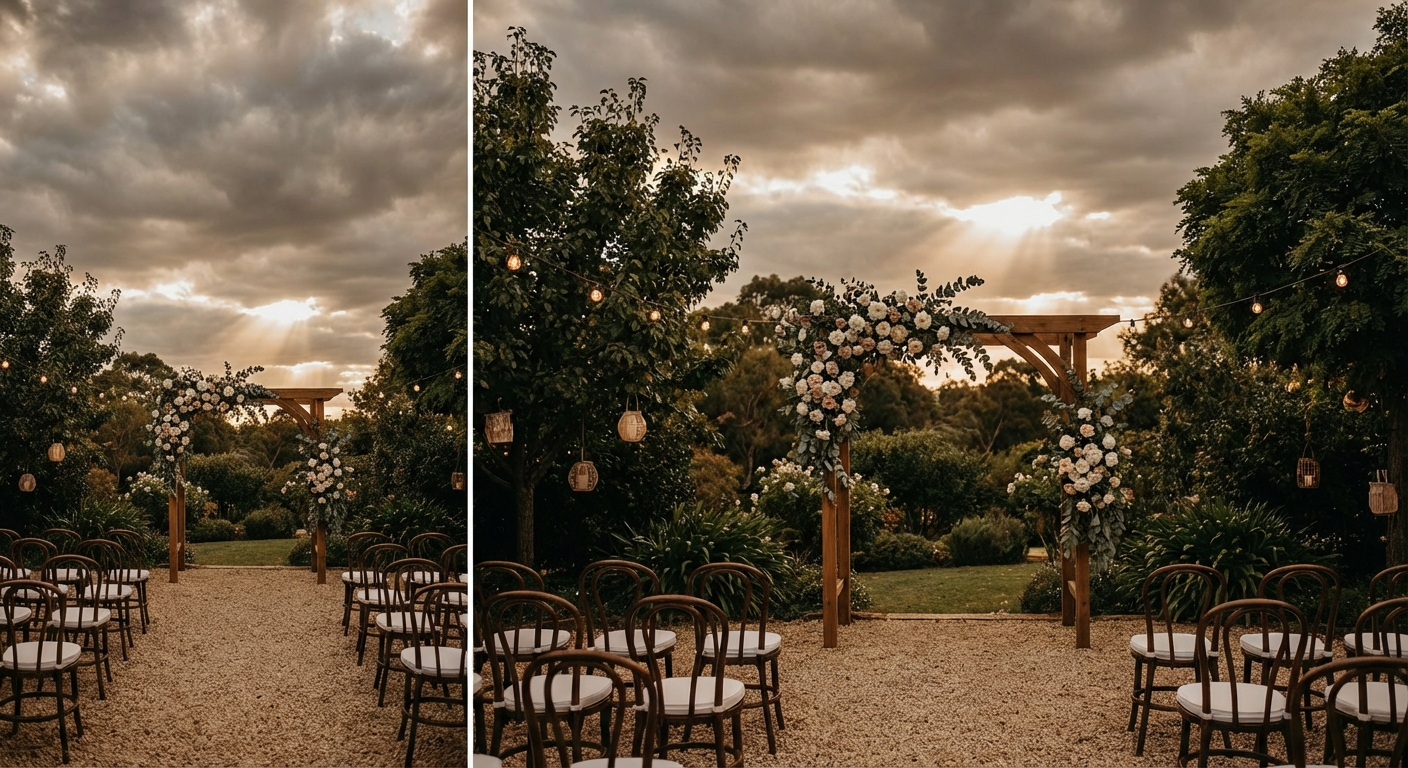
Australia is a country of weather extremes. One weekend it is a glorious 24 degrees with not a cloud in sight, and the next a southerly change rolls through bringing sideways rain, 60-kilometre-per-hour winds, and temperatures that plummet overnight. If you are planning an outdoor or semi-outdoor wedding anywhere on this continent, a contingency plan is not optional. It is the single most important piece of logistics you will organise.
The 2025-26 wedding season has already delivered some dramatic weather events. Couples in South-East Queensland dealt with late-season storms that flooded marquee venues in February. Melbourne brides sweated through consecutive 40-degree days in January. Even Tasmania, often considered a safe bet for mild conditions, experienced unseasonal hail in March. The lesson is clear: hoping for the best is not a strategy.
This guide covers every weather scenario Australian couples face, from blistering heat and torrential rain to high winds and bushfire smoke. You will learn what questions to ask your venue before signing the contract, how to communicate last-minute changes to your guests through your wedding website and digital RSVP platform, and how to turn an unexpected weather event into a memorable part of your story rather than a disaster.
Why Every Australian Wedding Needs a Plan B
The Bureau of Meteorology publishes historical data for every region in Australia, and the numbers tell a sobering story. Sydney receives an average of 12 rain days in March alone. Melbourne famously experiences four seasons in one day. Perth can swing from 38 degrees to 22 degrees within 48 hours during autumn. Even the driest capital, Adelaide, is not immune to freak storms during the warmer months.
Despite these statistics, many couples resist creating a contingency plan because it feels like admitting defeat. There is a superstitious reluctance to plan for bad weather, as though preparing for rain somehow invites it. This mindset is understandable but dangerous. The couples who have the best experience on challenging weather days are invariably the ones who planned for it months in advance and made calm, confident decisions on the day because every scenario had already been mapped out.
A contingency plan is not a lesser version of your wedding. It is an equally beautiful version that happens to account for what the sky is doing. Some of the most stunning wedding photographs in Australia are taken in the rain, with couples laughing under umbrellas, bridesmaids lifting their hems to splash through puddles, and dramatic storm clouds providing a backdrop that no amount of styling could replicate.
Critical Questions to Ask Your Venue Before Booking
The time to think about weather contingency is before you sign the venue contract, not two weeks before the wedding when the forecast looks grim. The right venue makes bad weather a minor inconvenience. The wrong venue makes it a crisis. Here are the questions every Australian couple should ask during venue inspections.
What Is the Indoor or Covered Backup Option?
This is the most fundamental question, yet many couples are surprised by the answer. Some outdoor-only venues genuinely have no covered alternative and rely on hired marquees as their wet weather solution. Others have a beautiful indoor space that accommodates the same guest count comfortably. You need to see the backup space in person and confirm it can hold your full guest list with the same table configuration.
Popular Australian outdoor venues like those in the Hunter Valley, Yarra Valley, Byron Bay hinterland, and Margaret River wine region often have purpose-built indoor spaces or barrel rooms that serve as elegant alternatives. Venues charging $15,000 to $40,000 AUD for the hire should absolutely provide a suitable backup at no additional cost. If a venue charges extra for their indoor option, factor that into your total budget from the start.
When Must the Final Decision Be Made?
Ask your venue what their cutoff time is for switching from Plan A to Plan B. Some venues need 24 hours notice to reset from an outdoor to indoor configuration. Others can pivot on the morning of the wedding. This timeline directly affects your stress levels. A venue that requires a 48-hour call means you are making the decision based on a forecast that may change, while a same-day decision gives you the most accurate information but less time to adjust.
The best venues have a protocol. They will typically offer a call with the couple on the morning of the event, review the radar together, and make a joint decision by a set time. Ask specifically what their process looks like and who makes the final call if there is a disagreement.
If a Marquee Is the Backup, Who Supplies It?
Marquee hire in Australia ranges from $3,000 to $15,000 AUD depending on size, style, and inclusions. Clear-roof marquees that let in natural light are popular but cost more, typically $6,000 to $12,000 AUD for a structure large enough for 100 to 150 guests. If your venue relies on a marquee for wet weather, clarify whether the cost is included in the venue hire, whether you need to organise it yourself, and whether the marquee company has availability during peak wedding season.
Critically, confirm that the marquee can be erected on short notice if needed. Some suppliers require a minimum of three days for setup. Others offer rapid-deployment structures designed specifically for last-minute weather changes. Having this arranged well in advance, even if you never use it, provides enormous peace of mind.
Handling Extreme Heat: Strategies for 35-Plus Degree Days
Heat is arguably the most common weather challenge for Australian weddings, particularly for ceremonies held between October and March. A 38-degree day in Sydney or a 42-degree scorcher in Adelaide does not just cause discomfort. It can lead to genuine health risks, especially for elderly guests, young children, and anyone standing in direct sun for an extended period.
Adjust Your Ceremony Timing
If extreme heat is forecast, consider shifting your ceremony to later in the afternoon. A 4:30pm or 5:00pm start avoids the worst of the heat while still capturing beautiful golden-hour light. Many Australian celebrants are accustomed to this adjustment and will happily accommodate a time change. Communicate any timing shift to guests immediately through your wedding website and consider an SMS blast through your RSVP platform if you have collected mobile numbers.
For summer weddings in Northern Queensland, where humidity compounds the heat, some couples opt for early morning ceremonies at 8:00am or 9:00am followed by a brunch reception. This avoids the oppressive midday conditions entirely and offers a fresh, modern alternative to the traditional evening format.
Guest Comfort Essentials
Shade is non-negotiable on a hot day. If your ceremony is outdoors, ensure there are shade sails, market umbrellas, or mature trees providing coverage for every guest seat. Provide handheld fans at each chair. These can double as your ceremony program if printed on one side. Offer cold water bottles or a water station at the ceremony entrance.
At the reception, ensure the venue has adequate air conditioning or industrial fans if the space is semi-open. Speak with your caterer about serving chilled canapes and lighter fare rather than heavy, hot dishes. A gelato cart or frozen cocktail station gives guests a refreshing treat and photographs beautifully. Budget approximately $8 to $15 AUD per head for these additions.
For your bridal party, plan indoor air-conditioned spaces for getting ready and for downtime between the ceremony and reception. Heat exhaustion is a real risk when people are wearing suits, heavy dresses, and full makeup in direct sun for hours.
The Wet Weather Game Plan: Rain, Storms, and Flooding
Rain on your wedding day is not the catastrophe it feels like when you first check the forecast. With the right preparation, a rainy wedding can be atmospheric, romantic, and deeply memorable. The key is having a clear plan that every vendor knows about well in advance.
Morning-of Decision Making
Check the Bureau of Meteorology radar rather than relying on weather apps, which often sensationalise conditions. The BOM radar shows you exactly where rain cells are, how fast they are moving, and whether they are likely to hit your venue during the ceremony window. Share this link with your wedding planner, venue coordinator, and celebrant so everyone is looking at the same information.
Most experienced wedding planners in Australia use a simple rule: if there is a greater than 60 percent chance of rain during your ceremony time, move indoors. A 30 to 60 percent chance warrants monitoring until two hours before, with the indoor setup prepared as a standby. Under 30 percent, proceed outdoors with umbrellas on hand just in case.
Turning Rain Into Stunning Photographs
Australian wedding photographers are skilled at working with rain, and many actively prefer it. Overcast skies create soft, even lighting that is incredibly flattering for portraits. Rain adds drama, movement, and emotion to images that sunny-day photographs simply cannot replicate.
Invest in a set of quality clear umbrellas for your bridal party. They allow your photographer to shoot through them while keeping everyone dry, and they look elegant in photographs. A pair of matching gumboots or Wellington boots for the couple has become an iconic Australian wedding rain-day prop. Budget $150 to $300 AUD for a set of clear umbrellas and boots, a minor expense that transforms your wet weather photos from stressful to spectacular.
If your venue has covered verandahs, porticos, or barrel rooms, these become naturally moody locations for portraits. Rain streaking across windows, puddle reflections, and misty landscapes all add layers of beauty to your wedding album.
Communicating Changes to Guests
If you are moving your ceremony indoors or adjusting the timeline due to weather, guests need to know as early as possible. Your wedding website is the best tool for this. Update the homepage with a banner or announcement that the ceremony location has changed, including clear directions to the new space if it differs from the original.
If your digital RSVP platform collected mobile numbers, send a brief group SMS on the morning of the wedding. Keep it simple: the venue, the adjusted location or timing, and reassurance that everything is under control. Guests take their emotional cues from the couple. If your message is calm and upbeat, they will arrive relaxed and ready to celebrate regardless of the weather.
High Winds and Severe Storms
Wind is the most underestimated weather threat for Australian outdoor weddings. A gentle breeze is charming; sustained 40-kilometre-per-hour winds with gusts to 60 are dangerous. Unsecured decorations become projectiles, marquees can lift, and standing under a floral arch becomes a genuine safety concern.
If severe wind or storm warnings are issued for your area, the decision is straightforward: move everything indoors or under a solid structure. No wedding aesthetic is worth risking guest safety. Speak with your florist about securing arrangements with weighted bases. Ask your stylist to use cable ties, sandbags, and anchoring systems for any freestanding structures.
For coastal weddings along the Great Ocean Road, Gold Coast, Sunshine Coast, or Northern Beaches of Sydney, wind is a near-constant factor. Choose venues with natural windbreaks such as cliff-side locations, tree-lined gardens, or purpose-built pavilions. If you are set on an exposed beachfront ceremony, ensure your celebrant has a quality wireless microphone system so vows are heard over the wind.
Bushfire Smoke and Air Quality Concerns
Australian couples know that bushfire season overlaps with peak wedding season. The devastating fires of 2019-2020 taught the wedding industry that smoke haze can affect venues hundreds of kilometres from any active fire front. Reduced visibility, poor air quality, and an eerie orange sky are not conditions any couple wants on their wedding day, but they are conditions that can be managed.
Monitor the Air Quality Index for your venue location in the weeks leading up to your wedding. An AQI above 100 is unhealthy for sensitive groups, and above 150 is unhealthy for everyone. If your wedding falls during a period of poor air quality, move the ceremony and any outdoor activities indoors. Ensure the venue has adequate ventilation or air filtration.
For guests with asthma or respiratory conditions, provide a designated cool, clean-air space inside the venue where they can retreat if needed. Mention this in your pre-wedding communications. If conditions are genuinely hazardous, your guests will understand and appreciate a fully indoor celebration over suffering through poor air for the sake of aesthetics.
Consider wedding insurance that covers bushfire and smoke-related cancellations or postponements. Several Australian insurers now offer specific event cover starting from $350 AUD for basic policies up to $1,500 AUD for comprehensive coverage including vendor no-shows and extreme weather events.
Wedding Insurance: Is It Worth It in Australia?
Wedding insurance has moved from a nice-to-have to a near-essential for Australian couples, particularly those with outdoor or semi-outdoor celebrations. The average Australian wedding now costs between $36,000 and $55,000 AUD, and a weather event that forces cancellation or significant changes can result in substantial financial loss.
Australian wedding insurance providers such as WedSure and various general insurers offer tiered policies. A basic policy covering severe weather, venue closure, and vendor insolvency typically costs $300 to $600 AUD. Comprehensive policies that include coverage for illness, injury, lost rings, damaged attire, and liability can run $800 to $2,000 AUD.
Read the Product Disclosure Statement carefully. Most policies require you to take reasonable steps to mitigate loss, which means having a documented contingency plan. Some policies exclude claims where the couple knew about adverse conditions and proceeded with an outdoor setup regardless. Having a written Plan B that you discussed with your venue actually strengthens any potential insurance claim.
Given the unpredictable nature of Australian weather and the significant financial investment a wedding represents, insurance at $500 to $800 AUD is a modest price for peace of mind. Consider it a non-negotiable line item in your wedding budget.
Building Your Contingency Plan: A Step-by-Step Template
A contingency plan does not need to be a 20-page document. It needs to be clear, shared with every vendor, and actionable under pressure. Here is a straightforward template that works for any Australian wedding.
Eight Weeks Before the Wedding
Confirm your venue's wet weather and extreme heat protocols in writing. Get specific details on the indoor backup space, including capacity, layout options, and any additional costs. Share this information with your photographer, videographer, celebrant, florist, and caterer. Each vendor should confirm they can operate seamlessly in the backup location.
If you are using a marquee as your backup, confirm the booking and ensure the supplier can erect it within your required timeframe. Pay any deposits required to secure the marquee for your date.
Two Weeks Before the Wedding
Begin monitoring the long-range forecast for your venue location. Do not panic over early predictions. Weather models at the two-week mark are unreliable, but they give you a general sense of the pattern. Prepare your wedding website with a draft weather update that can be published at short notice. Have a group SMS template ready to send if needed.
Confirm that your emergency contact list includes mobile numbers for your venue coordinator, wedding planner, celebrant, photographer, florist, caterer, and transport provider. Create a group chat with your key vendors so decisions can be communicated instantly on the day.
The Day Before and Morning Of
Check the BOM radar and forecast at 6:00am on the wedding day. If conditions require a switch to Plan B, make the call by 8:00am to give vendors maximum time to adjust. Contact your venue coordinator first, then update your vendor group chat simultaneously.
Publish your weather update on your wedding website and send the SMS to guests. Keep the tone positive and confident. Something like: 'Quick update! We are moving our ceremony to the beautiful indoor space at [venue name] due to the forecast. Same time, same love, just a different backdrop. See you there!' conveys control and warmth.
Remember that your guests are there for you, not the weather. A calm, happy couple sets the tone for the entire celebration. Embrace whatever the day brings, trust the plan you built, and focus on the reason everyone has gathered together.
Regional Weather Guide for Popular Australian Wedding Locations
Understanding the typical weather patterns for your chosen region helps you plan more effectively. Here is a quick reference for some of Australia's most popular wedding destinations.
Sydney and surrounds experience warm, humid summers with afternoon thunderstorms common from December to February. Autumn (March to May) offers the most reliable conditions with mild temperatures and lower rainfall. The Hunter Valley follows a similar pattern but can be several degrees warmer inland.
Melbourne and the Yarra Valley are famously unpredictable year-round. Even in summer, temperatures can swing 15 degrees in a single day. Always have an indoor option in Melbourne regardless of the season. The Mornington Peninsula adds coastal winds to the equation.
Brisbane, the Gold Coast, and the Sunshine Coast have a subtropical climate with a distinct wet season from November to March. Afternoon storms are frequent but usually brief. Autumn and winter (April to September) offer dry, pleasant conditions that make South-East Queensland one of the best winter wedding destinations in Australia.
Perth and Margaret River enjoy a Mediterranean climate with dry, warm summers and wet, cool winters. The risk of extreme heat is highest in January and February, while winter weddings benefit from lush green landscapes and dramatic skies.
Adelaide and the Barossa Valley experience hot, dry summers with heatwave risk from December to February. Autumn is ideal, with warm days, cool evenings, and harvest season creating a spectacular backdrop for winery weddings.
Tasmania offers mild summers and cool, changeable conditions year-round. The island's weather can shift quickly, making indoor backup options essential even during the warmer months. Hobart and the Tamar Valley are popular choices for couples seeking a cooler, more temperate setting.
Australian weather will always be unpredictable, and that is part of what makes this country extraordinary. The golden light after a storm, the crisp clarity of a cool autumn morning, the warmth of a balmy evening on the coast: these are the moments that make Australian weddings uniquely beautiful.
A contingency plan is not an admission that something will go wrong. It is the smart, confident decision of a couple who wants their day to be wonderful regardless of what the sky decides. Build your plan early, share it with your vendors, communicate clearly with your guests, and then let go of what you cannot control. The best weddings are not the ones with perfect weather. They are the ones where the couple and their guests are fully present, laughing together, and celebrating love in whatever conditions the day brings.