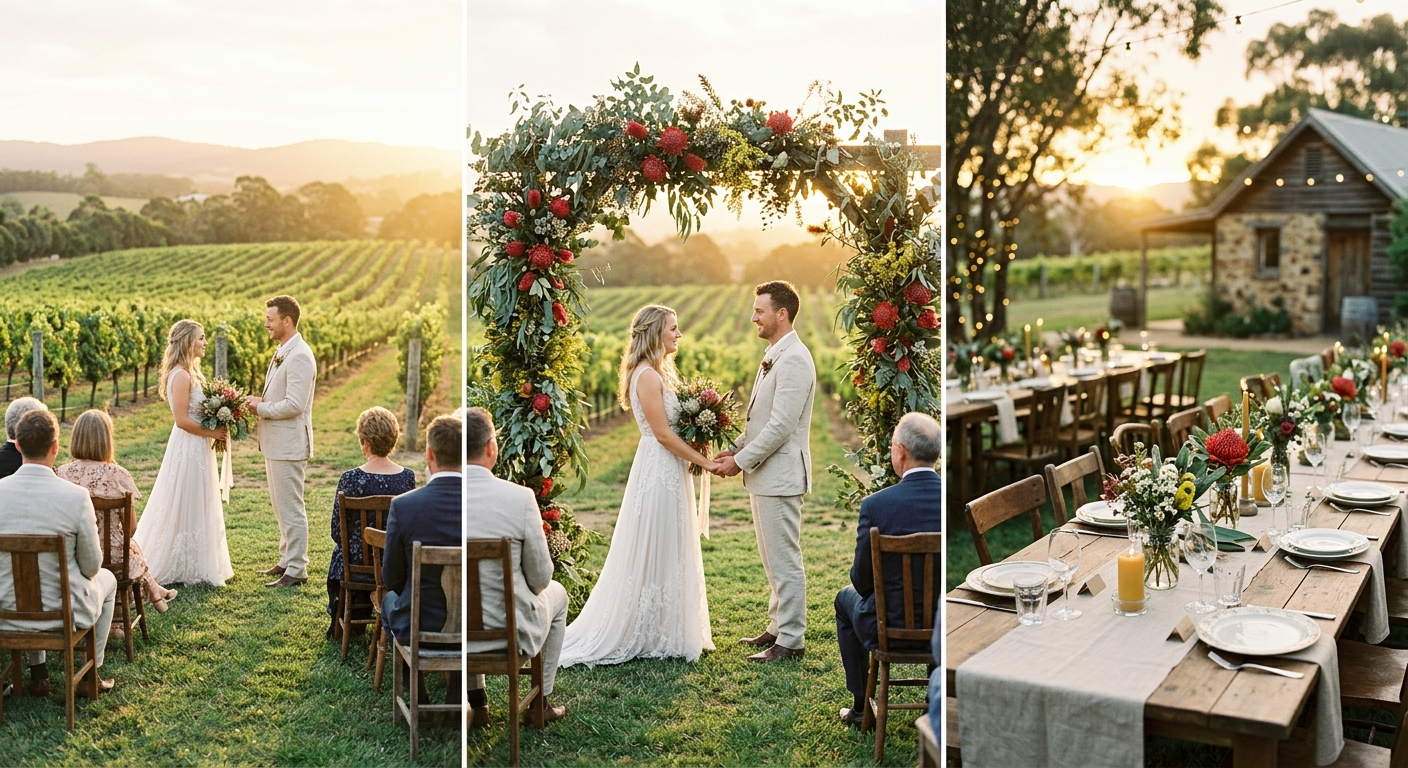
The modern Australian wedding is a significant environmental event. Between the flowers flown in from overseas, the single-use confetti discarded at the end of the night, the food prepared in quantities calibrated for maximum rather than optimal, and the stationery printed on virgin stock that will be read once and binned, the average Australian wedding generates a quantity of waste that is difficult to justify in an era of climate consciousness. Australian couples in 2026 are increasingly aware of this impact, and they are doing something about it. The sustainable wedding is no longer a fringe movement or a compromise position. It is one of the fastest-growing segments of the Australian wedding market, and it is being embraced by couples who want their wedding day to reflect their values without sacrificing the aesthetics or the experience they have dreamed about.
The eco-chic wedding — a celebration that is both environmentally responsible and visually stunning — has emerged as the defining aesthetic of the sustainable wedding movement in Australia. The eco-chic approach is not about austerity or sacrifice. It is about making deliberate, informed choices that reduce environmental impact while enhancing the quality and character of the celebration. An eco-chic wedding might feature native Australian flowers sourced from a local grower within 50 kilometres of the venue rather than imported roses flown from Kenya. It might serve a seasonal menu designed around what is growing in the region rather than a standard catering package built around year-round availability. It might use digital invitations and plantable thank-you cards instead of printed paper goods that end up in landfill. Each of these choices reduces the wedding's environmental footprint while often reducing cost and increasing the distinctiveness of the celebration.
This guide examines the sustainable wedding movement in Australia in 2026. It explores the practical steps couples can take to reduce the environmental impact of their wedding without compromising on the experience, the Australian suppliers and venues that are leading the sustainable wedding space, the common misconceptions that hold couples back from making greener choices, and the frameworks available for measuring and communicating your wedding's sustainability credentials to your guests. Whether you are planning a micro-wedding in the Yarra Valley, a coastal celebration in Byron Bay, a winery wedding in the Margaret River region, or a city-based event in Sydney or Melbourne, the following pages cover everything you need to know about planning a sustainable eco-chic wedding in Australia.
Understanding the environmental case for a sustainable wedding requires first understanding the scale of the problem. The Australian wedding industry generates an estimated 20,000 tonnes of waste annually, with the average wedding producing approximately 50 kilograms of waste per guest. This figure includes catering waste, floral arrangements that are discarded after the event, single-usedecorations, printed materials, and packaging from supplier deliveries. It does not include the carbon footprint of guest travel, supplier logistics, or the embodied carbon in hired items like furniture and lighting. The total environmental impact of the Australian wedding industry is substantial — and the couples who are choosing to reduce their share of that impact are doing so for reasons that are personal, cultural, and increasingly financial.
Understanding the Environmental Impact of an Australian Wedding
The carbon footprint of an average Australian wedding is estimated at 14 to 20 tonnes of CO2 equivalent — comparable to driving a car for 60,000 kilometres. This figure includes the emissions associated with guest travel (the largest single contributor for most weddings), catering and food production, floral arrangements, venue energy use, and the manufacturing and disposal of wedding goods and materials. For a wedding with 80 guests travelling from within Australia, guest travel accounts for approximately 40 to 50 percent of the total carbon footprint. For weddings with significant interstate or overseas guest attendance, this proportion rises substantially.
The catering component of a wedding's environmental impact is often underestimated by couples who have not considered the supply chain behind their menu. Food waste at Australian weddings is estimated at 20 to 30 percent of what is prepared — a consequence of caterers over-producing to ensure there is enough for every scenario, and of couples being reluctant to ask guests to commit to dietary preferences in advance. The result is that a significant proportion of the food prepared for a wedding is discarded at the end of the night. This waste represents not just the food itself but the water, land, and energy used to produce it, the transport emissions involved in getting it to the venue, and the methane emissions from its decomposition in landfill.
Floral waste is the most visible form of wedding environmental impact, and it is the category where couples have the most direct control. The average Australian wedding uses between 300 and 600 stems of flowers, the majority of which are imported — roses from Kenya, peonies from the Netherlands, tulips from the United Kingdom. The carbon intensity of importing flowers from these distances is substantial, and the post-event fate of most wedding flowers is landfill or composting of variable quality. Australian flower farmers and specialist wedding florists who work with locally grown and in-season flowers offer a compelling alternative that reduces transport emissions while supporting Australian agricultural communities.
Where the Biggest Impact Opportunities Lie
The most effective sustainability interventions for an Australian wedding are not the visible ones — the bamboo straws and paper invitations that represent a tiny fraction of total impact. They are the structural choices that shape the wedding's environmental footprint from the outset. Venue selection has an outsized impact: a venue with solar power, rainwater collection, and compostable serviceware reduces the wedding's footprint more than any other single choice. Catering strategy is the second-largest impact area: a caterer who works with seasonal menus, manages portions carefully, and has a food waste protocol reduces impact across multiple dimensions. Guest travel is the third major impact area, and one that couples often overlook — the location of the venue relative to the majority of guests, and the accommodation infrastructure available to reduce car travel, both significantly affect the total carbon footprint of the event.
These structural choices do not mean that smaller interventions do not matter. Every plantable invitation card removes paper from landfill and replaces it with a living plant. Every locally sourced floral arrangement supports an Australian flower farmer and eliminates the transport emissions of imported alternatives. Every hired item that is reused rather than purchased new reduces the manufacturing impact of the wedding. The eco-chic approach is additive: each deliberate choice builds on the others, creating a wedding that is cumulatively and genuinely more sustainable than a conventional celebration. But the structural choices — venue, catering, location — are where the real impact lies, and they are the first decisions couples should make when sustainability is a priority.
Choosing an Eco-Certified Wedding Venue in Australia
The venue is the single most important sustainability decision in wedding planning. Australian venues have responded to growing demand for sustainable event spaces with a range of eco-certification programmes and environmental initiatives. Understanding what eco-certification means and how to evaluate the sustainability claims of venues is essential to making an informed choice.
The Green Key Global programme is the leading international eco-certification standard for venues and events, and a growing number of Australian venues have achieved Green Key certification. A Green Key venue has demonstrated compliance with a comprehensive set of environmental standards covering energy efficiency, water management, waste reduction, and staff training. Venues with Green Key certification undergo annual audits and are required to demonstrate continuous improvement. For couples seeking a venues with verified environmental credentials, Green Key certification is the most reliable indicator available in the Australian market.
Beyond Green Key, several Australian venues have developed proprietary sustainability programmes that reflect their specific environmental context. Wineries in the Margaret River region have pioneered sustainable viticulture and have extended these practices to their event operations, with some properties achieving carbon-neutral status through a combination of renewable energy, native reforestation, and renewable energy credits. Coastal venues in Queensland and New South Wales have developed water conservation programmes that are particularly relevant given the ongoing water scarcity challenges in many parts of the country. Rural and regional venues with land holdings have in some cases developed biodiversity programmes that offset event-related emissions through revegetation and habitat restoration.
When evaluating venues for sustainability, ask specific questions: What is the venue's energy source? Do they have solar panels or a renewable energy agreement? What is their food waste protocol — do they compost, donate surplus, or track waste rates? Do they use compostable or reusable serviceware for events? What is their water management strategy? Do they have an environmental policy that is publicly available? A venue that is genuinely committed to sustainability will have clear, specific answers to these questions, and they will be happy to share their environmental performance data. A venue that deflects with vague commitments to being green probably does not have a substantive sustainability programme.
Leading Australian Eco-Wedding Venues by State
New South Wales hosts several of Australia's leading sustainable wedding venues. The McLean Estate in the Southern Highlands operates entirely on solar power with battery storage and has a comprehensive food waste diversion programme that redirects all event food waste to local farms. The Centennial Vineyard in the Hunter Valley is certified carbon-neutral for events and offers couples a detailed sustainability report after each celebration. The Headlands Hotel at Austinmer, perched on the Illawarra escarpment overlooking the Pacific Ocean, has achieved a five-star sustainability rating from the Tourism Australia Sustainable Tourism programme and sources all event catering from suppliers within 50 kilometres.
Victoria's Yarra Valley has become a hub for sustainable weddings, driven in part by the region's strong agricultural sustainability movement. Levantine Hill Estate has implemented a comprehensive sustainability programme including solar energy, water recycling, and a hive network that supports local biodiversity. The Pinot Club at Domain Daylesford operates from a heritage building that has been retrofitted with energy-efficient systems throughout. The Mornington Peninsula hosts several venues with strong environmental credentials, including the Mantons Creek Estate, which has developed an extensive native garden programme that provides florals for events from its own property.
Queensland venues have responded to the state's unique environmental context — including the Great Barrier Reef and significant biodiversity challenges — with sustainability programmes that reflect the regional stakes. The奥伦东海岸 venues in the Sunshine Coast region have pioneered water conservation strategies that are particularly relevant given the region's periodic drought conditions. The Daintree Rainforest and Port Douglas venues have developed programmes that tie venue operations to reef conservation and rainforest protection initiatives. The Gold Coast Hinterland venues have engaged with the Queensland Environmental Protection Agency to develop event sustainability frameworks that are among the most rigorous in the country.
Western Australia's Margaret River region is arguably Australia's leading sustainable wedding destination. The combination of world-class wineries with strong environmental credentials, a culture of sustainability in the local food and wine community, and the region's extraordinary natural environment has created a concentration of eco-certified venues that is unmatched elsewhere in the country. venues like Howard Park, Vasse Felix, and Leeuwin Estate have sustainability programmes that extend from vineyard management to event operations, and several have achieved carbon-neutral status for their event offerings. The Margaret River Region is also home to several dedicated sustainable wedding venues that have been designed from the ground up with environmental performance as a primary design criterion.
Native Australian Floristry and Seasonal Sourcing
Floral arrangements are among the most visible elements of a wedding, and they are also one of the most significant sustainability decision points. The conventional wedding floral supply chain — which typically involves imported flowers flown from Kenya, the Netherlands, Colombia, and Ecuador — has a substantial carbon footprint that most couples are unaware of. The solution is not to have fewer flowers or to accept less beautiful arrangements. It is to work with florists who have built their practice around Australian grown, in-season, and native flowers.
Australian native flowers — waratahs, kangaroo paw, banksias, flannel flowers, leucospermum, and wax flowers — have come into their own as wedding floristry materials in 2026. Once considered humble or provincial, Australian natives are now recognised internationally as some of the most striking and distinctive flowers available. Wedding florists who specialise in native arrangements have developed techniques that use these materials in sophisticated, editorial-quality designs that rival anything produced with imported flowers. The aesthetic of Australian native floristry — textural, organic, with strong colour palettes that reflect the extraordinary diversity of the Australian landscape — has become a defining visual identity for Australian weddings that is recognisably distinct from overseas trends.
The seasonal availability of Australian flowers is richer than most couples realise. Spring — from September to November across most of Australia — brings tulips, ranunculus, poppies, and sweet peas alongside native specialties like flannel flowers and billy buttons. Summer — December through February — is peak season for Australian natives including waratahs, banksias, and leucadendrons, as well as imported varieties that are in season in the northern hemisphere and available locally through controlled growing conditions. Autumn — March through May — brings dahlias, chrysanthemums, and the last of the spring bulbs, alongside native grasses and seed pods that add textural depth to arrangements. Winter — June through August — is the season for foliage-forward arrangements, with gums, foliage, and structural botanicals taking centre stage while flowers take a supporting role.
How to Find and Work with a Sustainable Florist
Finding a florist who is genuinely committed to Australian grown and seasonal sourcing requires asking the right questions at the outset of your conversations. Ask where they source their flowers from. A florist who can name specific Australian growers and explain their sourcing relationships is demonstrating transparency that you should expect. Ask what is in season at your wedding date and how they design around seasonal availability rather than against it. Ask what proportion of their flowers are Australian grown and what proportion are imported. A florist who is evasive about these questions may be relying heavily on imported flowers despite making sustainability claims.
The Flower Farmers of Australia collective — a network of flower farms across the country that sell directly to florists and couples — is the best resource for finding sustainably sourced wedding flowers. Several members of the collective specifically service the wedding market and have developed relationships with specialist wedding florists who share their sustainability values. Using the collective's farm directory, you can identify growers in your state and region, and you can work with your florist to source directly from these farms. The result is a supply chain that is shorter, more transparent, and more supportive of Australian agriculture than the conventional import-dominated alternative.
Low-Waste Catering and the Seasonal Menu Strategy
Catering is the most complex sustainability challenge in wedding planning, and it is also the area where the biggest gains are available. The conventional wedding catering model — which involves standardised menus, bulk food preparation, and buffer quantities that assume maximum rather than optimal attendance — generates significant waste. The sustainable catering model requires a different approach: one that is more attentive to actual quantities, more flexible in its menu design, and more engaged with the full lifecycle of the food it produces.
The seasonal menu strategy is the foundation of sustainable wedding catering. A seasonal menu is built around what is growing in the region at the time of the wedding — which means lower transport emissions (because the food does not need to be stored in refrigeration or shipped long distances), fresher ingredients (because they are harvested close to the event date), and often lower cost (because seasonal produce is typically more abundant and therefore cheaper than produce that is out of season). A summer wedding in the Yarra Valley might feature a menu built around stone fruit, tomatoes, fresh herbs, and lamb from a nearby farm — ingredients that are at their peak in January and February and that cannot be replicated in June with the same quality or the same sustainability profile. A winter wedding in the Adelaide Hills might feature root vegetables, brassicas, and game meats — a menu that reflects the season's abundance in a way that is both delicious and principled.
Food waste management is the second critical component of sustainable wedding catering. Australian caterers have developed several strategies for reducing food waste at events: exact portion calculation based on confirmed RSVP numbers (rather than worst-case scenario buffers), sharing tables where guests serve themselves from central platters (reducing plated food waste), food donation arrangements with SecondBite or Foodbank for surplus that does occur, and composting programmes that divert unavoidable food waste from landfill. Ask your caterer what their food waste rate is on average across their events and what their specific waste reduction and diversion protocol involves. A caterer who tracks this data and can demonstrate improvement over time is one you can trust to manage your event's food impact responsibly.
Australian Caterers Specialising in Sustainable Wedding Menus
The sustainable wedding catering market in Australia has matured significantly, with several caterers building their reputation specifically around low-waste, seasonal, and locally sourced menus. In New South Wales, The Seasonal Catering Co. in Sydney works exclusively with Australian farmers and fishermen and has developed a zero food waste to landfill programme for all events. In Victoria, Forehore Catering in Melbourne has a dedicated sustainability manager who oversees sourcing, waste management, and carbon tracking for all wedding clients. In Queensland, Coral Sustainable Catering on the Sunshine Coast has built its menu around the extraordinary seafood diversity of the Coral Sea and works with local producers to ensure that every ingredient on its menus is sourced within 150 kilometres of the venue.
Western Australia's catering scene has been shaped by the Margaret River region's food culture, which has long prioritised local sourcing and sustainable production. The Margaret River Catering Company works with the region's wineries and farms to produce menus that reflect the region's agricultural calendar in detail, with dishes that change monthly to align with seasonal availability. The Busselton-based provider also offers carbon-neutral catering options through a partnership with a local native reforestation project that offsets event-related emissions. In South Australia, Adelaide-based Saffron and Sage has built a loyal following for its zero-waste wedding catering and its closed-loop food waste composting programme that returns nutrients to the soils of partner farms.
Plantable Stationery, Digital Invitations, and the End of Single-Use Paper
Wedding stationery is one of the most tangibly changeable elements of wedding planning — it is the category where couples can most directly see and feel the sustainability choice they are making. The shift from conventional printed stationery to plantable, recycled, or digital alternatives is one of the most immediate and satisfying sustainability decisions in the planning process. It is also an area where Australian suppliers have developed particularly sophisticated products.
Plantable stationery — invitations, ceremony programmes, and thank-you cards embedded with seeds that grow into flowers, herbs, or vegetables after planting — has moved from novelty to mainstream in Australian weddings. Suppliers like Botanical Paper Co. in Melbourne and The Seed Card Company in Sydney produce plantable stationery in a range of styles and formats that are appropriate for wedding use. The seeds are embedded in the paper during manufacturing — the paper is made from post-consumer recycled material, and the seeds are mixed into the pulp before pressing. Recipients tear or soak the stationery after use, plant it in soil, water it, and watch it grow. The environmental benefit is double: the paper is recycled rather than landfilled, and it produces a living plant rather than waste.
Digital stationery has matured as a category and is now the default choice for eco-conscious Australian couples in 2026. Paperless Invites, Greenvelope, and Paper Source all offer digital invitation platforms with wedding-specific designs and RSVP management built in. The environmental case for digital invitations is straightforward: no paper, no printing, no shipping, no waste. But there are practical considerations that require thoughtful execution. Digital invitations require guests to have email access and the digital literacy to navigate an online RSVP — considerations that may exclude older guests or those without reliable internet access. The solution is not to abandon digital invitations but to offer a hybrid approach: digital invitations for guests who can manage them comfortably, with printed alternatives available on request for guests who need them. This approach reduces paper use substantially without excluding anyone from the celebration.
Reducing Waste Across All Wedding Materials
Beyond stationery, the sustainable wedding requires a systematic approach to waste reduction across all materials used in the event. Confetti — whether paper, metallic, or synthetic — is one of the most avoidable forms of wedding waste. The environmental case against confetti is clear: it is single-use, it rarely decomposes (metallic and synthetic confetti are particularly problematic), and it enters the environment as litter. Alternatives include dried flower petals (which are fully biodegradable and visually superior), native grass seed heads (which add texture and movement), or no confetti at all — which is increasingly the choice of couples who have considered the impact and decided that the aesthetic gain does not justify the environmental cost.
Hired and borrowed materials are preferable to purchased materials wherever possible. Wedding hire companies across Australia offer a vast range of furniture, tableware, glassware, and decorative items that can furnish a wedding without generating any purchase-related waste. The furniture is reused across hundreds of events; the tableware is washed and returned to inventory; nothing enters landfill at the end of the night. The economics of hiring versus purchasing also favour hiring for most weddings — the capital cost of purchasing equivalent items typically exceeds the hire cost, and the items are discarded after a single use. For couples who want to own their wedding decorative items as keepsakes, consider items that have a life beyond the wedding day — candlesticks, vessels, linens — rather than single-use decorative elements that are designed to be discarded.
Managing Guest Travel and Accommodation Sustainability
Guest travel is the largest single contributor to the carbon footprint of most Australian weddings, and it is the sustainability dimension that couples have the least direct control over. You cannot dictate how your guests travel to your wedding, and you cannot make the decision for them. But you can influence behaviour by making sustainable choices in your venue and accommodation selection, by providing information that makes the sustainable option easy, and by framing sustainability as a positive value rather than a constraint.
Venue location is the primary determinant of guest travel emissions. A wedding at a city venue in Sydney, Melbourne, or Brisbane is accessible by public transport for the majority of local guests, and interstate guests arrive by flight once rather than making a combination of shorter journeys. A wedding at a remote rural venue — while desirable in many other respects — increases the dependence on car travel for local guests and often requires a significant domestic flight followed by a long drive for interstate guests. The environmental case for accessible venues is clear, and it is one that couples who are serious about sustainability should weigh carefully against other venue selection criteria.
Accommodation selection can substantially affect the travel footprint of your wedding. A venue with on-site accommodation or accommodation within walking distance reduces car travel between the accommodation and the venue for every guest who stays nearby. A block booking at a property that is close to the venue — and that includes transport options like shuttle buses or group transfers — makes the low-emission choice the easy choice for guests. For interstate guests who must fly, carbon offset programmes are widely available and are increasingly expected by couples who are tracking the sustainability performance of their event. The voluntary purchase of carbon offsets to cover estimated guest travel emissions is a legitimate and meaningful sustainability action — it does not eliminate the emissions, but it ensures that they are addressed.
Understanding Wedding Carbon Offsetting
Carbon offsetting for weddings involves calculating the estimated emissions from your event — including guest travel, venue energy use, catering, and materials — and purchasing offsets that are equivalent to those emissions. The offset is purchased from a registered carbon offset provider and funds projects that reduce or remove greenhouse gas emissions — typically reforestation projects, renewable energy developments, or community energy efficiency programmes. The offset does not change the emissions from your event; it ensures that an equivalent amount of emissions is reduced or removed elsewhere, resulting in a net zero outcome.
Australian carbon offset providers include Greenfleet, Climate Active, and South Pole, all of which offer calculators specifically designed for event emissions. The calculator requires inputs about guest numbers, travel distances, venue energy use, catering details, and material quantities. The output is an estimated carbon footprint in tonnes of CO2 equivalent and a recommended offset purchase. For an average Australian wedding with 80 guests, the estimated offset cost ranges from $300 to $800 AUD depending on the venue, travel profile, and catering choices. This cost is modest relative to the total wedding budget and represents a meaningful action that addresses the largest sustainability challenge in wedding planning.
Building a Wedding That Reflects Your Values
The sustainable eco-chic wedding is not a compromise. It is not a less beautiful version of a conventional wedding with guilt-reduction features bolted on. It is a different approach to wedding planning — one that makes deliberate, informed choices at every stage of the process and that results in a celebration that is more distinctive, more personal, and more aligned with the values of the couple hosting it. The couples who have planned sustainable weddings will tell you that the process changed how they thought about their celebration — that it forced them to be intentional about every choice rather than defaulting to convention, and that the result was a wedding that felt more authentically theirs than it might otherwise have been.
The practical steps available to Australian couples are substantial and accessible. Eco-certified venues exist in every state. Australian native florists are available in every major city and regional centre. Seasonal catering is available from caterers who have built their practice around it. Plantable stationery is mainstream and affordable. Carbon offsetting is straightforward and cost-effective. The barrier to planning a sustainable wedding in Australia in 2026 is not availability — it is awareness. Couples who understand what is possible, and who are willing to make deliberate choices at each stage of the planning process, can reduce their wedding's environmental footprint substantially without sacrificing any dimension of the experience they have envisioned.
The decision to plan a sustainable wedding is also a statement about values — about what you believe matters and what you are willing to act on in the most personal and significant decision of your planning process. Your guests will notice. They will see the native flowers sourced from a local farm, the seasonal menu built around what is growing within 100 kilometres of your venue, the plantable stationery that transforms into living plants after your wedding day, the digital invitations that eliminated a box of paper from the equation. And they will understand something about who you are and what you care about. The sustainable wedding is one of the most honest things you can do for your celebration. Make it yours.
The rise of sustainable weddings in Australia reflects a generation of couples who are applying their values to every dimension of their lives — including the most celebratory day of all. The eco-chic wedding is not a trend that will fade when the cultural moment passes. It is a structural shift in how Australian couples approach wedding planning, driven by genuine concern about environmental impact, better information about the sustainability choices available, and a desire to align the biggest day of their lives with what they actually believe.
For more guides on planning an Australian wedding that reflects your values, explore the WeddingRSVP blog. From sustainable venue selection to seasonal floristry, from low-waste catering to carbon offsetting, we cover the full range of considerations for couples who want their wedding to be beautiful, memorable, and responsible.