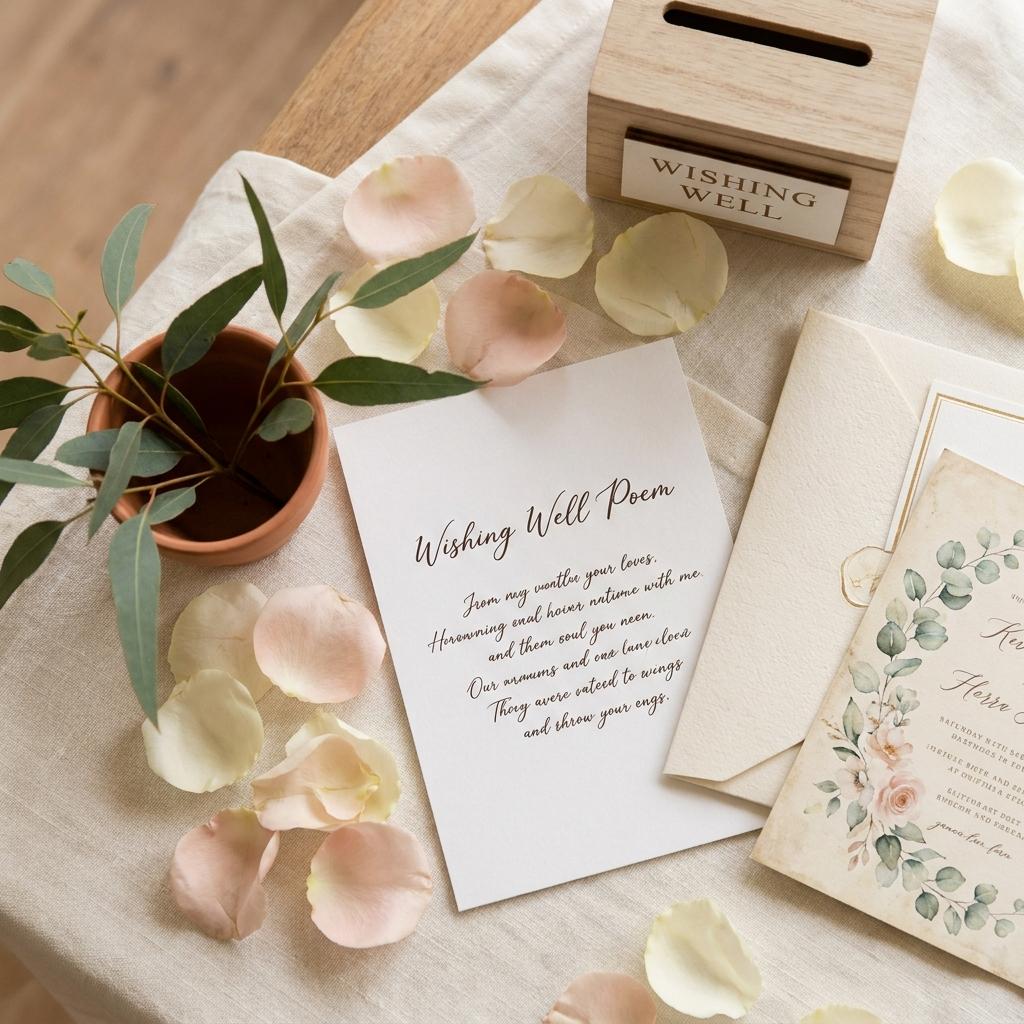
Australian couples have made their preference clear: the traditional wedding gift registry is no longer the default. Across Sydney, Melbourne, Brisbane, Perth, and regional wedding destinations like the Hunter Valley, Yarra Valley, and Byron Bay, wishing wells - where guests contribute towards a gift, honeymoon, or home fund rather than buying from a pre-selected registry - have become the dominant approach to wedding gifting. Estimates suggest that more than 70 percent of Australian couples now prefer cash contributions over physical gifts, and the wishing well has evolved from a pragmatic accommodation of changing guest preferences into a meaningful ritual in its own right. Yet despite its widespread adoption, the wording of a wishing well remains one of the most consistently stressful elements of Australian wedding planning. How do you ask for money without sounding mercenary? How do you phrase a wishing well poem that feels warm rather than transactional? How do you communicate your preferences to a multigenerational guest list that includes both cash-savvy twenty-somethings and relatives who still find the concept uncomfortable?
This guide answers those questions comprehensively. It covers the etiquette principles that underpin effective wishing well wording, provides template wording for every situation from formal vineyard weddings to relaxed beach celebrations, explains how to integrate your wishing well into your wedding website or digital RSVP platform, and addresses the specific challenges that arise when asking for monetary gifts from Australian guests across different age groups, cultural backgrounds, and financial circumstances. Whether you are marrying at a winery in the Margaret River region, a waterfront venue on the Gold Coast, or a historic property in Adelaide, the principles in this guide will help you communicate your wishes with grace and clarity.
The good news is that wishing well wording does not need to be perfect - it needs to be genuine. Australian guests are generally comfortable with the concept of a wishing well and are looking for signals that their contribution will be meaningful and appreciated, not that they are being processed through a financial transaction. The difference between wording that works and wording that falls flat is usually not vocabulary - it is tone. And tone, as this guide will show, can be managed with a few clear principles.
Why Wishing Wells Have Become the Australian Wedding Default
The rise of the wishing well in Australian wedding culture reflects broader shifts in how young Australian couples live and what they need. Unlike previous generations who typically established their household from scratch upon marriage, most Australian couples in 2026 already live together before they wed. They have shared a kitchen, accumulated household items, and built a lifestyle that makes a conventional gift registry - a toaster, a stand mixer, a set of towels - largely redundant. The average Australian couple in their late twenties or early thirties has been living independently for several years before their wedding. They do not need another toaster. They need a contribution towards a honeymoon that will create memories, a home deposit that will create a future, or a specific experience that will enrich their lives in ways a physical object cannot.
The financial reality reinforces this shift. The cost of living in Australian capital cities has fundamentally changed the relationship between wedding gifts and household economics. A cash contribution of $150 AUD from each guest at a wedding of 80 guests represents $12,000 AUD - a meaningful contribution to a honeymoon fund, a home deposit in a regional area, or a reduction in the post-wedding financial压力. A physical gift of equivalent value - a set of wine glasses, a picnic set, a kitchen appliance - would arrive at a home that already has these items and would need to be stored, returned, or quietly donated. Australian couples are acutely aware of this mathematics, and their guests are increasingly aware of it too.
The wishing well also reflects the changing demographics and values of Australian wedding guests. Guests who travel from interstate or overseas for a wedding - common in a mobile Australian population where family members are frequently dispersed across states - face substantial costs in attending. A cash contribution to a wishing well allows these guests to participate meaningfully in the couple's celebration without the logistical burden of selecting, purchasing, and transporting a physical gift across state or international borders. Similarly, guests on tighter budgets can contribute an amount that reflects their financial circumstances without the social pressure of matching the gift value of wealthier guests.
Understanding Australian Wedding Gifting Culture in 2026
Australian wedding gifting culture sits somewhere between the formality of British tradition and the informality of American practice, shaped by the country's multicultural population and its exposure to global wedding trends. Unlike some cultures where cash gifting is deeply formalised - with prescribed amounts based on the couple's social status or the guest's relationship to the couple - Australian wishing well culture is more relaxed and less prescriptive. Guests are not expected to give a specific amount, and the social pressure around gift value is lower than in many comparable markets. This informality is a strength of the Australian approach, but it also means that the wording of your wishing well needs to do more interpretive work: it needs to signal your preferences clearly without prescribing behaviour.
The role of the wishing well table at the wedding itself has also evolved. In 2026, most Australian venues will include a designated wishing well table as part of their standard event setup, often styled to complement the overall wedding aesthetic. Some couples opt for a physical wishing well - a decorative box, a vintage chest, or a themed display - while others rely entirely on a digital wishing well hosted on their wedding website or RSVP platform. The choice between physical and digital - or a combination of both - affects the wording you choose and where that wording appears: on a card beside a physical wishing well, on your wedding website, in your digital RSVP communication, or across all three touchpoints.
The Etiquette Principles That Should Guide Your Wording
Wishing well etiquette is less rigid than many couples assume, but it is not nonexistent. The underlying principle is simple: you are communicating a preference, not making a demand. Your guests have the right to give whatever they wish - including a physical gift, a charitable donation, or no gift at all - and your wording should never imply otherwise. With that principle established, the secondary rules are straightforward. Avoid specifying amounts, even as a suggested minimum. Avoid framing your wishing well in transactional language that reduces guests to donors. Avoid language that makes a physical gift feel inadequate or unwelcome. And always communicate your wishing well preference through your wedding website and RSVP platform in addition to any physical wishing well display, so that guests who prefer not to bring cash on the day have an alternative pathway to contribute.
The question of whether to include a physical gift option is one of the most common sources of wishing well anxiety for Australian couples. The etiquette consensus in 2026 is clear: you do not need to offer a physical gift fallback, but it is gracious to do so. A simple addendum to your wishing well wording - something like 'And if a gift is more your style, we also have a small registry at [store]' - acknowledges that some guests will always prefer to give something tangible, without implying that cash is a lesser choice. This is particularly relevant for older relatives or guests from cultural backgrounds where physical gift-giving is the established norm. Making a physical gift option available does not diminish your wishing well - it simply acknowledges the diversity of your guest list.
What to Avoid in Your Wishing Well Wording
Certain phrases have become clichés in Australian wishing well wording precisely because they are awkward attempts to solve the same underlying problem: how to ask for money without sounding like you are asking for money. Phrases like 'Your presence is the greatest gift, but should you wish to give...' have been done to death because they contain a kernel of genuine etiquette wisdom - you do not want to make guests feel obligated - but the phrasing has become so familiar that it reads as formulaic rather than sincere. If you are going to use a version of this framing, make it short and direct: 'Your presence is our greatest gift. If you would like to contribute, we have a wishing well for our honeymoon.'
Equally avoid anything that feels like a price point or a financial expectation. Even phrases that seem to offer guidance - 'gifts of $50 or more appreciated' - can feel mercenary to guests who are attending your wedding at significant expense, particularly if they are travelling from interstate or overseas. The wishing well should be an open invitation, not a minimum donation ask. Similarly, avoid language that positions your wishes as requirements: 'We request only cash gifts' has appeared in enough social media horror stories about wedding invitations that it has become a cautionary tale. The tone should be preference, not instruction.
Wishing Well Wording Templates for Every Australian Wedding Style
The right wishing well wording depends on the character of your wedding. A formal city wedding in a heritage venue in Melbourne or Sydney calls for different language than a relaxed beach wedding on the Gold Coast or a rustic celebration in the Adelaide Hills. The following templates are designed to be adapted to your specific context, not copied verbatim. Read through all of them, identify the tone that most closely matches your wedding personality, and then customise the language to reflect your actual circumstances.
Modern Minimal: For the Contemporary Australian Couple
Modern minimal wishing well wording is direct, warm, and uncluttered. It works particularly well for couples having a contemporary wedding aesthetic - industrial venues, minimalist styling, modern Australian cuisine. The key is brevity: if you can say it in two sentences, do not stretch it to a paragraph.
Template: 'We have everything we need for our home, so instead of gifts we would love your contribution to our wishing well. It will go towards our honeymoon through regional Australia - we cannot wait to share it with you.' This framing explains the 'why' behind your wishing well (the honeymoon), which makes the request feel more personal and less transactional. If you are saving for a home deposit instead, substitute that detail: 'We are saving for our first home together and your contribution will mean more than any physical gift we could receive.'
The detail about what the wishing well is for - the honeymoon, the home fund, the experience - is the element that transforms a generic cash request into a meaningful invitation. Guests who understand what they are contributing towards are more likely to give generously and more likely to feel emotionally connected to the gift.
Warm and Traditional: For Formal Australian Weddings
Traditional wishing well wording uses slightly more formal language while retaining the warmth that prevents it from feeling transactional. This style suits vineyard weddings in the Hunter Valley or Yarra Valley, historic estate venues, and formally styled celebrations where the overall aesthetic leans classical.
Template: 'In keeping with tradition, we have established a wishing well for our wedding. Your generous contribution will go towards our honeymoon fund, which will allow us to create the memories of a lifetime together. We are deeply grateful for your presence at our celebration and appreciate any contribution you feel able to make.' This framing uses the language of tradition to give the wishing well a sense of legitimacy and ceremony, which can help guests who feel uncertain about the appropriateness of giving cash. The phrase 'any contribution you feel able to make' explicitly disclaims any minimum amount and acknowledges varying financial circumstances, which is both gracious and important.
For couples who want to reference a specific experience: 'We are planning an extended honeymoon exploring the coastlines of Queensland and the outback of Western Australia, and your contribution to our wishing well will help make this dream trip a reality.' Detail makes the request compelling. Vague honeymoon funds feel less personal than specific itineraries.
Relaxed Australian: For Beach, Bush, and backyard Weddings
Relaxed Australian wording is characterised by informality, directness, and a sense of humour that acknowledges the absurdity of asking for money without actually saying the words 'please give us money'. This style suits beach weddings on the Sunshine Coast or Byron Bay, bush weddings in the Dandenong Ranges or Blue Mountains, and backyard celebrations on rural properties.
Template: 'We know this is 2026 and the whole gift registry thing is a bit old school. We have a flat full of stuff we actually use. What we really want is a holiday, so if you were thinking of getting us something, a contribution to our honeymoon fund would be incredible. And honestly, just having you there is the best gift of all.' This framing works because it does not try to hide what it is doing. It acknowledges the awkwardness of the situation with self-aware humour and then pivots directly to the ask. The final line - 'just having you there is the best gift of all' - is the sincerity anchor that prevents the rest of the message from feeling mercenary.
For couples who prefer a slightly softer version: 'We have been lucky enough to build a home we love together. What we would really appreciate is contributions towards our honeymoon adventure - and what we absolutely do not want is you feeling any pressure to give. Your presence is what matters most to us.'
Honeymoon Fund: For Couples with a Specific Destination
Honeymoon fund wording is the most compelling variant because it gives guests a vivid picture of what their contribution will enable. Specificity is the key technique here: the more detail you provide about your honeymoon plans, the more emotionally engaging the wishing well becomes.
Template: 'Rather than a traditional gift, we are asking our guests to help us build our dream honeymoon. We will be spending two weeks exploring the Greek islands - Santorini sunsets, Milos beaches, and a lot of exceptionally good food - and every contribution to our wishing well will go towards making this trip as special as possible. We have created a breakdown on our wedding website showing how different contribution levels help fund specific parts of the trip: $100 AUD covers a sunset dinner, $250 AUD funds a day trip between islands, $500 AUD makes a hot air balloon ride over Cappadocia possible.' This breakdown approach - if you choose to use it - should be on your wedding website rather than your physical wishing well card, since it involves more detail than is appropriate for a brief wishing well display. But it is highly effective at making the asking feel tangible and emotionally resonant.
Adding Your Wishing Well to Your Wedding Website or RSVP Platform
The most significant development in Australian wishing well culture in recent years has been the shift from a physical wishing well table at the wedding venue to a digital wishing well hosted on the wedding website or RSVP platform. This shift has been accelerated by the rise of wedding websites that function as comprehensive planning hubs - carrying the invitation, the RSVP, the registry information, the accommodation details, and the itinerary all in one place - and by the increased comfort of Australian guests with digital payments and fund transfers.
A digital wishing well solves several problems that a physical wishing well cannot. Guests who would feel awkward placing cash in a wishing well in front of other guests - a real social anxiety for some, particularly older relatives or guests from more conservative backgrounds - can contribute privately through the wedding website. Guests who are attending from overseas or interstate can contribute digitally without needing to bring cash to the venue. And the digital record of contributions makes the thank-you process more systematic: you can track who has contributed and personalise your appreciation accordingly.
When integrating your wishing well into your wedding website, the wording should be slightly more detailed than your physical wishing well card, since you have more space and the guest is in a more considered reading mode. Include the bank details or payment link clearly - this is not the place for subtlety - and explain what the contributions are for. If you are using a specific platform like Honeyfund or a bank transfer, name it. If you are saving towards something specific, describe it. And include a clear statement that contributing is entirely optional: 'We genuinely do not expect gifts and your presence is enough. This is simply here if you would like to contribute.'
Managing Online Payments and Guest Privacy
The practical management of a digital wishing well involves some decisions that do not arise with a physical wishing well. Most Australian couples use either a dedicated honeymoon fund platform (like Honeyfund, which integrates with Australian bank accounts), a direct bank transfer with details listed on the wedding website, or a combination of both. Each approach has trade-offs. A dedicated platform provides a polished guest experience and automatic tracking of contributions, but typically takes a small percentage or requires the couple to pay transfer fees. A direct bank transfer is free but requires manual tracking and means sharing your BSB and account number publicly, even if only on a password-protected wedding website.
The privacy concern is real but manageable. Most Australian banks do not object to BSB and account numbers being shared for the purpose of receiving wedding contributions, provided the website is not publicly indexed. If your wedding website is behind a password - which it should be if it contains RSVP information and personal details - your bank details will not be accessible to search engines. If you are uncomfortable sharing your personal account details even in a password-protected environment, a dedicated platform like Honeyfund or a split between a physical wishing well and a digital option is a reasonable alternative.
Navigating Multigenerational Guest Lists and Cultural Expectations
One of the most delicate aspects of wishing well wording is managing the expectations of guests from different generations and cultural backgrounds who may have different comfort levels with cash gifting. Older guests - particularly those from Anglo-Australian backgrounds who came of age in an era when formal gift registries were the standard - may feel uncertain about the appropriateness of a wishing well and may interpret vague wishing well wording as an indication that physical gifts are preferred. Younger guests, by contrast, are typically very comfortable with digital contributions and may find overly formal wishing well wording unnecessarily stiff.
The solution is layered communication. Your wedding website and digital RSVP should carry detailed wishing well information that speaks to younger, digitally fluent guests in a style they recognise. Your physical wishing well card - if you have one - should use slightly more traditional language that signals legitimacy and tradition to older guests without alienating younger attendees. And for relatives who you suspect may be deeply uncomfortable with the concept, a brief and gracious verbal or written note alongside your save-the-date or invitation - something as simple as 'We have a wishing well set up for our honeymoon fund - details on our website' - can preempt awkwardness without making the conversation feel transactional.
For guests from cultural backgrounds where wedding gifting practices differ from the Anglo-Australian norm - including many Asian, Middle Eastern, and Mediterranean communities where cash gifting is the established tradition rather than a modern accommodation - the wishing well concept is typically very familiar and often less formal in its cultural context. In these cases, your wishing well wording does not need to introduce the concept so much as communicate your specific preferences: whether you prefer contributions to a wishing well over a physical gift, and what those contributions will fund.
The perfect wishing well wording does not exist - there is only the wording that is right for you, your wedding, and your guest list. The principles in this guide matter more than the templates: be genuine, be specific about what you are raising funds for, avoid transactional language or prescribed amounts, and always give guests the option of a physical gift if they prefer. Australian wedding culture has evolved to make the wishing well the norm rather than the exception, and your guests - across generations and cultural backgrounds - are generally comfortable with the concept and want to contribute to your happiness. Trust that, communicate clearly, and let the rest take care of itself.
The wishing well is ultimately not about the money. It is about your guests being part of something meaningful - a honeymoon that will become one of the defining experiences of your relationship, a home that you are building together, a life that you are stepping into as a married couple. When guests understand that their contribution is part of that larger story, they give with warmth rather than obligation. Your wording is the first sentence of that story. Make it count.
For more guides on Australian wedding RSVP etiquette, wording, and digital planning, explore the WeddingRSVP blog. And when you are ready to manage your RSVPs, gifts, and guest communications in one place, get started with your free WeddingRSVP account today.