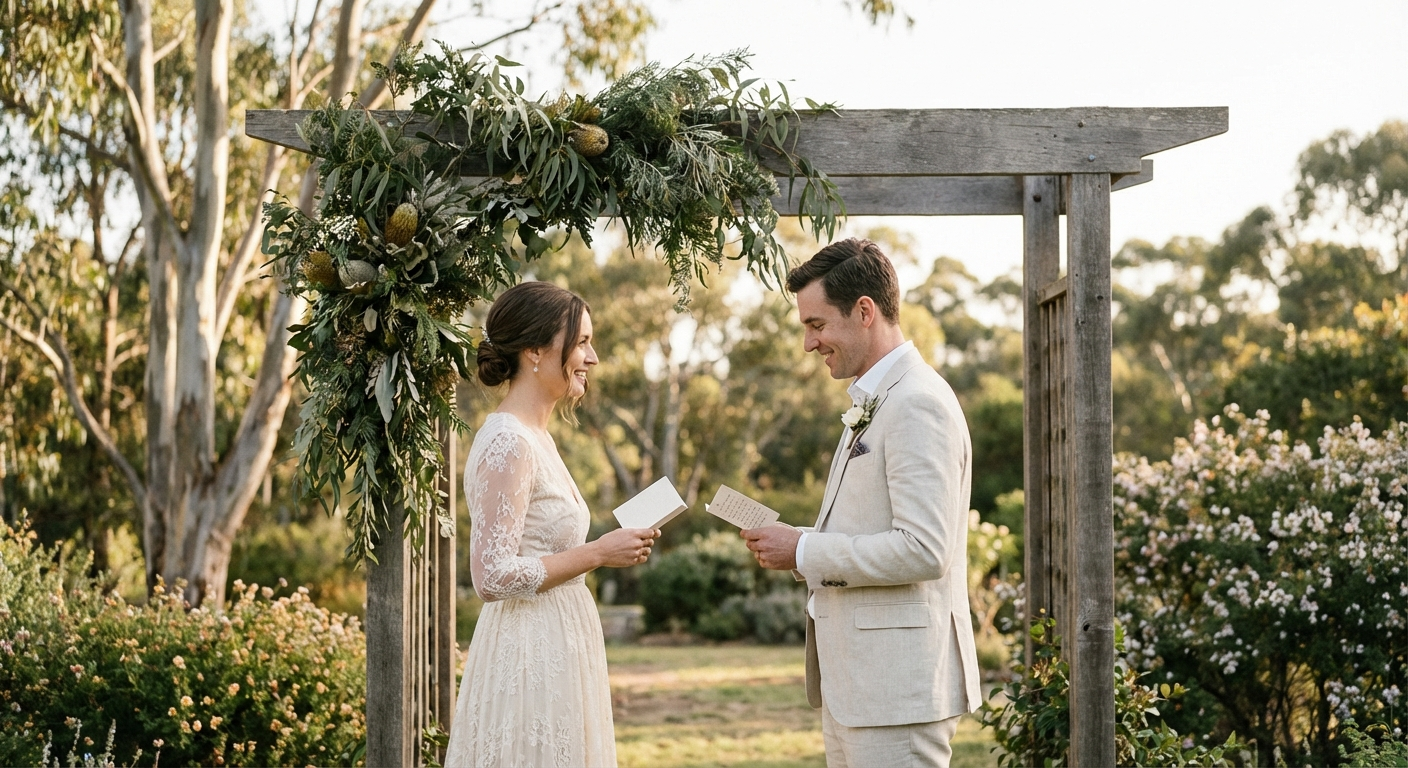
There is a moment in every personalised wedding ceremony where the room shifts. The music has faded, the celebrant has finished their opening words, and the couple turns to face each other. One of them unfolds a piece of paper, takes a breath, and begins to speak directly to the person they are about to marry. In that moment, every guest leans forward. The air changes. This is why personal vows have become the single most requested element of Australian weddings in 2026.
According to the Easy Weddings 2026 trends report, personalisation now outranks every other priority for Australian couples, including budget and sustainability. And nowhere is personalisation more powerful than in the vows themselves. These are the words your guests will remember long after they have forgotten the colour of the napkins or the flavour of the cake. They are the emotional centrepiece of your ceremony, and getting them right matters.
But writing personal vows is genuinely difficult. Most couples have never written anything this intimate, this public, and this high-stakes. The blank page can feel paralysing. How long should they be? How personal is too personal? What if you cry so hard you cannot read them? What if your partner writes something poetic and yours sounds like a greeting card? This guide answers every one of those questions with practical, tested advice tailored specifically for Australian ceremonies and celebrant requirements.
Why Personal Vows Are Dominating Australian Weddings in 2026
The shift toward personal vows reflects a broader cultural movement in Australian wedding culture. Couples are no longer content with a ceremony that could belong to anyone. They want the twenty minutes at the altar to feel as unique as their relationship, and personal vows are the most direct way to achieve that.
Australian celebrants report that upwards of seventy per cent of couples in 2026 are choosing to write their own vows, compared with roughly forty per cent a decade ago. The reasons are varied but consistent. Social media has normalised vulnerability, making couples more comfortable with public emotional expression. The average age of first marriage in Australia has risen to thirty-one for women and thirty-three for men, meaning couples have more life experience and more stories to draw from. And the pandemic era permanently shifted expectations around what a ceremony should feel like, with intimacy and authenticity replacing formality as the highest values.
The rise of outdoor ceremonies, which now account for the majority of Australian weddings, has also played a role. A ceremony under a Moreton Bay fig in a Brisbane garden or beneath the gum trees of a Yarra Valley vineyard simply feels different from a church service. The setting invites a more relaxed, conversational tone, and personal vows fit that atmosphere perfectly.
Understanding Legal Requirements for Australian Wedding Vows
Before you start writing, it is essential to understand what is legally required in an Australian wedding ceremony. Under the Marriage Act 1961, every ceremony must include specific legal vows known as the monitum and the vows of consent. Your celebrant will guide you through these, and they are non-negotiable.
The legal vows require each partner to say, in substance: 'I call upon the persons here present to witness that I, [name], take you, [name], to be my lawful wedded [husband/wife/spouse].' These words, or an approved variation, must be spoken during the ceremony. Beyond this legal requirement, however, you have complete freedom to say whatever you wish.
Most celebrants handle this by placing the legal vows at one point in the ceremony and the personal vows at another. A common structure is to have the couple share their personal vows first, creating the emotional high point, followed by the legal declarations, followed by the ring exchange. This approach satisfies the law while giving your personal words the space they deserve.
Check with your celebrant early in the planning process. Many Australian celebrants, particularly in cities like Sydney, Melbourne, and Perth, actively encourage personal vows and will offer guidance on structure and timing. Some will even review your drafts and provide feedback, which can be incredibly valuable for first-time vow writers.
Finding Your Voice: Where to Start When the Page Is Blank
The most common mistake couples make is sitting down with the intention of writing something beautiful. This almost always leads to writer's block because you are trying to perform rather than communicate. The best personal vows are not literary masterpieces. They are honest, specific, and spoken in the voice you actually use when talking to your partner.
Start by answering a series of prompts in a notebook or on your phone, without any concern for polish or structure. Write quickly, write honestly, and do not edit as you go. The raw material you generate in this brainstorming phase will be infinitely more valuable than any attempt to craft perfect sentences from scratch.
Brainstorming Prompts That Actually Work
Begin with these questions and spend at least ten minutes on each one. Write whatever comes to mind, even if it feels silly, tangential, or too private to share publicly. You will edit later. The goal right now is volume and honesty.
When did you first realise this person was different from everyone else you had dated? What specific moment or detail made you think, this is it? What is the most mundane thing your partner does that you find inexplicably endearing? What has your partner taught you about yourself that you did not know before? What is the hardest thing you have been through together, and what did it reveal about your relationship? What specific promises do you want to make about the future, and why do those promises matter to you?
If you are struggling with these prompts, try a different angle. Open your text message history with your partner and scroll through the last year. Look for moments that made you laugh, messages that moved you, and conversations that reveal the texture of your daily life together. These small moments are often the richest material for vows because they are specific, authentic, and recognisable to your partner.
Choosing the Right Tone for Your Ceremony
Your vows should sound like you. If you are naturally funny, your vows should be funny. If you are earnest and sincere, lean into that. If you communicate through dry wit and understatement, do not suddenly become a romantic poet at the altar. The jarring disconnect between your real voice and your vow voice will be obvious to everyone in the room, especially your partner.
That said, most successful vows blend at least two registers. A common and effective approach is to open with something light, perhaps a humorous observation about your relationship or a self-deprecating admission about the writing process itself, before transitioning into something more earnest and emotionally direct. This structure works because the humour builds rapport with the audience and releases tension, creating space for the deeper emotional content that follows.
Australian ceremonies tend to favour a more relaxed, conversational tone compared with formal British or American traditions. This is particularly true for outdoor weddings in locations like Byron Bay, the Gold Coast, Margaret River, or the Hunter Valley, where the setting itself signals informality. Embrace that. Your guests are not expecting Shakespeare. They are expecting you.
A Simple Structure That Works Every Time
Once you have your raw material, you need a framework to organise it. The following four-part structure is used by celebrants across Australia and consistently produces vows that feel natural, complete, and emotionally satisfying. You do not need to follow it rigidly, but having a skeleton to build on will prevent your vows from feeling scattered or shapeless.
Part One: The Story (How We Got Here)
Open with a specific moment or memory that captures something essential about your relationship. This is not a chronological retelling of your love story. It is a single, vivid scene that lands your audience in the emotional world of your relationship. The more specific the detail, the more universal the emotion.
For example, instead of saying 'From the moment we met, I knew you were special,' try something like 'The first time I knew I loved you was the morning after our camping trip in Wilsons Promontory, when I woke up to find you had already made coffee on the camp stove and were sitting in the fold-out chair reading a book as if we had been doing this for twenty years.' The specificity of the scene, the place name, the camp stove, the fold-out chair, transforms a generic sentiment into a moment your guests can see.
Part Two: What I Love About You (The Present)
This section acknowledges who your partner is right now and what they bring to your life. Again, specificity is everything. Anyone can say 'you make me a better person.' Only you can describe the exact way your partner challenges you during weekend hikes along the Bondi to Coogee walk, or how they always remember to buy the specific brand of oat milk you like, or how they held your hand through the entire flight to Perth because they knew you were nervous.
Aim for two or three specific qualities or habits, each illustrated with a concrete example. This is where your brainstorming material will prove most valuable. The small, private details of your daily life together are precisely what make personal vows feel personal.
Part Three: The Promises (The Future)
This is the core of your vows and the part that distinguishes them from a love letter or a toast. Vows are, by definition, promises. And the most powerful promises are specific, achievable, and reflective of your particular relationship rather than generic ideals.
Instead of promising to love unconditionally forever, promise to keep planning Sunday adventures even when life gets busy. Promise to always be the one who investigates the strange noise at night. Promise to learn to cook that one Thai dish your partner loves, even though you have failed at it three times already. These promises are real, they are testable, and they will make your partner smile because they recognise the truth in them.
A balance of three to five promises works well. Mix the serious with the light. A common approach is to alternate between meaningful commitments about communication, support, and partnership with lighter promises that reference your shared habits, inside jokes, or minor domestic negotiations.
Part Four: The Declaration (The Emotional Close)
End with a clear, direct statement of commitment. After the stories, the observations, and the promises, bring everything home with a simple declaration of what this moment means to you. This does not need to be elaborate. In fact, the most effective closings are often the shortest. After two minutes of detailed, personal content, a simple 'I choose you, today and every day' lands with enormous weight precisely because of its simplicity.
If you are using a ring exchange as part of your ceremony, your celebrant may suggest tying your closing declaration to the moment you place the ring. This creates a natural physical punctuation mark that reinforces the emotional conclusion of your vows.
How Long Should Your Vows Be?
The ideal length for personal vows is between ninety seconds and two and a half minutes when spoken aloud. This translates to roughly 250 to 450 words on the page. Anything shorter risks feeling incomplete, and anything longer risks losing the emotional thread and your audience's attention.
Read your vows aloud multiple times during the drafting process. What looks right on paper often sounds different when spoken. You will discover sentences that are too long to deliver in a single breath, words that trip you up, and transitions that feel abrupt. Reading aloud also gives you an accurate sense of timing, which is important if your celebrant has allocated a specific window for personal vows within the ceremony structure.
A critical consideration for couples: try to match lengths with your partner. You do not need to write the same number of words, but a significant imbalance, where one partner speaks for thirty seconds and the other for four minutes, creates an awkward asymmetry that guests will notice. Many Australian celebrants recommend that couples agree on a general length range without sharing the actual content, preserving the surprise while ensuring balance.
If you are worried about going too long, apply a ruthless editing principle: every sentence must earn its place. If a line does not add something specific, emotional, or promissory that no other line already covers, cut it. The tightest version of your vows will always be the most powerful.
Five Common Mistakes to Avoid
Having reviewed thousands of personal vows over their careers, Australian celebrants consistently identify the same pitfalls. Awareness of these common mistakes will save you from the most frequent sources of vow regret.
1. Being Too Generic
If your vows could be spoken by anyone to anyone, they are not personal enough. Statements like 'you are my best friend and my soulmate' are pleasant but interchangeable. Push every sentiment through the specificity filter: what exact moment, habit, or quality are you actually referring to? Ground every claim in evidence.
2. Over-Relying on Humour
Humour is a wonderful tool in vows, but it should serve the emotional arc rather than replace it. Vows that are entirely comedic can feel like a stand-up routine, leaving guests entertained but emotionally unsatisfied. The laughter should create a runway for the earnest content, not substitute for it. The best vows make people laugh and then cry.
3. Including Too Many Inside Jokes
One or two references that only you and your partner understand can be charming, creating a sense that your guests are witnessing something genuinely private and intimate. But a string of inside jokes excludes the audience and turns the vows into a private conversation that happens to have spectators. Remember that your guests need to follow the emotional journey, even if they do not catch every reference.
4. Referencing Exes, Doubts, or Difficult Family Dynamics
Your vows are not the place to process relationship history, air grievances, or make pointed comments about family members. Even well-intentioned references to past difficulties can land awkwardly in a public setting. Keep the focus forward-looking. The ceremony is about where you are going together, not where you have been apart.
5. Insisting on Memorising Instead of Reading
The desire to memorise your vows and deliver them from memory is understandable but risky. The emotional intensity of the moment, combined with adrenaline, nerves, and the sight of your partner, frequently causes even well-rehearsed words to vanish. Nearly every Australian celebrant recommends reading from a card, a small booklet, or your phone. Nobody will judge you for reading. They will be too busy reaching for tissues.
Managing Emotions on the Day
Crying during your vows is not only acceptable, it is almost expected. But uncontrollable sobbing that prevents you from speaking is a different matter, and it happens more often than you might think. Here are practical strategies that Australian celebrants recommend for managing the emotional intensity.
First, read your vows aloud at least ten times before the wedding. By the seventh or eighth reading, the words will have lost some of their initial emotional charge. You will still feel moved on the day, but the surprise factor that triggers the deepest emotional responses will be reduced. Think of it as emotional inoculation.
Second, use physical grounding techniques during the ceremony. Pressing your feet firmly into the ground, taking a slow breath before you begin, and making eye contact with your partner rather than the audience all help regulate your nervous system. If you feel a wave of emotion building, pause, breathe, and continue. A pause is not a failure. It is a powerful moment of real emotion that your guests will remember.
Third, have a backup plan. Give your celebrant a copy of your vows before the ceremony. If you genuinely cannot continue, your celebrant can step in and read the remainder on your behalf. Knowing this safety net exists often reduces the anxiety enough that you never need to use it.
Finally, consider the order in which you speak. If one partner is more likely to become emotional, having them go first can be helpful, as they will not have to manage their emotions through their partner's vows before delivering their own. Discuss this with your celebrant during your planning meetings.
Working With Your Celebrant: A Collaborative Approach
Your Australian celebrant is one of your most valuable resources in the vow-writing process, and many couples underutilise this relationship. A good celebrant does far more than officiate the legal requirements. They are experienced ceremony designers who have witnessed hundreds of vow deliveries and can offer perspective that no blog post can replicate.
Book a dedicated vow consultation with your celebrant, separate from your general ceremony planning meetings. Many celebrants in Sydney, Melbourne, Brisbane, Adelaide, and Perth offer this as part of their standard package, typically priced from $800 to $2,500 AUD for the full ceremony service. During this session, you can discuss tone, length, structure, and any specific elements you want to include or avoid.
Some couples choose to share their finished vows with their celebrant for feedback before the wedding. This is particularly helpful for identifying passages that might not land as intended, promises that could be misinterpreted, or jokes that might not read well in the ceremony context. A celebrant's outside perspective can catch issues that you, immersed in the writing process, might miss.
If you are hiring a celebrant specifically for their expertise with personalised ceremonies, ask for references from previous couples who wrote their own vows. The best celebrants will have a portfolio of ceremonies they have designed and will be able to show you how personal vows fit within the broader ceremony arc.
Presenting Your Vows: Cards, Booklets, and Practical Details
How you physically hold and read your vows is a detail that many couples overlook until the last minute. The presentation matters more than you might expect, both for your comfort during delivery and for the visual aesthetic of your ceremony photographs.
The most popular option among Australian couples in 2026 is a small, professionally printed vow booklet. These can be ordered from local stationers or Etsy sellers who specialise in wedding stationery, typically costing between $25 and $80 AUD for a pair. A booklet feels substantial in your hands, photographs beautifully, and can be kept as a keepsake long after the wedding.
Handwritten cards are another elegant option, particularly if you or your partner have attractive handwriting. Use high-quality card stock and write with a pen that will not smudge under the pressure of nervous, slightly sweaty hands. Practice writing the final version at least once before committing to the good copy.
Reading from your phone is increasingly common and entirely acceptable, though it does carry a slight risk of distraction if notifications appear on screen. If you choose this route, switch to aeroplane mode before the ceremony, increase the font size, and disable auto-lock so the screen does not go dark mid-sentence.
Whatever format you choose, bring a backup copy. Tuck a folded printout into your jacket pocket, give one to your best man or maid of honour, or email a copy to your celebrant. The peace of mind that comes from knowing your words exist in multiple places is worth the thirty seconds of preparation.
Real Vow Excerpts for Inspiration
Reading examples from real Australian ceremonies can help you find your own voice. The following excerpts, shared with permission and lightly edited for privacy, illustrate different tones and approaches that have worked beautifully in recent ceremonies.
From a winery wedding in the Barossa Valley: 'I promise to always open the good wine on ordinary Tuesdays, because I have learned from you that ordinary Tuesdays are the ones worth celebrating. I promise to keep exploring with you, whether that means a new hiking trail in the Adelaide Hills or a new restaurant in Norwood or a new way of solving the same argument we have been having since 2021.'
From a beach ceremony in Noosa: 'You are the person I want to tell everything to. Every strange thought, every bad joke, every fear I am too proud to admit to anyone else. You have made honesty feel safe, and I did not know how much I needed that until you showed me.'
From a garden wedding in the Blue Mountains: 'I do not promise you perfection. I promise you persistence. I promise that when things get hard, I will stay in the room. I will keep talking, keep listening, and keep choosing us, even on the days when choosing us is the harder option.'
Notice what these excerpts have in common. They are specific. They use plain language. They make promises that feel real and achievable rather than grandiose and abstract. And they sound like actual human beings talking to someone they love, which is exactly what they are.
A Realistic Timeline for Writing Your Vows
Do not leave your vows until the week before the wedding. The pressure of a looming deadline combined with the stress of final wedding preparations is a recipe for panic-written vows that do not reflect your best self. Here is a realistic timeline that gives you space to write thoughtfully without dragging the process out over months.
Six to eight weeks before the wedding, begin your brainstorming phase. Spend time with the prompts listed earlier in this guide and write freely without editing. Four to five weeks before, start shaping your raw material into a rough draft using the four-part structure. Three weeks before, read your draft aloud several times and revise for clarity, length, and tone. Two weeks before, share your vows with your celebrant for feedback if you have chosen to do so. One week before, finalise your vows, print or write your presentation copy, and begin reading them aloud daily to build familiarity.
This timeline works particularly well for autumn weddings in Australia, when the planning period from engagement to wedding day often spans the cooler months of March through May. The shorter days and cosier evenings of autumn naturally lend themselves to reflective writing, making it an ideal season for the vow-writing process.
How Your RSVP Platform Can Support the Personalisation Journey
The same impulse that drives couples to write personal vows, the desire for authenticity and personalisation, extends to every other guest-facing element of the wedding. Your digital RSVP is often the first point of contact your guests have with the tone and personality of your celebration, and platforms like WeddingRSVP.org allow you to customise the experience to match.
Consider using your RSVP form to set the tone for the personalised ceremony your guests will experience. A custom question asking guests to share a favourite memory of the couple can provide additional material for your vows, your celebrant's address, or your MC's remarks during the reception. Questions about song requests or cocktail preferences extend the personalisation philosophy from the ceremony into the reception.
The thread connecting personal vows, customised RSVPs, and thoughtful guest experiences is consistency of intention. When every element of your wedding reflects who you actually are as a couple, the result is a celebration that feels cohesive, genuine, and memorable. And it all starts with the willingness to put your own words at the centre of your ceremony.
Writing personal wedding vows is one of the most meaningful things you will do in the lead-up to your wedding. It is also one of the most challenging. The vulnerability required to express your deepest feelings in public, in front of the people you care about most, is genuinely daunting. But the reward is a ceremony that belongs entirely to you and your partner, a moment that no template or tradition could have created.
Start early, write honestly, use the structure as a guide rather than a cage, and trust your celebrant to help you shape the ceremony around your words. The couples who write the best vows are not the best writers. They are the ones who are willing to be specific, to be vulnerable, and to sound like themselves. That is all your partner is hoping to hear.