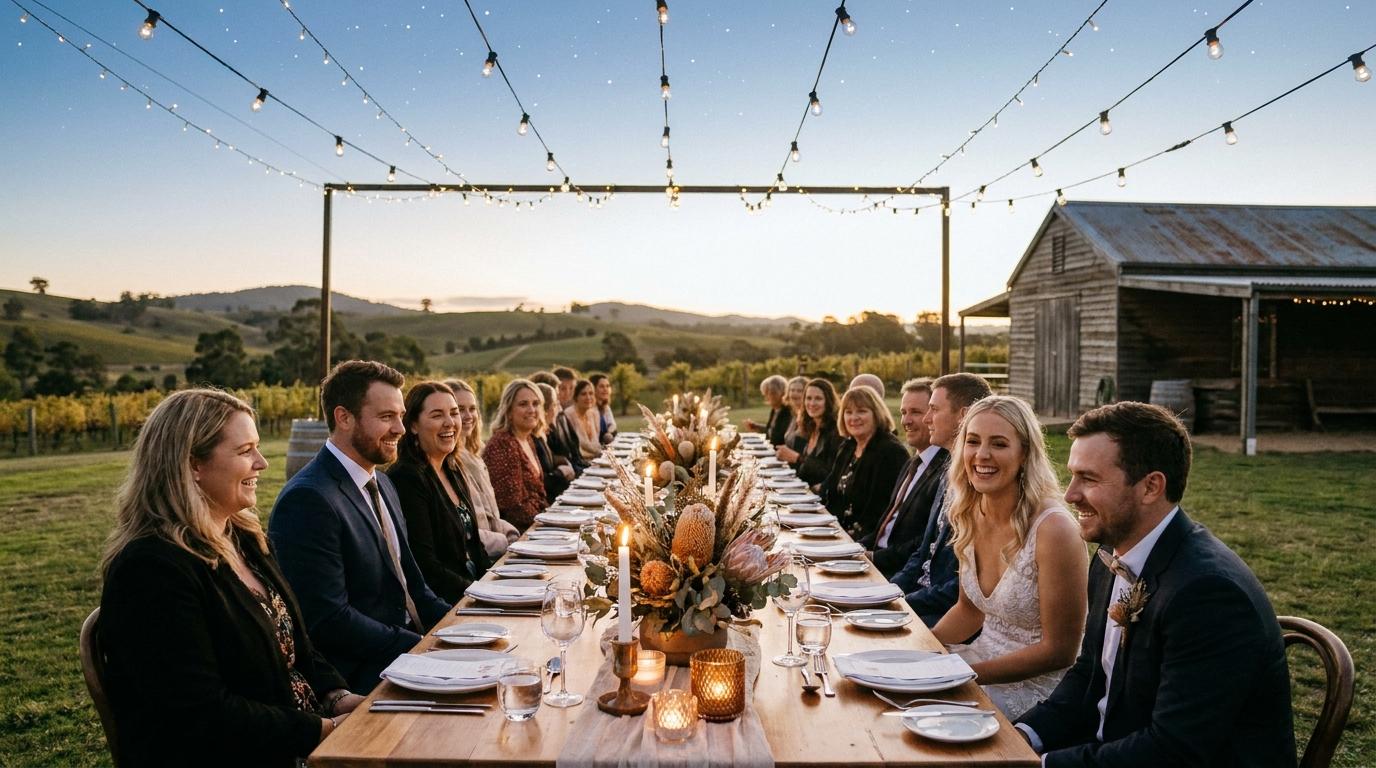
The average Australian wedding guest list has been shrinking for a decade, but in 2026 the trend has accelerated into something that feels more like a revolution. Across the country — from the wineries of the Margaret River region in Western Australia to the coastal retreats of the Gold Coast in Queensland, from the heritage properties of the Yarra Valley in Victoria to the rural estates of the Hunter Valley in New South Wales — couples are making a deliberate choice that would have seemed radical to their parents: they are inviting far fewer people. Fifty guests instead of 150. Thirty instead of 100. Twenty instead of fifty. And they are discovering that the smaller number is not a compromise. It is an upgrade.
The micro-wedding — generally defined as a celebration with fifty guests or fewer — has moved from a niche trend associated with pandemic-era restrictions into a mainstream philosophy embraced by couples who have genuinely chosen intimacy over spectacle. The reasons are varied: cost,当然是. But beneath the practical explanations is a more fundamental shift in what Australian couples want from their wedding day. They want to know everyone in the room. They want to spend meaningful time with each guest rather than rushing through a receiving line. They want a celebration that feels personal and present rather than logistical and overwhelming. These are not new desires — but the cultural permission to act on them has never been stronger.
This guide examines the micro-wedding phenomenon in Australia in 2026. It explores why the trend has emerged when it has, where the best venues and suppliers for intimate celebrations are located, how to plan a micro-wedding that punches above its weight in experience and aesthetics, and what couples who are accustomed to larger celebrations need to understand before they downsize. Whether you are already considering a micro-wedding or simply curious about what the trend involves, the following pages cover everything you need to know about intimate celebrations in Australia.
Why Australian Couples Are Choosing Micro-Weddings
The reasons Australian couples give for choosing a micro-wedding are as individual as the couples themselves, but a set of common themes emerges when you speak to couples who have made the choice. The first is authenticity. For a generation of couples who grew up watching reality television weddings that felt staged, performative, and more about the spectacle than the relationship, the idea of a wedding where every guest genuinely matters is genuinely appealing. A micro-wedding is not a smaller version of a large wedding. It is a fundamentally different approach to what a wedding is for. The couple who chooses fifty guests is choosing to spend their wedding day surrounded by the people who have shaped them — not a collection of obligations, extended family members they see once a year, or colleagues they have never had a meaningful conversation with.
The second reason is financial pragmatism. Australian wedding costs have increased substantially in the past five years. A mid-range wedding for 100 guests in Sydney or Melbourne can easily cost $80,000 to $120,000 AUD when venue hire, catering, photography, styling, flowers, entertainment, and celebrant fees are included. The same budget applied to a fifty-guest celebration produces a qualitatively different result: a higher per-guest spend on styling and food, a longer celebration with more time with each guest, and substantially less logistical complexity. Some couples are redirecting the savings into their honeymoon — a month-long trip through Europe or South America rather than two weeks — or into a deposit on their first home. The economic case for micro-weddings is straightforward and compelling.
The third reason is environmental and social consciousness. Australian couples in 2026 are more aware of the environmental footprint of large events than previous generations. A 100-guest wedding generates substantial waste — catering over-production, single-use elements, travel emissions for interstate and overseas guests — and an increasing number of couples are making choices that reflect their environmental values. A micro-wedding is not automatically sustainable, but it is more easily managed toward sustainability: less food waste, fewer travel emissions, more opportunities to work with local suppliers and choose eco-friendly options throughout the event.
The Post-Pandemic Acceleration of the Intimate Wedding
The COVID-19 pandemic disrupted Australian weddings in profound and lasting ways. The couples who were forced to cancel or postpone large celebrations in 2020 and 2021 discovered something unexpected: when the big wedding they had planned was no longer possible, many of them discovered they preferred the intimate version. The 30-person ceremony in a backyard or a small venue felt more meaningful, more present, and more genuinely celebratory than the 150-person event they had been planning. When restrictions lifted and larger weddings became possible again, a meaningful proportion of these couples chose not to return to their original plans. They kept the intimate format. The pandemic, paradoxically, gave Australian couples permission to want something smaller.
This shift has been sustained. Data from Australian wedding platforms and suppliers suggests that the proportion of weddings with fewer than fifty guests has stabilised at a level significantly higher than pre-pandemic baselines, even as the total number of weddings in Australia has returned to normal levels. The couples who discovered a preference for intimacy during the pandemic have carried that preference into their planning in subsequent years, and they have been joined by a new cohort of couples who entered the wedding planning process after the pandemic with an openly sceptical view of the large, logistical wedding format.
The Best Australian Venues for Micro-Weddings
One of the most significant advantages of a micro-wedding is the breadth of venue options it opens up. A large wedding — 150 guests or more — requires a venue that can accommodate the number comfortably, and that requirement narrows the field considerably. A micro-wedding of thirty or fifty guests, by contrast, can be hosted in spaces that are simply unavailable to larger celebrations: small boutique hotels, private dining rooms, historic cottages, art galleries, working farms, and one-hectare properties that would feel chaotic with 100 guests but feel perfectly proportioned with thirty.
Australia has an exceptional range of venues suited to intimate celebrations. In New South Wales, the Blue Mountains offer secluded retreats with mountain views — venues like the Fairmont Resort in Leura or the Parklands Country Lodge in Blackheath provide exclusive-use options for small groups with indoor and outdoor spaces that larger venues cannot replicate. In the Hunter Valley, many of the smaller wineries — including some that are too intimate to host large weddings — have become sought-after micro-wedding venues, offering ceremony spaces in the vineyard and dining in the cellar door. In Victoria, the Yarra Valley has a cluster of boutique wineries and farm-to-table restaurants that are purpose-built for intimate celebrations: places like Soumah Winery, Warburton Wine, and the Tesselaar KaBloom flower farm offer spaces that feel curated rather than commercial.
Queensland offers a distinct set of micro-wedding possibilities. The Gold Coast Hinterland — locations like O'Reilly's Rainforest Retreat and the Springbrook Network — provides rainforest and mountain settings that are genuinely extraordinary. On the Sunshine Coast, venues like the Lidward and the Flaxton Gardens offer intimate indoor and outdoor options with views across the Glass House Mountains. In Western Australia, the Margaret River region has established itself as one of the premier micro-wedding destinations in the country: the combination of world-class wineries, stunning coastal scenery, and purpose-built boutique accommodation creates an experience that feels complete in a way that larger destinations cannot match.
Unconventional Micro-Wedding Venue Ideas
The most memorable micro-wedding venues are often the ones that are not primarily wedding venues at all. Art galleries and museums in Australian cities offer extraordinary spaces — the Art Gallery of New South Wales, the National Gallery of Victoria, and the Queensland Art Gallery all have private event spaces that are available for hire and are spectacularly suited to intimate celebrations. Bookshops with event spaces, like Gertrude and Alice in Sydney or The Paperback Bookshop in Melbourne, offer a quirky, character-rich environment that says something distinctive about the couple. Boutique cinemas — like the Astor Theatre in Melbourne or the Golden Age Cinema in Sydney — offer a reception format that is genuinely unlike anything a traditional venue can provide.
Private residences — a family home, a farm property, a beachside holiday house — are increasingly popular micro-wedding venues for couples who want maximum control over the aesthetic and the experience. A backyard wedding at a family property in the Adelaide Hills or the Mornington Peninsula can be transformed through styling into something that rivals the most expensive commercial venues, at a fraction of the cost. The key considerations for a private residence wedding are access to power, water, and bathroom facilities; sufficient parking for guests; and a contingency plan for wet weather. With those basics covered, a private property can be one of the most meaningful and distinctive wedding venues available.
Budget Planning for an Australian Micro-Wedding
The financial case for micro-weddings is one of their most compelling features, but it requires careful planning to realise. A micro-wedding is not automatically cheaper than a large wedding — it is differently expensive. The venue hire cost does not scale linearly with guest numbers. A venue that charges $10,000 AUD for a 150-guest wedding does not charge $3,333 AUD for a 50-guest wedding. Many venues price their smaller event packages at a higher per-head rate because the setup cost is similar regardless of guest count. Understanding how venue pricing works for intimate events is the first step to budgeting accurately.
The areas where a micro-wedding genuinely saves money are catering and beverage minimums. Large wedding venues in Australia often have minimum spend requirements — for example, a minimum of $25,000 AUD on food and beverage for a Saturday evening event — that effectively determine the per-head cost regardless of what you actually spend. With a smaller guest list, these minimums become more proportional to your actual spend. A micro-wedding catering budget of $150 to $200 AUD per guest for a quality shared-table dinner at a boutique venue produces a result that would cost substantially more per head at a large venue with mandatory minimums.
The areas where a micro-wedding can cost more per head are styling, floristry, and entertainment. A florist creating arrangements for a room of fifty guests is not charging half the price of a room of 100 guests — the setup time, the materials, and the expertise are similar. A photographer or videographer is not offering half their rate for half the hours. The implication is that you should allocate your budget differently than you would for a large wedding: more per guest on food and experience, and accept that the per-guest cost of styling and documentation will be higher than the average figure you see in large wedding budget breakdowns.
Realistic Micro-Wedding Budgets for Australian Cities
For a 30-guest micro-wedding in Sydney or Melbourne in 2026, a realistic all-inclusive budget — covering venue hire, catering, beverages, photography, styling, floristry, celebrant, entertainment, and stationery — ranges from $35,000 to $65,000 AUD, depending on the standard of the venue and the suppliers chosen. A boutique winery wedding in the Yarra Valley or Margaret River at the mid-range of this scale typically falls between $40,000 and $55,000 AUD. A city-centre celebration at a restaurant or gallery private dining room can be closer to $30,000 to $45,000 AUD when the venue cost is lower but catering quality is high.
For a 50-guest wedding — still technically a micro-wedding by most definitions — the budget range shifts upward: $50,000 to $90,000 AUD for a quality celebration in a major city or regional destination. At 50 guests, you begin to encounter the same logistical complexity as a large wedding in some dimensions — multiple tables, a need for more substantial entertainment, a longer cocktail hour to fill — but the per-guest experience remains meaningfully more elevated than a 150-guest celebration at the same total budget. The sweet spot for most couples who are attracted to the micro-wedding concept is 30 to 50 guests, where the intimacy is genuine and the budget efficiency is real.
Navigating the Guest List: The Hardest Part of a Micro-Wedding
No aspect of micro-wedding planning generates more anxiety — or more conflict — than the guest list. When you are planning a wedding for 30 people and your parents expect to invite 80, the conversation is not straightforward. When you have a sibling who is offended that their best friend from university is on the list but their partner is not, the logistics of intimacy create interpersonal consequences that a large wedding would have avoided. Managing these conversations with honesty, clarity, and genuine care is the defining challenge of micro-wedding planning.
The framework that works best for most couples is to establish the guest list from first principles — who are the people without whom you would genuinely regret not having at your wedding — before introducing external expectations. Write down the thirty people you would most want in the room on the day you marry your partner. These are your non-negotiables. Once you have that list, you can assess where the remaining slots sit, what constraints exist, and how to handle requests. This approach does not eliminate the difficulty of guest list conversations, but it gives you a clear internal logic that you can articulate when questions arise. The couple who can say, 'We chose these thirty people because each one represents a relationship that has shaped who we are as a couple,' is in a stronger position than the couple who says, 'We did not know where to draw the line.'
The conversation with family members about the limited guest list deserves particular care. For parents who are contributing financially to the wedding — or who have contributed historically to expect a large celebration — a small guest list can feel like a rejection of their investment or their social circle. The key is to frame the choice as positive rather than restrictive: 'We chose an intimate celebration because we want to be fully present with every person in the room, and we want the day to feel like a dinner with our closest people rather than a logistical event.' Most parents, given this framing and the assurance that the celebration will be beautiful and meaningful, will come to understand the choice even if they do not initially embrace it.
Plus-Ones, Children, and Other Micro-Wedding Dilemmas
The micro-wedding guest list creates decisions that would not arise at a larger wedding. The first is plus-ones. At a 30-person wedding, allowing a guest to bring a partner who is unknown to the couple means that relationship takes up a meaningful proportion of the total headcount. Most micro-wedding couples apply a strict rule: long-term partners and spouses only, no casual plus-ones. This is a defensible and increasingly understood position, but it requires clear communication to the guests who are affected. An invitation that reads 'We have planned an intimate celebration and are only able to accommodate named guests' is unambiguous without being cold.
The second decision is children. Many micro-wedding couples choose an adults-only celebration, which is more commercially acceptable in the intimate wedding context than it might be at a larger event where it would feel like an attempt to cut costs. A 30-person wedding with no children is a 30-person wedding where every guest can be fully present and where the atmosphere is precisely calibrated for adults. This choice requires careful communication — the invitation should state clearly that the celebration is adults-only — and consideration for the families who will need to make childcare arrangements as a result.
Styling and Experience Design for Intimate Celebrations
One of the most significant advantages of a micro-wedding is the opportunity to create a level of styling and experiential quality that is simply impossible at a larger event. When your guest list is thirty people and your styling budget is equivalent to what you might have spent on a 100-guest event, every table is beautifully set. Every florist arrangement is considered and intentional. Every element of the guest experience — from the welcome drink to the place card to the parting gift — can be designed to an elevated standard. The micro-wedding is, at its best, a study in the quality that becomes possible when you stop trying to scale everything up and instead commit fully to doing fewer things at a higher standard.
The styling palette for an Australian micro-wedding in 2026 is moving away from the maximalist, Pinterest-amplified aesthetic of the early 2020s toward something more restrained and intentional. The dominant trend in intimate wedding styling is what designers are calling 'considered minimalism' — fewer elements, each of higher quality, arranged with attention to negative space and natural light. Think a single dramatic installation of dried pampas grass or banksia stems rather than twelve small arrangements; a long shared table with one sculptural candelabra rather than a collection of small scatter vases; a menu printed on a single card rather than a multi-piece suite.
The experience dimension of micro-weddings is where the format genuinely distinguishes itself from larger celebrations. With thirty guests rather than 130, there is time — genuine, unstructured time — for the couple to move through the room and speak with every guest. There is time for a long dinner that unfolds naturally rather than being compressed by a schedule. There is time for the speeches to be personal and unprepared rather than polished for a theatre. And there is time after the formal elements conclude for the celebration to evolve organically into an after-dinner gathering that feels like a dinner party rather than an event. This quality of presence — the feeling of a celebration that is unhurried and genuinely connected — is what most couples who choose micro-weddings are ultimately seeking.
Entertainment at a Micro-Wedding: Quality Over Scale
The entertainment options for a micro-wedding are meaningfully different from those appropriate for a large celebration. A DJ or band for 30 guests can be positioned close enough that the experience feels intimate rather than performative. A solo violinist or guitarist at a dinner setting provides ambient music that enhances conversation rather than competing with it. Some micro-wedding couples skip formal entertainment entirely in favour of a curated playlist and a speaker system that creates the right atmosphere without drawing attention to itself.
The most memorable micro-wedding entertainment experiences are often unexpected: a fire twirler in a vineyard at dusk, a close-up magician circulating between courses, a poet who writes and reads a piece specifically for the couple during the dinner. These experiences work at scale — a magician at a 200-guest cocktail party is a spectacle; a magician at a 30-guest dinner is an intimate performance that every guest can engage with. The micro-wedding format rewards creativity about entertainment because the scale allows for intimacy that larger events cannot create.
RSVP Management for a Small Guest List
The RSVP process for a micro-wedding has a different character than for a larger event. With a 30-guest list, every non-response is a much larger proportion of your total. A single non-responsive guest at a 30-person wedding is over three percent of your total headcount. At a 150-person wedding, it is less than one percent. This means that the follow-up process for a micro-wedding needs to be more proactive, more targeted, and more persistent than the equivalent process for a large wedding — because the margin for error is smaller.
A digital RSVP platform is particularly valuable for a micro-wedding because the management overhead is low and the real-time accuracy is essential. When you have only thirty guests, you can afford to know — at any given moment — exactly who has responded, who has not, what they are eating, and whether they have any special requirements. This level of granular knowledge is achievable with a digital platform and nearly impossible to maintain manually when you are also managing all the other logistics of your wedding.
The dietary management challenge is also more acute at a micro-wedding. With thirty guests, the statistical likelihood of having guests with complex dietary requirements — multiple food allergies, coeliac disease, religious requirements — is actually higher relative to the total headcount than it would be at a large wedding. A single coeliac guest at a 30-person wedding requires as much catering care as a single coeliac guest at a 130-person wedding, but the per-guest cost of providing a coeliac-safe alternative is proportionally higher. Build your RSVP dietary section to capture specific information and brief your caterer on every requirement before the event.
Managing Cancellation Risk at Intimate Weddings
The cancellation risk for a micro-wedding is disproportionately high compared to a large wedding. When one guest cancels from a 30-person list, you have lost over three percent of your attendance in a single withdrawal. When multiple guests cancel — due to illness, a work commitment, or a change in personal circumstances — you can quickly find yourself with a significantly reduced guest list that affects your catering numbers, your seating plan, and your budget. Many micro-wedding couples address this by setting a firm RSVP deadline at least four weeks before the event, confirming final attendance numbers with all guests two weeks before the date, and including a clear cancellation policy in their venue contract that accounts for small-number reductions.
Is a Micro-Wedding Right for You?
The case for a micro-wedding is strong for a specific type of couple: one that values depth over breadth, presence over spectacle, and quality over scale. If you are the kind of couple who would rather spend your wedding day in meaningful conversation with your closest 30 people than manage the logistics of a 130-person event, a micro-wedding is almost certainly the right choice. The couples who are happiest with their intimate celebrations are the ones who made the choice positively — because they wanted exactly this — rather than reluctantly, because they could not afford anything larger.
The couples who should think carefully before committing to a micro-wedding are those who genuinely love the energy of a large group, who have extensive families with strong expectations about attendance, or who have built their identity around the social event of their wedding. There is nothing wrong with any of these motivations — they are legitimate reasons to choose a larger celebration. The micro-wedding is not a superior format; it is a different format that is right for a specific set of values and priorities. Understanding whether those are your values and priorities before you commit to a smaller guest list is the most important planning step you can take.
For Australian couples in 2026, the micro-wedding is no longer a compromise or a fallback. It is a considered choice that reflects a genuine preference for intimacy, quality, and presence over scale and spectacle. The venues, suppliers, and planning resources available for intimate celebrations in Australia have expanded substantially to meet the demand. The couples who are choosing 30 or 50 guests over 130 or 150 are not missing out on anything — they are choosing something different, and in many cases, something better suited to who they are.
The rise of micro-weddings in Australia is one of the most significant shifts in wedding culture in recent decades. It reflects a generation of couples who are questioning the received wisdom about what a wedding should look like, and who are making choices based on what they actually want rather than what they are expected to want. The micro-wedding is not for everyone — but for the couples it fits, it is one of the most meaningful celebration formats available. If you are considering an intimate wedding, this guide has given you the framework to make that decision with confidence. From venue selection to budget planning, guest list management to styling, the details are specific but the principle is simple: a wedding is not about the number of people in the room. It is about the quality of the experience for the people who are there.
For more guides on Australian wedding planning, explore the WeddingRSVP blog. From RSVP management to venue selection, dietary requirements to styling inspiration, we cover every dimension of planning an Australian wedding in 2026.