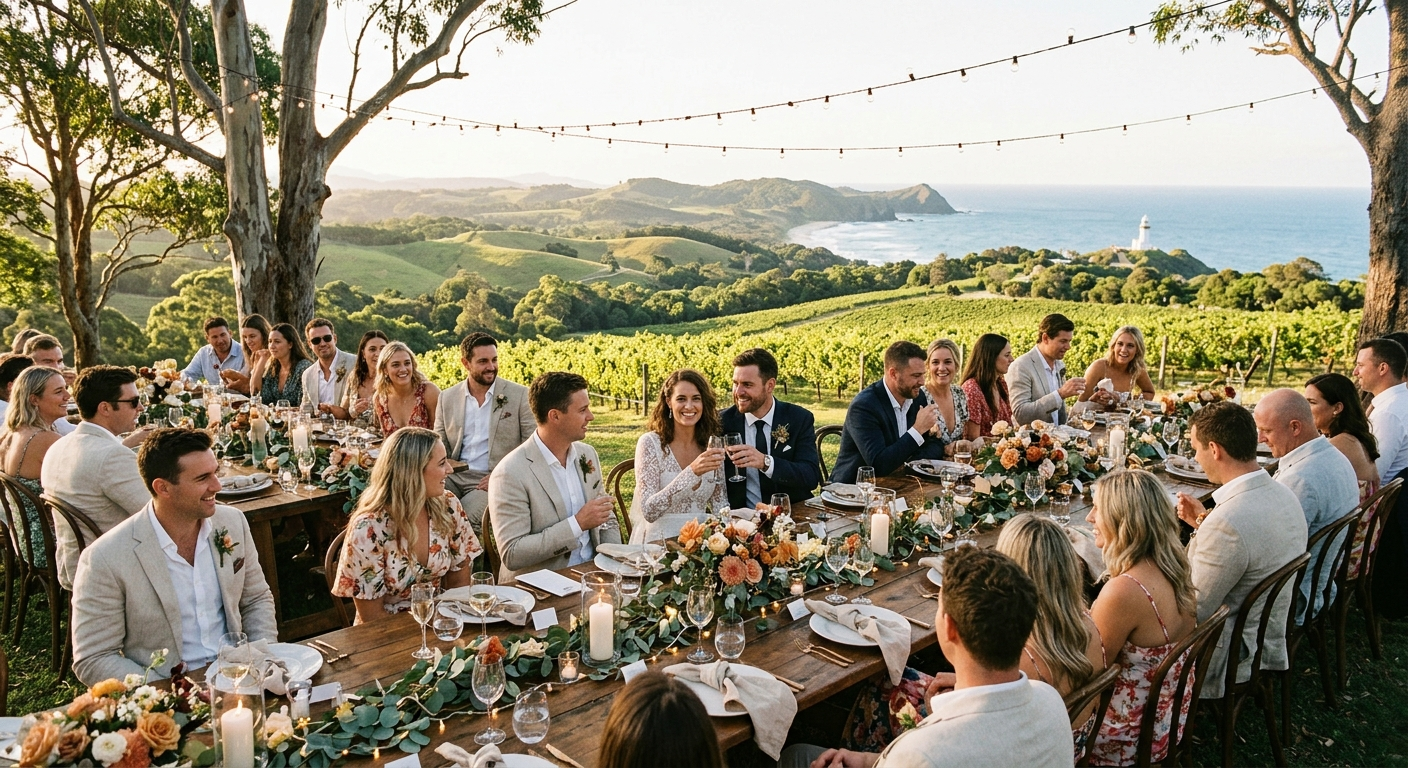
Australia's wedding industry has long operated on a simple premise: bigger is better. Large guest counts, expansive venues, elaborate floral installations, and multi-course sit-down dinners have been the aspirational template for generations of couples. But the economic and emotional calculus of large weddings is prompting a significant shift. In 2026, Australian couples are increasingly choosing to say 'I do' in front of 20, 30, or 40 of their closest people rather than 150 acquaintances, work colleagues, and distant relatives they see once every five years.
This is not merely a cost-driven decision — though the financial case is compelling. The rise of the micro wedding reflects deeper changes in how Australian couples think about celebration, community, and what they actually want their wedding day to feel like. The result is a wedding format that is more personal, more sustainable, more experiential, and — paradoxically — more memorable than the traditional large celebration. This article examines why micro weddings are surging in Australia, where the best micro wedding venues are located, how to plan one without sacrificing quality, and what couples who choose this path consistently report about their experience.
What Defines a Micro Wedding in Australia
The term 'micro wedding' has been in use since approximately 2015, but its definition has evolved significantly. Initially, it described ceremonies of 20 to 30 guests that attempted to replicate the structure of a large wedding at a smaller scale — the same formal elements, compressed. By 2026, the definition has matured. Australian micro weddings are now understood as intentionally curated celebrations where every guest has a genuine relationship with the couple, the event typically runs for a full day rather than a single evening, and the emphasis is on depth of experience rather than scale of spectacle.
The practical upper limit most Australian planners and venues use is 50 guests. Above 50, the logistical and financial differences between a micro wedding and a traditional celebration begin to narrow significantly. Below 30 guests, the event increasingly enters 'elopement' territory, though many couples with 20 to 30 guests explicitly choose terms like 'intimate celebration' or 'close-family wedding' rather than 'micro wedding' due to the latter's association with very small, informal gatherings.
The sweet spot for an Australian micro wedding in 2026 appears to be between 30 and 45 guests. This size allows couples to include close family, lifelong friends, and a small number of valued colleagues without the pressure of managing relationships with acquaintances, one-time collaborators, or extended family members with whom contact is limited to annual Christmas cards. It also allows every guest to have a genuine role in the day — standing beside the couple during the ceremony, participating in a meaningful way during the reception, and feeling the emotional weight of being genuinely included rather than simply accommodated.
The Financial Case: What Australian Couples Actually Save
The average cost of a traditional wedding in Australia in 2026 is approximately $53,000 AUD, according to the Easy Wedding Survey, with ceremonies in Sydney and Melbourne averaging significantly higher — approaching $70,000 AUD in some demographic segments. These figures include venue hire, catering at approximately $150 to $220 AUD per head, photography and videography at $4,500 to $9,000 AUD combined, flowers and styling at $4,000 to $8,000 AUD, and the often-overlooked line items of celebrant fees, hire equipment, transport, and accommodation. The total is substantial, and the pressure to justify the spend to family members who are contributing financially creates stress that many couples report as the most significant planning burden.
A micro wedding with 35 guests, by contrast, can realistically be executed for $18,000 to $32,000 AUD depending on location, vendor tier, and design ambition. The per-head cost for catering is similar — quality dining experiences in Australia do not become dramatically cheaper on a per-person basis simply because the total count is lower. But the elimination of 100 to 115 guests from the headcount removes $15,000 to $25,000 AUD from the catering line alone. When this saving is combined with reduced requirements for flowers, styling, furniture hire, and audio-visual equipment, the total cost differential is striking.
This saving does not mean a micro wedding is 'cheap.' It means that a micro wedding budget of $28,000 AUD produces a significantly more elevated experience than $28,000 AUD distributed across 130 guests. The couple can afford a premium photographer for the full day rather than a mid-tier option for abbreviated hours. They can choose a sought-after venue that only accommodates small groups rather than a larger, less characterful space. They can afford to personalise every element of the day rather than making compromises to keep costs within a constrained budget spread across a large headcount. The micro wedding does not require couples to accept less — it allows them to concentrate their resources on what actually matters to them.
Australia's Best Micro Wedding Venues
The venue market for micro weddings in Australia has expanded dramatically as demand has grown. Some of the country's most compelling micro wedding venues are spaces that are too small or characterful for large weddings, making them precisely suited to intimate celebrations. In New South Wales, the Hunter Valley offers numerous winery cellar doors and boutique accommodation properties that accommodate 30 to 50 guests with an authenticity that larger venues cannot match. The Brokenwood Wines cellar door, with its converted shipping container architecture and views across the vineyard, is regularly booked for micro weddings throughout the year.
Byron Bay continues to dominate the conversation for coastal micro weddings. The region's combination of stunning natural scenery, established wedding infrastructure, and year-round temperate climate — making it comfortable for outdoor ceremonies even in the Australian winter months of June to August — makes it consistently popular. Specific venues that have emerged as micro wedding specialists include Eucalyptus Lane, a working flower farm with a dedicated ceremony clearing and covered reception space, and Gaia Resort, which offers an integrated ceremony and reception venue with accommodation for the full guest list on-site.
Victoria's Yarra Valley is a natural fit for micro weddings, with the region's proximity to Melbourne and concentration of premium small-scale venues making it practical for couples wanting a destination feel without extensive travel logistics. The Coldstream Hills winery offers an intimate barrel room space that seats 40 guests at a single long table, creating a communal dining experience that is difficult to replicate in larger venues. In Western Australia, the Margaret River region has seen significant growth in micro wedding bookings, with venues like Hayshed Hill and the Farmhouse Margaret River offering small-group packages that include accommodation for 20 to 40 guests on-site.
South Australia's Adelaide Hills region offers some of the most cost-effective premium micro wedding venues in the country. The combination of relatively lower property and operating costs compared to New South Wales and Victoria, combined with the region's exceptional food and wine credentials, creates a compelling value proposition. Lady Jane, a converted chapel on the outskirts of Hahndorf, has become a particularly popular micro wedding venue, with its intimate enclosed space and surrounding gardens accommodating ceremonies and receptions for up to 45 guests at a fraction of the cost of equivalent Sydney or Melbourne venues.
Planning a Micro Wedding: What Changes and What Does Not
The planning process for a micro wedding differs from a traditional wedding in important ways, some of which are counterintuitive. The guest management challenge is substantially reduced — there is no need for a complex seating chart, no requirement to manage plus-ones for people the couple has never met, and no pressure to maintain relationships with guests who attend out of obligation rather than genuine connection. The invitation process is simpler, and the RSVP management that typically consumes significant planning energy is reduced to a handful of responses to track.
However, the stakes for each individual element are higher. In a 130-guest wedding, a mediocre MC is tolerable because most guests are engaged in conversations and the room has its own energy. In a 35-guest micro wedding, the quality of the MC, the entertainment, and the flow of the evening is immediately and collectively felt by every single person in the room. Similarly, the quality of food, wine, and service is more scrutinised when guests are seated at a single table rather than distributed across multiple tables with their own micro-conversations. Couples planning a micro wedding should not assume they can compromise on vendor quality — they should plan to invest in the vendors who will have the most direct impact on the guest experience.
The emotional planning challenge of a micro wedding is distinct. Many couples report that choosing not to invite certain people — colleagues, former school friends, extended family members — is more difficult than they anticipated, even when they are intellectually committed to the intimate format. The solution most couples find is to reframe the decision: rather than focusing on who is not invited, they focus on the extraordinary experience they are creating for the people who are. The majority of couples who choose micro weddings report that, in retrospect, the guest list question resolved itself once they began imagining what their wedding day would actually feel like rather than what they thought it should look like.
The Multi-Day Micro Wedding: Turning One Day Into an Experience
One of the most significant advantages of the micro wedding format is the feasibility of extending the celebration across multiple days without proportional cost increases. When catering costs are calculated on 35 guests rather than 130, the incremental cost of adding a Friday welcome dinner or a Sunday recovery brunch is genuinely affordable — perhaps $1,500 to $3,500 AUD for a shared long lunch, compared to the $5,000 to $8,000 AUD it would cost to extend a large wedding by a single additional event.
Australian couples are increasingly taking advantage of this financial reality to create weekend-long wedding experiences. A typical structure involves welcome drinks or a casual dinner on Friday evening, the wedding ceremony and reception on Saturday, and a relaxed Sunday gathering — perhaps a beach picnic, a winery visit, or a private chef breakfast at the accommodation. This structure serves a dual purpose: it gives guests who have travelled from interstate or overseas a more substantial experience that justifies the travel, and it creates the sense of a shared occasion rather than a single event, deepening the emotional resonance of the celebration.
For couples choosing destination micro weddings in regional Australia — the Margaret River region, the Hunter Valley, the Yarra Valley, the Adelaide Hills — the multi-day format also solves a logistical challenge that large weddings rarely address. Guests attending a regional wedding typically need to travel and stay overnight regardless of the format. A multi-day micro wedding gives them meaningful things to do during the additional days, transforming what could be an awkward overnight stay in an unfamiliar location into a genuine mini-holiday with friends and family at its centre.
The Australian Vendor Ecosystem for Micro Weddings
The growth of micro weddings in Australia has created a specialised vendor ecosystem that serves this segment specifically. Celebrants who focus exclusively or primarily on intimate ceremonies have emerged in each major city, bringing a depth of personalisation and ceremony craft that is difficult to achieve in the abbreviated ceremonies often conducted at large weddings. In Sydney, celebrants like Ashleigh and Mia from The Narrative Studio have built practices specifically around intimate ceremonies, bringing a storytelling focus that suits the micro wedding format particularly well.
Photographers have adapted their micro wedding offerings significantly. Rather than charging full-day rates that make micro wedding budgets unrealistic, many Australian photographers now offer half-day and bespoke micro wedding packages that cover the ceremony and portraits in three to four hours at approximately $2,200 to $3,500 AUD. This pricing reflects the different value equation of micro weddings — the photographer is delivering an exceptional product to a smaller number of subjects, and the images have a different character than large wedding photography, often prioritising intimacy and texture over the wide, crowded dance floor coverage that defines traditional wedding albums.
Caterers and chefs have been perhaps the biggest winners of the micro wedding trend. The ability to prepare a genuinely excellent dining experience for 35 guests — rather than producing adequate food at scale for 130 — has attracted culinary talent to the wedding market that previously found large wedding catering professionally unrewarding. Private chefs, small restaurant operators, and specialist wedding caterers like The Seasonal Kitchen in Melbourne and Banquet & Co. in Sydney now focus significant portions of their practice on micro weddings, delivering food quality that would cost significantly more in a traditional catering format.
Why More Australian Couples Are Choosing Intimate Celebrations
The micro wedding trend in Australia is not a reaction against weddings — it is a reaction in favour of them. Couples who choose intimate celebrations are not less committed to marriage or less excited about their wedding day. They are, in many cases, more intentional about what they want that day to mean and more deliberate about how they want it to feel. The feedback from Australian couples who have chosen micro weddings is remarkably consistent: they do not feel they missed out on anything. They feel they got exactly what they wanted.
The practical advantages — cost savings, vendor access, venue options, guest availability — are significant, but they are secondary to the emotional case. A micro wedding allows every guest to feel genuinely present rather than incidentally attended. It allows the couple to be present with every guest rather than managing the logistics of a large event. It allows the day to be personal rather than performed. In an era when Australian couples are increasingly thoughtful about how they spend their money, their time, and their attention, the micro wedding represents a wedding format that is financially sensible, emotionally resonant, and genuinely memorable — precisely because it is built around the people who matter most, rather than the people who were always going to be invited.