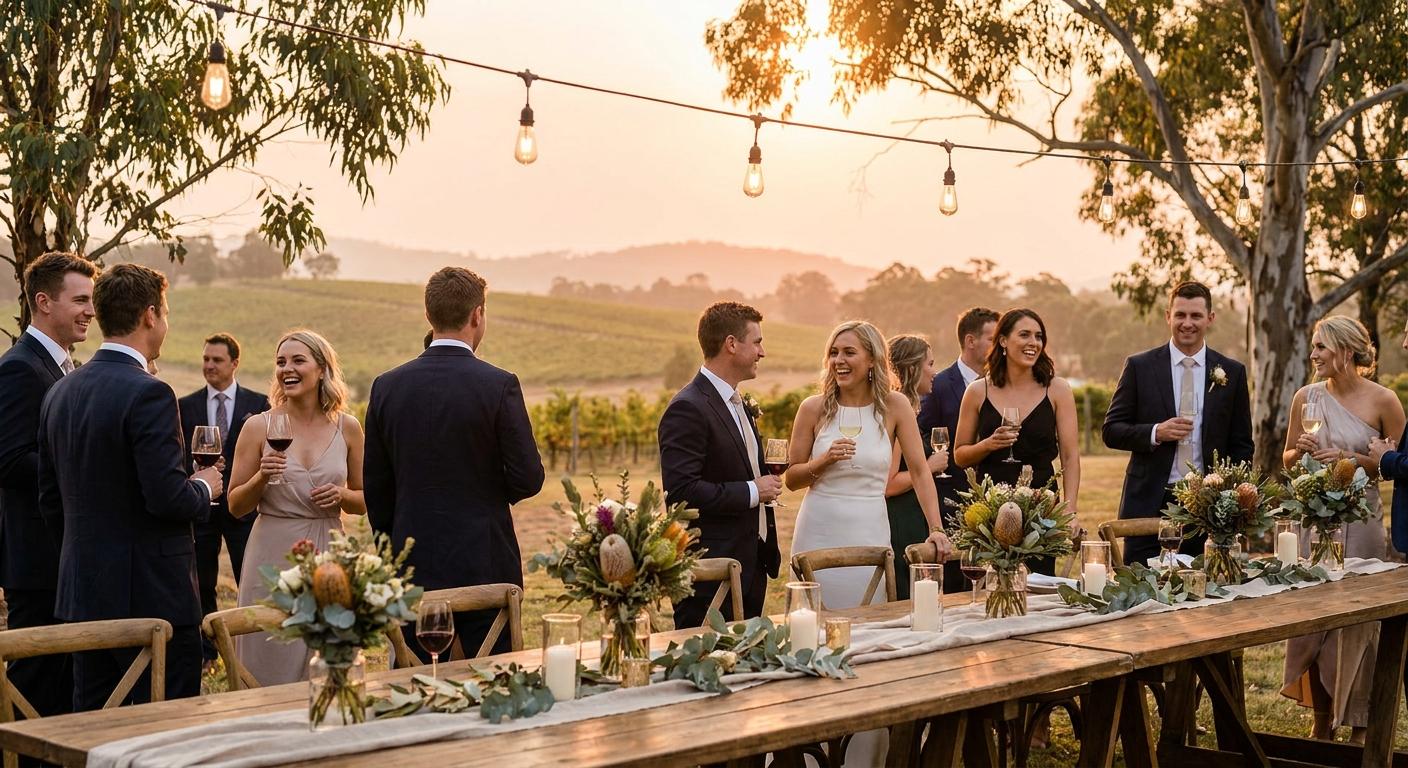
The traditional Australian wedding formula — a ceremony at 3pm, cocktails at 5pm, dinner and dancing until 11pm — is being rewritten by couples who want more. In 2026, an increasing number of Australian couples are choosing to stretch their wedding celebration across an entire weekend, turning what was historically a single day's event into a multi-day experience that allows guests, family, and the couple themselves to genuinely connect rather than simply witness a transaction of vows and a first dance.
The trend toward extended wedding celebrations has been building for several years, accelerated by post-2020 reassessments of what weddings are actually for. Couples who spent months in lockdown planning a single afternoon's event asked themselves what all that preparation was actually serving. The answer, increasingly, was connection — and connection takes time. A multi-day wedding gives everyone involved the space to be present, to have meaningful conversations, and to create shared memories that last well beyond the formal proceedings of a single day.
The Rise of Multi-Day Weddings in Australia
The multi-day wedding is not a new concept globally — destination weddings have long involved extended stays, and cultures across Southeast Asia and Europe have traditions of wedding celebrations spanning multiple days. But the Australian adaptation of this trend has its own character, shaped by the country's geography, climate, and the preferences of couples who are increasingly prioritising experience over spectacle.
According to the Easy Weddings 2026 Couples Survey, approximately 23 percent of Australian couples who married in the first half of 2026 chose to extend their celebration beyond a single day, compared with just 11 percent in 2022. The most common format is a two-day celebration — typically a welcome dinner or rehearsal evening on the Friday, followed by the main ceremony and reception on the Saturday — but three-day formats are gaining traction, particularly among couples who are hosting guests from interstate or overseas.
The economic argument for multi-day weddings is more nuanced than it first appears. While the total spend is inevitably higher than a single-day event, the per-guest cost of additional events is significantly lower than the main celebration. A casual Friday night welcome dinner at a local restaurant or a relaxed Saturday morning recovery brunch costs a fraction of the per-head price of the main reception, and guests frequently report that these informal events are the moments they most value. The net result is a wedding that feels more generous and more connected, often at a unit economics advantage compared to a single day of equivalent production value.
The logistics of multi-day weddings do require more planning, but the complexity is manageable with the right approach and the right digital tools. The key areas that require additional attention are the RSVP process, the guest accommodation arrangement, the itinerary design, and the budget allocation across multiple events. This article covers each of these areas with specific focus on how Australian couples can execute a multi-day wedding without losing their minds or blowing out their budget.
Best Australian Destinations for Extended Celebrations
Australia's diversity of landscapes and venue types makes it exceptionally well-suited to multi-day wedding celebrations. The country's best multi-day wedding destinations share a common characteristic: they offer enough to do, and enough visual richness, that guests are never bored between the scheduled events. The following destinations have emerged as the stand-out choices for Australian couples planning extended celebrations in 2026.
Hunter Valley in New South Wales remains the most popular destination for multi-day weddings in Australia, and for good reason. The region offers a concentration of world-class wineries, restaurants, and accommodation within a two-hour drive of Sydney, making it accessible for guests who are driving rather than flying. Couples can host a welcome dinner at one of the valley's renowned restaurants — suggest Restaurant Hundred at Ubbin in Pokolbin for a sophisticated first evening — followed by the main celebration at a winery venue such as Briar Ridge or Sunset Creek, with a recovery brunch at a cafe in the nearby town of Cessnock. The variety of venues within a tight geographic area eliminates the need for extensive travel between events, which is one of the most common friction points in multi-day wedding planning.
Byron Bay in northern New South Wales has become the preferred destination for couples who want a coastal, relaxed multi-day experience. The region's famous beaches, hinterland trails, and wellness culture create a natural environment for an extended celebration that feels less like a wedding and more like a gathering of people who happen to be celebrating a wedding. The Byron Bay surf club venues, Elements of Byron, and a range of hinterland estates provide ceremony and reception options that are distinctly Byron — barefoot-friendly, visually stunning, and relaxed in a way that is difficult to replicate in more formal settings. The regional airport with direct flights from Sydney and Melbourne makes it practical for interstate guests.
Margaret River in Western Australia is the premier destination for couples who want their multi-day wedding to double as a food and wine experience. The region's concentration of premium wineries, craft breweries, and artisan producers is unmatched in Australia, and the compact geography — everything is within a 30-minute drive — makes it ideal for a weekend where guests move between venues without excessive travel time. For couples who are planning a multi-day celebration with a strong culinary focus, Margaret River is in a category of its own. The average cost of a three-day Margaret River wedding package from a local coordinator ranges from $28,000 to $55,000 AUD for 60 guests, excluding accommodation.
The Yarra Valley in Victoria offers a compelling alternative for couples based in or near Melbourne, with the added advantage of cooler temperatures that make outdoor events more comfortable during the summer months. The region's proximity to Melbourne — approximately one hour's drive — means guests can commute daily rather than staying on-site, which significantly reduces accommodation costs for those on a tighter budget. For couples who want the winery wedding aesthetic without the cost of a full destination wedding, the Yarra Valley provides a practical middle ground.
Managing RSVPs Across Multiple Events
The RSVP challenge is the area where multi-day weddings diverge most significantly from single-day events, and it is also where digital RSVP platforms deliver their clearest value. When a wedding involves a welcome dinner, the main ceremony, a reception, and a recovery brunch, the number of decision points for each guest multiplies considerably. A guest who can simply reply 'yes' to a single-day wedding now needs to indicate their attendance preference for each individual event, plus any dietary requirements, plus their accommodation needs, plus potentially their transport requirements.
A well-configured digital RSVP system resolves this complexity without creating confusion. WeddingRSVP.org enables Australian couples to create custom question fields for each event in their multi-day celebration, allowing guests to indicate their attendance for the Friday welcome dinner, the Saturday ceremony and reception, and the Sunday brunch as separate decisions. This granularity is important because not all guests will attend all events — interstate guests who have flown in are more likely to attend everything, while local guests may attend only the main celebration. Collecting these decisions separately ensures the couple has accurate numbers for each event, which directly affects catering, seating, and supplier briefings.
The question design for a multi-day wedding RSVP requires more thought than a single-day invitation. Each event should have its own attendance question, and the platform should allow conditional follow-up questions — for example, if a guest indicates they are attending the Friday welcome dinner, a follow-up question should ask whether they have any dietary requirements for that specific event. The RSVP form should also include a field for accommodation arrangements, and potentially a transport preference field for destinations like Margaret River or Hunter Valley where shared transport between venues is common.
The timeline for RSVP collection also needs to be longer for multi-day weddings. A single-day wedding typically works with a four to six-week RSVP window. For a multi-day wedding, particularly one that involves travel and accommodation, the RSVP window should be extended to six to eight weeks minimum, with an earlier save-the-date sent to give guests maximum time to organise their travel. Best practice for a 2026 multi-day wedding is to send save-the-dates eight to twelve months out, with formal invitations sent six months before the event and an RSVP deadline of six to eight weeks before the wedding date.
Building Your Wedding Weekend Itinerary
The itinerary is the connective tissue of a multi-day wedding, and getting it right is the difference between an event that feels like a series of loosely related parties and one that feels like a cohesive experience. A well-designed itinerary balances scheduled events with unstructured time, gives guests clear information about what is happening and when, and allows the couple to be present rather than constantly managing logistics.
The Friday evening welcome event sets the tone for the entire weekend. It should be the most informal event of the celebration — the goal is to ease guests into the experience and give everyone a chance to meet and mingle before the formality of the ceremony. A cocktail-style welcome dinner works well in most settings, as does a relaxed bbq at a venue with outdoor space. The key is to avoid the temptation to over-program the evening. Two to three hours of structured or semi-structured time is sufficient — anything longer and the welcome event starts to feel like an obligation rather than a pleasure.
The main ceremony and reception day requires the most careful scheduling. The ceremony should ideally begin in the late afternoon — 4pm is a popular choice in summer, accounting for the earlier sunset — leaving time for photography between the ceremony and the reception. A gap of more than two hours between ceremony and reception is generally not recommended, as it creates a dead zone in the afternoon that can deflate the energy of the day. The reception itself should flow from cocktails and canapes to a seated dinner and dancing, with the dancing portion ideally running from 9pm to 11pm or midnight, depending on venue curfews and noise restrictions.
The Sunday recovery brunch is a relatively recent addition to the Australian wedding format, but it has quickly become one of the most appreciated elements of multi-day celebrations. The style should be the most casual of the weekend — think long-table breakfast at a local cafe, a picnic in a park, or a relaxed lunch at a beachside venue. The purpose of the recovery brunch is two-fold: it gives the couple a chance to thank guests personally before they depart, and it gives guests who have formed connections over the weekend a natural closing moment. Keep it to two hours maximum — by Sunday, everyone is ready for a reasonable bedtime.
Budgeting for a Multi-Day Wedding in Australian Dollars
The question every couple asks when considering a multi-day wedding is whether they can afford it. The honest answer is that a multi-day wedding does cost more than a single-day wedding of equivalent scale, but the cost premium is smaller than most couples expect, and the value per dollar spent is frequently higher. Understanding where the costs go and how to allocate the budget is the first step toward making an informed decision.
The venue cost is typically the largest single line item in any wedding budget, and multi-day celebrations offer an opportunity to reduce the per-event venue cost significantly. Rather than hosting all events at a single premium venue — which can cost $15,000 to $30,000 AUD for a full buyout — couples can distribute their events across different venues, using a premium venue for the main ceremony and reception while hosting welcome and recovery events at more affordable locations. A Friday welcome dinner at a local restaurant for 60 guests, for example, might cost $3,000 to $6,000 AUD including a cocktail-style food and beverage package, compared with $12,000 to $20,000 AUD for an equivalent event at a dedicated wedding venue.
The catering budget for a multi-day wedding requires careful allocation across events. The main reception dinner is the centrepiece and should receive the largest share of the catering budget. The welcome dinner can be structured as a standing cocktail event rather than a seated dinner, which reduces per-head costs by 30 to 40 percent while maintaining a high-quality guest experience. The recovery brunch is the lowest-cost event of the weekend and can be structured as a casual buffet or a cafe-style long-table breakfast. A realistic total catering budget for a 60-guest, three-day wedding in 2026 ranges from $18,000 to $35,000 AUD depending on the venue choices and the style of service.
The most important budgeting principle for multi-day weddings is to make deliberate choices about where to allocate premium spend and where to economise. The ceremony and reception are the events that guests remember most clearly and where the couple should concentrate their production budget. The supporting events — welcome dinner, recovery brunch — should be styled with care but should not replicate the production value of the main day. Guests do not compare the welcome dinner to the reception; they experience each event on its own terms. A beautiful welcome dinner at $4,000 AUD will feel like a treat; it will not feel lacking because it was not as elaborate as the $20,000 AUD reception.
Multi-day weddings represent a meaningful shift in what Australian couples are asking of their wedding celebration — more time, more connection, more memory, and less performance. The trend is not about extravagance or about trying to keep up with an increasingly elaborate wedding landscape. It is about giving the people who matter most to the couple the time and space to actually be present with them during one of the most significant transitions of their lives.
The logistics of a multi-day wedding are manageable with the right planning approach and the right digital tools. A well-configured RSVP system handles the complexity of multi-event attendance tracking, dietary requirements, and guest communication without adding administrative burden. An honest, well-structured budget ensures the couple can celebrate the entire weekend without the anxiety of financial overexertion. And a carefully designed itinerary — one that balances structure with space — ensures that every guest, and the couple themselves, leaves the weekend feeling that they have been part of something genuinely special.