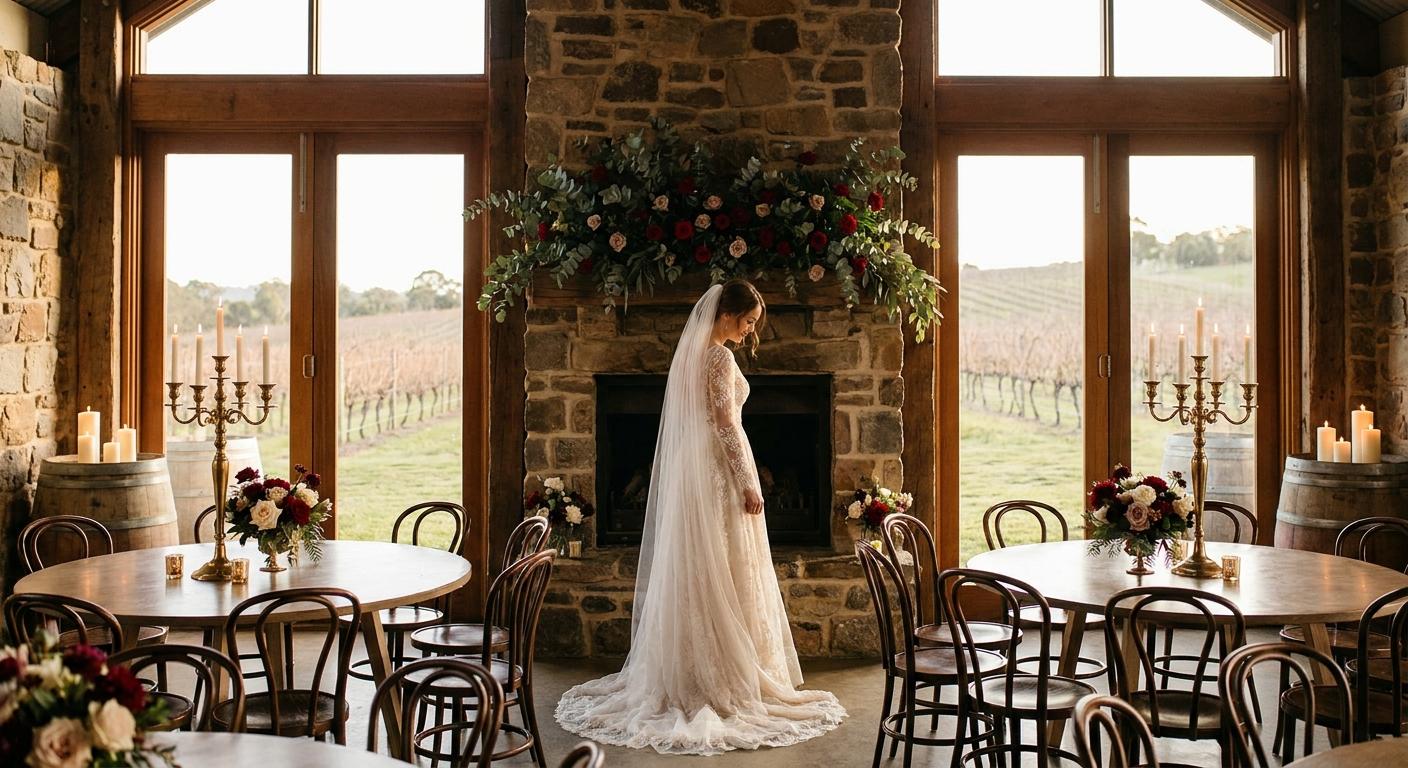
Australia's wedding calendar has long been dominated by the spring and summer months, with October through March accounting for the overwhelming majority of ceremonies conducted each year. The reasoning is intuitive: warm weather, longer days, and the natural abundance of spring and summer florals make outdoor celebrations straightforward to plan and beautiful to photograph. Yet a growing number of Australian couples are discovering that the off-peak months — particularly the winter period from June to August — offer a combination of practical advantages and atmospheric qualities that can make a winter wedding not just a compromise, but a genuinely superior choice.
July sits at the heart of the Australian winter, and it represents the most underutilised wedding month in the country. Venues that are booked solid every weekend from October to March sit empty on most July dates. Vendors who are unavailable for any booking on a spring Saturday have availability for a midwinter Friday. And the visual language of a winter wedding — candlelight, rich textures, atmospheric mist, long-sleeved elegance — is fundamentally different from, and in many ways more romantic than, the bright, floral-heavy aesthetic of a summer celebration. This article explores why Australian couples should consider a winter wedding, what makes July particularly compelling, which Australian destinations shine brightest in winter, and how to plan a winter wedding that takes full advantage of everything the season offers.
The Case Against Peak Season
The conventional wisdom that spring and summer are the 'best' times to marry in Australia is worth examining critically. The argument rests primarily on weather predictability and daylight hours, but both factors are less advantageous than they initially appear. Australia's eastern seaboard summers are increasingly defined by extreme heat events, with temperatures regularly exceeding 40 degrees Celsius in Sydney, Melbourne, and Brisbane during January and February. Outdoor ceremonies scheduled for 3pm in late January are not just uncomfortable for guests — they present genuine health risks, particularly for elderly relatives, young children, and anyone with heat sensitivity. The response from many couples has been to shift ceremonies earlier in the day or move entirely indoors, which begins to erode the principal advantage of a summer wedding.
Daylight saving time in Australia means that summer evenings are long, which is often cited as an advantage for wedding receptions. But the flip side is that photographers have increasingly harsh light to work with during the golden hour window that produces the most flattering wedding photographs. The overhead sun of an Australian summer afternoon creates unflattering shadows and overexposed highlights that require significant post-processing to correct. Winter afternoons offer a softer, more forgiving light quality that naturally flatters skin tones and creates the warm, romantic atmosphere that couples are paying photographers to artificially recreate at summer weddings.
The practical argument for winter weddings is the most compelling. Peak season wedding costs are not incidental — they reflect genuine supply constraints. The best photographers, videographers, celebrants, and florists in Australia's major cities are booked 12 to 18 months in advance for spring and summer dates, and their peak-season pricing reflects this scarcity. The same photographer who charges $4,500 AUD for a summer Saturday wedding may charge $3,200 AUD for a winter Friday. A realistic assessment of the cost differential between a peak-season and off-peak winter wedding suggests savings of 20 to 35 percent across the total budget, depending on the couple's vendor choices.
What Makes July Special for Australian Winter Weddings
July occupies a distinctive position in the Australian winter calendar. It is the coldest month in most of southern and eastern Australia, with average minimum temperatures in Melbourne dropping to 6 degrees Celsius and Sydney's average July low sitting around 8 degrees Celsius. This cold is precisely what makes July weddings work architecturally — the cooler temperatures make enclosed spaces with fireplaces and heating genuinely appealing, and the contrast between the crisp outdoor air and the warm interior of a venue creates the atmospheric layering that defines a beautiful winter wedding.
The light quality in July is also distinct. Australia's winter sun sits lower on the horizon than in summer, creating longer shadows and a warmer colour temperature throughout the day. For photographers, a ceremony conducted at 4pm in July will have a golden-hour quality that a summer ceremony at the same time cannot match. The sun sets earlier — around 5pm in Melbourne and 5:30pm in Sydney in July — which means the evening reception begins in the darkness that makes candlelight and uplighting so effective. A winter wedding reception in July is, almost by definition, a candlelit reception, creating an intimacy and romance that a bright summer afternoon reception cannot replicate.
July also falls outside the school holiday periods that create logistical challenges for guests. The New South Wales, Victoria, and Queensland winter school holidays fall in late June and early July, meaning the first two weeks of July are still within the holiday period for some families but revert to normal operations by mid-July. Compared to December and January, when school holidays create conflicts for families with children, July offers better guest availability for a significant portion of the Australian population.
Australian Destinations That Shine in Winter
The Hunter Valley in New South Wales is perhaps the most obvious beneficiary of the winter wedding season. The region's renowned winery restaurants — including Museo and Esca — have roaring fireplaces and enclosed dining spaces that are at their most atmospheric in July. A ceremony in a vineyard during winter, with the vines stripped bare and the air carrying the faint smell of wood smoke, is a visual experience fundamentally different from — and in many ways more dramatic than — a summer wedding among the same vines in full green leaf. The Hunter Valley's proximity to Sydney (approximately two hours' drive) also makes it practical for guests commuting from the city, keeping accommodation costs manageable for those not staying on-site.
The Yarra Valley in Victoria is another destination that winter elevates rather than diminishes. Many Yarra Valley wineries have stone-walled cellars and barrel rooms that are used for winter events specifically because they offer the enclosed, intimate character that suits the season. The region's proximity to Melbourne — approximately one hour's drive — makes it a practical option for couples who want a destination wedding without the complexity of air travel for guests. Yarra Valley wedding venues in July offer significant availability compared to the booked-solid spring and summer calendar, with many premium venues offering off-peak pricing packages.
Margaret River in Western Australia presents a different winter character. The region's winter rainfall is genuine, with wet days and dramatic cloud formations, but this is precisely what makes a Margaret River winter wedding distinctive. The dramatic coastline looks its most elemental in winter, with large swells on the ocean and the forest of the Leeuwin-Naturaliste National Park at its most vivid green. The region's many covered venues handle winter conditions gracefully, and the culinary richness of the Margaret River food and wine scene is perhaps most appropriately experienced in the cooler months when hearty winter menus feel natural rather than incongruous.
Byron Bay in northern New South Wales offers perhaps the most accessible winter wedding experience of any of Australia's destination wedding regions. The subtropical climate means winter temperatures rarely drop below 12 degrees Celsius during the day, making outdoor ceremonies genuinely comfortable without the heat stress of a summer Byron Bay wedding. For couples who want a coastal wedding without the cold of a Melbourne or Adelaide winter, Byron Bay in July offers a compelling compromise.
Styling and Design for a Winter Wedding
The visual language of a winter wedding is fundamentally different from the spring-summer aesthetic that dominates Australian wedding photography. Understanding this difference — and leaning into it deliberately — is what separates a winter wedding that feels like a cold-weather compromise from one that feels genuinely distinctive. The colour palette of a winter wedding should reflect the season's natural tones: deep burgundies, forest greens, warm ambers, charcoal greys, and the cream-white of bare branches.
Australian native florals are particularly well-suited to winter weddings, as many native species bloom in the cooler months. Grevilleas, banksias, flannel flowers, and waratahs are all available in winter and bring a distinctly Australian character to winter wedding florals that tropical imports cannot match. A winter wedding bouquet featuring waratahs and grevilleas against a deep charcoal or burgundy bridesmaid palette is a combination that is unmistakably Australian and unmistakably winter.
Candlelight is the single most important styling element for a winter wedding, and it should be deployed generously. The warm glow of candelabras on tables, candles lining the ceremony aisle, and firelight from a venue's fireplace creates the atmosphere that defines the season. The cost of candlelight is negligible compared to the floral installations that dominate summer wedding styling, which means a winter wedding can achieve a visual impact and atmosphere at a fraction of the cost of the equivalent summer floral installation.
Fabrics and textures take centre stage in winter wedding styling. Long-sleeved bridal gowns — impractical in summer heat but deeply romantic in winter — have become a defining winter wedding trend. Velvet, brocade, and textured lace are all season-appropriate choices that summer weddings cannot comfortably accommodate. For bridesmaid dresses, deep jewel tones — burgundy, emerald, sapphire, amethyst — are dramatically more effective in photography than the soft pastels of spring, and they complement the candlelit atmosphere of a winter reception with a richness that pastel tones cannot achieve.
Managing Guest Comfort in Winter
The most common objection to winter weddings — from guests as well as couples — is cold. Managing guest comfort is not complicated, but it does require deliberate planning different from the heat-management strategies of summer weddings. Venue selection is the most important factor. A venue with indoor and covered spaces that can accommodate the entire guest list comfortably in the event of bad weather is essential for a winter wedding. Couples should view their winter wedding venue in July or August before booking to assess its winter character firsthand rather than relying on summer photographs.
Heating strategy matters significantly at outdoor and semi-outdoor venues. Many Australian wedding venues have fixed outdoor heaters, but these are not always sufficient for genuinely cold evenings. Couples should discuss heating options with their venue coordinator during the planning phase and consider supplementary options — table heaters for outdoor cocktail areas, blanket stations for guests who have dressed for photography rather than warmth, and covered transition spaces between indoor and outdoor areas.
Timing of the ceremony is a subtle but important consideration for winter weddings. A 4pm ceremony in July allows for the ceremony and photographs to take place in the remaining daylight, with the reception moving indoors as darkness falls. This timing also allows guests to travel to the venue in daylight, which is more comfortable and safer on country roads than night driving in winter conditions. The dress code communication for a winter wedding should be explicit — a note on the invitation or wedding website specifying the venue's indoor and outdoor character and suggesting appropriate attire prevents guests from arriving underdressed.
Budget Advantages of the Winter Wedding
The financial case for a winter wedding deserves explicit examination, as the savings are substantial and are frequently underestimated by couples who have not priced out both peak and off-peak scenarios. Venue hire represents the most significant potential saving. Premium Australian wedding venues — particularly those with in-demand characteristics like waterfront views, vineyard settings, or heritage buildings — frequently offer winter packages that are 25 to 40 percent below peak-season pricing. A venue that charges $18,000 AUD for a Saturday peak-season hire in October may offer the same date in July for $11,000 to $13,000 AUD, either as a published winter package or as a negotiated rate. This single line item saving can amount to $5,000 to $7,000 AUD on a typical premium venue booking.
Vendor pricing follows the same pattern. Photographers, videographers, and celebrants who are fully booked for every weekend from October to March have genuine availability for winter dates and price accordingly. The saving on photography and videography alone — two of the largest vendor line items — can amount to $1,000 to $2,000 AUD when booking a midwinter date rather than an equivalent spring Saturday. Florists offer similar savings, as winter native blooms are not only more atmospheric for the season but also priced below the premium charged for out-of-season imported flowers that summer weddings often rely on.
The catering saving is more nuanced but still meaningful. Many caterers offer off-peak pricing for winter events, and the reduced need for ice for drinks, cold platters for canapes, and airconditioned climate control in venues can reduce operational costs that are passed on to the couple. A typical 80-guest winter wedding catering package in 2026 is priced between $8,000 and $14,000 AUD depending on the menu and service style, compared with $10,000 to $18,000 AUD for the same guest count in peak season. The cumulative effect of these savings can amount to $10,000 to $20,000 AUD for a mid-size wedding, depending on the vendor tier the couple has chosen.
The case for a winter wedding in Australia is not a case for settling. It is a case for choosing a different kind of wedding experience — one defined by candlelight and firelight, by native winter florals and rich jewel-toned palettes, by the distinctive quality of the Australian winter sun, and by the genuine warmth and intimacy that a winter celebration creates almost effortlessly. July sits at the heart of the Australian winter, and it is perhaps the single most underutilised month on the Australian wedding calendar.
The venues that are booked 18 months out for spring Saturdays have genuine availability for July dates. The photographers who are out of budget for a peak-season booking are available and better priced. The result is a wedding that is not a compromise with the season but a celebration of it — a wedding that looks, feels, and photographs as distinctly Australian as the summer ceremony it sits alongside, and one that offers genuine advantages in atmosphere, availability, and cost that the peak-season wedding cannot match. For Australian couples who are flexible about their wedding date, a July winter wedding deserves serious consideration.