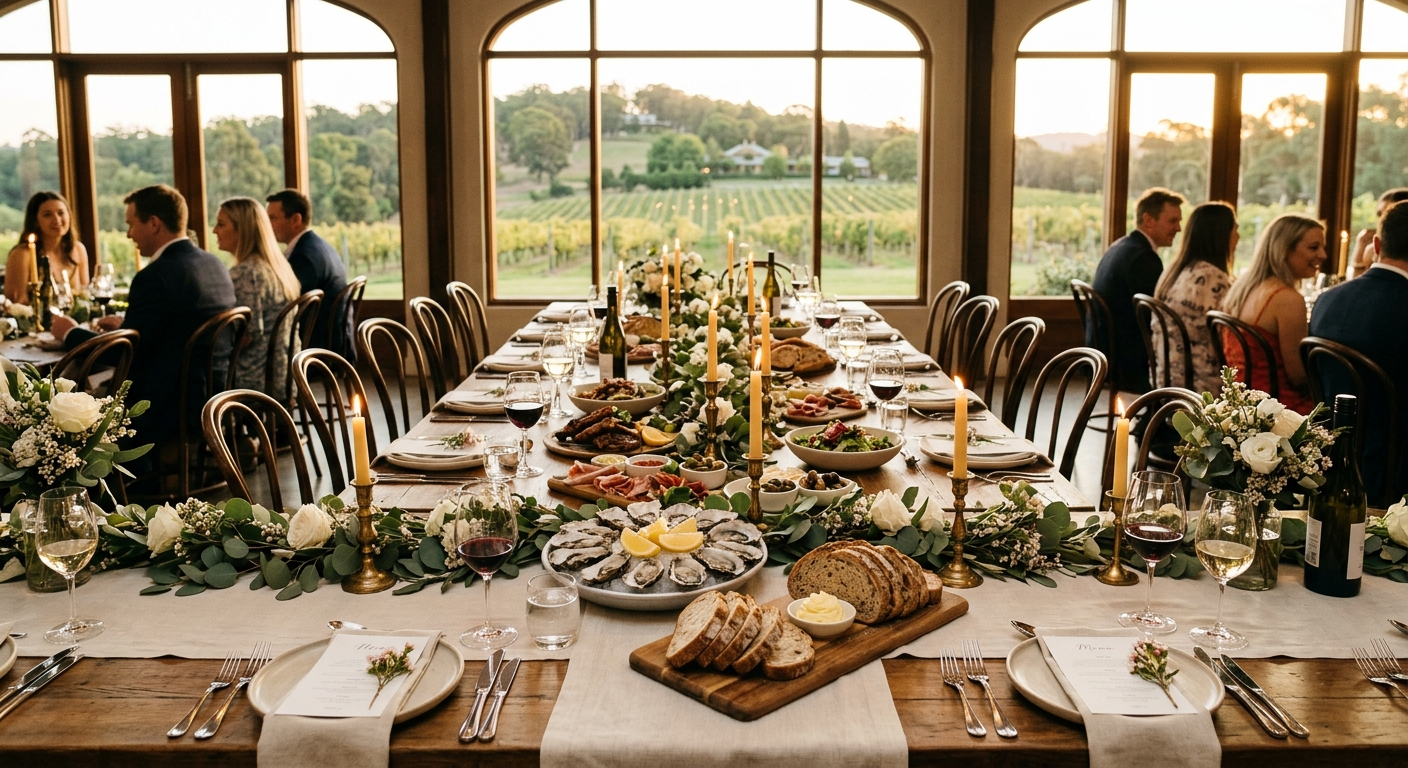
For decades, the Australian wedding dinner followed a reliable formula. Guests were seated at round tables, presented with a two or three-course alternate-drop menu, and invited to choose between a chicken option and a beef option before the cake was cut and the dancing began. It was not a bad formula. It was efficient, predictable, and safe. It is also, in 2026, increasingly obsolete.
The Easy Weddings 2026 Wedding Trends Report confirms what many suppliers and planners have been observing for the past two years: Australian couples are fundamentally rethinking the role of food in their wedding celebration. The meal is no longer a logistical necessity — a box to tick on the way to the speeches and the first dance. It is one of the primary vehicles for guest experience, personal expression, and genuine hospitality. And the catering choices that Australian couples are making in 2026 reflect this shift in ways that are reshaping the entire wedding food and beverage landscape.
The Cultural Shift: Why Wedding Food Is Being Reinvented
The appetite for better wedding food is not happening in isolation. It reflects broader changes in how Australians eat, socialise, and celebrate — changes that were accelerated by the pandemic and have now become permanent features of the hospitality landscape.
The rise of the shared dining culture, already embedded in Australian restaurant culture through the proliferation of small-plate menus, wine bar grazing, and communal dining experiences in cities like Melbourne, Adelaide, and Sydney, has fundamentally changed guest expectations. A wedding dinner that feels like a conference lunch feels out of step with how people eat on any ordinary night out. Couples who regularly share a bottle of wine and a series of small plates with friends at their local neighbourhood restaurant understand viscerally that the alternate-drop model — two options, no sharing, no conversation about the food — is an experience designed for a different era.
The second driver is the desire for authenticity. Food is one of the most personal elements of any celebration. A couple who are passionate about their local Vietnamese restaurant, who spent their gap year eating their way through regional Italy, or who bonded over Saturday morning farmers markets are not going to be fulfilled by a menu designed to offend nobody. They want their wedding food to reflect who they are. And the wedding industry in 2026 has matured enough to make that possible at almost every price point, through almost every catering format.
Shared Plates and Family-Style Dining
The single most significant wedding food trend in Australia for 2026 is the shift toward shared dining. Rather than individual plates served simultaneously, couples are choosing long banquet tables where dishes are placed at the centre and guests help themselves — passing plates, sharing portions, and creating a social dynamic around the food that individual plating simply cannot generate.
The appeal is both social and aesthetic. A long table set with shared platters, generous salads, bread baskets, and side dishes creates an immediate visual impression that feels abundant and celebratory. It signals warmth and hospitality in a way that a series of identical plated meals cannot. The dining experience feels more like a dinner party than a function — which, for many couples, is precisely the point.
In practice, the shared-plate format works best when the menu is designed for sharing. Substantial centrepieces — a whole roasted fish, a slow-braised lamb shoulder, a big pot of handmade pasta — give guests something to engage with and discuss. Accompaniments and sides are served in quantities that allow for genuine abundance. The result is a meal that feels generous without requiring the per-head cost of a multi-course plated dinner.
The regional variation in Australia is particularly rich for this style. A Margaret River wedding might centre on a long table of West Australian produce — King George whiting from the Great Australian Bight, Margaret River beef served share-style, local olives and olive oil as recurring elements. A Byron Bay wedding might feature a Northern Rivers long-table dinner with sub-tropical ingredients, local seafood from the Bay, and tropical fruits as dessert elements. The shared-plate format, more than any other catering style, allows the food to express a sense of place.
The Australian Artisan Spirit Bar
Alongside the transformation of the wedding dinner, the wedding bar is also undergoing a fundamental rethink in 2026. The standard arrangement — a basic beer and wine package with a limited spirits selection available at cash bar rates — is increasingly unacceptable to couples who have invested in every other element of their celebration.
The bespoke cocktail bar has emerged as one of the most requested wedding beverage experiences in Australia for 2026. Rather than a generic package, couples are working with bartenders to create a small selection of signature cocktails that reflect their story — a drink named after how they met, a cocktail featuring the botanicals from a distillery they visited together, or a serve that uses Australian native ingredients like finger lime, wattleseed, or lemon myrtle. The bespoke cocktail experience signals to guests that the bar has been thought about, and the photography from a well-designed cocktail station is consistently among the most shared content from any Australian wedding.
Australian distilleries have made this trend significantly more achievable than it would have been five years ago. The craft spirits movement has exploded in Australia, with independent distilleries now operating in every state. The West Australian whisky and gin scene — from the Margaret River distilleries to the Peel Street producers in Perth — offers a range that has become a genuine point of regional pride for West Australian couples. In Victoria, the Melbourne gin scene and the Yarra Valley whisky producers provide locally rooted options for Victorian celebrations. New South Wales has built a strong gin and whisky culture across the Hunter Valley and the Sydney metropolitan area. Couples who want a genuine sense of place in their beverage program can achieve it without the logistics that would have made this impossible a decade ago.
The practical benefit of the boutique spirit bar is that it does not need to be expensive. A small selection of four to six cocktails, a qualified bartender, and a curated local spirits range can be delivered for a cost that is comparable to — or marginally above — a standard full-bar package at many venues. The per-drink cost model that craft cocktail catering operates on actually suits the wedding format better than a flat package, because most guests are not heavy drinkers and the per-consumption model avoids the scenario where a pre-paid full bar package generates significant waste.
Interactive Food Stations and Live Cooking
The third major trend in Australian wedding catering for 2026 is the integration of live, interactive food experiences into the reception format. The concept is not new — the cocktail-hour cheese board and the late-night sausage roll have been wedding staples for decades — but the ambition and execution have escalated significantly.
The food station has evolved from a secondary offering to a centrepiece of the guest experience. Oyster shucking stations, where guests watch Pacific and Sydney rock oysters opened to order and served with a simple mignonette and lemon, have become one of the most reliably popular interactive elements at Australian coastal and harbour-side weddings. The experience is social, the oysters are exceptional, and the photography potential — a gloved shucker, a spray of sea mist, a dozen shells on the half-shell — is considerable.
The paella pan has become a signature wedding food station for couples who want a warm, communal, and visually impressive centrepiece. A large paella pan over an open flame, with the pan as the visual focus and the result served directly from the pan to guests, creates an event within the event. This format works particularly well for outdoor or barn-venue weddings in regional areas, where the open fire and the large-format cooking feel appropriate to the setting.
Woodfired pizza ovens have also migrated from the restaurant world into the wedding catering landscape. A mobile woodfired pizza station — where guests can watch bases being stretched, watch the oven working, and receive their pizza to order — delivers a different kind of experience from a paella station, one that reads as more casual and playful. For couples whose wedding aesthetic leans toward relaxed rather than formal, the pizza station communicates that alignment before a single word is spoken.
Late-Night Comfort Food: The Most Talked-About Wedding Moment
One of the most discussed trends in Australian wedding catering for 2026 is the late-night food moment — a deliberate, structured offering of comfort food at a point in the evening when guests have been dancing, drinking, and socialising for several hours and need sustenance to keep going.
The classic late-night offering in Australia has historically been a cheese board or a late-night snack plate delivered to each table. The 2026 version is more ambitious and more intentional. The most popular late-night food offerings in Australian weddings this year include: a dedicated fried food station — think Korean fried chicken, loaded fries, or a chip wagon — that operates as a kind of after-party catering; a sausage sandwich station featuring high-quality snags from a local butcher, served with caramelised onions and a choice of condiments; and a custom-designed midnight snack that reflects the couple — their favourite takeaway, their go-to comfort food, or a regional specialty from their part of Australia.
The late-night food moment serves a practical hospitality function — it genuinely keeps guests energised and extends the dancing — but it also serves an emotional function. The moment when a plate of hot food arrives after hours of celebration is a moment of care, a signal from the couple that they have thought about the guest experience even at 10pm. Guests remember this kind of detail disproportionately, and the couples who invest in the late-night moment consistently receive some of their warmest post-wedding feedback on the food.
Dietary Inclusion as Standard, Not Exception
One of the most meaningful changes in Australian wedding catering culture for 2026 is the normalisation of dietary inclusion as a standard planning consideration, not an afterthought or an optional extra. The expectation that a wedding menu must accommodate guests with specific dietary requirements — whether for medical, religious, ethical, or lifestyle reasons — has moved from a special request to a baseline requirement.
The data on dietary requirements in Australia supports this shift. Studies consistently indicate that approximately 12 to 15 percent of Australian adults follow a specific dietary pattern — vegetarian, vegan, gluten-free, dairy-free, or some combination of these — with younger demographics showing significantly higher rates. At a wedding of 100 guests, this means 12 to 15 guests are likely to have a dietary requirement that goes beyond the standard alternate-drop options. At a 150-guest wedding, the number rises accordingly.
The practical response to this reality is not a separate, compensatory vegetarian option served quietly alongside the main menu. It is a rethinking of the menu architecture so that the default dishes — or at least a substantial proportion of them — are already inclusive. A grazing table that features roasted vegetables, hummus, dips, fruit, nuts, and bread as primary elements alongside the cheese and cured meats is already largely plant-based without requiring a separate vegetarian menu. A shared-table dinner where the centrepieces include at least two plant-based options — a substantial vegetable dish, a legume or grain bowl, or a whole roasted vegetable — means that the plant-based guests are eating the same food as everyone else, not a reduced version of the menu.
The RSVP is the critical tool for making this work. A well-designed digital RSVP collects dietary requirements with sufficient specificity to capture the detail that matters — not just vegetarian but vegan, not just gluten-free but coeliac, not just dairy-free but the specific allergen in question. This information, collected in advance and fed directly into the catering brief, enables the caterer to plan accurately and to confirm any specialist requirements before the final menu is locked.
The 2026 Australian Wedding Catering Budget Guide
For Australian couples planning their wedding catering budget in 2026, the range of options and price points is broader than ever before — but this breadth can also make budgeting more complex. Understanding what drives catering costs, and where the trade-offs lie, enables you to make decisions that are right for your priorities rather than defaulting to whatever is familiar.
The most significant cost variable in wedding catering is format. A formal plated dinner — where each guest receives an individual plate at each course — requires the highest staffing ratio and the most kitchen preparation time, and consequently commands the highest per-head cost. In Sydney and Melbourne in 2026, quality plated dinner catering for a 100-guest wedding typically ranges from $140 to $220 AUD per head for a three-course meal, before beverages. Melbourne catering prices at the mid-market tier tend to run approximately 10 to 15 percent below Sydney equivalents.
A shared-plate or family-style dinner is typically 15 to 25 percent less expensive than an equivalent plated dinner on a per-head basis, because the staffing requirements are lower and the kitchen logistics are simpler. A quality shared-plate dinner for 100 guests in 2026 typically ranges from $110 to $175 AUD per head, depending on menu ambition and supplier choice. This style also lends itself well to a winter dinner — a long table of substantial braises, roasted vegetables, fresh bread, and shared desserts feels appropriately warming for a July wedding in the Adelaide Hills or an August wedding in the Yarra Valley.
A cocktail-style or standing-dining format — where guests are offered substantial canapes and food stations rather than a seated dinner — occupies a different cost position. The per-head cost is generally lower at $80 to $130 AUD per head for quality canape catering, but the format requires a significantly higher quantity of food per guest to achieve satisfaction, because guests are standing, moving, and eating in small portions rather than sitting down to a complete meal.
Beverage costs are frequently underestimated in wedding budgets. A full open bar package at an Australian wedding venue in 2026 typically costs between $45 and $85 AUD per guest for a four to five hour reception, depending on the quality level of the spirits and wine selected. The bespoke cocktail bar option, when priced on a per-drink or per-head consumption basis, can work out cost-comparable to a standard package — and delivers a significantly better experience.
The transformation of the Australian wedding meal in 2026 is not a single trend — it is a convergence of several directions, all pointing toward the same destination: a wedding dining experience that is more personal, more generous, more inclusive, and more reflective of the couple than the alternate-drop formula ever allowed.
The shared-plate table, the artisan spirit bar, the oyster station, the late-night fried chicken, the plant-based dish that is not an afterthought — each of these elements works individually and they work powerfully in combination. A wedding where the food has been chosen with genuine care, where the bar reflects the couple's taste, and where every guest — regardless of their dietary requirements — is eating the same celebratory food as everyone else is a wedding where the dining experience itself becomes one of the most talked-about elements of the day.
The practical advice for Australian couples planning their 2026 wedding catering is to start with the question of what you actually want your wedding to feel like. Work backward from that answer to the format. A shared-plate dinner suits a relaxed, long-table celebration. A formal plated dinner suits a more traditional structure. A cocktail format suits an energetic, social evening with a shorter formal program. Once the format is right, invest in the quality of the food over the breadth of the menu. A smaller menu executed exceptionally well will outperform a larger menu executed to an average standard every time. And use your RSVP to collect the dietary information that enables your caterer to deliver a menu where everyone at the table is included.