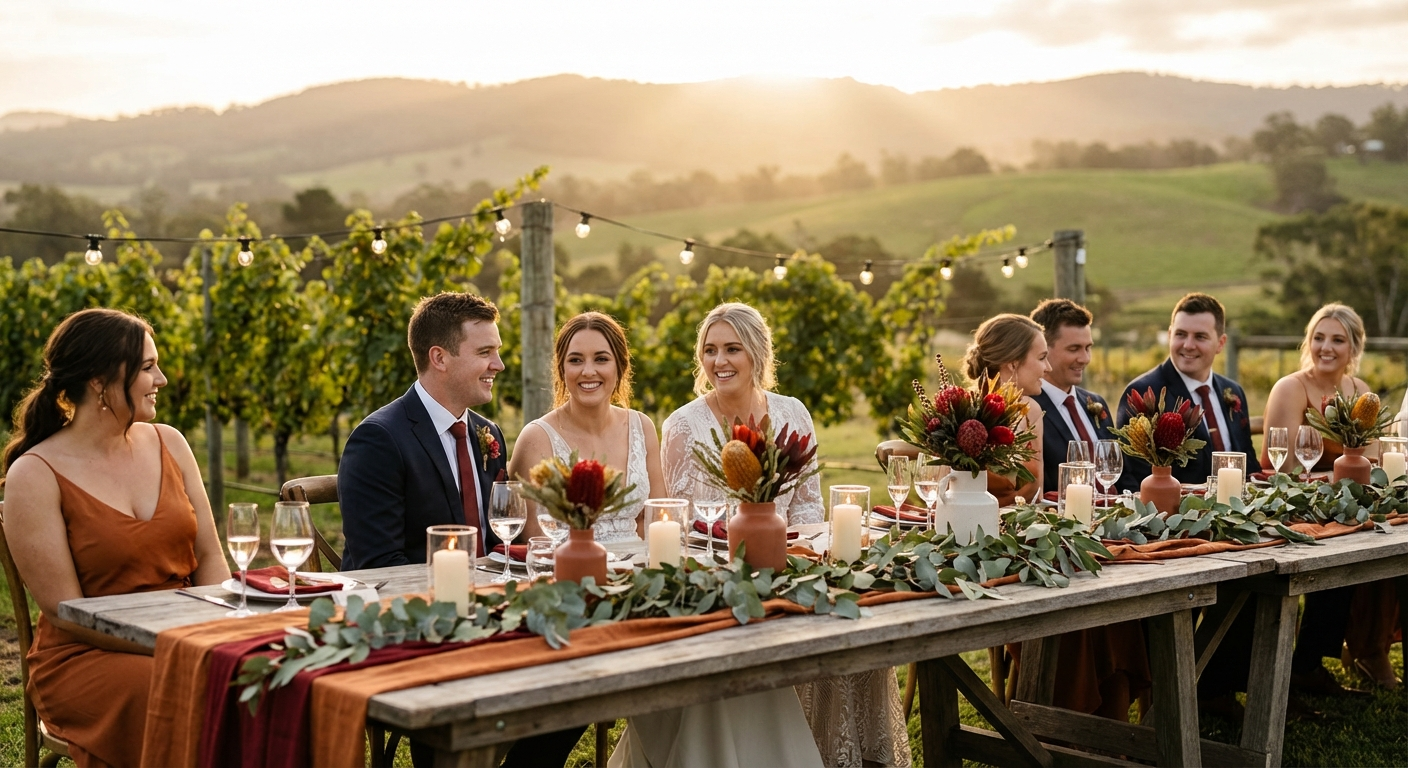
Something has shifted in the way Australian couples think about their wedding day. Increasingly, they are realising that a single day is simply not enough. After months of planning, thousands of dollars invested, and guests travelling from across the country, compressing the entire experience into six hours of ceremony and reception feels rushed. The solution gaining serious momentum in 2026 is the wedding weekend: a multi-day celebration that transforms a wedding from an event into an experience.
The concept is straightforward. Instead of a Saturday afternoon ceremony followed by a reception that ends at midnight, couples are extending the celebration across two or three days. Friday evening might feature relaxed welcome drinks where guests from different social circles can meet before the formalities begin. Saturday holds the main ceremony and reception. Sunday wraps things up with a leisurely recovery brunch where the newlyweds can actually spend time with the people they love, rather than racing through a receiving line.
This trend is particularly well suited to Australian autumn and winter weddings, when regional venues across the Hunter Valley, Yarra Valley, Margaret River, and beyond offer lower rates and stunning seasonal scenery. Cooler temperatures make outdoor activities comfortable during the day while creating the perfect excuse for cosy indoor gatherings in the evening. If you are planning a 2026 wedding between March and August, a wedding weekend could be the most memorable decision you make.
Why Wedding Weekends Are Trending Across Australia in 2026
The wedding weekend trend is not new globally, but it has reached a tipping point in Australia. Several factors are driving the shift, and understanding them will help you decide whether this format suits your celebration.
First, the average Australian wedding now costs between $35,000 and $55,000 AUD according to recent industry surveys. When couples are investing that kind of money, they want more than a few hours of memories. Spreading the celebration across multiple days increases the return on that investment dramatically, giving guests more time together and creating a richer tapestry of shared moments.
Second, Australian geography plays a significant role. Wedding guests in Australia frequently travel considerable distances. A couple based in Melbourne might have family in Brisbane, friends in Perth, and colleagues in Sydney. When guests are flying interstate or driving four hours to attend, a single-day event can feel disproportionate to the effort of getting there. A wedding weekend acknowledges and rewards that travel commitment.
Third, the 2026 wedding trend landscape is dominated by personalisation and guest experience. Couples want their wedding to feel like them, not like a template. A multi-day format provides the breathing room to include activities, settings, and moments that reflect the couple's personality in ways a packed six-hour reception simply cannot accommodate.
Choosing the Right Venue for an Australian Wedding Weekend
The venue is the foundation of a successful wedding weekend, and Australia offers extraordinary options for multi-day celebrations. The key requirements are accommodation capacity, multiple event spaces, and ideally a location that feels like a destination even if it is only ninety minutes from a major city.
Regional Wine Country Venues
Wine regions remain the gold standard for Australian wedding weekends, and for good reason. The Hunter Valley in New South Wales, the Yarra Valley in Victoria, and Margaret River in Western Australia all offer estates with ceremony spaces, reception venues, on-site accommodation, and surrounding attractions that keep guests entertained across multiple days.
In autumn, these regions are at their most spectacular. The Yarra Valley transforms with rich amber and gold foliage from late March through May, while the Hunter Valley enjoys mild temperatures perfect for outdoor gatherings without the oppressive humidity of summer. Margaret River, meanwhile, offers dramatic coastal scenery alongside its celebrated wineries, giving guests options for whale watching and coastal walks between wedding events.
Expect to pay between $8,000 and $25,000 AUD for venue hire across a weekend, depending on the property and the season. Many estates offer packages that include accommodation for the bridal party, ceremony and reception spaces, and coordination support. Booking during the autumn and winter off-peak period, roughly May through September, can reduce costs by twenty to thirty per cent compared with the October to April peak season.
Mountain and Hinterland Retreats
For couples drawn to cooler climates and dramatic landscapes, mountain and hinterland venues provide an exceptional setting. The Blue Mountains west of Sydney, the Dandenong Ranges outside Melbourne, the Gold Coast Hinterland in Queensland, and Cradle Mountain in Tasmania all offer properties designed for multi-day stays.
These venues excel in winter, when fireplaces, mulled wine stations, and cosy interiors create an atmosphere that summer weddings simply cannot replicate. A winter wedding weekend in the Blue Mountains might feature Friday evening drinks around a fire pit, a Saturday ceremony in a sandstone chapel with views across the Jamison Valley, and a Sunday brunch in a glass-walled pavilion overlooking morning mist rolling through the eucalyptus canopy.
Mountain venues typically range from $6,000 to $20,000 AUD for a weekend booking, with some all-inclusive properties offering accommodation, catering, and event coordination in a single package. The Dandenong Ranges, being close to Melbourne, offer particularly strong value as guests can drive in under an hour while still feeling immersed in nature.
Coastal and Beachside Properties
Coastal wedding weekends work beautifully in Australian autumn, when beach towns empty of summer tourists and the light takes on a warm, golden quality that photographers adore. Byron Bay, the Mornington Peninsula, Noosa, and Dunsborough near Margaret River all offer properties suited to multi-day celebrations.
Autumn along the Australian coast brings mild daytime temperatures in the low twenties, reduced crowds, and some of the best surfing and walking conditions of the year. A coastal wedding weekend might include Friday afternoon beach games and fish and chips, a Saturday ceremony on a clifftop or in a beachfront garden, and a Sunday morning ocean swim followed by brunch at a local cafe.
Coastal venue hire for a weekend typically ranges from $5,000 to $18,000 AUD, though premium beachfront properties in Byron Bay can command higher rates even in the off-season. The Mornington Peninsula offers excellent value with the added benefit of proximity to Melbourne, making it accessible for interstate guests flying into Tullamarine.
Planning Your Wedding Weekend Itinerary
A well-structured itinerary is the difference between a wedding weekend that flows naturally and one that feels like a forced march through scheduled activities. The goal is to create a framework that guides guests through the weekend while leaving enough unstructured time for people to relax, explore, and connect on their own terms.
Friday: The Welcome Event
The Friday welcome event serves two critical purposes. It gives guests who have travelled a chance to settle in and decompress after their journey, and it allows people from different parts of the couple's life to meet in a low-pressure setting before the formality of the main event.
Keep the Friday event casual and relaxed. A barbecue, a wine tasting at the venue, or simple drinks and canapes around a fire pit all work well. The key is accessibility: guests should be able to arrive at different times without feeling they have missed something important. Avoid structured speeches or formal seating. This is about connection, not performance.
Budget roughly $30 to $60 AUD per person for Friday catering, depending on whether you choose a full meal or lighter grazing options. Many couples find that a well-stocked grazing table with local cheeses, charcuterie, and regional wines strikes the perfect balance between generous and manageable.
Saturday: The Main Event
Saturday is the centrepiece, and the benefit of a wedding weekend is that your main event can actually breathe. Without the pressure of cramming everything into a single day, you can allow more time between the ceremony and reception for photos, cocktail hour, or a sunset walk. Guests are already settled and relaxed from the previous evening, which means the energy in the room is warmer and more connected from the moment the ceremony begins.
For autumn and winter weddings, consider timing your ceremony for the early afternoon to maximise natural light, then transition into a cocktail hour as the sun sets. Australian autumn sunsets occur between 5:30 and 6:30 PM depending on your location and the month, providing a spectacular backdrop for pre-reception drinks.
The reception itself can extend later when guests do not need to drive home, as most will be staying on-site or nearby. This is one of the great advantages of the wedding weekend format. Dancing until midnight or beyond becomes natural rather than rushed, and the after-party can continue in a communal space without anyone needing to call a taxi.
Sunday: The Recovery Brunch
The Sunday brunch is, for many couples, the most cherished part of the entire wedding weekend. It is the moment when the formality has dropped away, the pressure has lifted, and everyone is simply enjoying each other's company in the afterglow of the celebration.
Plan for a late morning start, around 10:00 or 11:00 AM, to allow for inevitable late nights. A relaxed brunch with good coffee, fresh pastries, eggs, and perhaps a Bloody Mary or mimosa station is all you need. This is not an event that requires a formal seating plan or entertainment. It is simply time together.
Many couples find the Sunday brunch is where they have their most meaningful conversations with guests. On Saturday evening, you are pulled in every direction. On Sunday morning, you can sit with your university friends, catch up with your partner's grandmother, and actually taste the food. Budget around $25 to $45 AUD per person for a generous brunch spread.
Managing RSVPs for Multiple Events Across the Weekend
One of the practical challenges of a wedding weekend is that not every guest will attend every event. Some may only be available for Saturday. Others might arrive Friday but need to leave before Sunday brunch. Managing these varying levels of attendance requires a thoughtful approach to your RSVP process.
A digital RSVP platform is essentially non-negotiable for wedding weekends. Paper invitations simply cannot capture the complexity of multi-event attendance, dietary requirements across multiple meals, and accommodation preferences. An online RSVP system allows you to create separate response options for each event, giving guests the flexibility to indicate exactly which parts of the weekend they will attend.
When setting up your RSVP page, list each event separately with clear times, locations, and dress codes. For example, your RSVP form might include checkboxes for Friday Welcome Drinks, Saturday Ceremony and Reception, and Sunday Recovery Brunch. This approach gives you accurate headcounts for each caterer and helps you plan accommodation allocation.
Send your invitations at least ten to twelve weeks before the wedding weekend, particularly if you are asking guests to stay overnight. Interstate guests will need time to book flights and arrange accommodation, and giving them advance notice shows respect for their time and travel commitments. Include links to nearby accommodation options for guests not staying at the venue, with a range of price points from budget motels to boutique hotels.
Follow up with a gentle reminder four weeks before the weekend. A well-designed wedding website with all logistics in one place, including maps, parking information, a weekend schedule, and a frequently asked questions section, will dramatically reduce the number of individual queries you receive in the final weeks of planning.
Budgeting for an Australian Wedding Weekend
The obvious question with a wedding weekend is cost. Adding two extra events and potentially covering accommodation does increase the total investment. However, the increase is often more manageable than couples expect, particularly when booking during the autumn and winter off-peak season.
A realistic breakdown for an eighty-guest wedding weekend in regional Australia might look like this. Venue hire for the full weekend typically runs from $8,000 to $20,000 AUD depending on the property and season. Friday welcome drinks with grazing and beverages might cost $3,500 to $5,000 AUD. The Saturday ceremony and reception, which would be the major expense regardless of format, ranges from $15,000 to $30,000 AUD. Sunday brunch adds approximately $2,000 to $3,500 AUD. Accommodation subsidies, if you choose to cover some or all guest lodging, might add $3,000 to $8,000 AUD.
In total, a wedding weekend might cost ten to twenty-five per cent more than a single-day wedding at the same venue. But the cost per hour of celebration drops significantly, and the depth of the experience for both couple and guests increases exponentially. Many couples offset the additional cost by choosing an off-peak date, negotiating multi-day venue packages, or scaling back on traditional single-day expenses like elaborate centrepieces or late-night dessert bars.
One important financial consideration: be thoughtful about what you ask guests to pay for. Australian wedding etiquette generally expects the couple to cover all food and beverages at events they host. If the Friday and Sunday events are framed as your hosted gatherings, guests will expect to eat and drink without opening their wallets. If budget is tight, you might make the Friday event BYO drinks while providing food, or frame the Sunday brunch as an optional gathering at a nearby cafe where everyone pays their own way.
The Seasonal Advantages of Autumn and Winter Wedding Weekends
Choosing a wedding weekend between March and August in Australia comes with significant practical advantages that extend well beyond lower venue rates.
Autumn, from March through May, is widely regarded by wedding photographers as the best season for Australian wedding photography. The light is softer and warmer than summer, the golden hour stretches longer, and if your venue is in a wine region or mountain area, the changing foliage provides a natural colour palette that no stylist could replicate. The temperatures in most Australian regions sit comfortably between fifteen and twenty-five degrees Celsius, warm enough for outdoor ceremonies but cool enough that guests are not wilting in the heat.
Winter, from June through August, offers a completely different but equally compelling atmosphere. There is something inherently romantic about gathering people you love in a warm, candlelit space while the cold presses against the windows outside. Winter wedding weekends in the Blue Mountains, the Macedon Ranges, or the Tasmanian highlands create an intimacy that summer events struggle to match. Shorter daylight hours mean earlier transitions to evening ambience, and the cooler weather opens up menu possibilities like slow-cooked lamb, rich red wines, and warm desserts that would feel heavy in summer.
Both seasons also offer dramatically improved availability at premium venues. Properties in the Hunter Valley, Yarra Valley, and Margaret River that are booked twelve to eighteen months in advance for summer dates often have weekend availability with just six months notice during the cooler months. This flexibility extends to vendors as well: photographers, florists, and caterers who command premium rates during peak season may offer more competitive pricing or upgraded services when their calendars are quieter.
Guest Communication and Logistics
Clear, comprehensive communication is the single most important factor in ensuring your wedding weekend runs smoothly. Guests need to know what is happening, when, and what to bring, well in advance of the weekend itself.
Your wedding website should serve as the central hub for all logistics. Include a detailed weekend schedule with times, locations, and dress codes for each event. Provide a map of the venue and surrounding area, highlighting accommodation options, parking, and any useful local amenities. If your venue is in a regional area, include driving directions from the nearest airport or major city, along with estimated travel times.
Consider creating a shared playlist, photo album, or group chat for the weekend. These small digital touches help build anticipation in the weeks before the event and provide a convenient way for guests to share photos and memories afterward. A dedicated wedding hashtag remains useful for aggregating social media posts, though its importance has diminished as more couples prioritise present-moment enjoyment over documentation.
For the weekend itself, a printed or digital itinerary placed in each guest's accommodation is a thoughtful touch. Keep it simple: event names, times, locations, and a brief note about dress code. Resist the urge to over-schedule. The beauty of a wedding weekend is the organic moments that happen in the spaces between planned events.
Finally, appoint a reliable friend or family member as the weekend coordinator, someone who is not in the bridal party but knows the schedule and can answer guest questions. This person becomes invaluable for fielding the inevitable texts asking what time is brunch and where do I park, freeing you to actually enjoy the weekend you have spent months planning.
Making Your Wedding Weekend Uniquely Australian
The best Australian wedding weekends lean into their setting rather than fighting it. If you are in wine country, make wine a central thread: Friday tastings, Saturday reception wines from the estate, Sunday brunch with a cellar door visit. If you are in the mountains, embrace the landscape with guided walks, scenic lookout gatherings, and menus built around hearty regional produce.
Native Australian flora has become a defining element of wedding styling in 2026, and a weekend format gives you more opportunities to incorporate it. Think banksia and protea arrangements for the ceremony, eucalyptus garlands along the reception tables, and native wildflower posies as favours for guests to take home. These choices support local growers and create a visual identity that is unmistakably Australian.
Food is another opportunity to celebrate Australian provenance. Work with caterers who source locally and seasonally. An autumn wedding weekend in the Barossa Valley might feature Adelaide Hills cheese on the Friday grazing table, South Australian lamb at the Saturday reception, and freshly baked sourdough with local preserves at the Sunday brunch. In the Hunter Valley, consider incorporating the region's celebrated semillon wines and locally grown olive oils.
Australian wedding weekends also benefit from the country's outdoor culture. Even in winter, Australians are comfortable spending time outside, and activities like morning yoga, bushwalks, lawn games, or a bonfire evening feel natural in a way that they might not in colder climates. These low-key group activities create shared experiences that bind guests together and generate the kind of spontaneous, joyful moments that become the wedding stories retold for years.
The wedding weekend represents a fundamental rethinking of what a wedding celebration can be. By extending beyond a single day, you create space for the connections, conversations, and quiet moments that make a wedding truly meaningful. Your guests have the chance to move beyond small talk and actually get to know each other. You, as a couple, get to be present for more of your own celebration rather than experiencing it as a beautiful blur.
Australian autumn and winter provide the ideal conditions for this format: stunning scenery, comfortable temperatures, reduced venue competition, and a natural intimacy that the cooler months bring. Whether you choose a vineyard in the Yarra Valley, a retreat in the Blue Mountains, or a coastal property on the Mornington Peninsula, the multi-day format allows your venue to become more than a backdrop. It becomes a character in your wedding story.
Start planning early, communicate clearly with your guests, and invest in a digital RSVP system that can handle the complexity of multi-event attendance. Most importantly, remember that the goal is not to fill every minute with scheduled activities. The goal is to create the conditions for memorable moments to happen naturally, and then step back and let them unfold.