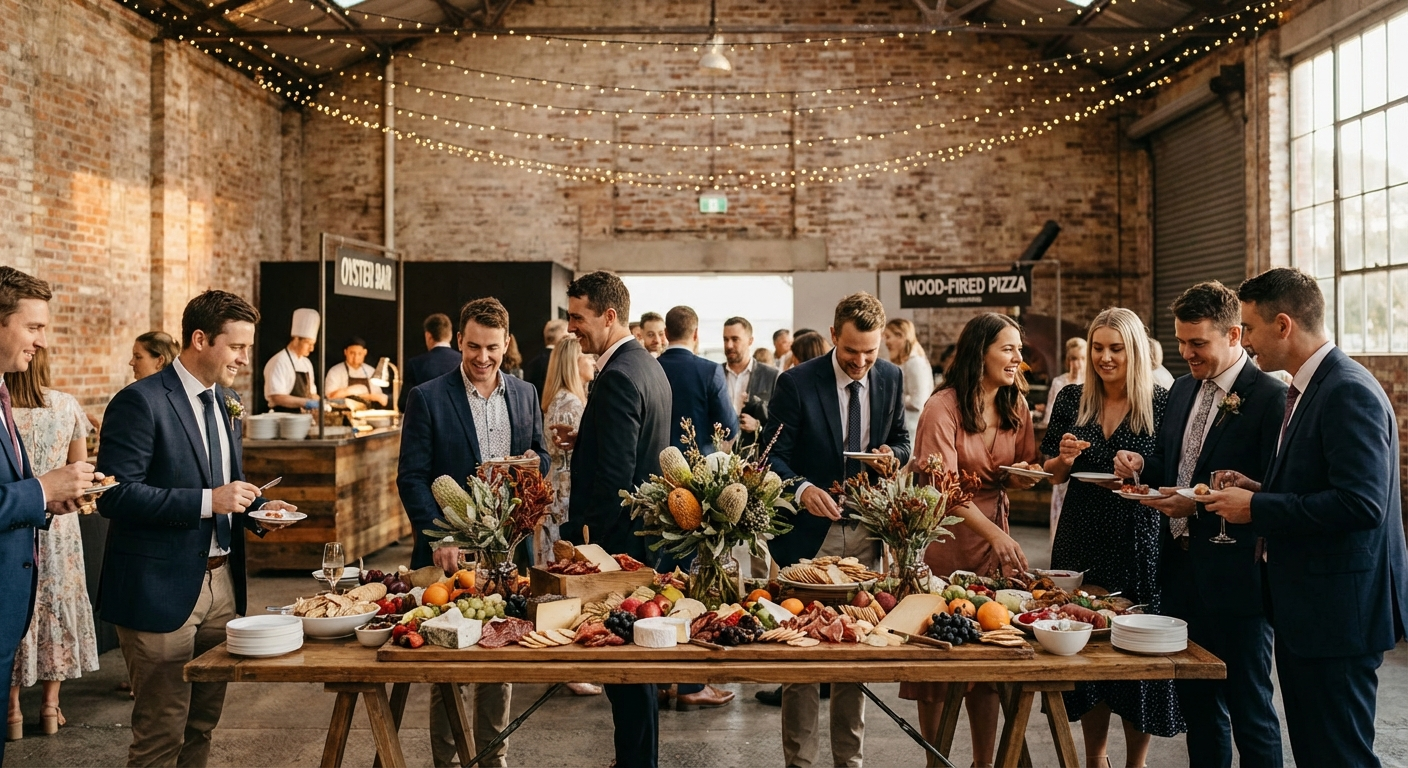
The alternate-drop three-course dinner has been the default Australian wedding reception format for decades. Bread rolls on white linen, a choice between chicken and beef, a slice of cake served with tea. It worked. It was familiar. And in 2026, couples across Australia are politely showing it the door.
A quiet revolution is reshaping how food and drink are experienced at Australian weddings, driven by couples who see their reception meal not as a necessary formality but as one of the most memorable and shareable moments of the entire celebration. Progressive dining, interactive food stations, theatrical grazing experiences, and late-night culinary surprises are replacing the rigid seated dinner with something far more engaging, personal, and distinctly Australian.
This shift is not about rejecting tradition for the sake of novelty. It reflects a deeper change in how couples think about hospitality. They want their guests to move, mingle, discover, and delight. They want the food to tell a story about who they are, where they come from, and what they love. And Australian caterers, chefs, and food artisans are rising to the occasion with extraordinary creativity.
Whether you are planning a winery wedding in the Yarra Valley, a coastal celebration on the Gold Coast, or an urban warehouse reception in Sydney, this guide explores the progressive dining and interactive catering trends defining Australian weddings in 2026, with practical advice on planning, budgeting, and making it work with your RSVP process.
What Is Progressive Dining and Why Australian Couples Love It
Progressive dining at a wedding means moving away from the single seated meal towards a multi-stage culinary journey that unfolds across the reception. Rather than sitting down at seven o'clock and standing up at eight-thirty, guests experience food in waves throughout the evening, each stage offering a different flavour, format, and energy.
A typical progressive dining reception might begin with elegant canapes during a garden cocktail hour, transition into shared platters at long communal tables for the main course, and conclude with a dessert grazing station that doubles as a late-night sweet bar. Between stages, guests are free to move, dance, mingle, and explore. The meal becomes woven into the fabric of the celebration rather than interrupting it.
Australian couples are drawn to this format for several reasons. First, it suits the relaxed, social nature of Australian entertaining. Australians are backyard barbecue people at heart, and progressive dining captures that convivial energy in a refined wedding context. Second, it solves the common complaint that traditional seated dinners create lulls in the evening where energy drops. With progressive dining, the food keeps the momentum going all night.
Third, and perhaps most importantly for couples navigating the 2026 wedding landscape, progressive dining can be surprisingly cost-effective. By distributing the food budget across multiple smaller courses and stations rather than concentrating it in one expensive plated meal, couples often find they can offer a more impressive overall experience for the same or lower per-head cost.
Interactive Food Stations: The Centrepiece of Modern Receptions
If progressive dining is the philosophy, interactive food stations are the showpiece. These are chef-manned or self-serve stations positioned around the reception venue, each offering a distinct cuisine, cooking style, or ingredient focus. They transform the reception into a curated food market where guests become active participants rather than passive diners.
Popular Station Formats for Australian Weddings
The most requested interactive food stations at Australian weddings in 2026 include live pasta stations where a chef prepares fresh fettuccine or ravioli to order, woodfired pizza ovens that produce blistered margheritas in ninety seconds, raw bars featuring freshly shucked Sydney Rock oysters or South Australian Spencer Gulf prawns, and Asian-inspired stations offering handmade dumplings, bao buns, or poke bowls.
Carving stations remain a crowd favourite, particularly at regional weddings. A whole slow-roasted lamb on the spit is a powerful visual centrepiece at a Hunter Valley celebration, while Tasmanian grass-fed beef brisket sliced to order works beautifully for a rustic property wedding in rural Victoria or Queensland.
Cheese and charcuterie stations have evolved far beyond a simple platter on a board. Leading Australian wedding caterers are now creating dramatic cheese towers and flowing grazing walls that stretch across entire tables, incorporating local artisan cheeses from producers like Holy Goat in Sutton Grange, Bruny Island Cheese in Tasmania, and Woodside Cheese Wrights in the Adelaide Hills.
For couples who want something with a distinctly Australian character, native food stations featuring bush tucker-inspired dishes are gaining popularity. Think lemon myrtle cured salmon, wattleseed dukkah with sourdough, pepperberry-crusted kangaroo, and finger lime pearls scattered over fresh seafood. These stations tell a story about Australian terroir and give international guests an unforgettable taste of the country.
Logistics and Layout Considerations
Successful food stations require thoughtful spatial planning. Most venue coordinators recommend a minimum of two square metres per station, with clear traffic flow paths to prevent bottlenecks. For a wedding of one hundred guests, three to four stations operating simultaneously is the sweet spot, offering variety without overwhelming the space or the catering team.
Station placement should consider the natural flow of your venue. Position the most visually dramatic station, such as a woodfired oven or carving station, near the entrance to the reception space so it creates an immediate wow factor. Place quieter stations like grazing tables and dessert bars in secondary areas to draw guests through the full space.
Timing matters enormously. Work with your caterer to stagger station openings so each new reveal creates a fresh wave of excitement. A popular approach is to open two savoury stations during the cocktail-to-dinner transition, introduce a third midway through the evening, and unveil the dessert station after the first dance or speeches.
Shared Table Dining: The Social Alternative
For couples who love the idea of a seated meal but want more energy and interaction than traditional plated service, shared table dining offers the perfect middle ground. This format places generous platters, boards, and bowls in the centre of long communal tables, and guests serve themselves family-style.
Shared table dining has deep roots in Australian food culture. It mirrors the way Australians eat at home, at barbecues, and at their favourite restaurants. There is something inherently warm and generous about a table laden with food, and it creates natural conversation starters as guests pass dishes, compare favourites, and discover new flavours together.
The format works exceptionally well at long trestle tables, which have become one of the most popular reception layouts in Australia. A typical shared table menu might include two or three proteins, such as herb-crusted lamb shoulder, citrus-roasted chicken, and pan-seared barramundi, alongside four or five seasonal sides and salads, freshly baked bread, and house-made condiments.
From a catering perspective, shared tables are typically priced between $120 and $180 AUD per person for a premium menu, compared to $150 to $250 AUD per person for fully plated service with equivalent quality ingredients. The savings come from reduced labour costs, as shared table service requires fewer waitstaff than individually plated courses, without any compromise on food quality or presentation.
In the Barossa Valley and McLaren Vale regions of South Australia, shared table dining has become almost the default format for winery weddings, with menus designed to complement the estate wines. Similarly, in the Mornington Peninsula and Yarra Valley in Victoria, caterers frequently design shared menus around hyper-local seasonal produce, changing dishes monthly to reflect what is at its absolute best.
The Art of the Grazing Table: From Trend to Tradition
Grazing tables have transcended their status as a fleeting Instagram trend and cemented themselves as a genuine element of Australian wedding culture. In 2026, the grazing table is no longer a novelty. It is an expected and beloved component of the reception experience, often serving as the centrepiece of the cocktail hour or as a pre-ceremony welcome for arriving guests.
What has changed is the level of sophistication. Early grazing tables were essentially large cheese boards with crackers. Today, the best Australian grazing stylists create immersive edible installations that are as visually stunning as any floral arrangement. Think cascading arrangements of seasonal fruit, artisan cheeses, house-made dips, cured meats, edible flowers, honeycomb, sourdough, and native botanicals, all styled with the precision of a still-life painting.
Leading grazing stylists across Australia charge between $25 and $60 AUD per person depending on the scale and premium ingredients involved. For a wedding of eighty guests, a substantial grazing table typically costs between $2,000 and $4,800 AUD. The higher end of that range includes premium additions like Tasmanian smoked salmon, truffle-infused cheese, imported prosciutto, and elaborate native floral styling.
The grazing table also serves a practical function that couples often overlook until their wedding day: it buys time. If your ceremony runs late, if photos take longer than expected, or if there is a gap between the ceremony and reception, a grazing table ensures your guests are fed, happy, and socialising rather than standing around wondering when dinner will arrive. It is hospitality in its most generous and Australian form.
Food Trucks and Mobile Catering: Casual Elegance on Wheels
Food truck weddings have matured significantly in Australia since they first appeared at outdoor receptions around 2018. In 2026, food trucks are no longer seen as a budget compromise or a novelty. They are a legitimate and increasingly popular catering choice that offers variety, theatre, and a relaxed atmosphere that perfectly suits the Australian temperament.
The format works particularly well for outdoor and semi-outdoor celebrations, which account for a significant proportion of Australian weddings. Properties, farms, private gardens, and beachside venues all lend themselves naturally to food truck setups, where the trucks themselves become part of the visual landscape of the reception.
Popular food truck combinations for Australian weddings include a pairing of a woodfired pizza truck with a gourmet burger truck, providing two distinct dining experiences for guests who prefer different options. Vietnamese banh mi and pho trucks are increasingly popular at Melbourne weddings, while seafood trucks featuring fish and chips, lobster rolls, or fresh oysters are a natural fit for coastal celebrations along the NSW South Coast, Queensland's Sunshine Coast, or Western Australia's Margaret River region.
Pricing for food truck wedding catering typically ranges from $60 to $120 AUD per person, making it one of the more accessible catering formats. Most food truck operators offer wedding-specific packages that include setup, service for four to five hours, and cleanup. Some couples choose to supplement food trucks with a separate dessert truck or gelato cart, which typically adds $15 to $30 AUD per person.
When planning a food truck reception, confirm with your venue that trucks can access the site and that there is adequate power supply. Some regional properties and beach locations may require generators, which the food truck operators can usually arrange. Also consider weather contingencies. A backup marquee or covered area near the trucks ensures service continues smoothly if the notoriously unpredictable Australian weather decides to make an appearance.
Late-Night Food: The Midnight Surprise That Keeps the Party Going
One of the most celebrated catering innovations at Australian weddings in 2026 is the late-night food reveal. This is a separate food moment, typically happening between ten o'clock and midnight, designed to re-energise the dance floor and give guests a delicious reason to stay longer.
The concept is simple but effective. Just when guests think the food is finished, a new station appears with something completely different from the main meal. The element of surprise is key, and couples are having enormous fun choosing late-night offerings that reflect their personality or tell a story about their relationship.
Popular late-night food options at Australian weddings include gourmet meat pies and sausage rolls, which tap into deep Australian nostalgia. Melbourne couples frequently choose a late-night dumpling station or ramen bar, paying homage to the city's legendary Asian food culture. Sydney couples lean towards loaded fries, fried chicken sliders, or gourmet jaffle stations. In Queensland, a late-night acai bowl or fresh tropical fruit station provides a lighter option for summer celebrations.
The classic Australian late-night option that never fails is a Maccas run, where the couple secretly arranges for trays of cheeseburgers, nuggets, and fries to appear on the dance floor at eleven o'clock. While not exactly gourmet, it generates genuine joy and excitement every single time, and the photos of guests in formal wear eating cheeseburgers have become some of the most shared wedding images on Australian social media.
Budget for late-night food typically sits between $15 and $40 AUD per person depending on the format. A tray of homemade sausage rolls is at the lower end, while a staffed ramen or dumpling station is at the premium end. Many couples reduce their main meal spend slightly to fund the late-night surprise, viewing it as an investment in the party atmosphere that pays dividends in guest enjoyment and memorable moments.
Beverage Trends: Signature Cocktails and Interactive Drink Stations
The progressive dining revolution extends naturally to beverages. Australian wedding drink service in 2026 is moving away from the standard beer, wine, and soft drink package towards curated drink experiences that complement the food journey.
Signature cocktails remain enormously popular, with couples creating one or two bespoke drinks that tell their story. A couple who got engaged on a holiday in Queensland might serve a passionfruit and coconut rum cocktail. A pair of Melbourne coffee enthusiasts might offer an espresso martini station as their signature welcome drink. The trend is towards drinks with narrative, served in glassware that suits the wedding aesthetic.
Gin and tonic stations have become a staple at Australian weddings, particularly at venues in wine regions where local distilleries provide the spirits. Guests choose from a selection of Australian craft gins, such as Four Pillars from the Yarra Valley, Adelaide Hills Distillery, or Archie Rose from Sydney, and customise their drink with botanical garnishes including native finger limes, lemon myrtle, and Davidson plum.
Non-alcoholic options have evolved dramatically. The days of soft drinks and orange juice as the only non-drinking options are over. Australian couples in 2026 are investing in premium non-alcoholic cocktail menus, featuring drinks made with Lyre's or Monday Distillery spirits alternatives. Kombucha on tap, pressed juice bars, and artisan lemonade stations ensure that non-drinking guests feel equally celebrated and catered to.
Beverage packages at Australian wedding venues typically range from $50 to $95 AUD per person for a four to five hour package. Interactive beverage stations with a dedicated bartender generally add $500 to $1,500 AUD to the overall reception cost, depending on the complexity of the setup and the premium of the spirits involved.
Managing Dietary Requirements with Interactive Catering
One of the practical advantages of progressive dining and food station formats is their natural ability to accommodate diverse dietary requirements. Unlike a plated meal where every dietary restriction requires a separate kitchen preparation, food stations can be designed so that multiple dietary needs are met within the same offering.
A well-planned station setup might include a dedicated plant-based station alongside omnivore options, ensuring vegan and vegetarian guests have their own curated experience rather than receiving a modified version of the standard meal. A raw bar is naturally gluten-free. A grazing table can easily incorporate dairy-free cheeses and gluten-free crackers alongside traditional options.
This is where your digital RSVP process becomes essential. When collecting RSVPs through a platform like WeddingRSVP.org, include a detailed dietary requirements question that goes beyond simple checkboxes. Ask guests to specify allergies, intolerances, and preferences, and share this information with your caterer well in advance so they can design stations that naturally accommodate the range of needs in your guest list.
For stations where cross-contamination is a concern, such as nut allergies, work with your caterer to establish clear labelling and separation protocols. Most professional Australian wedding caterers are well-versed in allergen management and will create station signage that clearly identifies ingredients and potential allergens.
Consider adding a specific question to your RSVP about preferred cuisines or food station interests. This serves double duty: it helps your caterer gauge demand for each station and it makes guests feel that their preferences genuinely matter. Some couples even create a fun food preference poll within their RSVP, asking guests to vote on late-night food options, which builds excitement before the wedding and ensures the surprise lands perfectly.
Budgeting for Progressive Dining: A Practical Breakdown
Understanding the cost structure of progressive dining helps couples make informed decisions about where to invest and where to save. The following breakdown reflects typical 2026 pricing from caterers across major Australian cities and wedding regions.
A cocktail-style reception with four to five canape varieties plus two food stations for eighty guests typically costs between $8,000 and $14,000 AUD, or roughly $100 to $175 per person. This format eliminates the need for formal table settings and extensive waitstaff, often saving on venue styling and staffing costs as well.
A hybrid format combining a shared table main course with pre-dinner food stations and a late-night offering for one hundred guests generally falls between $14,000 and $22,000 AUD, or $140 to $220 per person. This is comparable to a traditional three-course plated meal at the same quality level, but delivers a significantly more engaging guest experience.
Food truck catering for one hundred guests, including two trucks operating for five hours plus a dessert offering, typically costs between $8,000 and $15,000 AUD. This can represent a saving of $3,000 to $8,000 compared to equivalent venue-based catering, making it an attractive option for couples prioritising other budget areas.
Key areas where couples can optimise their progressive dining budget include choosing seasonal and local ingredients, which are fresher, more affordable, and more sustainable. Reducing the number of protein-heavy stations in favour of vegetable-forward options can cut food costs by fifteen to twenty per cent without compromising guest satisfaction. And negotiating a package deal with a single caterer who manages all stations, rather than hiring multiple independent operators, typically reduces the overall cost by ten to fifteen per cent.
How to Choose the Right Caterer for Your Format
Not every caterer is equipped to deliver a progressive dining reception. The skill set required is different from traditional plated service, and choosing the wrong caterer is one of the most common mistakes couples make when attempting non-traditional formats.
Look for caterers who feature interactive or progressive formats prominently in their portfolio, not as an afterthought or add-on. Ask to see photos and testimonials specifically from station-based or progressive events. Request a tasting that reflects the actual formats you are considering, not just a plated sample menu.
In Sydney, leading progressive dining caterers include The Grounds Catering, who specialise in food station and grazing formats for garden and warehouse weddings, and Gastronomy, known for their innovative shared table menus across venues in the Sydney basin. In Melbourne, Showtime Events and Two Good Co are setting the standard for interactive food experiences at industrial and heritage venues.
Brisbane couples should explore the offerings of Cuisine on Cue and Garnish Catering, both of which have developed strong progressive dining programs suited to Queensland's outdoor wedding venues. In Perth, Heyder and Shears and Good Company offer flexible, station-based catering that works beautifully at Swan Valley and Margaret River celebrations.
During your caterer consultation, ask these essential questions: What is your staffing ratio for food stations versus plated service? How do you handle dietary requirements across multiple stations? Can you provide a timeline showing when each station opens and closes? What is your contingency if a station runs low on a particular item? What venue infrastructure do you need for each station type? The answers will quickly reveal whether a caterer has genuine expertise in progressive formats or is simply adapting a plated service approach.
Making Progressive Dining Work with Your Venue
The success of a progressive dining reception depends heavily on your venue's layout, infrastructure, and flexibility. Not every venue is naturally suited to food stations and roaming service, so it is important to assess the space with both your caterer and venue coordinator before committing to a format.
Open-plan venues with flexible floor space are ideal. Warehouses, barns, marquees, and outdoor properties give caterers room to position stations creatively and allow guests to move freely between them. Heritage ballrooms and traditional function rooms with fixed layouts can work but may require creative station placement to avoid congestion around doorways and fixed furniture.
Power and water access are practical considerations that often catch couples off guard. Stations requiring live cooking, such as woodfired ovens, induction cooktops, or espresso machines, need dedicated power circuits. Most established venues have this infrastructure, but private properties and outdoor locations may require generator hire, which typically costs between $500 and $1,500 AUD depending on the power requirements.
Work with your venue to establish a clear floor plan that shows station positions, guest flow paths, the dance floor, seating areas, and bar locations. This plan should be finalised at least six weeks before the wedding and shared with all vendors so everyone understands the spatial relationship between food, music, and social areas.
If your venue has both indoor and outdoor spaces, consider spreading stations across both areas to encourage guests to explore the full property. A cocktail bar on the terrace, a carving station in the courtyard, and a dessert table inside creates a natural journey that makes even a familiar venue feel fresh and exciting.
The way Australian couples feed their wedding guests is changing, and the change is delicious. Progressive dining, interactive food stations, and curated grazing experiences are not fleeting trends. They represent a fundamental shift towards hospitality that is more generous, more personal, and more aligned with the way Australians actually love to eat and entertain.
Whether you choose a full progressive dining journey, add a few food stations to your cocktail hour, or simply surprise your guests with a late-night food reveal, the key is to choose formats and menus that feel authentically you. The best wedding food is not the most expensive or the most elaborate. It is the food that makes your guests feel welcomed, celebrated, and reluctant to leave the party.
Start the conversation with your caterer early, use your digital RSVP to gather the dietary information that makes these formats shine, and trust that your guests will remember the experience long after the last canape has disappeared.