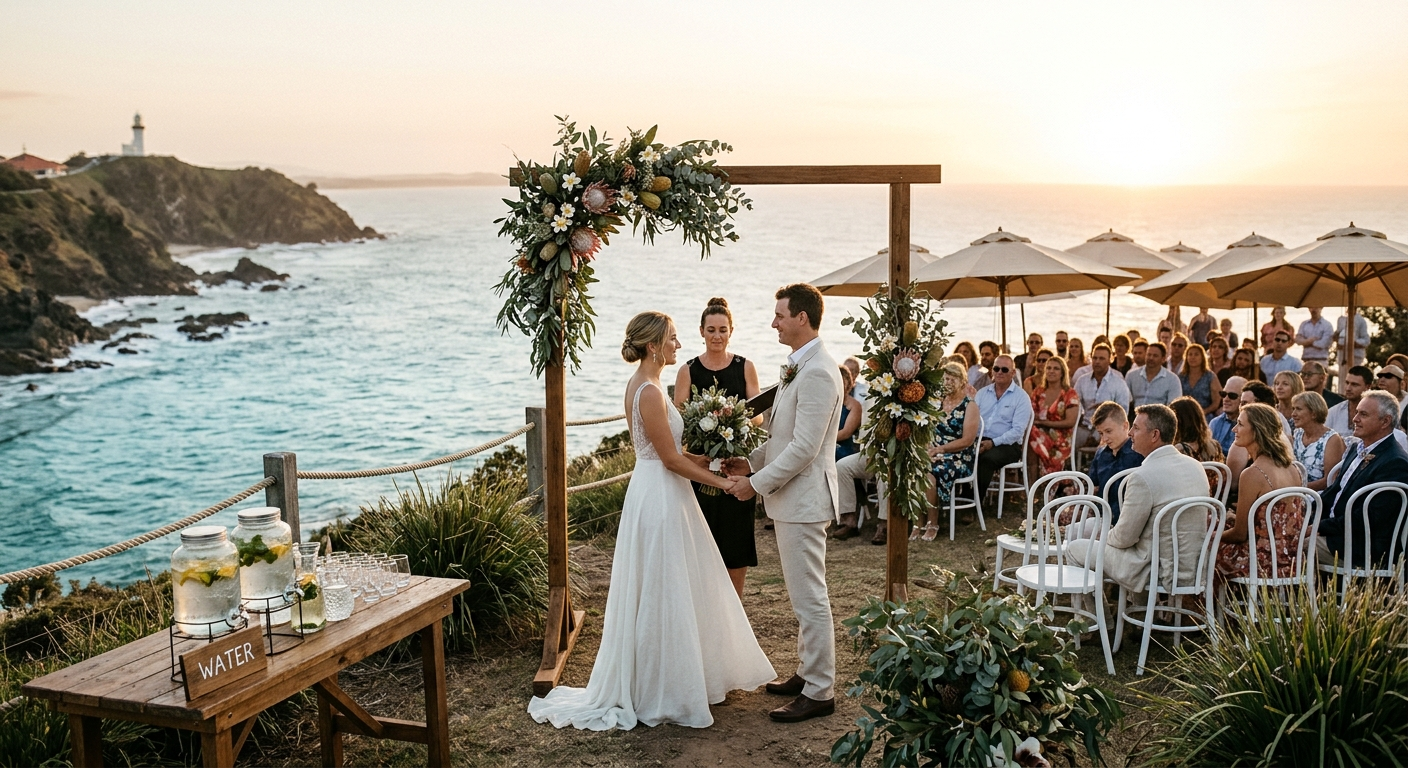
Every year, more Australian couples say their vows between December and February than in any other concentrated window outside spring. The reason is straightforward: summer is when Australia is at its most relaxed, most social and most photogenic, with long evenings, open-air venues and a calendar where the whole country seems to be celebrating at once. For couples planning a wedding across the 2026-27 Australian summer, that same appeal is precisely what you need to plan around, carefully and well.
Australian summer weddings come with a specific, measurable problem: heat. Summer weddings can bring extreme temperatures of 35 degrees and above with absolutely no wind in sight, and the risk is not only discomfort. Guests standing in full sun for an hour is a genuine health concern, and the practical reality is that a poorly timed outdoor ceremony can define how your day is remembered for everyone who was there. The good news is that every Australian summer wedding that works, from Byron Bay to the Barossa Valley, solves the same handful of problems in the same handful of ways.
This guide covers how to choose a summer venue across NSW, VIC, QLD, SA, WA and TAS, how to time your ceremony for both comfort and light, how to keep guests comfortable and suppliers functioning, what a realistic Australian summer wedding budget looks like in AUD, and the planning timeline including the legal notice requirements that apply to every Australian marriage. It also covers what your RSVP process needs to collect so that the heat does not quietly become someone else's problem.
Why Summer Weddings Dominate the Australian Calendar
Australia's wedding season peaks twice a year, in spring from September to November and again in early autumn from March to April. November is the single busiest month at 15% of all weddings, followed by March at 13% and October at 12%. June and July are the quietest months, hosting just 4% and 3% of weddings respectively as couples avoid the southern hemisphere winter. A December to February wedding therefore sits directly alongside the busiest part of the year rather than in a gap in it.
The underlying driver is the calendar itself. Australia registered 120,844 marriages in 2024, an average of around 331 marriages a day, with Saturday remaining the dominant day of the week by a wide margin. A summer wedding lets you use the full strength of that Saturday appetite while adding something the cooler months cannot reliably offer: an evening that runs deep into the night without guests wanting to leave.
There is a countervailing pressure worth naming. Because summer overlaps school holidays, Christmas and New Year, some guests travel at different times or cannot travel at all, and the end-of-year party season competes for the same celebrants, caterers and florists. The couples who plan a summer wedding best treat December as peak-season pricing and January as peak-season logistics, not as a quiet window between two busy ones.
Summer also unlocks formats the rest of the year cannot dependably deliver: outdoor ceremonies that run past sunset, sea and estuary views, and reception spaces that stay comfortable deep into the evening. Those advantages are real enough that most Australian couples who choose summer would choose it again. They simply plan for the conditions instead of hoping the conditions go away.
Choosing a Summer Wedding Venue in Australia
The most consequential decision you will make is where you hold the ceremony, because it determines how much shade, air conditioning and indoor backup you actually have. Summer venue availability across Australia is extremely regional, and the safest approach is to shortlist by climate first and by style second.
In New South Wales, the Hunter Valley and Byron Bay are the headline wedding regions for summer. Byron Bay gives you ocean-front ceremonies with a subtropical outlook, while the Hunter Valley provides winery settings with established cellar-door and event infrastructure. Sydney couples should also look at coastal properties along the harbour and ocean edges. NSW is also the most expensive state for catering in the country, with an average of $7,782 against a national average of $6,177, so build that difference into your budget.
Victoria offers the strongest combination of summer venue quality and climate control. The Yarra Valley and the Mornington Peninsula remain the benchmark winery regions, and inner Melbourne has an unusually deep supply of restaurants, galleries and heritage buildings with proper air conditioning. For couples who find Melbourne summers too hot, the Victorian High Country is genuinely cooler than the city and worth considering for a summer ceremony.
Queensland splits into two very different propositions. The Gold Coast, Sunshine Coast and the Whitsunday Islands deliver resort and beach weddings through the southern summer. Far North Queensland reverses the pattern: the northern wet and dry season pattern means the dry season runs from May to October, so a December to February wedding in Cairns or Port Douglas is a wet season wedding, with tropical downpours as the main risk rather than heat. That is not a disqualifier, it is a different plan requiring a covered ceremony and a firm wet-weather pivot.
South Australia delivers reliable dry heat. The Barossa Valley, McLaren Vale and the Adelaide Hills all host summer weddings, but Adelaide summers include occasional sudden 40-degree days, which is precisely why historic stone winery venues need confirmed high-capacity air conditioning. Western Australia has the Swan Valley and Margaret River, with Margaret River particularly popular for summer weddings and Perth a reliable supplier base. Tasmania is the outlier in the best way: the Bureau of Meteorology records mean maximum temperatures at Scotts Peak of 21.5 degrees in January, 21.2 degrees in February and 21.8 degrees in December, so a Tasmanian summer wedding is a mild-weather wedding rather than a heat management exercise.
Whatever region you choose, ask three questions in writing before you pay a deposit. What shade exists over the ceremony area? What is the air conditioning capacity of the reception space? What happens if the forecast turns? A venue with a genuine wet-weather and heat contingency is worth a premium in summer. A venue without one is not.
Timing the Ceremony for Comfort and Light
The single most effective decision you can make is timing. Australian wedding planning guidance is consistent on this point: a late afternoon ceremony followed by an early evening reception beats a midday ceremony in almost every summer scenario. You get softer light, lower temperatures at the moment your guests are most uncomfortable, and a golden hour photography window that runs into the night.
Set the ceremony for late afternoon wherever possible. Across most Australian capitals in December and January, peak afternoon temperatures land between 2pm and 4pm. A 4pm ceremony in December places your vows after the worst of the heat and into the kind of light that makes coastal and garden venues photograph beautifully. A later start also stretches the reception, which means more of your day happens in the evening air your guests will actually enjoy.
Where the forecast is genuinely hot, moving the ceremony into a shaded area is not optional hospitality, it is guest care. Australian wedding guidance is direct on this: if the forecast is a scorcher, move your ceremony into a shaded area for the comfort of not only yourselves but your entire guest list, or hire enough large market umbrellas to shade all your loved ones. There are wedding photographs where guests fainted in the sun. Plan so that this cannot be one of yours.
Timetabling also lets you put the heat behind you rather than in front of you. A 4pm ceremony, a 5pm cocktail hour, golden hour portraits at 6.30pm and a 7.30pm reception running into the cooler evening is a structure that works from the Gold Coast to the Barossa.
Keeping Your Guests Comfortable
Australian summer wedding planning guidance converges on a short list of comforts that guests genuinely notice. Sunscreen comes first: a large tub or an aerosol at the entrance keeps guests happy on arrival and costs almost nothing. Place water where people actually are, near the ceremony entrance, the bar and the dance floor, rather than in a single dispenser by the venue door.
Your suppliers need the same consideration. Australian wedding planners routinely advise having plenty of cold water bottles on hand for vendors, because photographers, florists, caterers and celebrants are on their feet all day in Australian summer conditions, and dehydrated suppliers slow down and suffer. A bridal party kit with face blotters, sunscreen, travel-size deodorant and body wipes waiting in a cool room is a small, sensible investment.
Shade is the other half. Shade umbrellas, parasols and canopies over guest seating make the difference between a comfortable afternoon and a miserable one, and they also protect guests from direct UV exposure, which is a serious concern in Australia where UV levels through summer are extreme. Do not assume your venue's landscaping provides enough. Count the chairs, count the shade, and hire what is missing.
Two Australian traditions suit summer perfectly. An ice cream cart is a reliably popular addition that needs no explanation, and wooden fans left on each seat at the ceremony work as a functional favour guests keep. Refrigerated drinks matter as much as water, with fruit and mint infused water served alongside iced water and the standard beverage package.
Guests with any vulnerability to heat need advance notice. Note the outdoor nature and expected conditions on your wedding website and in your invitation so that elderly relatives, parents with young children and anyone with a heat sensitivity can plan their own day around it.
Dress, Florals and Decor That Survive the Heat
Guests will take their cues from your invitation. Include the words outdoor, summer and lightweight in your dress guidance and you solve the majority of your guest comfort problems before they arrive. Specify summer-appropriate fabrics for both parties. Australian bridal retailers consistently note that summer wedding consultations now treat lighter-weight, breathable suiting as a standard expectation rather than a specialist request.
Your own attire needs the same consideration: lightweight, breathable fabrics, and for makeup a powder-based finish rather than liquid foundation. Liquid foundation runs on a hot face, and a bride spending her ceremony in a bathroom queue is not a good use of your timeline.
Florals are where summer weddings are most often compromised. Design around varieties that hold their form in heat. Natives such as banksia, grevillea and waratah are hardy, and tropical species handle humidity well. Ask your florist directly what will survive an afternoon in full sun, and be sceptical of any arrangement that depends on delicate imported blooms in an open-air setting.
Decor should be physically anchored rather than simply styled. Lightweight, wind-exposed installations need proper weighting in summer, and anything that can tip in a gust becomes a safety issue for seated guests. Test any large installation before the day and confirm the venue will permit it outdoors.
Budgeting for a Summer Wedding in Australia
The national average cost of a wedding in Australia in 2026 was $38,252, according to the Easy Weddings 2026 Australian Wedding Industry Report, which surveyed more than 4,000 couples. Venue is the dominant line item at an average of $17,518, roughly 46% of total spend, followed by catering at $6,177 nationally.
Most Australian venues charge $170 to $220 per head for food and beverage, and the full per-guest cost including venue, catering and beverages typically lands between $180 and $300 depending on the venue. The average Australian wedding now hosts around 88 guests, down from roughly 90 in recent years, reflecting a steady shift towards smaller, more intentional celebrations.
Summer is a premium period and should be budgeted as one. Peak-season venues are priced at their annual maximum, and a Friday or Sunday summer date is frequently cheaper than the Saturday equivalent. Moving a wedding by one day is among the largest single savings available in Australian wedding planning, and many couples redirect that saving into guest experience or a stronger photography package.
Two other budget realities are worth planning around. Most couples start with a budget of around $29,471 and then overspend by an average of 23%, which is why a summer wedding needs a contingency rather than a perfect plan. And 69% of Australian couples receive some financial assistance from family, so it is worth asking early and being specific about what form that help takes.
Where summer genuinely costs more is in the guest comfort line. Shade, hydration stations, air conditioning, ice cream carts, fans and umbrellas are real line items, and they are cheaper than the complaints, early departures and wedding-day regrets they prevent. Budget for them deliberately rather than as an afterthought.
Your Summer Wedding Timeline
Legal requirements come first and apply in every state and territory. The Marriage Act 1961 and the Marriage Regulations 2017 set the rules for getting married in Australia, and they require a notice of intended marriage to be given to an authorised marriage celebrant at least 1 month and no more than 18 months before your wedding. Lodge it as soon as your date and celebrant are confirmed, and ask your celebrant what they need in order to meet separately and in person with each of you before the ceremony, as the current rules require.
Save-the-dates should go out 6 to 8 months before the wedding date and invitations 6 to 8 weeks before. For a summer wedding, add the school holidays and public holidays to that calculation before you send a save-the-date, because a date that clashes with the Christmas period or the January school holidays will cost you attendance you cannot recover.
Your RSVP deadline should land 3 to 4 weeks before the wedding. Caterers typically need a final headcount 1 to 2 weeks out, venues need a room setup number, and you need a few days to chase anyone who has not responded. For a summer wedding, set that deadline earlier rather than later. Your caterer needs to order ice, your florist needs to know how much will be wilting in the sun, and your venue needs to know early whether you are moving the ceremony into the shade.
Two to three weeks out, confirm the heat and wet-weather plan with your venue in writing and confirm the ceremony timing. One week out, lock final numbers with every supplier. In the week itself, treat the day as a production: a coordinator, a run sheet, and a named person responsible for guest comfort on the day, covering shade, water, sunscreen and fans, so the couple is not managing logistics while getting married.
What This Means for Your RSVP Process
A summer wedding makes your RSVP form more consequential than usual, because the information you collect determines whether your suppliers can prepare properly. Dietary requirements need to be captured precisely, and it is worth asking about heat sensitivity, mobility and sun exposure needs alongside the usual allergies and meal choices, particularly where the ceremony is outdoors.
Ask about access and travel early. Summer venues in regional areas like the Hunter Valley, the Yarra Valley, Margaret River and the Barossa involve a drive, a shuttle or a coach, and those logistics belong in your guest communication. Clear travel information reduces the number of phone calls to your inbox and reduces the number of guests arriving late and uncomfortable.
Build your reminders in. A digital RSVP platform that reminds guests who have not yet responded is worth more in summer than at any other time, because the cost of a late no is highest when your caterer needs to reorder and your venue needs to reset the floor plan. Allow extra time in your schedule for chasing responses and treat the deadline as a real deadline.
Finally, use your RSVP process to set expectations about the day itself. A note that the ceremony is outdoors, that the reception is air-conditioned, that water and shade will be provided and that the dress guidance is summer-appropriate turns a potential problem into a non-event. In an Australian summer wedding, the way you communicate the conditions is as important as the way you plan for them.
A summer wedding in Australia is not a harder wedding than a spring one. It is a wedding with a different set of conditions to design around, and the couples who plan for those conditions produce celebrations that run late, stay comfortable and photograph beautifully in the best light of the Australian year.
The practical pattern that works across the country is consistent: choose a venue with genuine shade and confirmed air conditioning, time the ceremony for late afternoon, treat guest comfort as a budget line rather than an afterthought, and collect your RSVP information early enough that your caterer, florist and venue can all prepare properly for the day ahead.
WeddingRSVP helps Australian couples manage the details that determine whether those conditions are handled well. Our platform collects dietary requirements, heat sensitivity notes, travel needs and session attendance in one place, and reminds guests who have not yet responded, so your final numbers arrive before your suppliers need them. For couples planning an Australian summer wedding, that is the difference between a plan that survives the heat and one that does not.