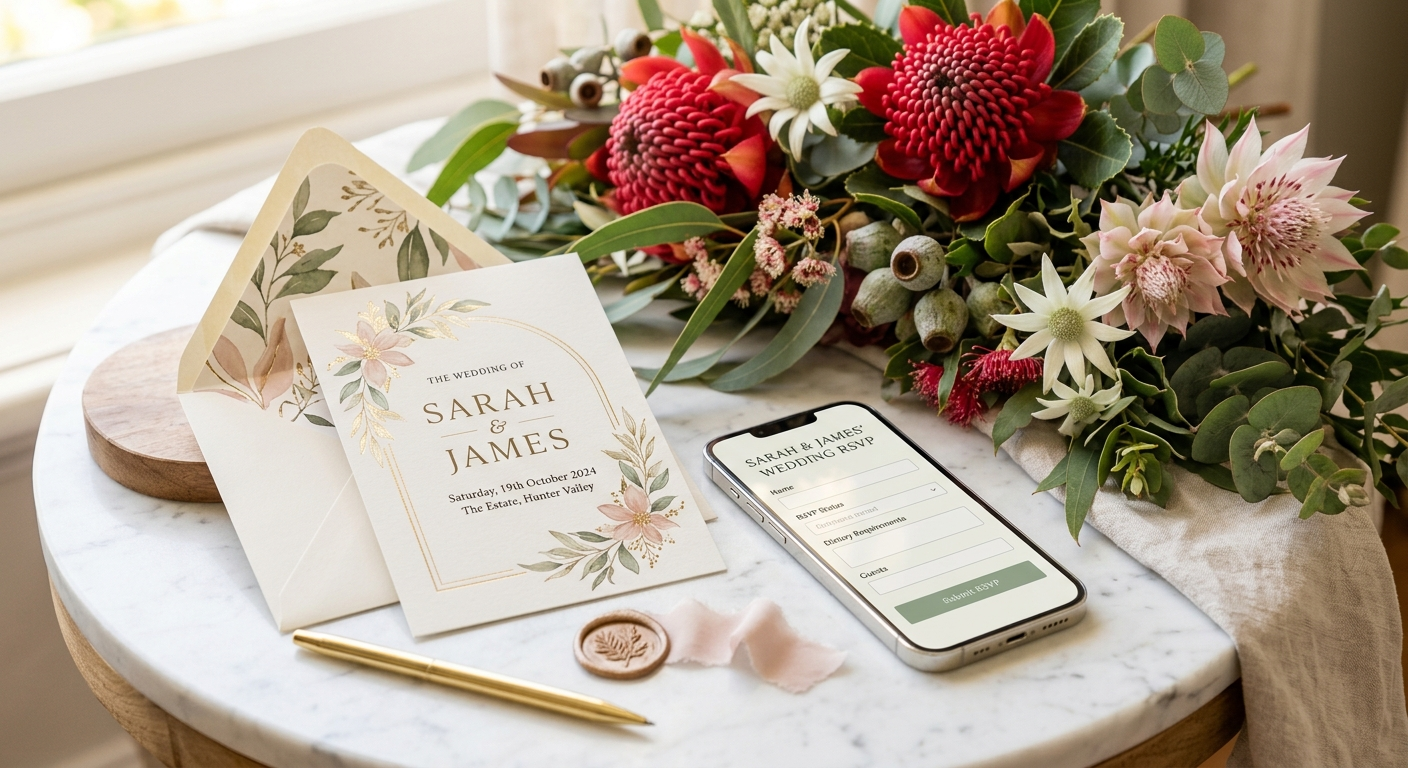
The paper RSVP card has had a good run. For generations of Australian couples, the small envelope tucked inside the wedding invitation represented the formal first point of contact between a couple and their wedding guests — a ritual that was as much about the anticipation of receiving responses as it was about the responses themselves. The ritual of addressing the envelope, posting it, and then waiting — sometimes for weeks — to see which guests had replied was, in its own way, part of the wedding experience. It is also, by 2026, largely obsolete.
Digital wedding RSVPs have become the default choice for Australian couples planning their wedding in 2026. The shift accelerated dramatically during the 2020-2021 period when physical mail was disrupted and in-person gatherings were restricted, and the convenience, speed, and environmental benefits of digital RSVPs have proven durable enough to sustain the transition permanently. According to the Easy Weddings 2026Couples Survey, more than 78 percent of Australian couples who married in the first half of 2026 used a digital RSVP system for their wedding, compared with just 34 percent in 2019. For couples planning a wedding in the second half of 2026 and beyond, the question is no longer whether to use a digital RSVP — it is how to use one well.
Why Australian Couples Are Choosing Digital RSVPs in 2026
The case for digital RSVPs rests on several practical advantages that compound into a meaningfully better experience for both the couple and their guests. The most immediate advantage is speed. A paper RSVP posted in a reply-paid envelope typically takes a minimum of five to seven days to reach the couple — assuming the guest remembers to post it, finds a post box, and does not let it sit on their kitchen bench for a few days first. A digital RSVP arrives within seconds of the guest submitting their response. For a couple managing a 150-guest wedding, the difference between a three-week RSVP window and a one-week RSVP window is significant — and it directly affects decisions about final catering numbers, seating arrangements, and supplier run-sheets.
The cost argument is also substantial and increasingly relevant for Australian couples facing wedding budgets that have been compressed by economic pressures. The average cost of traditional printed wedding stationery — invitations, envelopes, reply cards, reply-paid envelopes, and the postage for both directions — ranges from $600 to $1,800 AUD for a 100 to 150-guest wedding when sourced from a quality Australian stationer. A digital RSVP system eliminates this cost entirely. WeddingRSVP.org offers Australian couples a complete digital wedding RSVP and invitation platform at a fraction of this cost, with no compromise on the quality of the guest experience.
Environmental considerations also factor prominently in the decision for younger Australian couples. The paper wedding invitation industry generates significant waste — paper that is often coated or metallic, plastic-based invitation boxes, and the carbon footprint of express postage for time-sensitive deliveries. A digital RSVP eliminates this waste entirely. For couples who have organised their wedding to reflect their values in other areas — sourcing local flowers, choosing an eco-friendly venue, or minimising food waste — the digital RSVP is a consistent extension of that approach.
The data management advantage deserves particular attention. A digital RSVP system collects all guest responses in a centralised, searchable database that can be exported directly into catering briefs, seating chart tools, and supplier run-sheets. The manual process of transcribing paper RSVP cards into a spreadsheet — with all the errors, misinterpretations, and lost cards that process involves — is eliminated entirely. For a 120-guest wedding, this represents several hours of administrative work that is simply removed from the planning process.
Choosing the Right Digital RSVP Platform for Your Australian Wedding
The Australian market for digital wedding RSVP platforms has expanded significantly, and the quality gap between the best platforms and the rest has widened considerably. When evaluating platforms, Australian couples should prioritie a system that offers mobile-optimised design, customisable question fields, real-time response tracking, and guest communication tools. These features are now standard at the premium tier of the market, but the user experience and design quality varies significantly.
WeddingRSVP.org is designed specifically for Australian couples and provides a complete platform for digital wedding invitations, RSVP tracking, guest management, and dietary requirement collection. The platform is mobile-optimised, which matters because approximately 65 percent of wedding RSVP responses in Australia are submitted from mobile devices. A platform that does not function flawlessly on a smartphone is a platform that is creating friction for your guests at a moment when they are trying to do you a favour.
Customisation options are important for Australian couples who want their digital invitation to reflect the aesthetic of their wedding. The platform should allow custom colour schemes, fonts, and imagery that align with your wedding stationery and overall design direction. A digital invitation that looks generic or template-heavy reflects poorly on the couple and creates an inconsistent pre-wedding experience for guests. The best platforms offer sufficient customisation to create a digital invitation that feels intentional and on-brand without requiring design expertise.
Real-time response tracking is one of the most valuable features of a digital RSVP system and one that is most frequently underutilised by couples who are not aware of its potential. The ability to see, at any moment, how many guests have responded, how many have not yet responded, and which guests have indicated they are bringing a plus-one enables the couple to make informed decisions throughout the RSVP window. A well-configured digital RSVP system effectively replaces the role of a wedding planner’s guest management function for couples who are managing their wedding independently.
Wording Your Digital Wedding Invitation: Australian Etiquette and Conventions
The etiquette of wedding invitation wording is one of the areas where Australian couples most frequently seek guidance, and the transition to digital invitations has not simplified the question. The conventions of wedding stationery — the formal hierarchy of hosts, the naming conventions for divorced or deceased parents, the appropriate phrasing for evening receptions versus ceremony attendance — apply equally to digital and physical invitations, but the digital medium introduces new considerations about tone, length, and information architecture.
The most important principle for digital wedding invitation wording is clarity. A digital invitation does not have the spatial constraints of a physical card, which creates the temptation to include too much information. The invitation should communicate who is getting married, when and where the ceremony and reception are being held, and how to RSVP. Any additional information — accommodation recommendations, gift registry details, dress code — should be provided on a separate information page linked from the invitation, not embedded in the invitation itself.
For Australian couples, the question of who to name as the hosts of the wedding is handled with greater flexibility than in some other cultures. The traditional approach — naming the bride’s parents as hosts — remains common, particularly for more formal weddings, but Australian couples increasingly choose to omit host lines entirely or to name themselves as the hosts. The latter approach is particularly appropriate for couples who are funding their own wedding, which is now the majority approach for Australian couples in their late twenties and thirties.
The RSVP deadline for an Australian wedding should typically be set three to four weeks before the wedding date. This provides sufficient time for final catering confirmations, seating plan adjustments, and supplier run-sheet updates. For a wedding on a Saturday in November 2026, an RSVP deadline of mid-October is appropriate. The digital RSVP system should be configured to send a gentle reminder to non-responding guests five to seven days before the deadline — this automated follow-up function alone can increase response rates by 15 to 20 percent compared with a manual reminder process.
The Essential RSVP Questions Every Australian Couple Should Ask
The questions you include in your digital RSVP form are one of the most consequential design decisions you will make. The data you collect at this stage — about dietary requirements, plus-ones, song preferences, and attendance intentions — directly determines the quality of the guest experience on the day. A poorly designed RSVP form that fails to collect the information you need forces you into awkward last-minute conversations and, in some cases, means you simply do not know the answer to an important question until it is too late to act on it.
The essential questions that every Australian wedding RSVP should include are: full name of the guest, attendance confirmation (attending or not attending), dietary requirements or food allergies, plus-one confirmation (whether the guest is bringing a companion), and song request. These five questions cover the minimum information required to execute a smooth wedding. They should be configured as required fields — guests should not be able to submit their RSVP without completing all five questions.
The dietary requirements question deserves particular attention because the level of specificity you request directly affects the quality of the data you receive. A simple ‘dietary requirements’ free-text field generates responses that range from ‘none’ to ‘vegan, no gluten, no nuts, no soy’ to ‘I don’t eat fish but I’m fine with chicken’. A structured question with specific checkboxes — vegetarian, vegan, gluten-free, coeliac, dairy-free, nut allergy, shellfish allergy, other (please specify) — generates more actionable data that can be directly provided to your caterer.
The song request question is sometimes treated as optional, but it is one of the highest-value questions you can include in your RSVP. Guests who are asked to suggest songs feel genuinely included in the celebration and are significantly more likely to dance than guests at a wedding where the playlist is entirely curated by the couple. The RSVP is the ideal moment to collect this information because it reaches guests at a point of maximum engagement with your wedding — they are thinking about your celebration and are happy to contribute to it.
Managing Dietary Requirements and Accessibility Through Your RSVP
Australia has one of the highest rates of dietary restriction in the world, driven by both genuine medical requirements and lifestyle choices. Approximately 12 to 15 percent of Australian adults follow a specific dietary pattern, and the rate is significantly higher among younger demographics. For a 120-guest Australian wedding, this means 14 to 18 guests are likely to have a dietary requirement that affects their experience of your wedding meal. A well-configured digital RSVP enables you to collect this information with sufficient specificity to plan effectively — and to ensure that no guest is left without a suitable option on the night.
The distinction between different types of dietary requirement matters significantly for your catering planning. A vegetarian guest and a vegan guest require different catering responses. A coeliac guest requires a fundamentally different approach to food preparation than a guest who is simply avoiding gluten for lifestyle reasons. A guest with a life-threatening nut allergy requires your caterer to have a specific protocol for their food handling. Your RSVP form should collect information at a level of specificity that enables your caterer to respond appropriately to each guest’s requirements.
Accessibility considerations are also an important dimension of RSVP design that is frequently overlooked. If your wedding venue has mobility access considerations — steps without ramps, uneven outdoor terrain, or limited accessible parking — these should be communicated through the RSVP so that guests can inform you of any access requirements they may have. This is not only a practical planning consideration; it is a signal to your guests that you care about their experience and that their comfort matters to you.
The RSVP data on dietary requirements and accessibility needs should be provided to your caterer in a structured format that enables them to plan accurately. A digital RSVP system that allows you to export guest data in a spreadsheet or formatted document is invaluable here — the alternative is manually transcribing dietary information from paper cards, which is error-prone and time-consuming. Your caterer should receive this information at least two weeks before the wedding, so that they can finalise their menu and sourcing accordingly.
Tracking Responses and Managing Non-Responses
One of the most significant advantages of a digital RSVP system is the ability to track response rates in real time and to identify non-responses before they become a crisis. The typical response pattern for an Australian wedding RSVP follows a predictable curve: a small number of responses in the first 48 hours after invitations are sent, a spike in responses in the three to five days before the RSVP deadline, and a small tail of non-responses that persist until the deadline and beyond.
A digital RSVP platform that provides real-time tracking enables you to monitor this curve and to intervene strategically when the response rate falls below your expectations. If you have sent 120 invitations and have received only 40 responses five days before the RSVP deadline, you have a problem that requires immediate action — not a polite nudge, but a direct conversation with the guests who have not yet responded. The automated reminder function built into most digital RSVP platforms will handle the gentle nudge, but for guests who do not respond to the reminder, a personal message or phone call is the most effective approach.
The decision about how to handle guests who do not respond by the deadline is one of the most consistently stressful moments in wedding planning. The practical advice is to set a hard deadline and to hold to it. If your RSVP deadline is October 15 and you have not received a response from a guest by October 15, you should contact them directly and give them 48 hours to respond. If they do not respond within that window, you should count them as a non-attendee for final catering and supplier numbers. The temptation to hold a place open for a non-responsive guest is understandable but counterproductive — it costs you money and creates uncertainty that cascades into other planning decisions.
The ability to export your final RSVP data into a seating plan tool is another significant advantage of digital RSVP systems. The data flow from RSVP to seating plan should be seamless \u2014 guest names, attendance status, dietary requirements, and plus-one information should all transfer directly, minimising the manual data entry that is the primary source of errors in seating plan management. WeddingRSVP.org integrates with several popular seating plan tools used by Australian couples, making this final step of the guest management process as frictionless as possible.
Digital RSVP Etiquette: What Australian Guests Need to Know
The transition to digital RSVPs has been smoother than many anticipated, but it has introduced new etiquette questions for guests who are unfamiliar with the format. The most common concern is privacy — some guests, particularly older relatives, are uncomfortable submitting personal information through an online form. The solution is to communicate clearly, in your invitation message, that the RSVP platform is secure and that their information will be used only for wedding planning purposes.
The question of plus-ones is the etiquette area where digital RSVPs have generated the most confusion. The traditional approach — a named invitation that implicitly includes or excludes a plus-one based on how it was addressed — has been replaced by an explicit question in the digital RSVP. Couples should be clear in their invitation about who is invited, and the RSVP form should reflect this clearly. If a guest is invited individually, the RSVP should ask only for their name. If they are invited with a partner, the RSVP should indicate this and ask for both names.
The timing of the digital RSVP response is another area where etiquette has evolved. The traditional guideline — respond within two weeks of receiving the invitation — remains appropriate for digital RSVPs. However, the immediacy of the digital format has raised expectations. A guest who receives a digital RSVP and does not respond within 48 hours may receive an automated reminder, which can feel abrupt if they had planned to respond later. The etiquette guideline for guests is straightforward: respond as soon as you have a confirmed answer, and if you need more time to consult with a partner or check a calendar, do so promptly and respond within a few days rather than waiting for the deadline.
Digital RSVPs at Different Australian Wedding Venue Types
The optimal digital RSVP configuration varies depending on the type of wedding venue and the structure of the celebration. A single-site wedding — where the ceremony, cocktail hour, dinner, and dancing all take place at the same venue — is the simplest RSVP scenario because there are fewer moving parts and fewer questions required. A destination or multi-day wedding requires more sophisticated RSVP configuration, with separate RSVP tracking for different events across a weekend.
For winery weddings — a format that remains among the most popular for Australian couples, particularly in the Hunter Valley, Yarra Valley, Margaret River, and Barossa Valley regions — the RSVP should include a question about transport arrangements. Many winery venues are in regional locations where guests require shuttle bus transport or have limited parking. Collecting this information in advance enables the couple to coordinate transport logistics efficiently.
Beach and coastal weddings, popular along the Gold Coast, Sunshine Coast, and coastal Victoria, require weather-contingency information in the RSVP. If your ceremony is on the beach and may need to move to a covered area in case of inclement weather, this should be communicated through the RSVP, and the RSVP form should include a field for guests to indicate any weather-related concerns or accessibility needs for the beach venue.
For city weddings in Sydney, Melbourne, Brisbane, and Perth, the most valuable supplementary RSVP questions relate to transport and accessibility. Most city wedding venues have limited parking, and guests are increasingly relying on rideshare services or public transport. A question about approximate arrival time can help with venue access management, and information about the venue’s accessibility features should be available on request through the RSVP platform.
The digital RSVP is not merely a technological replacement for a paper card. It is a fundamentally better tool for the task of managing guest communication in the context of a modern Australian wedding. The speed, data quality, cost efficiency, and environmental benefits are significant, but the most important advantage is the reduction of uncertainty. A couple who has received and processed all of their RSVP responses three weeks before their wedding is a couple who can finalise their catering numbers, complete their seating plan, and brief their suppliers with confidence. A couple who is still chasing responses ten days before their wedding is a couple who is managing a planning crisis that was entirely preventable.
The implementation principles are straightforward: choose a platform that is mobile-optimised and designed for the Australian market, configure your RSVP questions with sufficient specificity to generate actionable data, set a clear and enforced RSVP deadline with automated reminders, and treat the dietary requirements and accessibility information you collect as a commitment to your guests that you will deliver a celebration where everyone is included. The digital RSVP is the first practical act of your wedding hospitality. Done well, it sets the tone for everything that follows.