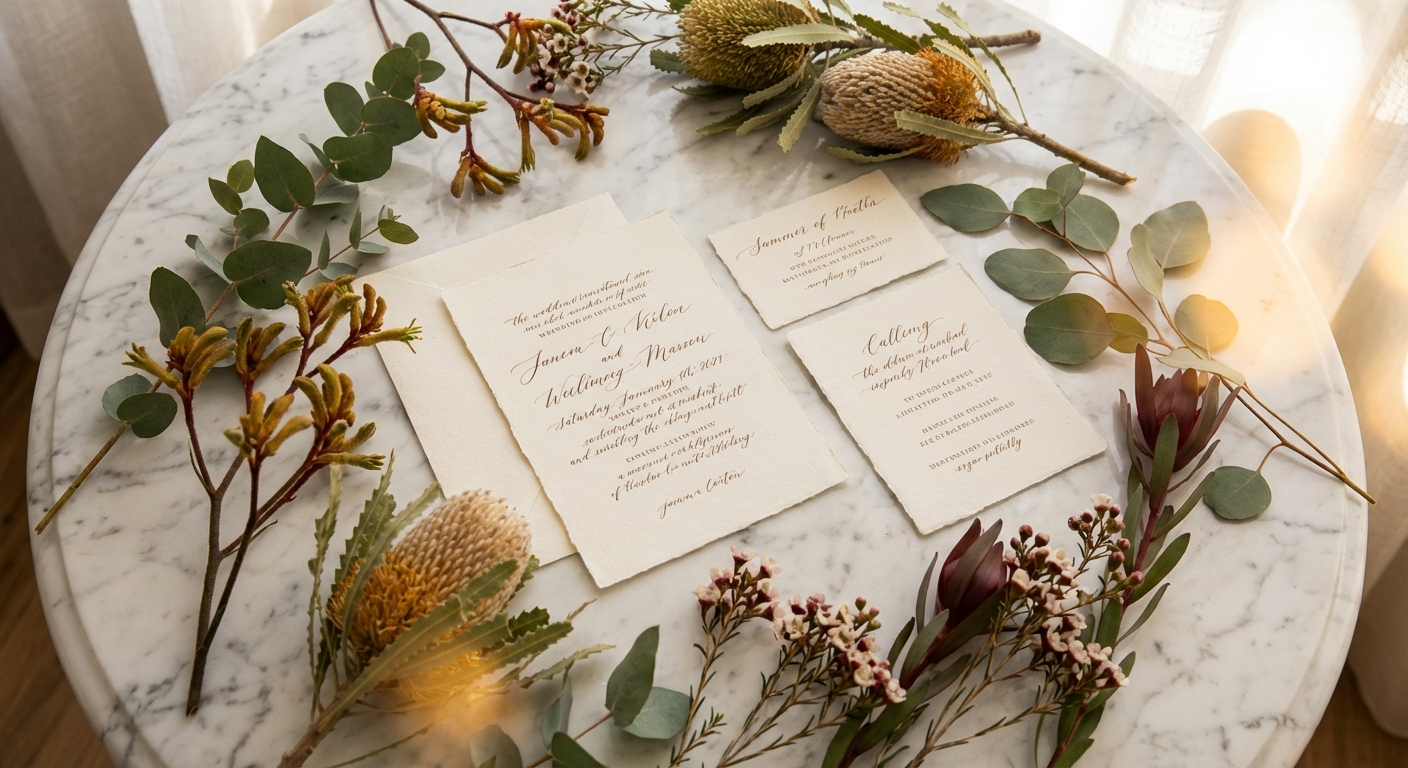
Your wedding invitation is the first glimpse your guests will have of your celebration. It sets the tone, communicates essential details, and — whether you realise it or not — tells people exactly what kind of day to expect. A formal invitation on heavy cotton card stock signals a very different affair from a playful illustrated design sent with a handwritten note.
For Australian couples planning a 2026 wedding, the invitation wording landscape has shifted considerably from the rigid templates of decades past. The days when every invitation had to begin with 'Mr and Mrs John Smith request the pleasure of your company' are well behind us. Modern Australian weddings span an extraordinary range of formality, from black-tie harbour celebrations in Sydney to barefoot ceremonies on the beaches of Byron Bay, and the invitation wording needs to match.
Yet this freedom brings its own challenge. With fewer hard rules to follow, many couples find themselves staring at a blank page wondering how to strike the right balance between informative and beautiful, personal and polished. Questions arise quickly. Who should be listed as the host? How do you word an invitation when parents are separated? What is the correct way to include your wedding RSVP website? How do you communicate a dress code without sounding bossy?
This guide answers every one of those questions with practical, ready-to-use templates tailored specifically for Australian weddings. Whether you are planning a formal seated dinner in Melbourne, a relaxed winery reception in the Hunter Valley, or a destination weekend in Margaret River, you will find wording that fits your celebration perfectly.
The Anatomy of an Australian Wedding Invitation
Before diving into specific templates, it helps to understand the building blocks that every wedding invitation shares. Regardless of formality level, your invitation needs to communicate six essential pieces of information: who is hosting, who is getting married, when it is happening, where it is happening, how to respond, and any additional details your guests need to know.
The host line opens the invitation and traditionally indicates who is paying for the wedding. In Australia, this convention has relaxed significantly. Many couples now host their own wedding, and the host line reflects this with phrasing like 'Together with their families' or simply leading with the couple's names. Where parents are contributing financially and wish to be acknowledged, the traditional host line remains appropriate.
The request line follows and sets the formality level immediately. 'Request the honour of your presence' signals a highly formal event, typically a religious ceremony. 'Request the pleasure of your company' is the standard formal phrasing for a secular celebration. 'Invite you to celebrate' is warm and contemporary. 'Would love you to join them' is relaxed and personal.
The couple's names come next, and the order is entirely a personal choice in modern Australian weddings. Traditionally, the bride's name appeared first, but there is no longer any expectation around this. Same-sex couples typically choose alphabetical order or whatever sounds best rhythmically.
The date, time, and venue details should be unambiguous. Australian conventions favour writing the date in full — 'Saturday, the fifteenth of November, two thousand and twenty-six' for formal invitations, or 'Saturday 15 November 2026' for contemporary ones. Always include the suburb or region alongside the venue name, as many guests will be unfamiliar with the location.
The RSVP details have evolved substantially with the rise of digital wedding RSVP platforms. Most Australian couples in 2026 now direct guests to a wedding website for responses, and the invitation wording should make this process clear and simple.
Formal Wedding Invitation Wording
Formal wedding invitations suit black-tie celebrations, grand ballroom receptions, and ceremonies in heritage venues or cathedrals. The language is traditional, the layout is symmetrical, and every element follows established convention. If your wedding is at a venue like Curzon Hall in Sydney, The George Ballroom in Melbourne, or Customs House in Brisbane, formal wording will complement the setting beautifully.
Parents of the Bride Hosting
This is the most traditional format and remains appropriate when the bride's parents are the primary hosts and financial contributors. The wording reads: 'Mr and Mrs David Thompson request the pleasure of your company at the marriage of their daughter, Emily Jane, to Mr James Robert Mitchell, son of Mr and Mrs Robert Mitchell, on Saturday, the eighteenth of April, two thousand and twenty-six, at half past three in the afternoon, The Calile Hotel, Fortitude Valley, Brisbane.'
If you prefer to include both sets of parents as hosts, the invitation opens with both families: 'Mr and Mrs David Thompson and Mr and Mrs Robert Mitchell request the pleasure of your company at the marriage of their children, Emily Jane and James Robert.' This format works particularly well when both families are contributing to the wedding costs and wish to be equally represented.
Couple Hosting Their Own Formal Wedding
Many Australian couples fund their own weddings and prefer to present themselves as hosts while maintaining formal language. A suitable template reads: 'Together with their families, Miss Emily Jane Thompson and Mr James Robert Mitchell request the pleasure of your company at their marriage on Saturday, the eighteenth of April, two thousand and twenty-six, at four o'clock in the afternoon, Sergeants' Mess, Mosman, Sydney.'
An alternative that places the couple front and centre while still acknowledging family: 'Emily Thompson and James Mitchell, together with their parents, invite you to share in the joy of their marriage.' This softens the formality slightly while retaining an elegant tone.
Contemporary Wedding Invitation Wording
The majority of Australian weddings in 2026 fall into the contemporary category — polished and intentional, but without the rigid formality of traditional invitations. This style suits garden ceremonies, winery weddings, restaurant receptions, and the vast number of celebrations that are elegant without being stiff.
A versatile contemporary template reads: 'Together with their families, Sarah Chen and Liam O'Brien invite you to celebrate their wedding. Saturday 15 November 2026, 3:30 pm. Stones of the Yarra Valley, St Huberts Road, Coldstream, Victoria. Reception to follow. RSVP by 1 October at sarahandliam.weddingrsvp.org.'
This format is clean, warm, and immediately readable. It communicates every essential detail without unnecessary flourishes and directs guests to a digital RSVP platform — now the standard for Australian weddings.
For couples who want a slightly more personal touch, consider opening with a line that reflects your relationship: 'After eight years of adventures, countless flat whites, and one very memorable road trip through the Kimberley, Sarah and Liam are finally making it official.' Following this with the standard details creates an invitation that feels distinctly yours.
Wording for Separated or Divorced Parents
Navigating blended family dynamics on a wedding invitation requires sensitivity. When parents are divorced, they are listed on separate lines without 'Mr and Mrs.' A suitable format: 'Mrs Jennifer Thompson and Mr David Thompson, together with Mrs Karen Mitchell and Mr Robert Mitchell, joyfully invite you to the wedding of their children, Emily and James.'
If a parent has remarried, their current spouse may be included: 'Mrs Jennifer and Mr Peter Andrews, together with Mr David Thompson, invite you to celebrate the marriage of Jennifer's daughter, Emily.' However, many couples find it simpler to use the 'Together with their families' opening, which gracefully sidesteps complex family structures while acknowledging everyone's role.
Where a parent is deceased, they may be honoured in the invitation wording: 'Emily Thompson, daughter of Jennifer Thompson and the late David Thompson, together with James Mitchell, son of Karen and Robert Mitchell, invite you to share in the celebration of their marriage.' This acknowledges the absent parent with dignity and warmth.
Same-Sex Couple Invitation Wording
Since marriage equality became law in Australia in December 2017, same-sex wedding invitations follow the same conventions as any other. The couple's names appear in whichever order they prefer, and the wording is identical. 'Together with their families, Daniel Harper and Michael Russo invite you to celebrate their wedding. Saturday 22 March 2026, 4:00 pm. The Terrace, Royal Botanic Gardens, Melbourne.'
Some couples choose to include a subtle acknowledgement of the journey to marriage equality, particularly if their relationship predates the 2017 legislation. This is entirely personal, and the invitation should reflect whatever feels authentic to the couple.
Relaxed and Casual Wedding Invitation Wording
Beach weddings, backyard celebrations, pub receptions, and festival-style weekends call for invitation wording that matches their easygoing atmosphere. Overly formal language on a casual invitation creates a jarring disconnect — your guests should feel the vibe of your wedding the moment they read the words.
A relaxed beach wedding template: 'Grab your sunnies and your dancing shoes — Sophie and Tom are getting hitched! Saturday 7 March 2026, 4 pm. Wategos Beach, Byron Bay. Barefoot ceremony, followed by dinner and dancing at The Farm. Let us know you are coming at sophieandtom.weddingrsvp.org by 1 February.'
For a pub or brewery reception: 'We are getting married and we want you there. Join us for the ceremony at Treasury Gardens, Melbourne, followed by a proper celebration at The Crafty Squire. Saturday 28 November 2026, 2:30 pm. RSVP at our website by 15 October — we need to tell them how many pies to order.'
A country or farm wedding: 'Dust off your boots and join Megan and Chris as they tie the knot under the big gum tree. Saturday 18 April 2026, 3 pm. Willow Farm, Daylesford, Victoria. Dinner, dancing, and a bonfire to follow. RSVP by 1 March at meganandchris.weddingrsvp.org.'
The key to casual wording is authenticity. Write the way you actually speak to your friends. If your natural communication style includes humour, let that come through. If you are warm and sentimental, lean into that. The invitation should sound like it came from you, not from a template.
RSVP Wording for Digital Wedding Websites
The shift toward digital RSVPs has been one of the most significant changes in Australian wedding stationery over the past five years. By 2026, the vast majority of couples use an online RSVP platform alongside or instead of traditional reply cards. This approach is faster, more accurate, and allows couples to collect additional information like dietary requirements and song requests in a single step.
The RSVP line on your invitation should be clear and direct. For a formal invitation: 'The favour of a reply is requested by the fifteenth of October at emily-and-james.weddingrsvp.org.' For a contemporary invitation: 'Please RSVP by 15 October 2026 at sarahandliam.weddingrsvp.org.' For a casual invitation: 'Let us know by 1 October — RSVP at our website: sophieandtom.weddingrsvp.org.'
Include both the RSVP deadline and the website URL directly on the invitation. While many couples also include the URL on a separate details card, having it on the main invitation ensures that even guests who misplace the additional cards can still respond.
For older guests or those less comfortable with technology, consider adding a phone number or email address as an alternative: 'RSVP online at our website or call Sophie on 0412 345 678.' This small addition can prevent RSVP anxiety for guests who are not confident navigating websites.
When using a platform like WeddingRSVP.org, your custom URL becomes part of your wedding branding. Choose something memorable and easy to type — your first names work perfectly. The platform handles dietary requirements, plus-ones, song requests, and attendance tracking, freeing your invitation from having to communicate all of these details.
Venue-Specific Invitation Wording for Popular Australian Settings
Different Australian wedding settings call for wording that reflects their unique character. Here are templates tailored to the most popular venue types across the country.
Winery and Vineyard Weddings
Australia's wine regions — the Hunter Valley, Yarra Valley, Barossa Valley, Margaret River, and McLaren Vale — host thousands of weddings each year. Winery invitations should evoke the landscape and atmosphere. A template: 'Surrounded by the vines of the Yarra Valley, Emma and Will invite you to share in the joy of their wedding day. Saturday 11 April 2026, 3:30 pm. Levantine Hill Estate, Coldstream, Victoria. Ceremony among the vines, followed by dinner in the barrel room. RSVP by 1 March at emmaandwill.weddingrsvp.org.'
The reference to specific venue features — vines, barrel rooms, cellar doors — helps guests visualise the day and builds anticipation. It also subtly communicates that the setting is outdoors, which helps with wardrobe choices.
Beach and Coastal Weddings
Beach weddings are quintessentially Australian, from the Gold Coast and Noosa in Queensland to Jervis Bay in NSW and the Great Ocean Road in Victoria. Keep the wording relaxed and evocative: 'With salt air and sunshine, Jess and Ryan invite you to celebrate their marriage by the sea. Saturday 14 February 2026, 4 pm. Main Beach, Noosa Heads, Queensland. Sundowners and dinner at Rickys to follow. Toes in the sand, love in the air. RSVP at jessandryan.weddingrsvp.org by 10 January.'
For beach weddings, practical details matter. Consider adding a line about footwear or shade: 'We recommend flat shoes or bare feet for the sandy ceremony' helps guests prepare without a separate information card.
Bush and Rural Weddings
Country and bush weddings are a growing trend in Australia, with couples choosing farms, stations, and bushland properties across regional NSW, Victoria, and Western Australia. These invitations should capture the landscape: 'Under wide skies and towering gums, Kate and Ben invite you to witness their marriage at Willow Creek Station, Mudgee, NSW. Saturday 25 April 2026, 2:30 pm. Bush ceremony followed by a long-table dinner under the stars. Please RSVP by 15 March at kateandben.weddingrsvp.org.'
Rural weddings often require additional logistical information — driving directions, accommodation options, road conditions — which is best handled on your wedding website rather than cramming it onto the invitation itself.
City and Urban Weddings
Urban weddings in Australian capital cities offer rooftop bars, art galleries, heritage buildings, and waterfront restaurants as backdrops. The wording can be sleek and modern: 'Sarah and Alex invite you to their wedding. Saturday 6 June 2026, 5:00 pm. Ceremony and reception at The Olsen, Chapel Street, South Yarra, Melbourne. Cocktails from five, dinner from seven. Black tie. RSVP by 1 May at sarahandalex.weddingrsvp.org.'
For city venues, including the suburb is essential — many guests, particularly those travelling from interstate, will not know where the venue is located within the city. Adding a dress code is also more common with urban weddings, where the formality level may not be immediately obvious from the venue name alone.
Details Cards and Additional Enclosure Wording
Most Australian wedding invitations in 2026 are sent as a suite: the main invitation, a details card, and sometimes a separate RSVP card (though this is increasingly replaced by a website reference). The details card is where you communicate the practical information that does not belong on the primary invitation.
A standard details card includes accommodation suggestions, transport information, gift preferences, and any special instructions. A template: 'Accommodation: We have reserved a block of rooms at the Novotel Hunter Valley at a special rate of $189 AUD per night. Mention the Chen-O'Brien wedding when booking. Transport: A shuttle bus will operate between the Novotel and Stones of the Yarra Valley from 2:30 pm, returning at 11:30 pm. Gifts: Your presence is the greatest gift. Should you wish to contribute to our honeymoon fund, details are on our wedding website.'
The wishing well or gift registry wording deserves particular care. Australian couples overwhelmingly prefer monetary contributions or honeymoon funds over traditional registries, but the request needs to be handled with grace. Avoid phrasing that sounds demanding or transactional. 'Your presence at our wedding is the only gift we need. For those who wish to help us start our next adventure, a wishing well will be available on the day' strikes the right balance.
For destination or interstate weddings, include travel logistics prominently: 'Getting There: The nearest airport is Ballina Byron Gateway (BNX), approximately 30 minutes from the venue. Qantas, Virgin Australia, and Jetstar operate daily flights from Sydney, Melbourne, and Brisbane. We recommend booking early for the best fares.'
How to Word Dress Code on Australian Wedding Invitations
Communicating a dress code is one of the trickiest parts of wedding invitation wording. Too prescriptive and it feels controlling. Too vague and half your guests show up in the wrong attire. Australian weddings span such a wide range of formality that clear guidance is genuinely helpful for guests.
For a formal wedding, simply stating 'Black Tie' or 'Formal Attire' is sufficient. Guests familiar with these dress codes will understand the expectation, and those who are not will look it up.
The challenge arises with the middle ground. 'Cocktail Attire' is widely understood and works well for evening receptions at restaurants, hotels, and urban venues. 'Smart Casual' is appropriate for winery weddings, garden parties, and relaxed daytime celebrations, though it remains one of the most misinterpreted dress codes in existence.
For outdoor and regional weddings, practical guidance helps enormously: 'Garden Party Attire — please wear flat shoes suitable for grass' or 'Relaxed Coastal — think sundresses and linen suits, leave the stilettos at home.' This specificity prevents wardrobe mishaps while keeping the tone light.
Some couples add a colour palette request: 'We would love our guests to wear earthy tones — think terracotta, sage, mustard, and cream.' This creates stunning group photographs and a cohesive visual experience without being overly restrictive. It has become increasingly popular at Australian weddings in 2026, particularly for intimate celebrations where the guest list is smaller and the visual impact of coordinated colours is more pronounced.
When to Send Wedding Invitations in Australia
Timing matters as much as wording. Send too early and guests forget to respond. Send too late and they have already made other plans. The Australian convention is to mail invitations eight to twelve weeks before the wedding date, with the RSVP deadline set at four to six weeks before the event.
For a peak-season wedding (October through April), aim for the longer end of this window. A November wedding invitation should go out by early September at the latest, giving guests ten to twelve weeks to respond. This is particularly important for weddings that fall near public holidays — Melbourne Cup weekend in early November, for example, or the Australia Day long weekend in January.
Off-peak weddings (May through September) can follow a slightly shorter timeline, as guests are less likely to have competing events. Eight weeks before is generally sufficient.
Destination weddings require significantly more notice. If your guests need to book flights and accommodation — even within Australia — send save-the-date cards six to eight months in advance and follow up with the formal invitation twelve weeks before the date. A wedding in Broome, Hamilton Island, or the Kangaroo Island requires your Sydney or Melbourne guests to plan a proper trip, and they will appreciate the lead time.
For couples using a digital RSVP platform, the invitation goes out with the website URL, and guests can respond immediately. This typically results in faster response rates than traditional mail-back cards. Most couples using WeddingRSVP.org see seventy to eighty per cent of responses within the first two weeks of sending invitations, with the remainder trickling in as the deadline approaches.
A gentle reminder at the two-week-before-deadline mark is perfectly appropriate. A brief message through your wedding website or a text to non-responders will capture the stragglers without being pushy: 'Just a friendly reminder that RSVPs for our wedding close on 15 October. If you have not already, please respond at our website so we can finalise numbers with our caterer.'
Common Invitation Wording Mistakes Australian Couples Make
Even with the best intentions, certain mistakes appear frequently on Australian wedding invitations. The most common is ambiguity around plus-ones. If a guest is invited with a partner, address the invitation to both by name. If a single guest is not offered a plus-one, address it to them alone. Never write 'and guest' unless you genuinely mean it — this open invitation can create headaches when unexpected plus-ones RSVP and your venue has a strict capacity.
Another frequent error is omitting the year from the date. While it may seem obvious, an invitation that reads 'Saturday 15 November' without the year causes confusion, particularly if it arrives in a different calendar year or is kept as a keepsake.
Spelling and grammar errors undermine even the most beautiful stationery. Have at least three people proofread your invitation before it goes to print. Pay particular attention to venue names, suburb spellings, and the names of the wedding party — misspelling your future mother-in-law's name on the host line is not an ideal start to family relations.
Including too much information on the main invitation is another common pitfall. The primary invitation should be elegant and focused. Detailed directions, accommodation lists, shuttle bus schedules, and gift registry information all belong on your details card or wedding website. A cluttered invitation is difficult to read and undermines the design.
Finally, inconsistent formality levels across your stationery suite create a disjointed impression. If your invitation is formal, your details card, menu cards, and place cards should match. If you have chosen a playful, casual tone, carry that through every printed element. Consistency signals intentionality, and your guests will notice — even subconsciously — when the tone shifts between pieces.
Your wedding invitation is far more than a logistical notice. It is the opening statement of your celebration, the first moment when your guests begin to feel the excitement of your day. The words you choose create atmosphere before a single candle is lit or a single flower is arranged.
For Australian couples in 2026, the invitation landscape offers remarkable freedom. You can honour tradition with formal language and classic layouts, or you can break entirely new ground with wording that sounds exactly like you. The only rule that truly matters is clarity — make sure your guests know where to be, when to be there, and how to tell you they are coming.
Whether you are calligraphing formal invitations for a black-tie affair at a Sydney harbourside mansion, letterpress printing vineyard-inspired suites for a Hunter Valley celebration, or designing playful digital invitations for a beach wedding in Byron Bay, let the wording reflect the genuine spirit of your relationship and the day you are creating together.
And when it comes to your RSVP process, make it as easy as possible. A clean, simple wedding website where guests can respond in under a minute will always outperform a reply card that requires a stamp and a trip to the postbox. Your guests will thank you, your planning will be smoother, and you can focus your energy on the details that truly matter — like writing those vows.