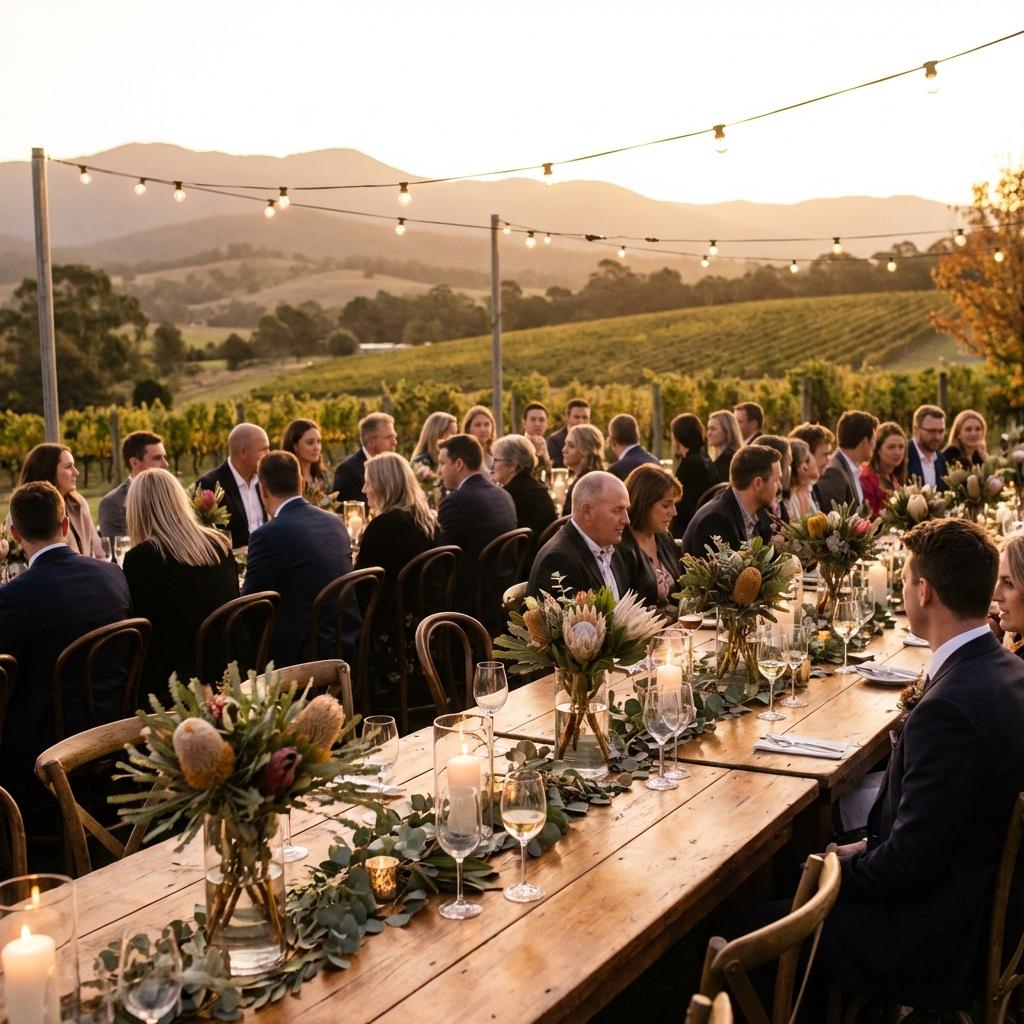
The Australian wedding landscape has shifted. For much of the past decade, the prevailing assumption was simple: a great wedding is a big wedding. Guest lists swelled to 150, 200, even 300 people. Venues expanded to accommodate them. Couples spent months — and increasingly large sums — trying to include everyone. Then something changed. Australian couples in 2026 are making a deliberate and increasingly popular choice: they are choosing fewer guests, more meaning, and experiences that would simply not be possible at scale.
The micro-wedding has arrived as a preferred format, not a fallback option. Where once a guest list of 20 or 30 people prompted sympathy or questions about cutting Aunt Margaret, the intimate celebration is now sought after, discussed openly, and celebrated on social media. Hashtags like #microweddingau and #intimateweddingaustralia have generated millions of views on Australian accounts. Venues that once required minimum numbers now offer exclusive micro-wedding packages. Caterers have redesigned menus for groups of 20 to 50. The data tells a clear story: the average Australian wedding guest list has contracted significantly since 2020, and that contraction is now a preference, not a circumstance.
This article explores why micro-weddings have become the defining wedding trend in Australia for 2026, what the numbers look like, where the best micro-wedding venues are, how to plan one, and what this shift means for the broader wedding industry. Whether you are an engaged couple reconsidering your own plans or simply curious about where the industry is heading, this is the complete picture.
What Exactly Is a Micro-Wedding?
The term micro-wedding has been in use since at least 2014, but its definition has evolved significantly. In 2026, the Australian wedding industry broadly defines a micro-wedding as a celebration with between 10 and 50 invited guests. Some definitions extend to 75 guests, but the consensus trend places the ideal micro-wedding in the 20-to-35 range — small enough to create genuine intimacy, large enough to include the people who matter most.
The key distinction is not simply numbers. A micro-wedding is defined by intention as much as size. It is a wedding where every guest is present by design, not default. Where the couple has asked: who do we actually want beside us on this day? The result is a guest list built on meaning rather than obligation, and an atmosphere that reflects that clarity.
The pandemic accelerated awareness of this format. When large gatherings became impossible between 2020 and 2022, tens of thousands of Australian couples discovered what was possible in intimate celebrations. Venues that had never considered bookings of 20 people suddenly opened their smallest rooms. Suppliers who had built businesses around large-scale events adapted overnight. What was born of necessity became a revelation. Many couples who married in that period reported that the intimacy of their celebration was the thing they valued most — more than the flowers, the cake, or the dress.
Why Australian Couples Are Choosing Micro-Weddings in 2026
The reasons Australian couples are gravitating toward micro-weddings in 2026 are multiple and deeply personal. No single factor explains the trend — it is the convergence of financial realities, changing social expectations, and a broader re-evaluation of what celebration means.
Financial Reality in a Cost-of-Living Crisis
The cost of an average Australian wedding has risen sharply. Where a celebration that cost $30,000 AUD five years ago might now require $50,000 AUD or more, couples are making deliberate choices about where that money goes. The appeal of a micro-wedding is straightforward: fewer guests means a smaller venue, less catering, fewer floral arrangements, and a lower overall spend — while simultaneously enabling a significantly higher per-guest experience.
Rather than spending $50,000 AUD to feed 200 guests average hotel-style meals, a micro-wedding budget of $30,000 AUD can deliver a five-course dinner at a premium vineyard restaurant, a live chef cooking at the table, or an international destination wedding for the entire guest list. The economics become compelling when you run the numbers.
This reallocation reflects a broader shift in values. Australian couples in 2026 are more likely to prioritise a spectacular photographer, a world-class meal, or a once-in-a-lifetime venue over a headcount that dilutes the experience. The conversation has moved from how do we afford everything to how do we afford the things that matter.
The Influence of Social Media and Celebrations Worth Sharing
Australian wedding content on Instagram and TikTok has shifted dramatically toward intimate celebrations. The visually striking nature of a small, beautifully designed wedding — a long table set for 24 in a sun-drenched Yarra Valley vineyard, a barefoot ceremony on a Whitehaven Beach island with 18 guests — performs differently on social platforms than a generic ballroom event. These images are being saved, shared, and emulated by couples planning their own celebrations.
The trend is reinforced by Australian wedding photographers and stylists who have built significant followings showcasing micro-wedding content. The algorithm rewards visual distinction, and intimate weddings offer more opportunity for striking, personal imagery than large-scale events where the visual story can feel diluted.
Changing Attitudes Toward Family and Obligation
A generational shift in how Australian couples relate to guest list obligation is also at play. The expectation that a wedding must include every relative, every family friend, and every colleague from work is weakening. Many 2026 couples are making conscious decisions to invite only those with whom they have genuine, ongoing relationships.
This is particularly pronounced among couples who have relocated interstate or internationally. An Australian couple living in Melbourne but originally from Queensland faces an increasingly difficult calculation: do we invite the extended family we see every three years, or do we build a guest list around the people who are actually present in our daily lives? The answer increasingly favours presence over bloodline.
Environmental and Ethical Considerations
Sustainability has become a primary driver for many couples choosing micro-weddings. The environmental footprint of a 30-person celebration is fundamentally different from one hosting 250 guests. Food waste, transport emissions, single-use materials, and the overall resource intensity of large weddings are significant — and increasingly visible to couples who care about these trade-offs.
A micro-wedding at a regional venue where guests carpool or stay locally eliminates many of these concerns. The environmental argument dovetails with the financial one, creating a compelling case for smaller celebrations that feels aligned across multiple values.
What Does a Micro-Wedding Cost in Australia?
Understanding micro-wedding costs in Australia requires moving away from the average wedding cost benchmarks, which are skewed by large-scale events. The economics of a micro-wedding are distinct, and the range is wide depending on ambition and location.
Average Budget Ranges
A realistic micro-wedding budget in Australia in 2026 typically ranges from $10,000 AUD for a simple, DIY celebration to $45,000 AUD or more for a premium experience at a sought-after venue. The most common range falls between $18,000 and $30,000 AUD — which at a traditional large wedding might represent the catering budget alone.
Breaking this down: a premium micro-wedding venue in Sydney or Melbourne can cost between $3,000 and $10,000 AUD for exclusive hire. Catering by a respected chef or fine-dining team for 30 guests might run $3,000 to $8,000 AUD depending on menu complexity. Photography and videography from an experienced professional: $3,500 to $7,000 AUD. Celebrant, flowers, styling, and miscellaneous: $3,000 to $6,000 AUD. These figures assume a premium, well-designed celebration — not a budget bare-minimum event.
Where the Money Goes
The most significant difference between micro-wedding and large wedding budgets is how they are weighted. In a large wedding, catering typically consumes 40 to 50 percent of the total budget. In a micro-wedding, catering remains significant — quality food for 30 guests still costs — but the venue cost, which can represent 15 to 25 percent in large weddings, often becomes a smaller relative share because premium per-head pricing offsets the small headcount.
The result is that micro-wedding budgets can be redirected toward elements that deliver disproportionate impact: a celebrated photographer, a live musician for the ceremony, premium florals from a sought-after stylist, or even a destination venue that would be completely out of reach for a 200-person event.
Regional Venues and Cost Advantages
Regional Australia offers compelling cost advantages for micro-weddings. A Yarra Valley vineyard, a Hunter Valley estate, a Margaret River winery, or a Byron Bay beachfront property can cost significantly less per head than a Sydney or Melbourne equivalent — while delivering a dramatically superior backdrop. Many regional venues are actively seeking micro-wedding bookings in 2026, having rebuilt their business models around smaller, higher-yield events.
The total travel cost for guests who do attend can be offset by providing accommodation recommendations or negotiating group rates. For many guests, the cost of attending a regional micro-wedding is comparable to attending a city wedding when you factor in parking, transport, and the expectation to purchase a gift.
Australia's Best Micro-Wedding Venues
Australia's landscape offers extraordinary variety for micro-wedding celebrations. The venues that are best suited to intimate celebrations — and most sought after in 2026 — share certain qualities: exceptional natural settings, flexible spaces that feel exclusive rather than empty, and staff experienced in delivering premium experiences for small groups.
Victoria
The Yarra Valley remains Victoria's premier micro-wedding destination. Estates like Rochford Wines, Domaine Chandon, and a range of smaller private vineyards offer exclusive spaces perfectly scaled for 20 to 50 guests. The Mornington Peninsula offers coastal alternatives — cliff-top restaurants, private beach ceremonies, and boutique winery venues within an hour of Melbourne.
Melbourne itself offers distinctive urban micro-wedding options: rooftop restaurants in the CBD, private dining rooms at award-winning restaurants, art gallery spaces, and historic buildings that lend themselves to intimate celebrations. These urban options appeal to couples who want a city wedding without the logistical complexity of a large venue.
New South Wales
Sydney's northern beaches and hinterland offer some of NSW's most photogenic micro-wedding settings. Private estates in Palm Beach, intimate ceremony spaces at the Royal Botanic Garden Sydney, and vineyard venues in the Hunter Valley are consistently popular. The Hunter Valley in particular has invested heavily in micro-wedding-specific offerings, with several wineries now marketing exclusive-use packages for small groups that include ceremony setup, catering, and styling.
The Blue Mountains offer a dramatic alternative: misty forests, charming weatherboard cottages, and boutique guesthouses that host weddings of 20 to 40 guests in utterly distinctive surroundings. The appeal for couples seeking something genuinely different from a coastal or vineyard wedding is significant.
Queensland
Queensland's micro-wedding appeal centres on its climate and coastline. The Gold Coast hinterland offers rainforest venues, mountain estates, and boutique resorts that operate year-round due to the state's subtropical weather. Byron Bay remains the state's iconic micro-wedding destination — a beach ceremony at Main Beach or Wateg's Beach, followed by a reception at one of the town's celebrated restaurants, is a formula that consistently delivers.
The Whitsunday Islands offer rare seclusion for couples seeking a destination micro-wedding. Private island resorts and bareboat wedding ceremonies cater to groups as small as 10, offering exclusivity that is simply not achievable on the mainland.
South Australia, Western Australia, and Tasmania
South Australia's Barossa Valley is one of the country's most underrated micro-wedding destinations. The region's world-class wineries, Mediterranean climate, and relatively compact geography make it ideal for a weekend celebration with 20 to 40 guests. Cellar door tastings, long-table dinners in working vineyards, and accommodation within walking distance of ceremony venues give Barossa micro-weddings a cohesion that is difficult to achieve elsewhere.
Western Australia's Margaret River region has built a strong reputation for premium food and wine experiences that translate directly to micro-wedding settings. The combination of stunning coastline, world-class wineries, and boutique accommodation makes Margaret River a bucket-list destination for many Australian couples.
Tasmania has emerged as a sophisticated micro-wedding destination, with its cool climate, exceptional produce, and intimate venues attracting couples seeking something genuinely different. Historic estates near Hobart, vineyard venues in the Tamar Valley, and private coastal properties offer distinctive settings with exceptional food credentials.
How to Plan a Micro-Wedding: A Practical Timeline
Planning a micro-wedding follows the same fundamental steps as any wedding, but the reduced scale creates opportunities and challenges that are distinctly different. The planning timeline for a micro-wedding can be shorter than a large wedding — six to nine months is realistic for most celebrations — but the per-decision time investment is often higher because each choice is more consequential when the guest list is smaller.
Step One: Finalise Your Guest List
The guest list is the foundational decision of any micro-wedding, and it should be resolved before any other planning step. The number of guests you settle on will determine your venue options, catering requirements, and budget allocation. A useful starting framework is to list the people you genuinely want present, then work backward: if this group is 22 people, what venues accommodate 22 people well? If it is 45, what are the options?
Many couples find the guest list conversation unexpectedly emotional. The practice of actively choosing who to include — rather than working through a default family list — requires direct conversations that can be uncomfortable. The key is to remember that a micro-wedding is not a statement about who matters less; it is a statement about who matters most. Most guests who are not invited will understand when the reason is framed as budget and experience rather than exclusion.
Step Two: Book Your Venue
Venue availability for micro-weddings is tighter than you might expect at premium locations. The best regional venues — particularly in the Yarra Valley, Hunter Valley, Margaret River, and Byron Bay — can book out six to twelve months in advance for exclusive micro-wedding use. Start your venue search as early as possible, ideally nine to twelve months before your intended date.
When evaluating venues, ask specifically about their minimum guest requirements, exclusive-use policies, and any restrictions on outside suppliers. Some venues require you to use their in-house catering, which can limit flexibility. Others are completely flexible, allowing you to bring your own caterers, stylists, and other suppliers. Understand these constraints before signing any contract.
Step Three: Brief Your Suppliers
Micro-wedding suppliers operate differently from large-event vendors. A photographer who typically shoots 200-person weddings may not have the right pricing or portfolio for a 30-guest celebration. Seek suppliers who have specific micro-wedding experience and understand the different requirements of an intimate event.
The RSVP process for a micro-wedding benefits significantly from a purpose-built digital platform. With fewer guests, the accuracy of dietary requirements, song preferences, and logistical details matters more — there is less margin for error when the event is intimate. A digital RSVP platform like weddingrsvp.org allows you to collect all this information systematically, send automated reminders, and manage your guest list in real time. For a 30-guest wedding, manual follow-up on non-responses is entirely feasible — but for a 200-guest event, it becomes a significant administrative burden that a digital platform eliminates entirely.
Step Four: Design Your Day
The reduced scale of a micro-wedding creates opportunities for design choices that would be impractical or unaffordable at a larger event. A florist who would need 200 stems for a large wedding might instead create an extraordinary installation for 30 guests. A musician who would be background audio at a 200-person reception can instead perform a 45-minute intimate set that becomes the centrepiece of the evening.
Consider the flow of the day in more detail than you might for a large event. With 30 guests, people will notice if there is a 40-minute gap between the ceremony ending and dinner starting. The pacing of a micro-wedding deserves the same attention as a large event, but the stakes are higher because the intimacy makes every awkward moment more visible.
Common Micro-Wedding Challenges and How to Address Them
Micro-weddings are not without their challenges. Understanding these before you commit to the format will help you make an informed decision and plan accordingly. The most common challenges are not deal-breakers — they are planning problems with practical solutions.
Managing Family Expectations
The most common challenge for Australian couples choosing a micro-wedding is navigating family expectations. Parents and grandparents who envisioned a large family celebration can find a small guest list confronting, particularly when close relatives are not included. The key is to have these conversations early and frame the decision positively — emphasise the experience you are creating, not the people you are leaving out.
Some couples address this by livestreaming their ceremony for guests who cannot attend, or by hosting a separate celebration for family and friends at a later date. A small intimate ceremony followed by a larger casual reception for extended family is a hybrid approach that is becoming increasingly common in Australia.
The Per-Head Cost Trap
A challenge that surprises many couples is the per-head cost structure of many venues and caterers. When venues have high minimums or caterers price on a per-head basis, a small guest list can result in a higher cost-per-guest than a larger event. The solution is to negotiate carefully and understand what your budget is actually purchasing.
Some venues offer micro-wedding packages that bundle venue, catering, and sometimes styling at a fixed price — these can represent excellent value compared to building the event piece by piece. Others quote a high per-head minimum that must be met regardless of actual attendance. Always clarify the minimum spend requirements and negotiate where possible.
Making a Small Guest List Feel Special
There is a risk — real but overstated — that a micro-wedding can feel underdressed or sparse. The solution is thoughtful design rather than excessive spending. Every guest at a micro-wedding should feel that their presence is genuinely valued. Personalised place cards, individualised touches, and experiences that bring the group together — a shared activity, a meaningful ceremony, a surprise element — create a sense of occasion that no budget can manufacture.
RSVP Management for Micro-Weddings
RSVP management for a micro-wedding has a different character than for a large celebration. With 30 guests, an RSVP card sent by traditional post with a manual tracking spreadsheet is entirely manageable. But the accuracy, convenience, and sustainability arguments for digital RSVP management apply at every scale — and at a micro-wedding, the marginal value of each confirmed guest is higher.
A digital RSVP platform allows you to collect dietary requirements, song preferences, plus-one details, and any accessibility needs from each guest in a structured format. Automated reminders reduce the follow-up burden, and real-time dashboards give you an accurate picture of your confirmed guest count at any point in the planning process. For a micro-wedding with a tight budget, confirming your exact headcount is critical — overcatering by even five guests represents meaningful waste and unnecessary cost.
The social dynamics of RSVP also shift at micro-wedding scale. When your guest list includes only people you know well, a non-response carries a different weight than it does for a distant acquaintance at a large wedding. Follow up personally, by text or phone call, rather than relying solely on automated reminders. A direct conversation is both more effective and more consistent with the intimacy you are building into your day.
The Future: Is the Micro-Wedding Here to Stay?
The evidence strongly suggests that micro-weddings are not a passing trend. The drivers behind their rise — financial pressure, changing social expectations, environmental awareness, and a desire for more intentional celebration — are structural rather than cyclical. They are not going away as pandemic memories fade; they are deepening as a generation of couples redefines what a wedding is for.
The Australian wedding industry has responded by building genuine infrastructure around micro-weddings. Venues that previously did not consider groups under 80 guests now market exclusive micro-wedding packages. Caterers have developed menus designed for intimate dining. Celebrants have created ceremony formats suited to small groups. This infrastructure will sustain the format independent of any single cultural moment.
The most significant long-term implication is a broadening of what is considered a normal or aspirational wedding. The idea that a wedding must be a large, elaborate, expensive celebration is giving way to a more pluralistic view: that the best wedding is the one that reflects who you are as a couple, regardless of size. In that world, a micro-wedding is not a compromise — it is a choice, and often the more courageous one.
The rise of micro-weddings in Australia is one of the most significant shifts in the wedding industry in a generation. It represents a move away from wedding planning as status display and toward wedding planning as intentional curation of experience. For Australian couples in 2026, the question is no longer how big can we make this — it is how meaningful can we make this.
The financial, emotional, and logistical arguments for micro-weddings are compelling. But the most powerful argument is the simplest: when you reduce the guest list to the people who genuinely matter, the day changes. It becomes more present, more personal, and more reflective of the relationship it celebrates. Every guest at a micro-wedding is there because they are wanted. That is a profound shift from the traditional model, and it is changing what a wedding means.
If you are planning an Australian wedding in 2026 and the idea of an intimate celebration appeals to you, explore it seriously. Visit venues that accommodate small groups. Talk to suppliers who specialise in micro-weddings. Use a digital RSVP platform to manage your guest list with precision. The planning process for a micro-wedding can be shorter and less stressful than a large event — and the day itself will be something your guests, and you, will remember for the rest of your lives.